Active corruption definition: South Africa’s PRECCA explained

TL;DR:
- Active corruption involves offering or agreeing to give a benefit to influence illegal or biased actions under South African law. Both the giver and receiver can be prosecuted under the same statute, regardless of whether money transfers occur. The Madlanga Commission’s public records provide valuable evidence for examining corruption patterns before criminal convictions.
Active corruption, known formally as active bribery, is the act of giving, offering, or agreeing to give a gratification to another person in order to influence that person to act in a manner that is illegal, dishonest, unauthorised, or biased. Under South African law, this conduct is criminalised by section 3 of the Prevention and Combating of Corrupt Activities Act 12 of 2004 (PRECCA). The statute is available in full on the South African Government’s official website.
PRECCA s3 (active limb): “Any person who… gives or agrees or offers to give to any other person any gratification, whether for the benefit of that other person or for the benefit of another person, in order to act, personally or by influencing another person so to act, in a manner that amounts to the illegal, dishonest, unauthorised, or biased… misuse or selling of information or material acquired in the course of… any powers, duties or functions arising out of a constitutional, statutory, contractual or any other legal obligation…”
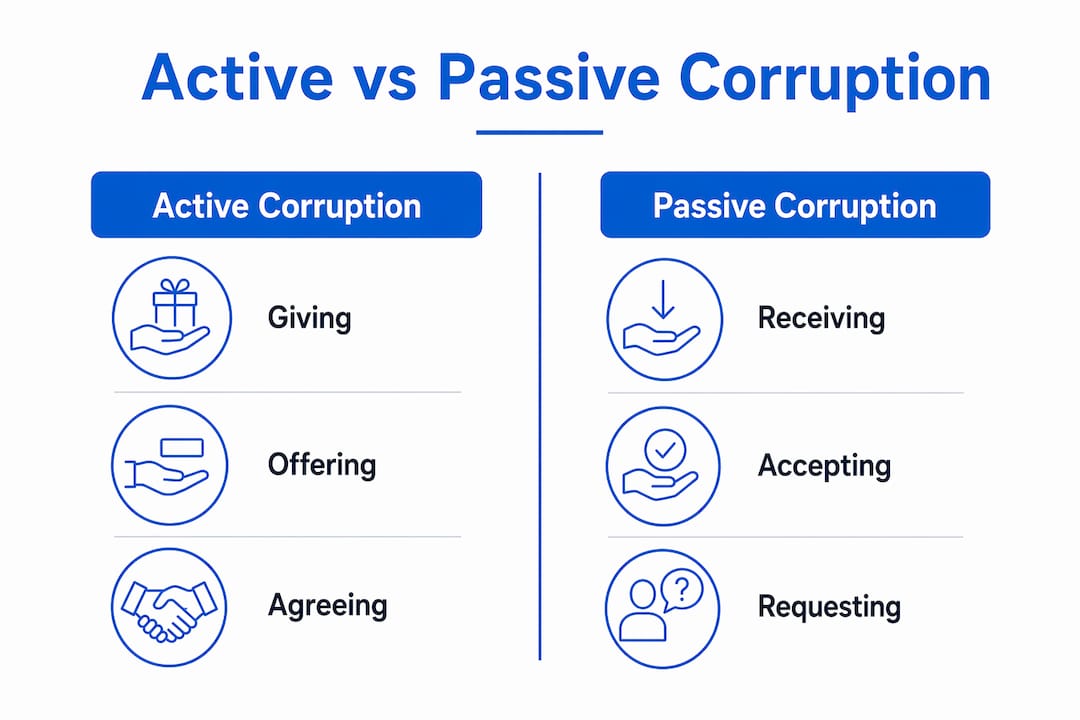
PRECCA does not use the labels “active” and “passive” in its text. Legal practitioners apply those terms as functional shorthand: the giver is active, the receiver is passive. Both roles are prosecutable under the same statute.
Table of Contents
- What is the difference between active and passive corruption?
- What does PRECCA s3 actually say?
- What must the prosecution prove for an active corruption charge?
- South African examples and commission findings
- What are the penalties for active corruption in South Africa?
- Which agencies investigate and prosecute active corruption in South Africa?
- How to report suspected active corruption in South Africa
- Why the Madlanga Commission archive matters for corruption research
- Key takeaways
- Why the Madlanga Commission archive changes how we study corruption
- Useful sources for further research
- FAQ
What is the difference between active and passive corruption?
The distinction turns on which side of the transaction you occupy. The person who initiates the offer or hands over the benefit commits active corruption. The person who solicits, accepts, or agrees to accept that benefit commits passive corruption. South African law captures both sides within PRECCA rather than in separate bribery provisions.
Active corruption (the giver’s side):
- Offering a gratification to a public official to approve a tender
- Promising a payment to a witness to change testimony
- Arranging for a third party to transfer funds on your behalf to influence a decision
- Paying a small fee to speed up a licensing process (facilitation payments count)
Passive corruption (the receiver’s side):
- A procurement officer requesting a kickback before awarding a contract
- A police officer accepting cash to lose a docket
- A judge agreeing to receive a benefit in exchange for a favourable ruling
A brief illustration: a construction company director who transfers R50,000 to a municipal official’s personal account to secure a contract commits active corruption. The official who receives and keeps that money commits passive corruption. Crucially, both the giver and receiver are prosecutable under PRECCA. Gratification can flow directly or through intermediaries, and the statute covers private-sector transactions as well as dealings with public officials.

What does PRECCA s3 actually say?
Section 3 is the general offence of corruption and it covers both limbs of a corrupt transaction in a single provision. The full statutory text is reproduced at LawLibrary’s annotated version of PRECCA, which is a stable research link for citation purposes.
Section 3 — General offence of corruption: Any person who, directly or indirectly (a) accepts or agrees or offers to accept any gratification from any other person, whether for the benefit of himself or herself or for the benefit of another person; or (b) gives or agrees or offers to give to any other person any gratification, whether for the benefit of that other person or for the benefit of another person, in order to act… in a manner that amounts to the illegal, dishonest, unauthorised, or biased… misuse or selling of information or material acquired in the course of the exercise, carrying out or performance of any powers, duties or functions arising out of a constitutional, statutory, contractual or any other legal obligation… is guilty of the offence of corruption.
Three statutory terms carry most of the legal weight.
Gratification is defined broadly in PRECCA and includes money, gifts, loans, fees, rewards, employment, contracts, services, and any other advantage. Facilitation payments — small payments to speed up routine processes — are explicitly captured, which surprises many first-time readers of the statute.
Influence does not require that the influenced person actually changes their conduct. The offer or agreement alone is sufficient to complete the offence.
Illegal, dishonest, unauthorised, or biased describes the quality of the act being induced. The statute also covers the misuse or selling of information acquired in the exercise of official duties, which extends the offence well beyond straightforward cash-for-contract scenarios.
PRECCA’s scope is deliberately wide. It covers both public- and private-sector bribery and applies to any person, not only public officials.
What must the prosecution prove for an active corruption charge?
Prosecutors must establish four core elements to secure a conviction for active corruption under PRECCA s3.
- The act: the accused gave, agreed to give, or offered to give a gratification. An offer alone is sufficient — no transfer of money needs to have occurred.
- A gratification: the benefit must fall within PRECCA’s broad definition. Cash is the obvious form, but contracts, employment offers, sexual favours, and even information qualify.
- Intention to influence: the accused must have acted with the purpose of inducing another person to act in an illegal, dishonest, unauthorised, or biased manner, or to misuse information or authority.
- Connection to duties or powers: the conduct being influenced must relate to the recipient’s constitutional, statutory, contractual, or other legal obligations.
Proving intention is the most contested element in practice. Prosecutors typically build active-corruption charges by tracing financial flows, identifying intermediaries, and relying on documentary exhibits and witness testimony to establish the link between the gratification and the recipient’s duties. Indirect payments routed through shell companies or family members are common evasion tactics, and PRECCA’s wording (“directly or indirectly”) is designed to close that gap.
A simple fact pattern: a supplier emails a procurement manager offering a R200,000 “consultancy fee” if the manager recommends the supplier’s bid. The email is the offer (element 1), the fee is the gratification (element 2), the word “if” establishes the conditional intention to influence (element 3), and the manager’s procurement role connects the conduct to official duties (element 4). The offence is complete at the moment the email is sent.
South African examples and commission findings
Hypotheticals are useful for teaching, but real South African matters show how the elements actually play out.
Private-sector supplier scenario: A construction firm submits a tender to a municipality and, separately, arranges for a director’s personal company to pay R150,000 to the municipal official chairing the evaluation committee. The payment is routed through a third-party “consultant.” This is a textbook active-corruption fact pattern: indirect gratification, intermediary involvement, and a clear connection to the official’s procurement duties.

Witness tampering: Acts Online’s reproduction of PRECCA includes provisions covering corrupt activities in relation to witnesses and evidential material. Offering a witness money to change or withhold testimony is itself a separate statutory offence, layered on top of the general corruption charge.
Commission-level evidence: The Madlanga Commission of Inquiry has produced public records touching on alleged corruption within South Africa’s police, prosecution, and intelligence sectors. The Medicare24 SAPS tender case, which involves an R360 million procurement and a guilty plea by Cat Matlala, illustrates how tender-related corrupt conduct is documented at commission level before criminal proceedings are finalised. Commission findings are not judicial convictions, but they generate exhibits, testimony, and timelines that researchers and prosecutors can use.
Pro Tip: Commission records and judicial decisions are different things. A commission finding that conduct “appears corrupt” does not equal a criminal conviction. Always distinguish the two when citing sources in academic or legal work.
Researchers can verify South African prosecutorial outcomes through NPA press releases, the Southern African Legal Information Institute (SAFLII) case database, and the Madlanga Commission case files, which catalogue exhibits and hearing records in searchable form.
What are the penalties for active corruption in South Africa?
PRECCA does not prescribe a fixed sentence for the general corruption offence; sentencing falls within judicial discretion, guided by the seriousness of the conduct and the value of the gratification. Courts have imposed substantial custodial sentences in high-value corruption matters.
Criminal consequences:
- Imprisonment (no statutory maximum is prescribed for the general offence, leaving the court to weigh all relevant factors)
- A fine, which may be imposed in addition to or instead of imprisonment in less serious matters
- Inclusion on the Register for Tender Defaulters, which bars convicted persons and entities from public contracts
Ancillary consequences:
- Asset forfeiture under the Prevention of Organised Crime Act (POCA), which allows the state to recover proceeds of corruption
- Disciplinary action and dismissal for employees in both public and private sectors
- Loss of public office or professional licences
- Civil claims by the affected organisation to recover losses caused by the corrupt conduct
- Reputational and regulatory consequences, particularly for listed companies and regulated professionals
Sentences in reported South African cases have ranged from suspended terms for minor facilitation payments to lengthy effective imprisonment in large-scale procurement fraud matters. For current sentencing guidance, SAFLII’s case database and NPA published judgments are the most reliable primary sources.
Which agencies investigate and prosecute active corruption in South Africa?
South Africa distributes anti-corruption responsibility across several agencies, and understanding who does what prevents misdirected complaints.
| Agency | Statutory basis / mandate | Typical function | When to contact |
|---|---|---|---|
| National Prosecuting Authority (NPA) | National Prosecuting Authority Act | Prosecutes criminal corruption charges in court | After investigation; also receives referrals from commissions |
| Hawks (DPCI) | South African Police Service Act, as amended | Investigates serious corruption, organised crime, and commercial crime | When reporting a serious corruption matter for criminal investigation |
| Special Investigating Unit (SIU) | Special Investigating Units and Special Tribunals Act | Civil and administrative recovery of state losses; refers criminal matters to NPA | Corruption involving state funds, contracts, or assets |
| Public Protector | Constitution of the Republic of South Africa | Investigates maladministration and abuse of power in public administration | Complaints about government officials or state institutions |
| Corruption Watch | Non-profit civil monitor | Receives public complaints, publishes investigations, refers matters to authorities | Whistleblowers and members of the public seeking a non-government channel |
These agencies often run parallel processes. A commission inquiry (such as the Madlanga Commission) may uncover evidence that is simultaneously referred to the Hawks for criminal investigation and to the SIU for civil recovery. The commission itself does not prosecute; it produces records and recommendations that fuel subsequent criminal or disciplinary action.
How to report suspected active corruption in South Africa
Reporting corruption safely requires preparation. Rushing to a public accusation without documentation exposes you to defamation liability and weakens any subsequent investigation.
- Gather documentation first. Collect emails, contracts, payment records, and any other evidence before making contact with an agency. Investigators need specifics: dates, amounts, names, and the connection to official duties.
- Assess urgency. If evidence is at risk of destruction or you face threats, contact the Hawks or NPA immediately rather than waiting to compile a full file.
- Choose the right channel. Criminal conduct goes to the Hawks or NPA. State-asset losses go to the SIU. Maladministration by a public official goes to the Public Protector. Civil monitors like Corruption Watch are useful if you want guidance before approaching a formal agency.
- Submit your referral and request a reference number. Every formal complaint should generate a reference number. Keep it. Without it, follow-up is nearly impossible.
- Follow up in writing. After 30 days, send a written follow-up to the agency. If there is no response, escalate to the NPA’s office or the relevant oversight body.
Pro Tip: Before making any public statement about a named individual’s alleged corruption, consult a lawyer. South African defamation law does not automatically protect good-faith allegations, and a poorly worded public accusation can expose you to a civil claim even when your underlying suspicion is correct.
Reporting portals: the Hawks maintain a tip-off line; the SIU has an online referral form; Corruption Watch accepts complaints through its website. All three channels accept anonymous reports, though named complaints with supporting documentation are more likely to generate a formal investigation.
Why the Madlanga Commission archive matters for corruption research
The Madlanga Commission of Inquiry is a public judicial inquiry chaired by Justice Mbuyiseli Madlanga. Its mandate covers criminal infiltration, political interference, and corruption within South Africa’s police, prosecution, and intelligence services. What makes it particularly valuable for researchers is not just the findings but the raw materials: testimony, exhibits, case files, and rulings that are publicly accessible in searchable form.
For active corruption research, the archive offers:
- Witness testimony that describes alleged corrupt transactions in granular detail, including the mechanics of how gratifications were structured and transferred
- Documentary exhibits such as contracts, bank records, and correspondence that illustrate the evidentiary trail prosecutors rely on
- Timelines and case summaries that map conduct to specific actors, dates, and official duties
- Key figures profiles that help researchers understand the roles of witnesses and officials appearing in hearings
Commission records are especially useful because they collect evidence that may not yet have produced public prosecutorial outcomes but already reveals patterns of corrupt behaviour. The exhibits catalogue and witness profiles are the two most research-efficient entry points.
Pro Tip: When searching the Madlanga Commission archive for a specific matter, start with the case files index rather than the full hearing transcripts. Case summaries give you the key actors and exhibit references, which you can then cross-check against the exhibits catalogue for primary documents.
Key takeaways
Active corruption under PRECCA s3 is complete the moment a gratification is offered or agreed upon — no transfer of money needs to occur, and both the giver and the receiver face prosecution under the same statute.
| Point | Details |
|---|---|
| Statutory definition | PRECCA s3 criminalises giving, offering, or agreeing to give a gratification to influence illegal, dishonest, or biased conduct. |
| Active vs passive | The giver commits active corruption; the receiver commits passive corruption — both are prosecutable under PRECCA. |
| Four prosecution elements | Act of giving/offering; a gratification; intention to influence; connection to the recipient’s duties or powers. |
| Key agencies | Hawks investigate, NPA prosecutes, SIU recovers state losses, Public Protector handles maladministration. |
| Reporting first step | Gather documentation and obtain a reference number before making any public accusation. |
Why the Madlanga Commission archive changes how we study corruption
The standard critique of anti-corruption research in South Africa is that it relies too heavily on prosecutorial outcomes, which are slow, contested, and often inconclusive. Commission records break that dependency. The Madlanga Commission’s public archive, curated under Justice Mbuyiseli Madlanga, makes primary evidence accessible before a single criminal verdict is handed down. Testimony, exhibits, and case files are available now, not years from now after appeals are exhausted.
What strikes me about this approach is how it shifts the burden of understanding. Citizens and researchers no longer have to wait for a court to confirm what the evidence already shows. The archive’s evidence leaders have structured the record so that a student writing a dissertation and a lawyer preparing a brief can navigate the same materials. That is not how public inquiries typically work, and it matters.
The gap between what commissions uncover and what courts eventually prosecute is where corruption often hides. Making that gap visible, and searchable, is the Commission’s most underappreciated contribution to South African governance.
Useful sources for further research
The sources below are the most authoritative starting points for anyone researching active corruption under South African law.
| Source | What it contains | Why it is useful |
|---|---|---|
| PRECCA — South African Government | Full statutory text of Act 12 of 2004 | Primary source for all PRECCA citations |
| PRECCA — LawLibrary annotated | Annotated, chapter-structured version of s3 | Stable research link; easier to navigate than the gazette PDF |
| PRECCA — Acts Online | Chapter 2 offences including witness-related provisions | Useful for specific offence categories beyond the general corruption charge |
| SD Law — Bribery and corruption in South Africa | Legal commentary on PRECCA scope and mutual liability | Accessible explanation of how both sides of a transaction are prosecuted |
| ICFP — Corruption and bribery | Statutory elements, facilitation payments, evidentiary issues | Practitioner-level summary of PRECCA’s application |
| Madlanga Commission — public archive | Hearing records, exhibits, case files, witness profiles | Primary-source evidence on corruption in police, prosecution, and intelligence |
| Madlanga Commission — case files | Indexed case summaries with exhibit references | Entry point for tracing specific alleged corrupt conduct |
| National Prosecuting Authority (NPA) | Prosecution guidance, press releases, case outcomes | Authoritative source for criminal prosecution outcomes and referrals |
| Special Investigating Unit (SIU) | Civil recovery mandates, referral forms, published reports | Source for state-asset recovery matters and SIU proclamations |
| Corruption Watch | Public complaint portal, published investigations | Civil monitoring channel for whistleblowers and public complainants |
FAQ
What is active corruption?
Active corruption is the act of giving, offering, or agreeing to give a gratification to influence another person to act illegally, dishonestly, or in an unauthorised manner. Under South African law, it is criminalised by PRECCA s3.
What is the difference between active and passive corruption?
Active corruption is committed by the giver of a gratification; passive corruption is committed by the person who accepts or agrees to accept it. Both are prosecutable under the same provision of PRECCA.
What are the main types of corruption?
PRECCA covers a range of corruption types beyond the general offence, including offences relating to public officers, foreign public officials, agents, members of legislative bodies, judicial officers, and members of the prosecuting authority. Active and passive bribery are the two functional categories within each type.
What is an example of a corrupt activity under South African law?
A supplier who pays a municipal procurement official to approve a tender commits active corruption under PRECCA s3. The official who accepts that payment commits passive corruption. Both are guilty of the offence of corruption regardless of whether the contract is ultimately awarded.
Where can I find South African active corruption case records?
The Madlanga Commission case files provide publicly accessible records of alleged corruption in police, prosecution, and intelligence matters. For finalised criminal proceedings, the SAFLII database and NPA press releases are the primary sources.
This article is general legal information, not professional legal advice. For guidance on a specific matter, consult a qualified South African attorney or contact the relevant authority directly.
Recommended
- Articles · The Madlanga Commission
- The R360 million SAPS Medicare24 tender - and Cat Matlala’s guilty plea - Madlanga Commission
- Case Files of the Madlanga Commission of Inquiry - The Madlanga Commission Archive
- The Khumalo arrest and the Mokwele appointment - IDAC’s case under the microscope - Madlanga Commission