Madlanga Commission case file documentation: access guide

TL;DR:
- The Madlanga Commission’s public archive is freely searchable and contains hearing records, exhibits, and rulings. Formal requests via PAIA are necessary for missing, restricted, or archived documents, with appeals possible if refused. Proper citation and verification of records are essential for accountability and legal proceedings.
The Madlanga Commission’s full public archive lives at madlangacommission.co.za, where hearing-day records, witness indexes, exhibits, and rulings are freely searchable. When a document is missing, restricted, or archived, the Promotion of Access to Information Act (PAIA) gives you a formal request route. The Commission was established by Proclamation R269 of 2025 (Government Gazette 53048, 23 July 2025), with Justice Mbuyiseli Madlanga appointed Chair. That proclamation is the authority you cite when framing a PAIA request or an appeal.
Immediate steps:
- Visit madlangacommission.co.za and search by hearing day, witness name, or exhibit label.
- Check the Methodology, Sourcing & Corrections page for provenance notes and any corrections already logged.
- If a record is absent, download PAIA Form A, address it to the Commission’s Information Officer, and include the exact hearing day, exhibit label, and file reference.
- If refused, file an internal PAIA appeal within 30 days of the decision.
Pro Tip: Always note the exhibit label and hearing-day date before submitting a PAIA request. A request citing “Day 110, Exhibit FA1” is processed faster than a vague description.
Table of Contents
- What documents make up a Madlanga Commission case file?
- How do you access and download commission case files?
- How do you verify document authenticity and track discrepancies?
- What legal and archival rules govern Commission records?
- How should journalists, lawyers, and researchers cite commission documents?
- What do you do when a file is missing, disputed, or withheld?
- Key takeaways
- Why transparent record-keeping is the backbone of accountability
- The Madlanga Commission archive is your primary source
- Useful sources and further reading
- FAQ
What documents make up a Madlanga Commission case file?
A commission case file is not a single PDF. It is a structured bundle of records, and knowing what belongs in it helps you spot what is missing.
Core document types:
- Daily hearing transcripts and minutes
- Witness statements and affidavits (including A1 primary statements and supplementary statements)
- Exhibits and annexures (physical or digital items tendered as evidence)
- Rulings, subpoenas, and procedural orders
- Media briefings and provenance documents
The archive publishes hearing-day pages for each sitting. Multiple hearing-day records are published, each linking to transcripts and attached exhibits. Exhibits follow a labelling pattern: a witness’s primary affidavit is typically the A1 statement; supporting documents are labelled as annexures. When testimony references “Annexure FA1,” that label is your search term in the archive.
The NARSSA prototype file plan for commissions of inquiry requires a master register of files, annexure covers, and a confidential records register. That structure is what the Commission’s Records Manager is responsible for maintaining.
How do you access and download commission case files?
Public archive workflow
- Go to madlangacommission.co.za.
- Use the hearing-day index or the witnesses index to locate the relevant sitting.
- Open the hearing-day page and download the transcript or exhibit directly.
- Cross-check the exhibit list on the page against references in the transcript.
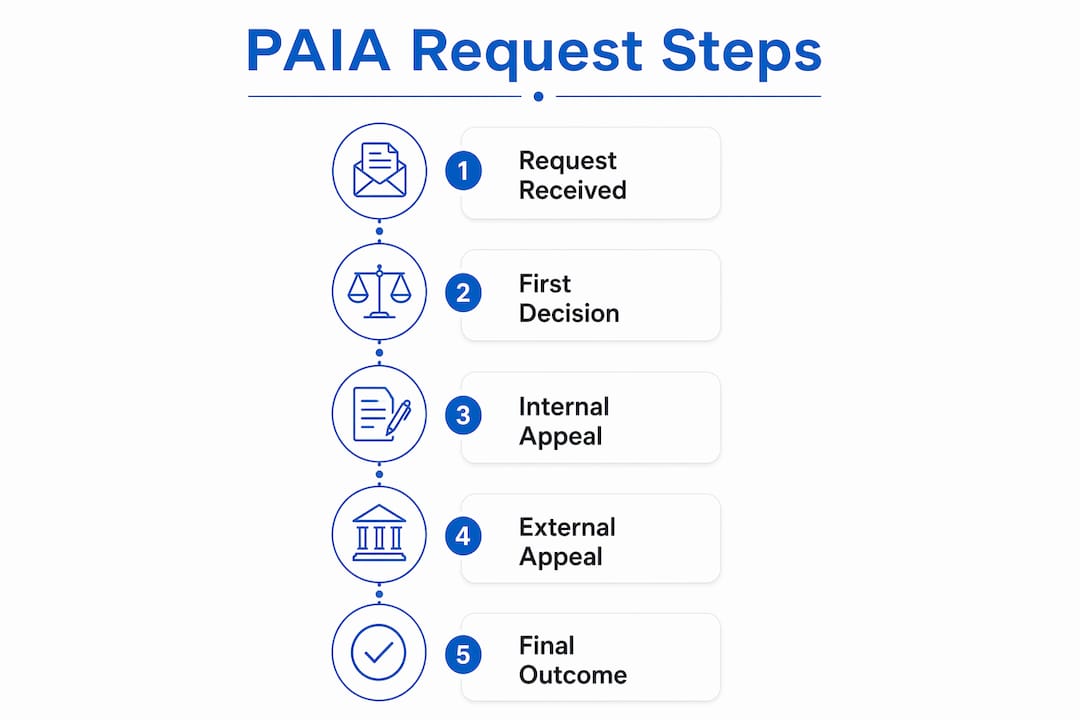
PAIA workflow for restricted or archived records
- Identify the exact record: hearing day, date, exhibit label, and file number if known.
- Complete PAIA Form A with a precise description of the record sought.
- Address the request to the Commission’s Information Officer (contact details are on the archive’s contact page).
- Pay the prescribed request fee (set by PAIA regulations; the Section 14 manual lists current fee schedules).
- Await the decision within the statutory window.
- If refused, file an internal appeal within 30 days of receiving the refusal.
- If the internal appeal fails, apply to court for judicial review.
Contact points: the Commission’s Records Manager handles day-to-day file queries; the Information Officer handles formal PAIA requests. The key figures page lists current staff roles.
| Stage | Statutory deadline |
|---|---|
| PAIA first decision | 30 days from receipt of request |
| Internal appeal decision | 30 days from receipt of appeal |
| Court review application | As soon as practicable after appeal refusal |
Pro Tip: Include the register or file number when you know it. NARSSA’s file-plan rules assign the Records Manager responsibility for the master file register, so citing that number speeds up the search considerably.
How do you verify document authenticity and track discrepancies?
The quickest first step is to locate the exhibit in the archive and check whether the upload timestamp, file owner, and document date are consistent with the testimony. If the exhibit is absent, that absence is itself a discrepancy worth documenting.

Reporting from July 2026 shows the Commission has faced disputes over A1 statement authenticity and missing annexures, including voice notes challenging the provenance and dates of statements. This is not unusual in complex inquiries, but it means every requester and reporter should treat exhibit verification as a routine step, not an afterthought.
Verification checklist:
- Compare the exhibit label in testimony against the label in the archive.
- Check the document’s stated date against the witness timeline (who was present, when the statement was taken).
- Review digital metadata: upload timestamp, file owner, version history if available.
- Look for annexure references within the affidavit text and confirm each is present in the archive.
- Note any discrepancy in a running log with the hearing-day citation and exhibit label.
Evidence-tracking workflow:
- Record the discrepancy: hearing day, exhibit label, and the specific inconsistency.
- Check the Methodology, Sourcing & Corrections page — corrections are sometimes already logged there.
- Send a records-locating query to the Commission’s Records Manager with the exact references.
- If unresolved, submit a PAIA Form A requesting the missing or corrected exhibit.
- Request a sworn explanation or corrected exhibit if the discrepancy affects legal proceedings.
Pro Tip: For journalists and legal teams preparing cross-examination questions, frame authentication queries around three specifics: the document’s creation date, the chain of custody from author to Commission, and whether any version other than the archived one exists. Those three questions cover most disputed-exhibit scenarios.
What legal and archival rules govern Commission records?
Three instruments define the framework. Proclamation R269 of 2025 establishes the Commission, gives it power to subpoena and compel documents, and requires both an interim and a final report. PAIA (Act 2 of 2000) gives the public a right to request state-held records and prescribes the Form A process, timelines, and fees. NARSSA sets file-plan standards for commissions, including registers, annexure covers, and disposal rules.
| Legal source | Practical implication |
|---|---|
| Proclamation R269 of 2025 | Commission can subpoena documents; sets reporting deadlines and scope |
| PAIA (Act 2 of 2000) | Public right to request records; Form A, 30-day decision window, internal appeal |
| NARSSA file-plan prototype | Defines master register, annexure covers, confidential records control, disposal |
Key provisions to know:
- R269 authorises the Commission to refer matters for prosecution and adopt regulations under the Commissions Act, 1947.
- PAIA Section 14 manuals (published by public bodies including The Presidency) set out the fee schedule and the grounds for refusal.
- NARSSA’s prototype assigns the Records Manager specific duties: maintaining the master copy, the register of files opened, and the confidential records register.
Understanding what a commission of inquiry can and cannot compel is useful context when framing a PAIA request that references subpoenaed documents.
How should journalists, lawyers, and researchers cite commission documents?
Always cite the archive URL, the hearing day and date, and the exhibit label. Add the Commission docket or file number when it appears on the document.
Citation examples:
- News article: Madlanga Commission of Inquiry, Day 110 (01 June 2026), Exhibit FA1, available at madlangacommission.co.za [accessed date].
- Legal pleading: Judicial Commission of Inquiry (Proclamation R269/2025), Hearing Day 142, 17 July 2026, Witness Statement A1 [Witness K], archived at madlangacommission.co.za/witnesses/witness-k.
- Academic/research: Madlanga Commission of Inquiry (2025–2026), Day 115 transcript (08 June 2026), exhibit index, Madlanga Commission public archive, https://madlangacommission.co.za.
On redactions and privacy: where the Commission has ordered witness identity protection, use the archive’s anonymised label (for example, “Witness I” or “Witness K”) rather than any name that may have circulated informally. Verify an exhibit against the archive before publishing or filing; do not rely on a copy obtained outside the official record.
The Commission’s Methodology, Sourcing & Corrections page records provenance notes and logged corrections. Checking it before citing an exhibit is the single fastest way to confirm you are working from the current, authoritative version of a document.
What do you do when a file is missing, disputed, or withheld?
If an exhibit referenced in testimony is absent from the archive, document the gap immediately and submit a PAIA request. Do not wait to see whether it appears later.
Escalation sequence:
- Document the discrepancy: hearing day, exhibit label, and the testimony passage that references it.
- Check the Methodology, Sourcing & Corrections page for any logged update.
- Send a records-locating request to the Commission’s Records Manager (include the exact references).
- Submit PAIA Form A to the Information Officer if the Records Manager cannot resolve it.
- File an internal PAIA appeal within 30 days if the request is refused.
- Apply to court for judicial review if the internal appeal fails.
Template request (adapt as needed):
Internal appeal checklist:
- State the grounds for appeal (incorrect refusal ground, procedural error, public interest).
- Attach a copy of the original PAIA Form A and the refusal letter.
- Include the hearing-day citation and exhibit label as evidence of the record’s existence.
- Submit within 30 days of the refusal date.
Key takeaways
The Madlanga Commission’s public archive is the primary source for case file documentation; PAIA, Proclamation R269 of 2025, and NARSSA together define what exists, who controls it, and how to compel access.
| Point | Details |
|---|---|
| Start with the public archive | Search madlangacommission.co.za by hearing day, witness, or exhibit label before filing any formal request. |
| Use PAIA for restricted records | Complete Form A, address it to the Information Officer, and expect a decision within 30 days. |
| Verify exhibits against testimony | Check upload timestamps, document dates, and annexure labels; log every discrepancy with the hearing-day citation. |
| Cite the legal framework | Proclamation R269 of 2025, PAIA (Act 2 of 2000), and NARSSA file-plan rules govern what records exist and how long they are kept. |
| Madlanga Commission archive | The Commission’s searchable archive is the authoritative starting point for citizens, journalists, and legal professionals. |
Why transparent record-keeping is the backbone of accountability
Public inquiries produce mountains of paper, but their value depends entirely on whether that paper is findable, verifiable, and contestable. The Madlanga Commission, under Justice Mbuyiseli Madlanga’s chairmanship, is investigating allegations that reach into the highest levels of South Africa’s police, prosecution, and intelligence structures. The stakes for getting the record right are not administrative. They are prosecutorial.
Disputed A1 statements and missing annexures are not just procedural irritants. They are the points where accountability either holds or collapses. When journalists and legal professionals follow formal PAIA procedures rather than relying on informal copies, they preserve their legal standing to challenge a refusal, compel a correction, and ultimately use the record in court. Skipping the formal route to save time often costs far more later.
The Madlanga Commission archive is your primary source
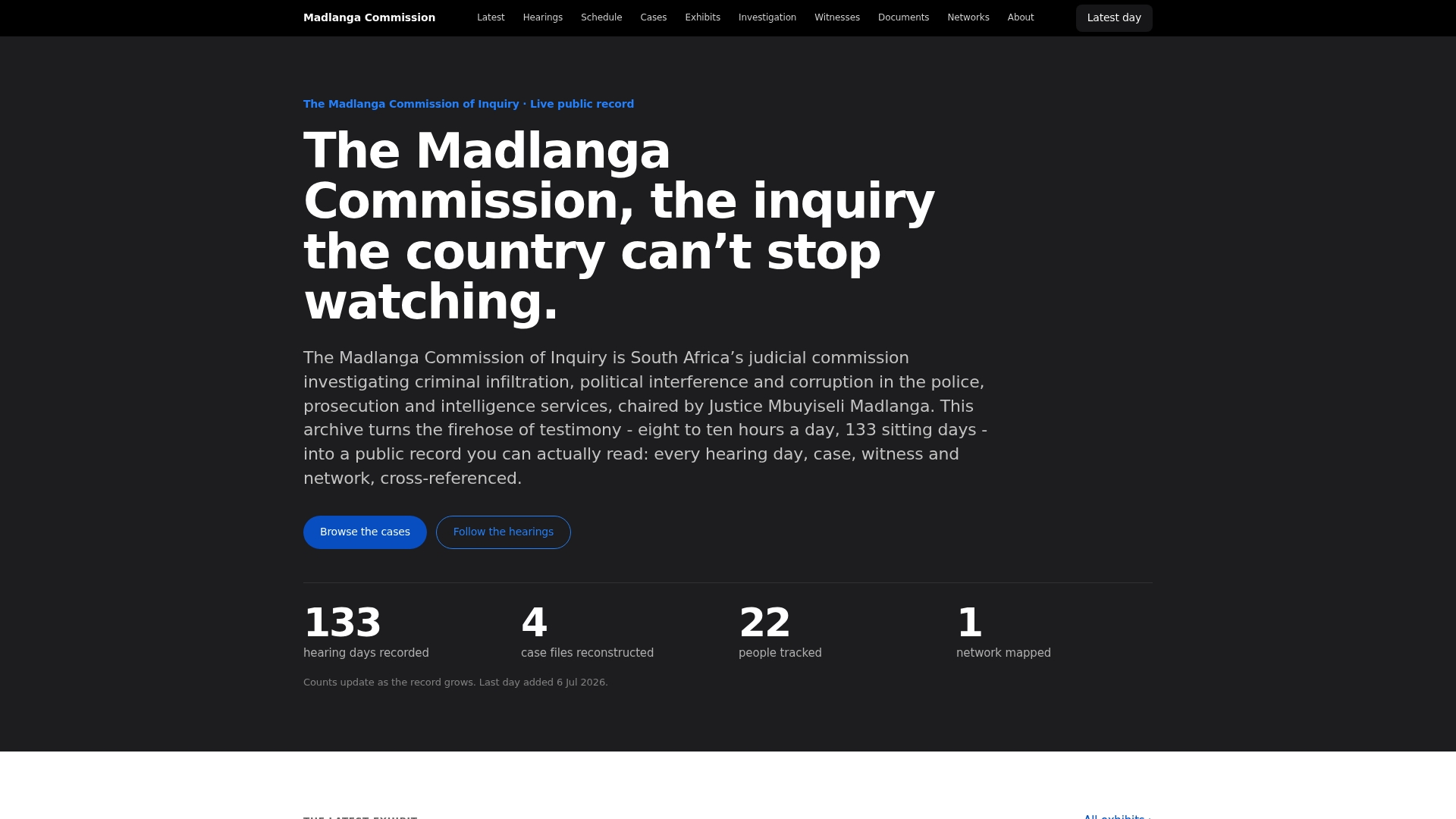
Every case file search should start at madlangacommission.co.za. The archive gives you hearing-day transcripts, the full witness index, exhibit lists, and rulings in one searchable place, without requiring a formal request for the vast majority of records.
For provenance questions, corrections, and missing exhibit reports, the Methodology, Sourcing & Corrections page is the right channel. It logs updates to the record and explains how sourcing decisions are made, which matters when you are preparing a citation or a PAIA appeal. If you find a discrepancy between testimony and an archived exhibit, report it there. The archive is a living record, and corrections are part of how it stays authoritative.
Useful sources and further reading
The sources below are the primary references for any PAIA request, citation, or verification workflow related to the Commission.
- Proclamation R269 of 2025 (Government Gazette 53048) — the establishing instrument; cite this when referencing the Commission’s powers, scope, and reporting obligations.
- LawLibrary copy of Proclamation R269 — annotated legislative text; useful for legal citations requiring a clean, accessible version.
- PAIA Section 14 manual (The Presidency) — Form A, fee schedules, timelines, and appeal procedures.
- PAIA Manual (Parliament, 2025) — explains why archived or restricted records require formal requests even when other documents are publicly posted.
- NARSSA file-plan prototype for commissions of inquiry — defines the master register, annexure covers, confidential records control, and disposal rules; essential for understanding what the Records Manager is required to maintain.
- Inside Politic — disputed A1 statements and missing annexures — July 2026 reporting on voice notes challenging statement provenance; illustrates the types of evidentiary disputes readers should anticipate.
- Madlanga Commission public archive — primary source for all hearing-day records, including Day 110, Day 115, Day 142, and Day 143.
| Source | Best used for |
|---|---|
| Proclamation R269 / Government Gazette | Citing the Commission’s legal basis and subpoena powers |
| PAIA Section 14 manual | Form A completion, fee schedules, appeal timelines |
| NARSSA file-plan prototype | Understanding filing structure and Records Manager duties |
| Inside Politic reporting | Illustrating disputed-exhibit scenarios in verification work |
| Madlanga Commission archive | All primary record searches and citation URLs |
FAQ
Where are the Madlanga Commission case files published?
The Commission publishes its full archive at madlangacommission.co.za, including hearing-day transcripts, witness statements, exhibits, and rulings, all freely searchable without registration.
What is PAIA Form A and when do you need it?
PAIA Form A is the prescribed request form under the Promotion of Access to Information Act (Act 2 of 2000). You need it when a record is restricted, archived, or absent from the public archive; submit it to the Commission’s Information Officer and expect a decision within 30 days.
How do you verify that an exhibit is authentic?
Check the exhibit label and document date against the testimony reference, review the digital metadata (upload timestamp and file owner) in the archive, and confirm that all annexures cited in the affidavit text are present. Log any discrepancy with the hearing-day citation and report it via the Methodology, Sourcing & Corrections page.
Which laws govern access to Commission records?
Three instruments apply: Proclamation R269 of 2025 (establishing the Commission and its powers), PAIA (Act 2 of 2000, governing public access to state-held records), and NARSSA’s file-plan standards for commissions of inquiry.
What do you do if a PAIA request is refused?
File an internal PAIA appeal within 30 days of the refusal, stating the grounds (incorrect refusal basis, procedural error, or public interest). If the internal appeal also fails, you may apply to court for judicial review.