Madlanga Evidence and Crime Intelligence Oversight in South Africa

Crime intelligence oversight in South Africa runs through five main channels: the Joint Standing Committee on Intelligence (JSCI), the Inspector-General for Intelligence (IGI), the Auditor-General, the Portfolio Committee on Police, and the Independent Police Investigative Directorate (IPID). Together they produce annual reports, IGI certificates, financial audits, and parliamentary inquiries. Oversight exists on paper and in practice, but documented gaps in enforcement mean independent reviews and reform remain far from optional.
TL;DR:
- Oversight bodies frequently fail to access comprehensive operational metrics, making it difficult to measure the true effectiveness of crime intelligence activities.
- Structural weaknesses like politicisation, poor organizational learning, and fragmented coordination persist despite recent legislative reforms such as GILAA.
- Public testimony from judicial commissions enhances transparency by providing detailed, searchable records of specific misconduct and operational failures.
- Most oversight reports focus on procedural compliance rather than actual impact, leaving the effectiveness of crime intelligence largely unverified.
- The oversight framework relies on limited, siloed powers, with no single entity capable of full transparency or enforcement, which hampers accountability efforts.
Table of Contents
- Who actually oversees crime intelligence, and what powers do they hold?
- What legal framework defines these oversight powers?
- How does oversight actually work day to day?
- How do you measure whether crime intelligence oversight is working?
- What problems does oversight keep finding, year after year?
- What reforms are underway, and where does the Madlanga Commission fit?
- How should you actually use these oversight outputs?
- Why public evidence archives matter for real accountability
- Where to find the evidence behind the oversight debate
- Further reading and primary sources
- Sources
- FAQ
Who actually oversees crime intelligence, and what powers do they hold?
Five statutory bodies carry the weight of crime intelligence oversight in South Africa, each with a distinct mandate and a distinct blind spot.
The Joint Standing Committee on Intelligence (JSCI) sits at the center. Established under the Committee of Members of Parliament on and Inspectors-General of Intelligence Act 40 of 1994, it must submit annual reports to the President and to Parliament, and it can request audit reports and demand investigations into specific concerns. It works largely behind closed doors, which protects operational secrecy but also limits what the public ever sees of its findings.
The Inspector-General for Intelligence, operating through the Office of the Inspector-General for Intelligence (OIGI), has statutory access to intelligence records and premises. The IGI reviews the lawfulness and effectiveness of intelligence activity and issues certificates and reports to ministers and to the JSCI. This is the one office with a legal right to walk into a facility and ask hard questions.
The Auditor-General audits intelligence spending, but secret service accounts create a genuine constraint: much of the money moves through channels that resist standard financial scrutiny, so audits confirm compliance with process more often than they confirm value for money.
The South African Police Service Crime Intelligence Division answers operationally to police leadership, while the Independent Police Investigative Directorate and the Civilian Secretariat for Police handle misconduct and policy oversight respectively. IPID investigates deaths in custody, police shootings, torture allegations, and criminal conduct by officers, including some within crime intelligence structures.
These bodies refer matters to each other constantly:
- The IGI can flag concerns that trigger a JSCI inquiry.
- The Auditor-General’s findings often become the evidence base for a Portfolio Committee hearing.
- IPID’s criminal investigations can surface facts that feed into a judicial commission, such as the Madlanga Commission.
- The Civilian Secretariat monitors implementation of policy recommendations across all of the above.
No single office has full visibility. That is by design, and it is also the structure’s biggest weakness.
What legal framework defines these oversight powers?
Crime intelligence oversight in South Africa rests on a handful of statutes, each carrying specific reporting timetables and specific limits.
- Committee of Members of Parliament on Intelligence Act 40 of 1994 establishes the JSCI’s oversight function and requires an annual report to the President and Parliament, alongside the power to call for audits and targeted investigations.
- Inspector-General appointment and removal safeguards are built into the same legislative framework. The IGI is appointed with parliamentary involvement specifically to insulate the office from executive pressure, and removal requires more than a minister’s say.
- Intelligence Services Act and National Strategic Intelligence Act define what intelligence services may collect, how they may share information, and what internal control mechanisms must exist before operations proceed.
- General Intelligence Laws Amendment Act (GILAA), enacted in 2025, forms part of the government’s legislative response to state-capture findings. It followed recommendations to strengthen oversight and empower the IGI, though independent assessments note that implementation gaps remain even after the law’s passage, according to the PARI/NCAC independent assessment.
The tension running through all of this is structural, not accidental. Secrecy protects live operations and source safety. Transparency protects citizens from abuse. South Africa’s legal framework tries to hold both at once by giving oversight bodies access that ordinary citizens don’t have, then restricting what those bodies can publish. That trade-off works only when the oversight bodies themselves stay independent, funded, and willing to act on what they find.
How does oversight actually work day to day?
Oversight isn’t a single event. It’s a reporting chain, and understanding that chain tells you where accountability tends to break down.
The flow typically runs: the Head of Service reports to the responsible Minister, who reports to the Inspector-General, who reports to the JSCI. Each link is supposed to add scrutiny, not just pass paperwork upward.
- IGI certificates confirm whether an intelligence service’s activities comply with the law and with its mandate. A clean certificate is a compliance signal, not a performance rating.
- Auditor-General audits verify financial controls, but as noted above, secret accounts limit how far this scrutiny reaches into actual spending decisions.
- Parliamentary tools include written questions, committee hearings, and public evidence sessions. A 2025 parliamentary question (NW5471) to the Acting Minister of Police asked directly whether independent assessments measure the operational impact of crime intelligence and requested data on equipment evaluation rates, with the reply referencing JSCI, IGI, and Portfolio Committee oversight rather than supplying hard figures.
- Independent panels and value-add surveys attempt to measure whether crime intelligence actually improves policing outcomes, separate from whether it complies with the rules.
Pro Tip: If you want to gauge how seriously an oversight report takes its job, check whether it cites specific operational metrics (case referrals, equipment usage rates) or only confirms procedural compliance. The second kind tells you almost nothing about effectiveness.
The gap between “compliant” and “effective” is where most public frustration with crime intelligence oversight actually lives.
How do you measure whether crime intelligence oversight is working?
Assessors use four broad approaches: financial audits, operational impact studies, value-add surveys, and organisational learning reviews. Each measures something different, and none of them alone gives a complete picture.
Operational impact studies try to connect intelligence products to actual case outcomes, arrests, or crime reduction. Value-add surveys ask operational police divisions whether the intelligence they received was useful, timely, or actionable. Organisational learning reviews, like the one produced through a University of South Africa thesis on the SAPS Crime Intelligence Division, examine whether the organisation absorbs lessons from past failures or repeats them.
The metrics that matter most in practice include:
- Case-clearance contribution, tracking how often crime intelligence products contribute to arrests or prosecutions.
- Time-to-action, measuring how quickly intelligence gets from analysis to operational deployment.
- Equipment evaluation rates, which the 2025 parliamentary question specifically flagged as data Parliament wanted but had not yet received in full.
- Quality indicators, assessing whether intelligence products meet basic standards of accuracy and usability before reaching operational teams.
The persistent problem: no standardised national metric exists for crime intelligence effectiveness. Secrecy provisions limit what independent researchers can access, record-keeping varies between units, and academic studies, including the UNISA thesis on organisational learning, describe inconsistent documentation as one of the field’s most stubborn obstacles. That single gap explains why so many oversight reports read as procedural rather than substantive.
What problems does oversight keep finding, year after year?
The same failures surface repeatedly across audits, commissions, and academic reviews, and they cluster into four categories.
- Politicisation. Independent assessments following the state-capture period documented politicisation and institutional contamination within intelligence services, according to the Inclusive Society Institute’s analysis. When leadership appointments serve political loyalty rather than operational competence, oversight bodies lose the internal cooperation they need to function.
- Capacity and learning gaps. The UNISA research into SAPS Crime Intelligence found organisational learning deficiencies that limit the division’s ability to convert lessons from past operations into improved practice going forward. Poor record-keeping and weak after-action review processes mean the same mistakes recur without anyone formally flagging why.
- Coordination failures. Multiple intelligence entities operating under the National Intelligence Coordinating Committee (NICOC) framework don’t always share information effectively, which fragments the very oversight process meant to catch problems early.
- Accountability shortfalls. Recommendations from previous reviews often sit unimplemented for years. The PARI/NCAC assessment found that even after high-profile findings of institutional weakness, follow-through on corrective action moved slowly, and equipment evaluation and documentation gaps persisted well past the point they were first flagged.
None of these problems is new information to anyone who has followed South African intelligence politics over the past decade. What’s changed is how much of the evidence is now on public record, thanks in part to commission testimony that puts named officials and specific decisions into the transcript.
What reforms are underway, and where does the Madlanga Commission fit?
Reform in this space moves in two speeds: legislative change, which is slow and formal, and public evidence gathering, which moves faster and shapes political pressure in real time.
The High-Level Review Panel recommendations and the subsequent General Intelligence Laws Amendment Act (GILAA), passed in 2025, represent the formal legislative track. GILAA responds directly to state-capture findings by aiming to strengthen the IGI’s powers and improve financial controls. Independent assessments note the law addresses structural weaknesses on paper, but implementation gaps remain, including how quickly agencies actually adopt new reporting standards.
Recommended fixes that go beyond legislation include:
- Independent review panels combining security expertise with civil-society participation, an approach the Inclusive Society Institute argues restores public trust more effectively than internal reviews alone.
- Clearer mandate boundaries between JSCI, IGI, and IPID to reduce the referral gaps described earlier.
- Improved vetting and professionalisation standards for crime intelligence personnel.
- Standardised metrics across audits, so effectiveness can be compared year over year instead of assessed in isolation.
This is where a public record like the Madlanga Commission archive adds something the statutory bodies can’t fully provide on their own. Commission hearings put named witnesses, specific case files, and documentary exhibits into a public record that oversight professionals, journalists, and Parliament itself can cite directly. That kind of visibility doesn’t replace the IGI or the Auditor-General. It gives their findings a public evidentiary backbone that’s harder to quietly shelve.
How should you actually use these oversight outputs?
Reading an IGI certificate, an Auditor-General report, or a JSCI summary takes a specific approach, because these documents are written for compliance review, not public explanation.
- Start with what’s confirmed, not what’s praised. An IGI certificate confirming lawful conduct says nothing about whether the intelligence produced was useful. Look for the specific compliance finding, not the surrounding language.
- Cross-reference Auditor-General findings with Portfolio Committee hearings. Financial audits rarely explain operational failures on their own; committee transcripts often fill in the “why.”
- Use the Parliamentary Monitoring Group (PMG) to track written questions. Anyone can submit a question through an MP and follow the government’s formal reply, as the NW5471 example shows.
- Search the Madlanga Commission’s case archive for testimony connected to a specific unit or official. Exhibits and witness statements often surface details that never appear in a formal audit.
Pro Tip: If a government reply to a parliamentary question references “ongoing oversight by JSCI and IGI” without citing a specific report number or date, treat that as a placeholder answer, not a real one. Push for the underlying document.
Advocacy works best when it’s specific: request implementation timelines for named recommendations, build coalitions with other oversight-focused organisations, and set a calendar date to check whether promised action actually happened.
Why public evidence archives matter for real accountability
Statutory oversight in South Africa was built to work through closed committees and classified reports. That design made sense for protecting operations. It also meant that for decades, the public had almost no way to independently verify whether the JSCI, the IGI, or the Auditor-General were actually holding intelligence services to account, or simply rubber-stamping annual paperwork.
What’s changed is the volume of testimony now entering the public record through judicial commissions. When witnesses testify under oath about specific procurement decisions, appointment processes, or operational failures, and that testimony gets organized into a searchable archive alongside exhibits and rulings, journalists and researchers no longer depend entirely on official summaries. They can trace a claim back to the transcript itself.
That matters most for the people doing the unglamorous work of oversight: parliamentary staff drafting questions, academic researchers building the next organisational assessment, and civil society groups trying to hold agencies to their own stated commitments. Searchable hearing records don’t fix politicisation or capacity gaps by themselves. But they remove one persistent excuse, that the evidence was too scattered or too classified to check.
— Meriol Lainchyon
Where to find the evidence behind the oversight debate
The commission archive offers underlying testimony, exhibits, and rulings in one searchable place, rather than a summarized annual report months after the fact.
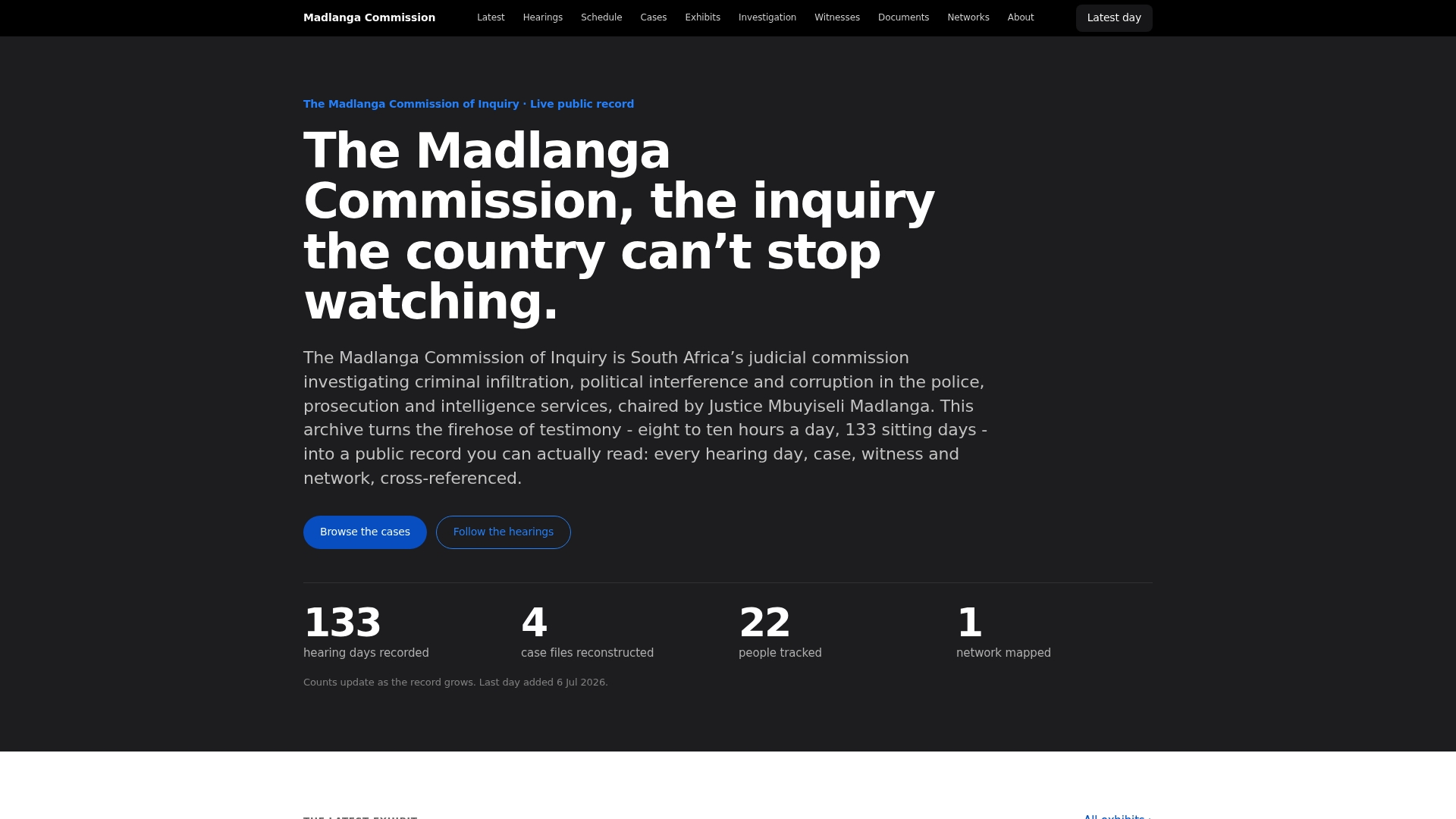
The archive holds daily hearing records, witness statements, exhibits, official rulings, and media briefings connected to allegations of criminal infiltration, political interference, and corruption across police, prosecution, and intelligence structures. Start with the Evidence Leaders page to see who curates and verifies the material entering the record, then check the methodology page to understand how sourcing and corrections work. From there, individual witness pages, including testimony from specialized units, let you follow a specific thread from first mention to final exhibit. Bookmark the case files relevant to your work now, and check back as new hearing days get added to the record.
Further reading and primary sources
For the statutory framework itself, read the Act 40 of 1994 directly, and check the OIGI’s official site for Inspector-General functions and reports. The gov.za policing and intelligence overview outlines how SAPS, the Civilian Secretariat, and IPID relate structurally.
For independent analysis, the PARI/NCAC assessment, the Inclusive Society Institute’s review, and the UNISA thesis on organisational learning each cover different weaknesses in depth. Parliamentary scrutiny is documented through PMG’s committee question archive, and case-level evidence sits in the Madlanga Commission’s public archive.
Sources
- Committee of Members of Parliament on and Inspectors-General of Intelligence Act 40 of 1994
- Independent Assessment for the National Anti-Corruption Advisory Council — PARI / NCAC
- Assessing crime intelligence in South Africa — Inclusive Society Institute
- An evaluation of the impact of organisational learning in the SAPS crime intelligence division on crime reduction — UNISA thesis
- Question NW5471 to the Acting Minister of Police — PMG
FAQ
Who is in charge of crime intelligence oversight in South Africa?
No single body runs it alone. The JSCI, the Inspector-General for Intelligence, the Auditor-General, the Portfolio Committee on Police, and IPID each hold a piece of the mandate, and they refer matters to one another when findings cross jurisdictions.
What does the SAPS Crime Intelligence Division actually do?
It gathers and analyzes information to support policing operations, including organized crime and corruption investigations, but academic research has found organisational learning gaps that limit how effectively lessons from past cases feed back into current practice.
What kinds of cases does IPID investigate?
IPID investigates deaths in police custody, police shootings, torture allegations, and criminal conduct by officers, including cases that touch crime intelligence personnel when misconduct allegations arise.
Is “crime intelligence” a real, distinct police unit in South Africa?
Yes. The SAPS Crime Intelligence Division is a formal, statutory unit within the police service, separate from civilian intelligence services, and subject to its own oversight chain through the IGI, JSCI, and Portfolio Committee on Police.