Cross examination inquiry: how to test testimony effectively

Cross-examination is the opposing party’s chance to question a witness who has already testified, aimed at testing credibility and pulling out admissions that move a case forward. Anyone approaching a cross examination inquiry needs to treat it as controlled interrogation, not conversation. The core objectives are simple to state and hard to execute:
- Expose contradictions between this testimony and earlier statements or documents
- Test the witness’s reliability, memory, and possible bias
- Elicit specific facts that support your version of events
Success has one honest measure: did you obtain a clear admission or a contradiction the presiding officer can’t ignore? Everything below builds toward that single outcome.
Key Takeaways
Effective cross-examination depends on leading, single-fact questions delivered in a controlled sequence that ends the moment you secure your key admission.
| Point | Details |
|---|---|
| Definition and goal | Cross-examination tests credibility and reliability to extract admissions or contradictions that support your case. |
| One fact per question | Leading questions that introduce a single fact keep witnesses from escaping into narrative answers. |
| Prepare before you stand | Map prior statements and exhibits to your questions, and rehearse fallback lines for evasive answers. |
| Rights in disciplinary hearings | The right to cross-examine is treated as central to fairness even where formal court rules don’t apply. |
| Stop at the admission | Once you secure the fact or contradiction you need, close the line rather than inviting explanation. |
Table of Contents
- What is the purpose of cross-examination in an inquiry?
- Core principles that govern effective cross-examination
- How do you prepare and structure a cross-examination?
- What do good cross-examination questions actually sound like?
- How does cross-examination work in disciplinary hearings?
- What common mistakes and objections should you watch for?
- How can you practise cross-examination using real inquiry transcripts?
- Where to read further on cross-examination technique
- Why practical rigor beats courtroom theatrics
- Sources
- FAQ
What is the purpose of cross-examination in an inquiry?
Cross-examination exists because untested evidence is dangerous. In the adversarial model, examination-in-chief gives a witness room to tell their story uninterrupted; cross-examination is where that story gets pressure-tested. It’s widely described as the engine of truth-seeking in adversarial proceedings, precisely because it forces a witness to defend claims under direct challenge rather than repeat them unchallenged, as Gawie le Roux’s overview of cross-examination lays out.
That purpose holds whether you’re in a High Court, a CCMA arbitration, or a workplace disciplinary hearing. What changes is the formality. The goal never does.
- Credibility testing: does the witness’s account hold up against their own prior statements?
- Reliability testing: could memory, perception, or motive have distorted what they saw?
- Fact extraction: what admissions, once made, support your client’s position?
Miss any one of these three, and your cross has covered ground without accomplishing anything.
Core principles that govern effective cross-examination
Cross-examination runs on a small set of rules, and breaking them is the fastest way to lose control of a witness.
Leading questions are not just tolerated in cross-examination, they’re expected. Unlike examination-in-chief, where leading questions on contested points are usually improper, cross allows you to put a statement to the witness and ask them to agree or disagree, according to Wikipedia’s overview of cross-examination practice. That’s your primary tool for keeping a witness inside the boundaries you set.
- Ask one new fact per question. Stack two facts into a single question and a witness will answer the easy one and dodge the hard one.
- Keep the tone even. Aggression rarely rattles a prepared witness, but it does erode your standing with the person deciding the outcome.
- Stay inside relevance. Wandering into inadmissible or tangential territory hands the witness room to recover.
- Anchor questions to documents and prior statements wherever possible, rather than relying on the witness’s memory of what they said.
Derebus commentary on South African cross-examination practice makes a point worth repeating: preparation and precision consistently beat theatrics, according to practical guidance published in the GCBSA law journal.
Pro Tip: Draft every cross-examination question as a statement first, then add a question mark. “You signed the register at 14:20, correct?” controls the witness far better than “What time did you sign the register?”
How do you prepare and structure a cross-examination?
A cross-examination that wanders is a cross-examination that fails. Five steps keep it disciplined:
- Define the goal for this witness. Decide before you stand up whether you need an admission, a discredited claim, or simply neutralised testimony. A vague goal produces vague questions.
- Map the paper trail. Line up prior statements, exhibits, and inconsistencies against the questions you plan to ask. Practitioner training built around trial-advocacy exercises consistently stresses this mapping step as the difference between a controlled cross and a fishing expedition, per SA Legal Academy’s practical guide to courtroom tactics.
- Sequence deliberately. Open with low-risk questions that box the witness into agreed facts, move to the question that extracts your key admission, then close before the witness recovers ground.
- Rehearse the evasions. Prepared witnesses deflect. Have a fallback question ready for every dodge you can predict, rather than improvising under pressure.
- Stop while you’re ahead. The most common tactical error is one question too many. Once you have the admission, sit down. An open-ended follow-up invites the witness to explain it away.
Mock cross-examination exercises build the instinct for when to stop, and legal training bodies treat rehearsal as essential rather than optional preparation, not a luxury reserved for major trials.
What do good cross-examination questions actually sound like?
The gap between reading about technique and using it under pressure is where most cross-examinations fall apart. A few working patterns:
- Boxing sequences: “You were on shift that night?” “You signed the log at 22:00?” “The log shows no entry after that?” Three short, leading questions, each adding one fact, none giving the witness room to explain.
- Putting your version: if your client disputes the witness’s account, you generally need to put that conflicting version to them directly. Skipping this step can weaken your later reliance on the contradiction, since a presiding officer may treat unchallenged testimony as effectively accepted, as explained in analysis of unchallenged witness testimony in disciplinary hearings.
- Questioning experts differently: with an expert witness, the target isn’t what they saw but why they concluded it. Probe the reasoning, the assumptions behind it, and whether they had every material fact when they formed their opinion, a distinction the GCBSA’s practitioner commentary treats as central to effective expert cross.
- Impeachment script: “You told the investigator X on 3 March. You’ve just told this hearing Y. Which version is correct?” One sentence, one contradiction, no room to hedge.
Hostile witnesses need shorter questions and tighter control; cooperative witnesses can sometimes be led further before you reach your target fact.
How does cross-examination work in disciplinary hearings?
Disciplinary and administrative inquiries relax the formal rules of court, but they don’t relax the right to cross-examine. South African labour law doesn’t prescribe a rigid cross-examination procedure, yet CCMA arbitrators and Labour Court judges treat the opportunity to test evidence as fundamental to a fair process, per le Roux’s analysis of cross-examination’s role in fairness.
Because disciplinary matters are usually decided on a balance of probabilities rather than beyond reasonable doubt, your questioning strategy should chase the more-probable-than-not version of events, not an unreachable certainty. A few practical points:
- The accused generally has the right to test every piece of evidence used against them, including witness statements read into record.
- A chairperson or presiding officer can ask you to justify relevance, but taking over your cross-examination or shutting it down too readily has led to findings of unfair procedure, per Labour Law Advice’s commentary on cross-examination rights.
- Secure the incident report, any written statements, CCTV logs, and the disciplinary code itself before the hearing starts. Arriving without them leaves you cross-examining from memory.
What common mistakes and objections should you watch for?
Most cross-examinations aren’t lost to clever witnesses. They’re lost to avoidable procedural errors.
- Don’t argue with the witness or make speeches disguised as questions; presiding officers notice, and it damages your credibility more than the witness’s.
- Don’t introduce new evidence mid-cross without laying a proper foundation for it first.
- Don’t ask open narrative questions (“tell us what happened next”) once you’ve boxed a witness. You’re handing back the control you just built.
Poise outperforms pressure. Aggressive cross-examination tends to cost the examiner credibility with the presiding officer more often than it unsettles a well-prepared witness, according to Labour Law Advice’s commentary on cross-examination as a professional tool.
If the chairperson interrupts to question relevance, answer briefly and pivot back to your sequence rather than debating the ruling. And if a line of questioning produces nothing but denials three times running, that’s your signal to abandon it and move to your next planned fact.
How can you practise cross-examination using real inquiry transcripts?
Reading about technique only gets you so far. Working through an actual hearing transcript, sentence by sentence, shows you how contradictions surface in real testimony rather than in a textbook example.
- Pull a witness statement and a hearing transcript side by side, then mark every point where the spoken testimony departs from the written record. That gap is where cross-examination should have landed.
- The Madlanga Commission archive stores searchable hearing records, witness profiles, and exhibits, which makes this kind of line-by-line comparison possible without sitting through hours of proceedings.
- Testimony from witnesses such as the Hawks narcotics team leader (SANEB) or IPID’s Assistant Director of Investigations offers material where questioners had to reconcile operational accounts with paper trails, a useful model for disciplinary settings.
- As a practical exercise, pick one witness page, draft ten leading questions from the exhibits listed there, and time yourself delivering them without a single open-ended prompt slipping in.
Where to read further on cross-examination technique
- Madlanga Commission case files for real hearing transcripts and exhibits
- Labour Law Advice’s guide to cross-examination at disciplinary hearings
- GCBSA’s Derebus commentary on practical cross-examination technique
Anyone building courtroom skills should also look at how law enforcement misconduct cases get investigated, since the evidence-handling questions there overlap heavily with disciplinary cross-examination.
Why practical rigor beats courtroom theatrics
Most guidance on cross-examination oversells confrontation. The research behind this piece points the other way: preparation, document anchoring, and short leading questions consistently outperform aggressive or theatrical tactics, both in outcome and in how a presiding officer receives the examiner.
Where conventional advice falls short is in treating disciplinary hearings as a lesser, looser version of court cross-examination. They aren’t. The rules are less formal, but the stakes for the person testifying are often just as severe as a courtroom matter, and the right to test that evidence carries real procedural weight.
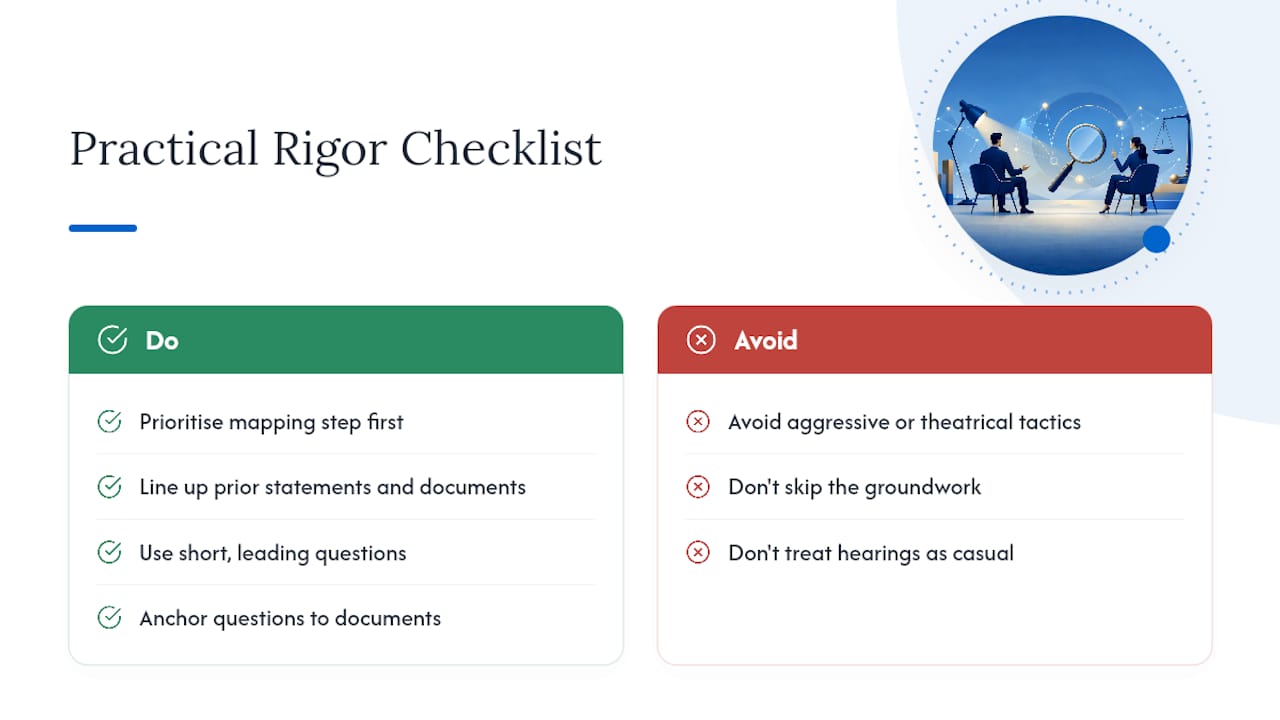
If you take one thing from this guide, prioritise the mapping step. Before you draft a single leading question, line up every prior statement and document against the witness’s expected testimony. Everything else, tone, sequencing, the courage to stop at the right moment, follows naturally once you know exactly where the contradiction lives. Skip that groundwork and no amount of composure in the room will save the cross.
Sources
- 5 reasons why cross-examination is important
- Cross examination at disciplinary hearings — Labour Law Advice
- Practical aspects of cross-examination — GCBSA law journal (Derebus excerpt)
FAQ
What should you avoid saying during cross-examination?
Avoid argumentative statements disguised as questions, open narrative prompts like “tell us what happened,” and introducing new evidence without first laying a foundation for it.
What questions come up most often during cross-examination?
Short, leading questions dominate: statements the witness must confirm or deny, each carrying exactly one new fact, often anchored to a document, date, or exhibit number.
What are the basic rules of cross-examination?
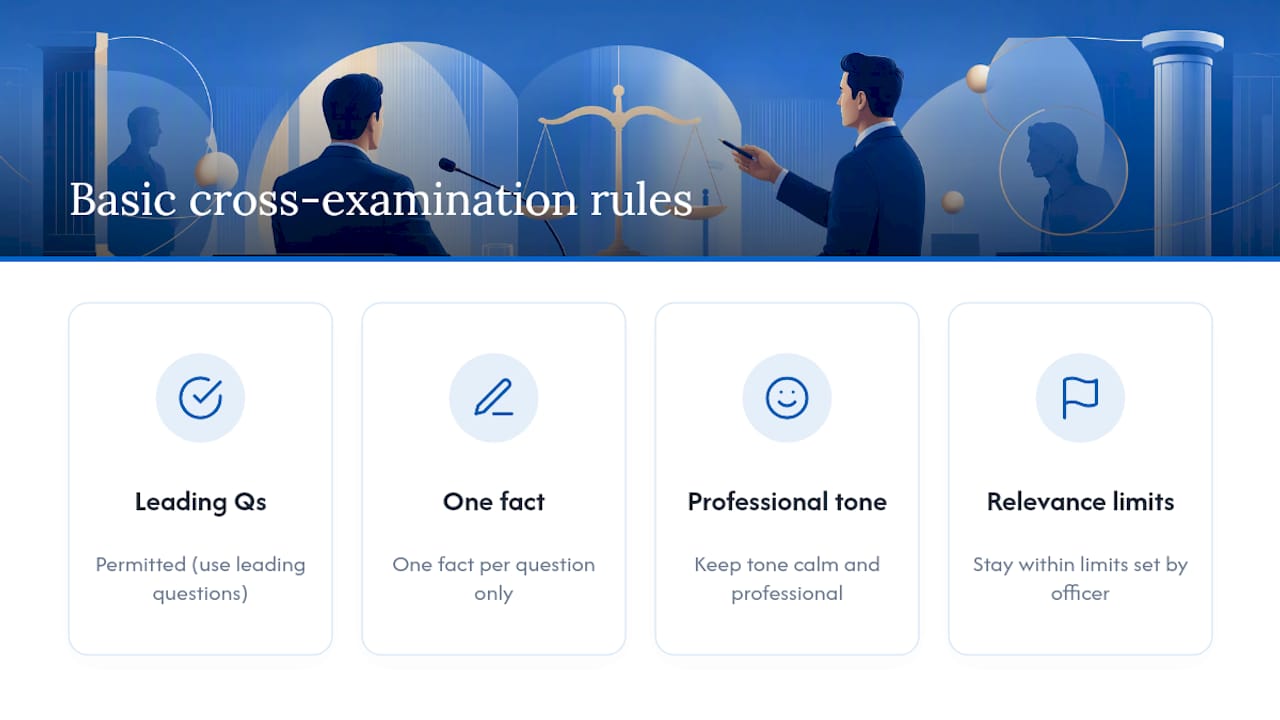
Leading questions are permitted, one fact belongs per question, the tone should stay professional, and questioning must stay within relevance limits set by the presiding officer.
What are the “Three C’s” of cross-examination?
Definitions vary across practitioners, but a commonly cited version centers on credibility, contradiction, and control, testing the witness’s credibility, exposing contradictions, and keeping firm control of the questioning throughout.