Data journalism corruption archive: how to search Madlanga records
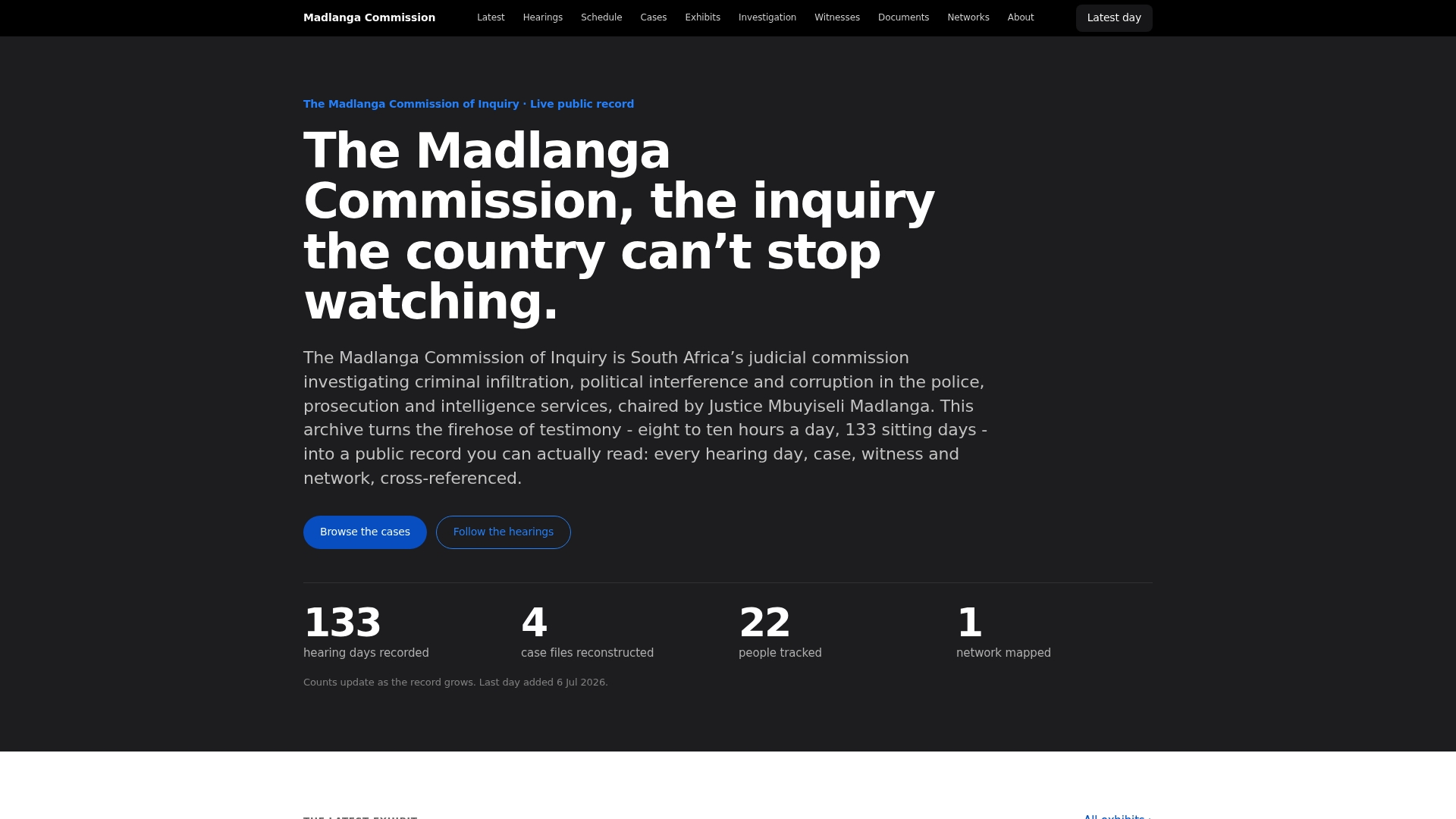
The official searchable record for South Africa’s Judicial Commission of Inquiry into criminality, political interference, and corruption sits at Madlangacommission, where hearings, exhibits, case files, and a dedicated methodology page let anyone search testimony, download primary documents, verify their provenance, and cite them properly. This is what a data journalism corruption archive actually looks like in practice: not a metaphor, but a structured, checksum-verified dataset behind a public commission of inquiry.
Start here:
- Open one case file and note its exhibit IDs before you extract anything
- Download an exhibit PDF and check it against the listed checksum
- Bookmark the live updates page if you’re tracking an ongoing matter
Pro Tip: Save the checksum and recording timestamp for every file the moment you download it. If a transcript is corrected later, that saved pair is your proof of which version you originally cited.
Key Takeaways
Reliable corruption reporting depends on verifiable primary records, and the Madlanga Commission archive supplies searchable, checksum-backed testimony, exhibits, and case files built on NARSSA and SANS standards.
| Point | Details |
|---|---|
| Access point | The archive lives at madlangacommission.co.za with searchable cases, exhibits, and hearings. |
| Verify before citing | Match checksums, timestamps, and custody fields before treating any record as final. |
| Know the legal limits | In-camera material, sealed exhibits, and privileged documents require formal requests, not assumptions. |
| Use open standards | NARSSA, SANS 15489/23081/16175, AtoM, and Archivematica keep records interoperable and trustworthy. |
| Madlanga Commission as the source | The archive pairs primary records with a dedicated methodology and corrections page for defensible citation. |
This article is general information, not a substitute for advice from a qualified lawyer. Consult a qualified legal professional about your own circumstances before acting on anything here.
Table of Contents
- What’s actually inside the data journalism corruption dataset
- What can you legally access, and what stays sealed?
- Which archival standards keep these records trustworthy?
- How do you search, extract, and export archive data?
- How do you verify and cite a Commission record?
- What are the privacy and ethics limits on using this data?
- Why the methodology and corrections page matters
- Action checklist before you publish anything
- Why this archive matters
- Get started with the Madlanga Commission archive
- Sources
- FAQ
What’s actually inside the data journalism corruption dataset
The archive isn’t one big document dump. It’s organized into distinct record types, each with its own format and metadata footprint. Hearing transcripts arrive as searchable text tied to a date and witness name. Audio and video recordings sit alongside them, timestamped to the transcript. Sworn affidavits and exhibits, mostly PDFs and scanned images, get their own exhibit IDs. Case file bundles group related exhibits under a single case reference, and where structured exports exist, they come as CSV or JSON rather than prose.
Every record carries metadata fields worth checking before you build an argument on top of it.
| Field | What it tells you |
|---|---|
| Creator | Who produced or submitted the document |
| Date | When it was created or entered into record |
| Exhibiting party | Which side introduced the evidence |
| Evidence ID | The stable reference number for citation |
| Checksum | Verifies the file hasn’t been altered |
| Ingest manifest | Confirms when and how it entered the archive |
A hearing links to its exhibits, and exhibits link to case file bundles, all through shared ID fields. That’s your join key if you’re merging Commission data with an external spreadsheet or timeline.
Pro Tip: Use exhibit IDs and case IDs, not file names, as your primary key when cross-referencing Commission records against news reports or court filings. File names get renamed; IDs don’t.
The case files hub is the fastest way to see this structure in action, and cases like the R200 million Durban cocaine bust show how a single exhibit thread runs through multiple hearings.
What can you legally access, and what stays sealed?
Not everything in a commission of inquiry is public, and knowing the difference protects you from a bad legal outcome. The Commission operates under the Commissions Act of 1947, which gives the Chairperson broad authority to set procedure, including how evidence is recorded and released. More recent regulations governing this specific inquiry confirm that mechanical and electronic recordings cannot be transcribed or published without the Chairperson’s direct order.
Common restrictions you’ll run into:
- In-camera hearings, closed to the public and press
- Sealed exhibits tied to ongoing criminal referrals
- Witness protection material
- Third-party confidentiality claims
- Material covered by legal professional privilege
If you need something restricted, the formal route runs through a written application to the Secretary or Chairperson, often supported by an affidavit setting out why disclosure serves the public interest. Response timelines vary by case complexity.
Regulations governing this inquiry also grant search and seizure powers and impose confidentiality duties on transcribers, who typically work under a sworn oath of secrecy. Never republish sealed material on the assumption no one will notice. Contempt and criminal exposure are real risks here, and if you’re sitting on something you suspect is sealed, get counsel before you publish, not after.
Which archival standards keep these records trustworthy?
A record is only as useful as its provenance. South Africa’s National Archives and Records Service Act (NARSSA) sets the baseline for how electronic government records must be preserved, including documented destruction procedures and mandatory transfer into archival custody. Public archives that skip this step risk losing the very oversight that keeps records credible, a gap researchers at the University of Cape Town have flagged as a structural weakness across South African institutions.
Look for these standards when judging whether a record is trustworthy:
- NARSSA Act compliance for transfer and custody
- NAAIRS and AtoM (Access to Memory) for descriptive metadata
- SANS 15489 for records management
- SANS 23081 for metadata frameworks
- SANS 16175 for digital recordkeeping systems
Preservation controls that back these standards up include fixity checksums, ingest and transfer logs, version history, and access-controlled audit trails, together called the “archival bond,” the documented link between a record and its original context.
Pro Tip: Before treating any downloaded file as authoritative, run through a five-item check: creator, transfer date, custody chain, preservation action log, and checksum match. If any field is missing, treat the file as provisional, not final.
Open-source tools like Archivematica for preservation ingest and AtoM for public discovery give commission archives a way to meet these standards without proprietary lock-in, though adoption across South Africa’s public sector is still uneven.
How do you search, extract, and export archive data?
Moving from a search query to a clean dataset takes six steps:
- Search by case ID, hearing date, or witness name in the archive
- Identify the authoritative record and note its metadata fields
- Download the original file along with its manifest
- Verify the checksum and timestamp against the listed values
- Convert and clean the file (OCR for scans, CSV or JSON for structured data)
- Analyze and visualize once the data is verified
Tools that make this workflow manageable without a commercial license:
- AtoM for browsing collection metadata and discovering related records
- Archivematica for preservation ingest and fixity checking
- OpenRefine for cleaning messy, inconsistent exhibit data
- Tesseract for OCR on scanned affidavits and exhibits
- QGIS or Gephi for mapping relationships between actors, locations, and cases
- R or Python for statistical analysis across large case bundles
Where the archive supports it, bulk export options include zipped exhibit folders and structured API access, delivering PDF, TIFF, WAV, MP4, CSV, and JSON depending on the record type.
Pro Tip: Store the manifest and checksum in the same folder as every downloaded file, and log each extraction step in a plain text file. If a court or editor ever asks you to reproduce your analysis, that log is what saves you.
OCR introduces its own errors, particularly on handwritten affidavits or degraded audio transcriptions. Cross-check anything OCR-generated against the original scan before quoting it directly.
How do you verify and cite a Commission record?
Verification comes down to five checks: confirm the manifest and checksum match, check the ingest timestamp, confirm the creator and custody fields, examine whether the transcription carries a signed oath record, and cross-check against the Commission’s corrections log for that item.
A workable citation template for a hearing transcript looks like this: Madlanga Commission, Hearing Transcript, Case ID [XXX], [date], retrieved [date], [URL]. For an exhibit: Madlanga Commission, Exhibit [ID], Case ID [XXX], [date], retrieved [date], [URL].
Corrected transcriptions get flagged and logged separately from the original. When you cite a record, check whether a corrected version exists and cite that one, noting the correction date. If a citation is disputed, the methodology and corrections page is the first stop, and unresolved disputes typically route through the evidence leader’s office.
Pro Tip: Cite the record and the specific version of the methodology page you consulted. Corrections pages get updated; your citation should reflect the state of the record at the time you relied on it.
What are the privacy and ethics limits on using this data?
Handling commission records responsibly means respecting both the law and the people named in them. The Protection of Personal Information Act (POPIA) and the Promotion of Access to Information Act (PAIA) govern how personal data inside these records can be stored, processed, and republished, alongside the Commission’s own rules on secrecy and in-camera material.
A basic security checklist for anyone downloading sensitive material:
- Encrypt local storage for downloaded exhibits
- Restrict access to named project team members only
- Log every access and transfer event
- Use SFTP or HTTPS for any file transfer
- Manage project passwords through a dedicated manager, not shared documents
On the ethics side: anonymize personal details where the law requires it, verify facts before publication rather than relying on a single exhibit, and never republish material you know or suspect is sealed. Around A large majority of South African public records may pass through appraisal or destruction with little independent oversight, which is exactly why treating this archive’s safeguards seriously matters more than it would for an ordinary news tip. Witness protection orders and in-camera rulings should shift not just how you store a record, but whether you publish anything derived from it at all.
Why the methodology and corrections page matters
The methodology, sourcing, and corrections page documents how records were sourced, how transcription and OCR were handled, and how errors get corrected once identified. Cite it any time your argument depends on a record’s provenance or its correction status, not just when something looks wrong.
If an item looks disputed or inconsistent, contact the evidence leader’s office through the Commission and retain the original manifest before requesting clarification.
Pro Tip: Cite both the record and the specific methodology entry or version behind it. That pairing is what protects a legal brief or published story if the record is corrected six months later.
Action checklist before you publish anything
Before a claim built on Commission data goes into a story or a legal filing, run this sequence:
- Locate and confirm the case ID for every record you’re using
- Download the manifest alongside the file itself
- Verify checksums against the listed values
- OCR and clean any scanned material
- Cross-reference against external reporting or court records
- Consult legal counsel before using anything sealed or ambiguous
Watch for red flags: missing metadata fields, timestamps that don’t line up with the stated hearing date, or gaps that suggest deleted material. Any one of these should pause your analysis until you can confirm what happened, ideally by checking the corrections log or contacting the evidence leader directly.
If sealed or sensitive material is involved at any stage, involve legal counsel before you extract, store, or reference it further.
Why this archive matters
I keep coming back to one idea: a commission of inquiry only holds power if its record survives longer than the news cycle around it. Justice Mbuyiseli Madlanga’s commission was built with that survival in mind, structured so a citizen, not just a credentialed reporter, can trace an allegation from testimony to exhibit to conclusion. The commitment to corrections and methodological transparency is what keeps that promise honest rather than performative.
Get started with the Madlanga Commission archive
Most public inquiry records in South Africa end up scattered across gazette PDFs, press briefings, and whatever a reporter managed to save before a link went dead. Madlanga Commission takes a different approach: one searchable archive with checksums, manifests, and a corrections log attached to every record, so you’re not reconstructing provenance from memory months later.
If you’re tracking a specific allegation, start with a concrete case, like the Khan network page, to see how linked hearings, exhibits, and rulings assemble into a single traceable narrative. From there, cross-reference against your own reporting or legal file, verify every exhibit against its checksum, and cite the record with confidence that it will still check out a year from now. Start your search at the case files archive today.
Sources
- State archives report — APC, University of Cape Town
- Commissions Act: Commission of Inquiry into State Capture: Rules governing proceedings (Government Gazette notice 41774)
- Managing electronic records: Policy, principles and requirements (National Archives of South Africa)
- Study on FOSS for digital archive ingestion and preservation in South Africa (2024)
FAQ
Where do I find the official Madlanga Commission archive?
The archive is at madlangacommission.co.za, with dedicated sections for case files, exhibits, and a methodology and corrections page for verifying records.
Can I download and republish sealed exhibits?
No. Sealed material requires Chairperson approval before transcription or publication, and republishing without it carries contempt and criminal risk.
What file formats does the archive provide?
Expect PDF and TIFF for scanned exhibits, WAV or MP4 for recordings, and CSV or JSON where structured exports exist.
How do I cite a corrected transcript?
Cite the corrected version with its update date, and reference the methodology page entry that logs the correction.
Do I need legal advice to use this data?
For sealed, in-camera, or witness protection material, yes. Public case files and exhibits generally don’t require it, but borderline disclosures always warrant a legal check.