Death Sentence in South Africa: Legal History and Reform

TL;DR:
- South Africa abolished the death penalty in 1995 through the Makwanyane ruling, citing rights to life and dignity. Despite abolition, public debates persist, fueled by high crime rates and corruption concerns, which influence calls for reinstatement. The Madlanga Commission documents systemic police and prosecution failures that continue to shape the debate.
Does South Africa still have the death penalty?
No. Capital punishment in South Africa was abolished on June 6, 1995, when the Constitutional Court handed down its ruling in S v Makwanyane. The court found the death sentence incompatible with the interim Constitution’s guarantees of the right to life and human dignity. Executions had already stopped in 1989, and a formal moratorium followed in 1990, but Makwanyane made abolition permanent and constitutionally binding.
Key facts from the ruling:
- Case: S v Makwanyane and Another (CCT 3/94), decided June 6, 1995
- Court: Constitutional Court of South Africa, per President Chaskalson
- Constitutional basis: Sections 9 (right to life), 10 (right to dignity), and 11(2) (prohibition on cruel, inhuman, or degrading punishment)
- Immediate effect: All existing death sentences remained valid but could not be carried out; inmates stayed in custody pending lawful substitution
- Legislative follow-up: The Criminal Law Amendment Act 105 of 1997 created the formal mechanism to replace every outstanding death sentence
Table of Contents
- How legislation formalized the end of capital punishment
- Why public debate on reinstatement refuses to go away
- How the Madlanga Commission advances judicial transparency
- How to use the Madlanga Commission archive for research
- How the death penalty was applied before 1995
- Did abolition change South Africa’s crime rates?
- Where does South Africa stand compared to the rest of Africa?
- What sentences replaced the death penalty?
- What constitutional rights drove the abolition decision?
- Key Takeaways
- FAQ
How legislation formalized the end of capital punishment
The Makwanyane ruling invalidated the statutory provisions authorizing capital punishment, but it left between 300 and 400 people on death row whose sentences still needed to be formally replaced. Parliament answered with the Criminal Law Amendment Act 105 of 1997, which set out a two-track substitution process.
Key legislative milestones:
| Year | Development |
|---|---|
| 1990 | Criminal Law Amendment Act 107 of 1990 ends mandatory death sentences; courts gain wider discretion |
| 1990 | Moratorium on executions declared; last executions had occurred in 1989 |
| 1995 | S v Makwanyane abolishes capital punishment constitutionally |
| 1997 | Criminal Law Amendment Act 105 of 1997 provides substitution mechanism for all outstanding sentences |
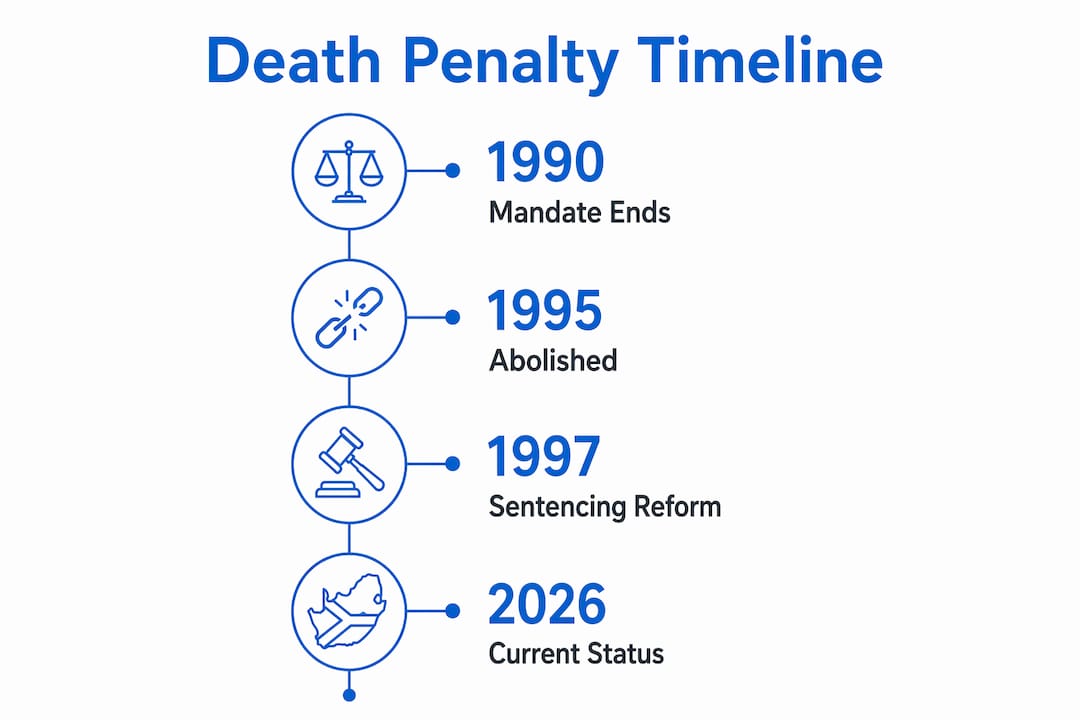
Under the 1997 Act, the Minister of Justice referred every confirmed death sentence to the original sentencing court. That court reviewed written arguments and trial evidence, then advised the President on an appropriate substitute sentence. The President was constitutionally bound to follow that advice. Crucially, the Act also allowed courts to antedate substituted prison terms to the date of the original sentence, so inmates received credit for time already served on death row.
Before 1990, courts were largely obligated to impose death for murder unless the accused proved extenuating circumstances. The 1990 Act shifted that to a discretionary framework requiring courts to weigh aggravating and mitigating factors and impose death only when no other sentence could properly serve the purposes of punishment.
Why public debate on reinstatement refuses to go away
Abolition settled the legal question. It did not settle the political one. South Africa’s violent crime rates have kept the debate alive for three decades, and the frustration is measurable. A 2014 poll found that a strong majority of South Africa’s millennial generation supported reintroducing the death penalty, a figure that reflects how persistently crime anxiety shapes public opinion.
Political parties across the spectrum periodically revive the reinstatement argument, usually after high-profile murders or when police corruption scandals erode confidence in the justice system. The two pressures feed each other: when citizens believe police and prosecutors are compromised, faith in any non-lethal punishment collapses. That intersection between capital punishment sentiment and corruption in law enforcement is precisely the terrain the Madlanga Commission now occupies.
A significant portion of South African millennials surveyed in 2014 supported reinstating the death penalty, illustrating how violent crime frustration continues to shape public attitudes more than two decades after abolition.
Pro Tip: When tracking shifts in public opinion on capital punishment, cross-reference polling data with the timing of major corruption revelations. The Madlanga Commission’s public hearing archive lets you map testimony dates against news cycles to see exactly how institutional failures drive reinstatement sentiment.
How the Madlanga Commission advances judicial transparency
The Madlanga Commission of Inquiry, chaired by Justice Mbuyiseli Madlanga, investigates criminal infiltration, political interference, and corruption inside South Africa’s police, prosecution, and intelligence services. Its mandate sits at the center of the same justice-system credibility crisis that fuels calls to bring back capital punishment.
What makes the Commission distinctive is the depth of its public record. Every hearing produces searchable case files, witness profiles, exhibits, official documents, rulings, and media briefings. Researchers do not need to attend proceedings live; the archive captures the full evidentiary record.
| Commission element | What it documents |
|---|---|
| Daily hearing records | Testimony, cross-examination, procedural rulings |
| Case files | Full evidentiary record per investigation |
| Witness profiles | Background and role of each witness |
| Exhibits and official documents | Primary source material supporting findings |
| Media briefings | Public-facing summaries of key developments |
One concrete example of the Commission’s scope: it publicly documents the R360 million SAPS Medicare24 tender scandal, including the related guilty plea. That level of granularity is what separates the Commission’s archive from a press release. For researchers connecting dots between systemic police corruption and broader justice reform debates, including the death penalty context, this is primary source material.
How to use the Madlanga Commission archive for research
The archive at madlangacommission.co.za is organized to support exactly the kind of cross-referencing that judicial research demands. Here is how to get the most out of it:
- Start with the case files index. The cases section groups investigations by subject matter, so you can identify which hearings are relevant to police corruption, prosecutorial failures, or intelligence interference before reading a single transcript.
- Use witness profiles to establish context. Each profile explains the witness’s role and institutional affiliation, which matters when you are trying to understand whether testimony reflects operational knowledge or political positioning.
- Cross-reference hearing dates with legislative history. If you are researching how post-abolition sentencing reforms interacted with police conduct, map hearing records against the 1997 Act’s implementation timeline.
- Check exhibits and official documents separately. Testimony summarizes; exhibits prove. For any claim about a specific corruption case, the documentary evidence in the exhibits section is the authoritative record.
- Track the methodology page for sourcing standards. The Commission explains how it verifies and documents evidence, which matters when you are citing its findings in academic or legal contexts.
How the death penalty was applied before 1995
South Africa’s history with capital punishment is long and racially marked. The gallows at Pretoria Central Prison were among the busiest in the world during the apartheid era. Hanging was the standard method, and the death sentence applied to murder, treason, robbery with aggravating circumstances, kidnapping, child-stealing, and rape under Section 277 of the Criminal Procedure Act 51 of 1977.

The application was demonstrably uneven, with racial and regional disparities shaping who received the sentence and who did not. The inconsistency extended to geography: because former homeland territories like Ciskei had their own legislation, a person convicted of murder in one part of the Eastern Cape could face death while someone convicted of the same crime in the adjacent former-Ciskei territory could not. The Makwanyane court cited this irrationality directly.
Before 1990, courts were effectively required to impose death for murder unless extenuating circumstances were proven by the defense. The 1990 Criminal Law Amendment Act shifted that burden, requiring the state to prove aggravating factors beyond reasonable doubt before death could be imposed.
Did abolition change South Africa’s crime rates?
The honest answer is: not in the way proponents of reinstatement hoped it would. South Africa’s homicide and violent crime rates remained high after 1995, and critics have pointed to that persistence as evidence that abolition removed a deterrent. The counterargument, supported by criminological research globally, is that the death penalty’s deterrent effect was never empirically established, and that South Africa’s crime drivers, including poverty, inequality, and institutional corruption, are structural rather than penal.
What abolition did change was the legal architecture. Courts shifted to a sentencing framework built around proportionality, rehabilitation, and minimum sentence legislation for serious offenses. The 1997 Act introduced mandatory minimum sentences for crimes that previously warranted death, creating a new floor for serious offenders without the irreversibility of execution.
Where does South Africa stand compared to the rest of Africa?
South Africa sits in a minority on the continent. As of 2026, most African states retain capital punishment in law, though many maintain de facto moratoriums. Countries including Rwanda and Mozambique have formally abolished it. Others, such as Nigeria and Tanzania, retain it and carry out executions.
South Africa’s 1995 abolition was among the earliest and most constitutionally grounded on the continent, driven by a post-apartheid rights framework rather than international pressure alone. That constitutional foundation makes reinstatement legally difficult: any future government seeking to restore the death penalty would need to amend the Bill of Rights, a process requiring a two-thirds majority in the National Assembly and approval by six of nine provincial legislatures.
What sentences replaced the death penalty?
Under the Criminal Law Amendment Act of 1997, crimes that previously carried the death sentence now attract mandatory minimum sentences. Life imprisonment is the standard replacement for the most serious offenses. For murder with aggravating circumstances, the minimum is life. For rape involving certain aggravating factors, the minimum is life. For robbery with aggravating circumstances resulting in serious injury or death, the minimum is 15 years for a first offender.
Courts retain discretion to depart from minimums when “substantial and compelling circumstances” exist, but that threshold is deliberately high. The framework reflects the Constitutional Court’s insistence in Makwanyane that punishment must be proportionate, correctable, and consistent with human dignity.
What constitutional rights drove the abolition decision?
The Makwanyane court built its ruling on three interlocking rights in Chapter Three of the interim Constitution. Section 9 guaranteed every person the right to life, with no qualification. Section 10 guaranteed the right to dignity. Section 11(2) prohibited cruel, inhuman, or degrading punishment.
The court’s reasoning was that the death penalty is irreversible and strips the condemned person of all remaining rights at the moment of execution. It treats the individual as an object to be eliminated rather than a person capable of reformation. That framing, dignity as a constitutional floor that punishment cannot breach, became the foundation of South Africa’s post-apartheid sentencing philosophy and continues to anchor arguments against reinstatement today.
Key Takeaways
South Africa’s Constitutional Court abolished the death sentence in 1995 in S v Makwanyane, finding capital punishment irreconcilable with constitutional rights to life, dignity, and freedom from cruel punishment.
| Point | Details |
|---|---|
| Abolition date and authority | The Constitutional Court ruled on June 6, 1995 in S v Makwanyane, ending capital punishment permanently. |
| Legislative mechanism | The Criminal Law Amendment Act 105 of 1997 substituted all outstanding death sentences with lawful prison terms. |
| Death row population at abolition | Between 300 and 400 people were on death row when Makwanyane was decided; all sentences required formal replacement. |
| Public opinion gap | A 2014 poll found strong support among South African millennials for reinstating the death penalty, reflecting persistent crime frustration. |
| Madlanga Commission relevance | The Commission’s public archive documents police and prosecutorial corruption, the systemic failures that drive reinstatement sentiment. |
FAQ
When was the death penalty abolished in South Africa?
Capital punishment was abolished on June 6, 1995, by the Constitutional Court in S v Makwanyane, which found it unconstitutional under the interim Constitution’s rights to life and dignity.
Does South Africa have the death penalty today?
No. South Africa has not carried out an execution since 1989, and the 1995 Makwanyane ruling made abolition constitutionally permanent. Reinstating it would require amending the Bill of Rights.
What replaced the death sentence for serious crimes?
The Criminal Law Amendment Act of 1997 introduced mandatory minimum sentences, including life imprisonment for murder with aggravating circumstances and for certain rape offenses.
What is the Madlanga Commission’s connection to capital punishment debates?
The Madlanga Commission investigates corruption in South Africa’s police, prosecution, and intelligence services. Institutional failures documented by the Commission directly fuel public frustration with the justice system, which in turn drives recurring calls to reinstate the death penalty.
How can researchers access Madlanga Commission hearing records?
The full public archive, including daily hearing records, case files, witness profiles, and exhibits, is available at madlangacommission.co.za/hearings, with recent sessions documented through 2026.