Definition of Corruption: What It Means for Society

Corruption is defined as the abuse of entrusted power for private gain. This definition, adopted by Transparency International and recognized across international governance frameworks, applies to politics, business, media, and education alike. The United Nations Convention against Corruption, known as UNCAC, reinforces this framing by criminalizing bribery, embezzlement, and money laundering rather than relying on a single catch-all definition. For activists, journalists, and citizens trying to hold power accountable, understanding what corruption actually means is the first step toward recognizing it, naming it, and fighting it.
What is the definition of corruption and its key elements?
Corruption, at its core, involves three distinct components: abuse, entrusted power, and private gain. Breaking each down reveals why the definition is both precise and broad enough to cover a wide range of misconduct.
Abuse means acting outside the boundaries of a role or responsibility. A police officer who accepts money to ignore a crime is abusing the authority granted by the state. A corporate manager who awards contracts to a family member is abusing the decision-making power granted by shareholders.

Entrusted power is the authority given to someone by an institution, organization, or the public. This includes formal authority, such as a government minister’s power to allocate public funds, and informal authority, such as a community leader’s influence over local decisions. Corruption violates norms of conduct and professional obligations, showing decision-making biased against the public interest rather than just illegal acts.
Private gain does not always mean money. It includes favors, political advantage, career advancement, or protection from legal consequences. Political scientist Stephen D. Morris defines corruption as the “illegitimate use of public power” to benefit a private interest, underscoring the deviation from the intended public good. That framing captures why corruption feels like a betrayal: someone given power to serve others uses it to serve themselves.
Pro Tip: When assessing whether an act qualifies as corruption, ask three questions: Was power entrusted? Was it abused? Who gained privately? If all three answers point to misconduct, the act fits the definition.
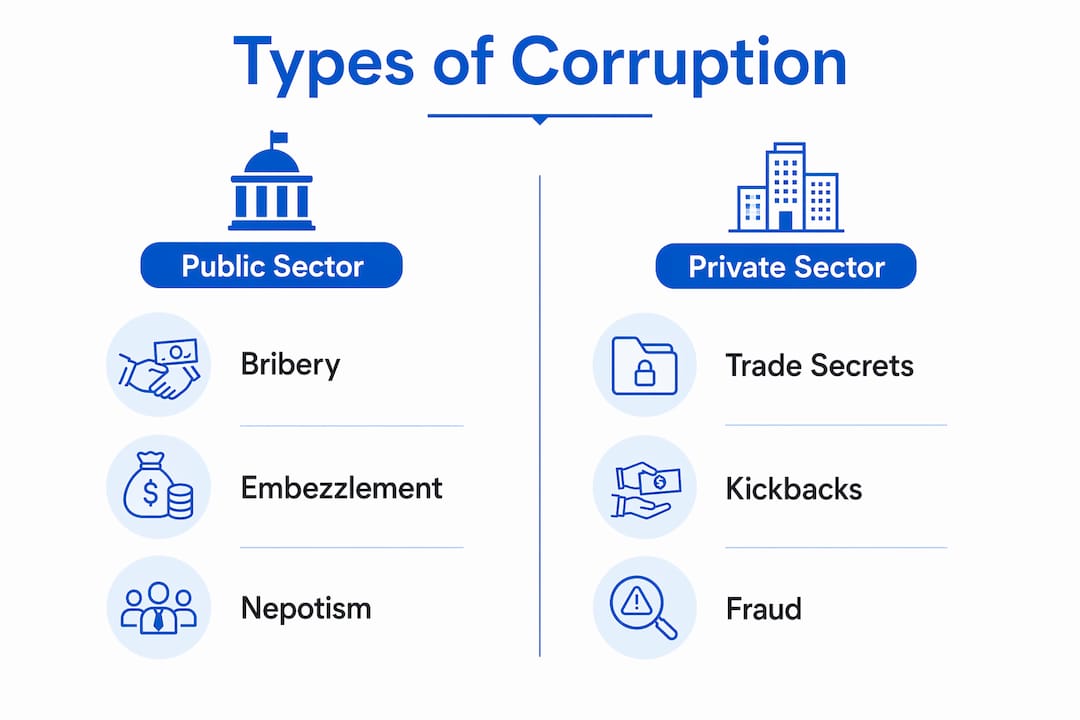
Corruption is not limited to government. Private sector corruption, such as employees selling trade secrets, fits the same definition of abusing entrusted power for private gain. This matters because anti-corruption conversations too often focus only on politicians and public officials, leaving corporate misconduct underexamined.
What are the main types and forms of corruption?
Corruption takes many forms. Recognizing each type makes it easier to spot in practice and harder for bad actors to disguise.
The most common types include:
- Bribery: Offering, giving, or receiving something of value to influence a decision. The most recognized form of corruption worldwide.
- Embezzlement: Stealing funds or assets entrusted to someone’s care. A treasurer who diverts public money into a personal account is embezzling.
- Nepotism: Favoring relatives in hiring, promotions, or contracts, regardless of merit.
- Cronyism: Favoring friends or political allies in the same way. The distinction from nepotism is the relationship type, not the harm caused.
- Influence peddling: Using personal connections or political access to secure favorable decisions for a third party, usually in exchange for payment or future favors.
- Legal corruption: Operating within the law while still distorting public interest. Legal corruption occurs within the confines of existing laws, representing a major hurdle for anti-corruption efforts because power holders often write their own legal protections.
| Type | Sector | Key characteristic |
|---|---|---|
| Bribery | Public and private | Direct exchange of value for a decision |
| Embezzlement | Public and private | Theft of entrusted assets |
| Nepotism | Public and private | Favoritism based on family ties |
| Cronyism | Primarily public | Favoritism based on political or social ties |
| Influence peddling | Public | Using access to secure decisions for others |
| Legal corruption | Public | Abuse within existing legal frameworks |
One underappreciated form involves future influence or obligations stored for later rather than direct immediate bribes. A politician who votes in favor of a corporation’s interests today, expecting a board seat after leaving office, is engaging in corruption. No money changes hands immediately, but the exchange is real. This delayed structure makes detection and enforcement significantly harder.
What causes corruption and how does it appear across sectors?
Corruption thrives where accountability is weak and transparency is absent. Three systemic conditions create the environment in which it grows.
- Lack of transparency: When decisions are made behind closed doors, there is no external check on whether power is being abused. Procurement processes without public disclosure are a classic example.
- Weak accountability: When officials face no real consequences for misconduct, the incentive to stay honest weakens. Oversight bodies that lack independence or enforcement power fail to deter abuse.
- Regulatory gaps: Laws that do not cover certain behaviors, or that are poorly enforced, create space for corruption to operate legally. This is the foundation of legal corruption.
In governance, corruption appears as abuse of office, falsification of public records, and manipulation of judicial processes. In business, it shows up as bid rigging, insider trading, and the theft of proprietary information. In civil society and media, it takes the form of paid editorial coverage, suppressed reporting, and captured advocacy organizations that serve donor interests over public ones.
Pro Tip: Journalists investigating corruption should map the decision-making chain before looking for the money. Corruption often hides in the gap between who has formal authority and who actually controls the outcome.
The causes are not purely structural. Individual incentives matter too. Low public sector salaries, cultural norms around gift-giving, and a perceived low risk of punishment all contribute to corrupt behavior at the individual level. Addressing corruption requires tackling both the system and the incentives within it.
What are the societal and governance impacts of corruption?
Corruption does not stay contained to the transaction where it occurs. Its effects spread outward, weakening institutions and eroding the conditions that make fair governance possible.
“Corruption is a serious impediment to the rule of law and sustainable development, eroding public confidence and the fairness of laws.” — United Nations
The United Nations’ framing is direct: corruption does not just cost money. It costs legitimacy. When citizens believe that courts are bought, that contracts are rigged, and that elections are manipulated, they stop trusting the institutions meant to protect them. That loss of trust is harder to rebuild than any financial loss.
| Impact area | Effect of corruption |
|---|---|
| Rule of law | Undermines equal application of laws and judicial independence |
| Democracy | Distorts elections, weakens representation, and silences dissent |
| Economic development | Diverts public funds, raises costs of doing business, deters investment |
| Public trust | Erodes confidence in government, courts, and public institutions |
| Institutional effectiveness | Destabilizes governance and weakens long-term policy outcomes |
The economic damage is concrete. Corruption raises the cost of doing business by adding unofficial fees and unpredictable risks. It diverts public funds away from schools, hospitals, and infrastructure. It deters foreign investment in countries where contract enforcement cannot be trusted. The communities that suffer most are those with the least political power to demand accountability.
How do international standards and organizations define and address corruption?
No single global legal definition of corruption exists. Instead, international frameworks criminalize specific corrupt acts while relying on broadly shared principles.
The key frameworks and bodies include:
- UNCAC (United Nations Convention against Corruption): Ratified by over 190 states as of 2025, UNCAC is the only legally binding universal anti-corruption treaty. It criminalizes bribery, embezzlement, trading in influence, and money laundering without imposing a single definition of corruption itself.
- Transparency International: The leading civil society organization tracking corruption globally. Its Advocacy and Legal Advice Centres have supported over 400,000 individuals reporting corruption worldwide, resulting in over 8,000 companies committing to stop corrupt practices.
- U4 Anti-Corruption Resource Centre: Focuses on the normative dimension of corruption, emphasizing that corruption breaches professional and ethical norms, not just legal ones.
The absence of a single binding definition is deliberate. Corruption manifests differently across legal systems, cultures, and sectors. A definition rigid enough to apply everywhere risks missing local forms of abuse. Global anti-corruption efforts benefit from clear principles but must adapt to diverse national manifestations and informal authority systems. National governments use UNCAC as a floor, then build definitions suited to their own legal contexts.
Key Takeaways
Corruption is the abuse of entrusted power for private gain, and its effects reach every sector of society, from governance and justice to economic development and public trust.
| Point | Details |
|---|---|
| Core definition | Corruption means abusing entrusted power for private gain, in both public and private sectors. |
| Types vary widely | Bribery, embezzlement, nepotism, cronyism, and legal corruption all fit the same core definition. |
| Systemic causes | Weak accountability, lack of transparency, and regulatory gaps create conditions for corruption to grow. |
| Societal damage | Corruption erodes rule of law, democratic institutions, economic development, and public trust. |
| International response | UNCAC and Transparency International set global standards without imposing a single rigid definition. |
The definition problem is also a detection problem
The hardest corruption to fight is the kind that looks legal. After years of following anti-corruption inquiries and reading testimony from officials, prosecutors, and whistleblowers, the pattern I keep seeing is this: the most damaging corruption rarely involves a bag of cash. It involves a board appointment, a regulatory decision quietly reversed, a contract awarded to the right firm after a dinner nobody reported.
The standard definition, abuse of entrusted power for private gain, is correct. But it is only useful if you can prove the abuse. Legal corruption, where power holders write laws that protect their own interests, sits just outside the reach of most enforcement frameworks. That gap is not an accident. It is the product of deliberate design by people who understand exactly where the legal boundaries are.
What activists and journalists need is not just a better definition. They need better tools for tracing the distance between a decision and its beneficiary. The witnesses who have testified at the Madlanga Commission show how that tracing works in practice: testimony by testimony, document by document, until the pattern becomes undeniable. Public awareness built on that kind of evidence is what actually changes systems.
The uncomfortable truth is that most citizens encounter corruption not as a dramatic scandal but as a slow erosion of fairness. The road that never gets fixed. The permit that requires a favor. The job that goes to the mayor’s nephew. Naming those experiences as corruption, using the precise definition, is itself a political act.
— Nkosi
How Madlangacommission documents corruption in real time
Madlangacommission provides a public record of the Madlanga Commission of Inquiry, a judicial investigation into criminal infiltration, political interference, and corruption within South Africa’s police, prosecution, and intelligence sectors.
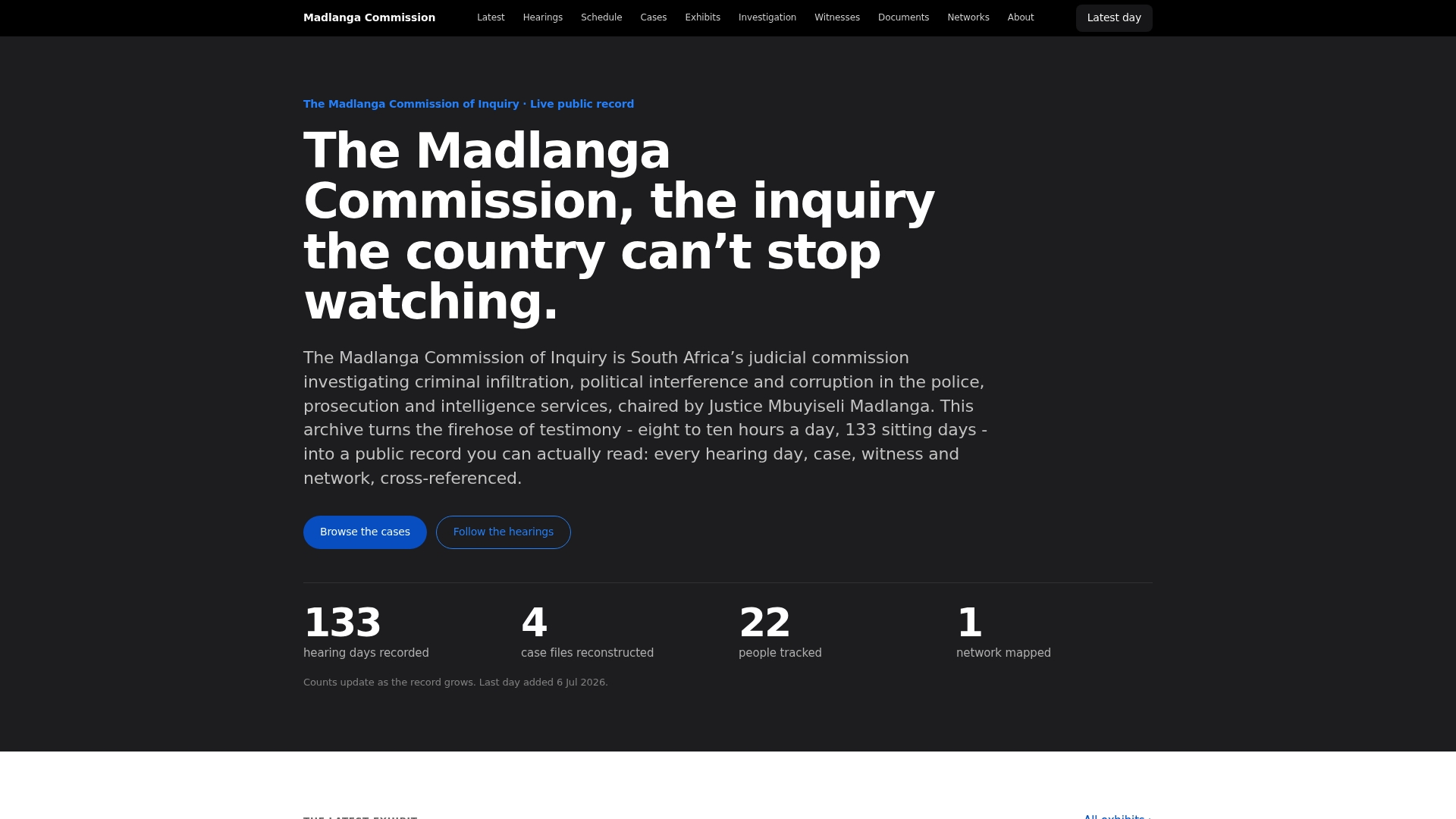
For citizens, journalists, and activists who want to see how corruption is investigated and documented at the highest level, the commission’s archive offers something rare: a structured, searchable record of testimony and evidence. The commission’s investigative methodology explains how evidence is sourced, verified, and presented. The full case files show corruption as it actually unfolds, not as an abstraction, but as a sequence of decisions, relationships, and consequences that can be traced and understood.
FAQ
What is the most widely accepted definition of corruption?
The most widely accepted definition is the “abuse of entrusted power for private gain,” adopted by Transparency International and recognized across international governance frameworks. It applies to public officials, private sector actors, and civil society alike.
Is corruption only a public sector problem?
Corruption occurs in both public and private sectors. Private sector examples include employees selling trade secrets or managers awarding contracts to family members, both of which fit the core definition of abusing entrusted power for personal benefit.
What is legal corruption?
Legal corruption occurs when power holders abuse their positions within the boundaries of existing law, often because they have written those laws to protect their own interests. It is harder to prosecute than outright bribery but equally damaging to public trust.
What is UNCAC and why does it matter?
UNCAC, the United Nations Convention against Corruption, is the only legally binding universal anti-corruption treaty. Ratified by over 190 states as of 2025, it criminalizes specific corrupt acts including bribery, embezzlement, and money laundering without imposing a single global definition.
How does corruption affect economic development?
Corruption diverts public funds, raises the cost of doing business through unofficial fees, and deters investment in countries where contract enforcement is unreliable. The United Nations identifies it as a serious impediment to sustainable development and the rule of law.