Document redaction rules: Madlanga Commission guide

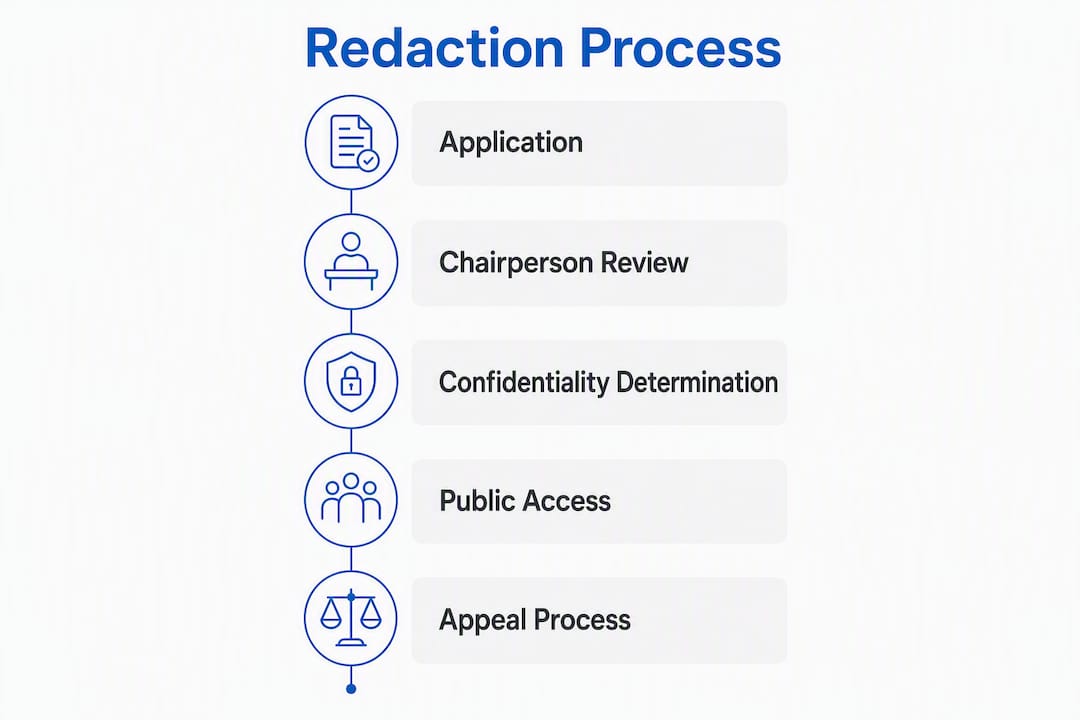
Under the Madlanga Commission’s document redaction rules, any document produced in response to a summons may be withheld or released only in redacted form if Justice Mbuyiseli Madlanga, as Chairperson, determines that portions are confidential under Regulation 10.4 or 10.6. The lawful grounds for redaction are specific: commercial sensitivity, personal information, national security or intelligence concerns, ongoing investigations, and legal professional privilege. Practically, this means a document may appear in the public record with passages blacked out, or may not appear at all. Affected parties are notified before the Commission refers any material publicly, giving them a narrow window to act.
- Confidential material is excluded from public records or released only in redacted form (Reg. 10.6).
- Grounds include commercial sensitivity, personal data, intelligence risk, active investigations, and legal privilege.
- The Chairperson is the sole decision-maker on every confidentiality claim.
- Notification to the claimant precedes any public reference, creating a brief window to respond.
Table of Contents
- Key takeaways for Madlanga Commission archive users
- Why the Chairperson alone decides, and what that means for transparency
- Access the Madlanga Commission archive for rulings and redacted documents
- Primary rules, statutes, and authoritative reading
- FAQ
Key takeaways for Madlanga Commission archive users
The Madlanga Commission’s redaction framework requires a written application under Regulation 10.4, and failing to file one generally waives the confidentiality claim entirely.
| Point | Details |
|---|---|
| Written application required | Reg. 10.4 demands a written application on affidavit identifying exact passages and stating grounds; no application usually means no protection. |
| Sole arbiter is the Chairperson | Justice Mbuyiseli Madlanga decides every confidentiality claim; decisions balance constitutional transparency against legitimate protection. |
| PAIA and POPIA intersect | PAIA access requests and POPIA data-protection duties can run alongside Commission rulings; know which process applies to your situation. |
| Use the notification window | The Commission notifies claimants before public reference; use that time to prepare redacted extracts or file a challenge. |
| Madlanga Commission archive | The public archive at madlangacommission.co.za holds hearing records, rulings, and redacted exhibits for researchers and journalists. |
Pro Tip: When handling redacted PDFs, use forensic redaction tools that permanently remove underlying text rather than visual overlays. A black box drawn over text in many PDF editors leaves the original data extractable. For legal teams, secure PDF redaction guidance covers the technical steps to avoid accidental disclosure.
Why the Chairperson alone decides, and what that means for transparency
Centralising confidentiality decisions in the Chairperson is a deliberate design choice, not an oversight. It produces consistent, legally defensible rulings rather than ad hoc outcomes that vary by document type or applicant. The Zondo Commission procedural alignment gives lawyers and journalists a predictable benchmark: strict written applications, detailed justifications, and a clear notification step before public reference.
For claimants, framing matters. An application citing “commercial sensitivity” without showing concrete harm is unlikely to succeed. Tie each ground to a specific consequence: POPIA obligations for personal data, active prosecution risk for intelligence material, or demonstrable financial damage for commercial information.
Civil-society pressure tells a different story. The Presidency confirmed that interim reports may stay confidential to protect ongoing investigations, while the Activists and Citizens Forum pushed for full disclosure without redactions. President Ramaphosa has stated that final reports will be made public, though timing may shift to protect persons at risk. Political statements affect publication timing; they do not change the legal standard for redaction.
Access the Madlanga Commission archive for rulings and redacted documents
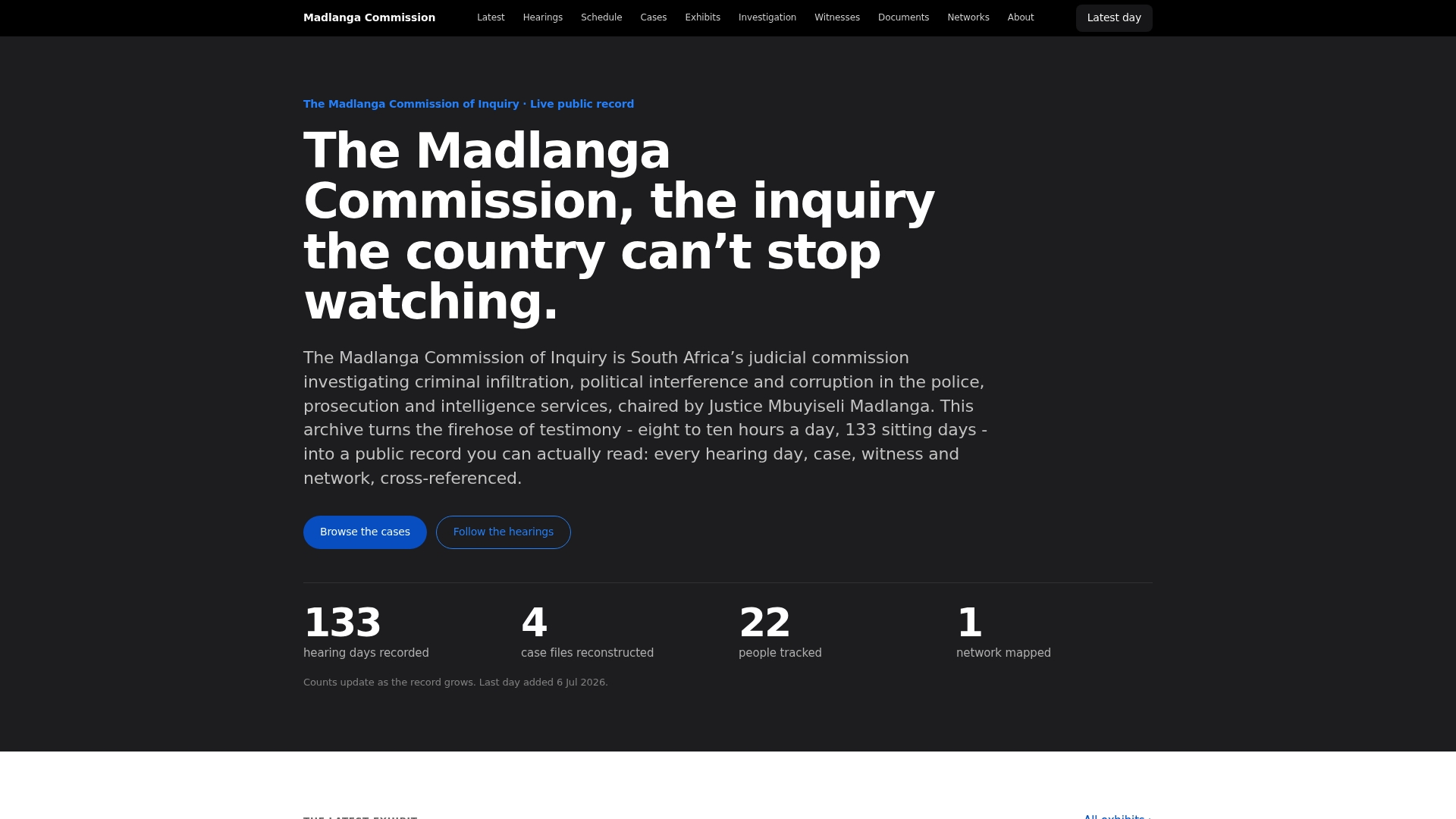
The Madlanga Commission public archive is the authoritative source for redacted material and Chairperson determinations. Hearing-day pages such as Day 123 and Day 124 publish transcripts and exhibits, including any redacted versions. Witness profiles often carry attached exhibits where redactions are visible in context. The methodology page explains how the archive processes materials and maintains version control. When citing an archived redacted document, note the hearing day, document reference, and the date of the Chairperson’s determination notice. Researchers reusing excerpts must still comply with POPIA handling requirements for any personal information that remains visible.
Primary rules, statutes, and authoritative reading
The sources below are ranked by authority. Primary sources (gazette, Commission PDFs) override press coverage or commentary.
- Gazetted Commission Rules (COI rules, 29 August 2025) — primary text of Regulations 10.1–10.8, including the written-application requirement and notification procedure.
- Commissions Act Rules PDF (gov.za) — statutory grounding for summons powers and redaction obligations.
- Inside Politic: Madlanga Commission regulations explained — secondary source summarising Reg. 10.4 and 10.6 in plain language.
- IOL: Presidency on interim report confidentiality — press coverage of civil-society pushback and executive position.
| Source type | Example | Use for |
|---|---|---|
| Primary (gazette) | COI Rules PDF, gov.za Commissions Act | Verifying exact regulatory text |
| Commission archive | madlangacommission.co.za hearing pages | Locating redacted exhibits and rulings |
| Press / commentary | IOL, Inside Politic | Context, timelines, political statements |
This article provides general information about Commission procedures, not legal advice. Verify current rules against the gazetted text or consult a qualified South African legal professional.
FAQ
What does Regulation 10.4 require from a document producer?
Regulation 10.4 requires a written application on affidavit that identifies the exact portions claimed as confidential and explains the grounds for non-disclosure. Failing to file this application generally waives the confidentiality claim.
Who decides whether a Madlanga Commission document is redacted?
Justice Mbuyiseli Madlanga, as Chairperson, is the sole arbiter of every confidentiality claim under the Commission’s rules.

How do PAIA and POPIA apply alongside Commission redaction rules?
PAIA governs public access requests for Commission-held records, while POPIA imposes data-protection duties on anyone processing personal information from those records. Both can apply simultaneously with Commission confidentiality rulings.
Where can I find redacted documents from the Madlanga Commission?
The Madlanga Commission archive publishes hearing transcripts, exhibits, and rulings, including redacted versions, on individual hearing-day and witness-profile pages.
Can a confidentiality ruling be challenged?
The notification the Commission sends before public reference is the practical window to prepare a challenge or protective application; the gazetted rules and the Commissions Act set out the procedural steps for doing so.