Equality Court: How Discrimination Cases Get Decided
TL;DR:
- Equality courts are specialized bodies that handle discrimination, hate speech, and harassment claims efficiently and with expertise. They provide a direct legal route for individuals to enforce their rights, emphasizing written documentation, timely filing, and procedural accuracy. Recent legal rulings across different jurisdictions continue to expand the scope and understanding of equality law, shaping future cases and defenses.
An equality court is a specialized judicial body that hears cases involving unfair discrimination, hate speech, and harassment. These courts exist to give citizens a direct legal path to enforce their rights without navigating the full complexity of general civil litigation. South Africa established its framework under the Promotion of Equality and Prevention of Unfair Discrimination Act 4 of 2000, commonly called PEPUDA, which created dedicated forums for equality legal cases at the magistrate court level. Similar rights protection courts operate across Finland, Australia, and the European Union, each with distinct procedural rules but a shared mandate: making anti-discrimination law enforceable in practice.
What is an equality court and what cases does it hear?
An equality court is defined by its subject matter jurisdiction. It hears claims rooted in unfair discrimination based on grounds such as race, gender, sex, disability, religion, and sexual orientation. Hate speech and harassment fall within its scope as well. General civil courts can technically address some of these claims, but equality courts are purpose-built for them, which means faster processing, specialized judicial expertise, and procedures calibrated to the specific evidentiary demands of discrimination cases.
The legal architecture behind these courts matters. PEPUDA in South Africa, the Equality Act 2010 in the United Kingdom, and the Sex Discrimination Act in Australia each define protected attributes and set the standard for what constitutes unlawful conduct. Courts apply these statutes to determine whether a respondent’s action was directly discriminatory, indirectly discriminatory, or defensible under a recognized exception. The distinction between direct and indirect discrimination is not academic. It determines the entire legal strategy on both sides of a case.
Equality courts also serve a systemic function. Each ruling contributes to a body of jurisprudence that shapes how future cases are decided. A finding against an employer for discriminatory hiring practices does not just compensate one applicant. It signals to every employer in that jurisdiction what conduct crosses the legal line.
How does the equality court process work?
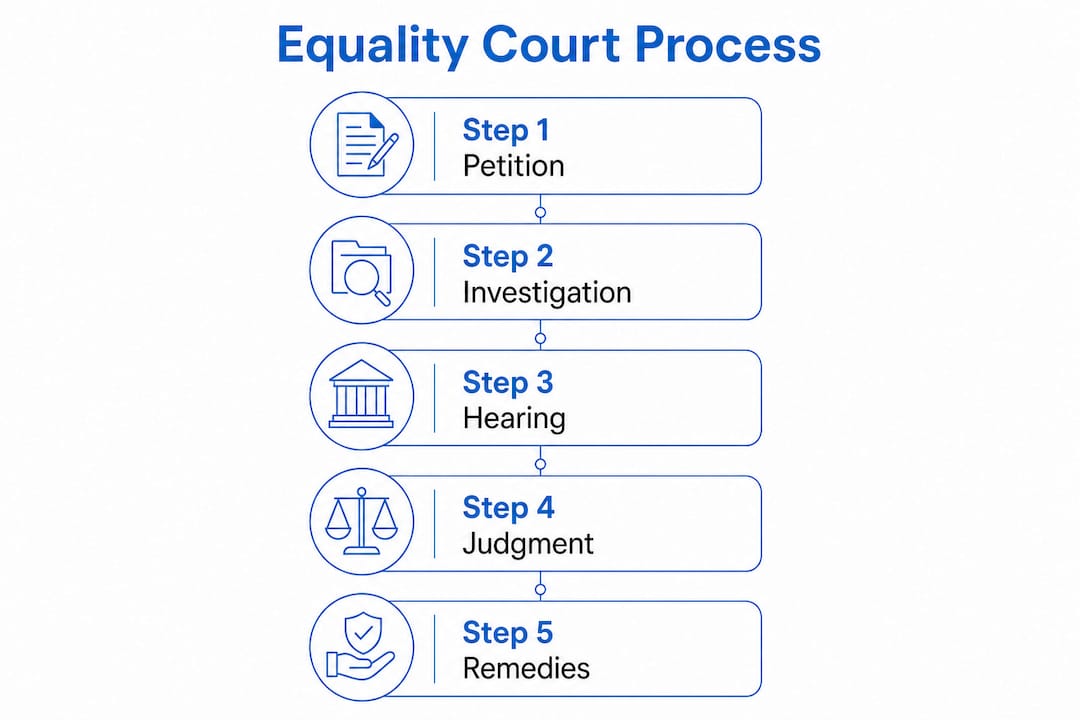
The procedural framework of an equality court or equivalent tribunal is designed to be accessible, but it is not informal. The process follows defined steps, and missing any one of them can end a case before it begins.
- Identify the correct forum. Not every discrimination claim belongs in an equality court. Some matters fall under labor tribunals, human rights commissions, or general civil courts. Filing in the wrong forum wastes time and may trigger jurisdictional dismissal.
- Prepare a written petition. The Finnish National Non-Discrimination and Equality Tribunal accepts petitions free of charge, and its process is entirely document-driven. Petitions must be in writing, clearly identifying the discriminatory act, the grounds invoked, and the remedy sought.
- Submit within the time limit. The Finnish tribunal rejects cases older than two years unless the petitioner documents a special reason for the delay. Most equality jurisdictions impose similar statutes of limitation. Missing the deadline is the single most common reason cases fail at the admissibility stage.
- Exchange documents and respond to clarification requests. Tribunals rely on thorough initial documentation. The Finnish tribunal requests clarifications to ensure sufficient investigation, and parties must respond promptly to keep the matter active.
- Await the written decision. Oral hearings are limited or nonexistent in many equality tribunals. The Finnish tribunal’s processing time averages around 12 months. Petitioners must plan for that timeline when deciding whether to pursue a claim.
Petition submission carries no filing fee in most equality forums. However, petitioners bear any costs from hiring legal representation. That distinction matters for individuals weighing whether to engage a lawyer or proceed independently.
Pro Tip: Document every incident with dates, names, and written records as soon as it occurs. Tribunals are document-driven, and a well-organized evidence file submitted at the outset is far more persuasive than a narrative reconstructed months later.

What do recent equality legal cases tell us about the law?
Recent rulings across multiple jurisdictions show that equality law is not static. Courts are actively redefining the boundaries of protected attributes, the limits of special measures defenses, and the meaning of substantive equality.
The most discussed ruling of 2026 came from the Australian Federal Court. The court upheld a landmark decision that excluding a transgender woman from a female-only app constituted unlawful gender identity discrimination under the Sex Discrimination Act. The applicant was awarded $20,000 in damages. That figure is significant not because it is large, but because the court reached it after rejecting the respondent’s special measures defense, signaling that well-intentioned exclusions can still constitute illegal discrimination.
The European Court of Justice delivered an equally consequential ruling in CJEU Case C-417/23. The court found that housing policies reducing family units in areas with over 50% immigrant populations amount to both direct and indirect discrimination based on ethnic origin, violating Article 21 of the EU Charter of Fundamental Rights. The ruling matters because it shows that facially neutral policies, ones that never mention ethnicity, can still constitute discrimination if their effect falls disproportionately on a protected group.
The UK Supreme Court added another layer of complexity in 2025. It clarified that “woman” for equality law purposes may exclude trans women who hold a Gender Recognition Certificate, directly affecting sex-based rights adjudications in single-sex spaces. The case involved access to Hampstead Heath swimming ponds and drew on the Equality Act 2010’s provisions on sex discrimination.
Courts are increasingly scrutinizing ‘special measures’ defenses, emphasizing that even well-intended measures creating direct disadvantage may constitute illegal discrimination. The 2026 Australian Federal Court ruling made clear that the burden of proving a special measure is lawful rests firmly with the party invoking it.
These cases collectively show that equality law is expanding in scope and precision. Legal advocates monitoring civil rights cases cannot treat prior interpretations as settled. Each ruling recalibrates what courts will accept as a defense and what they will not.
How does an equality court differ from other courts?
The practical differences between an equality court and a general civil court are significant enough to affect which forum a claimant should choose.
General civil courts handle a broad range of disputes. They apply standard rules of evidence, require formal pleadings, and typically involve higher costs. Equality courts and specialist tribunals narrow the focus to discrimination claims, which produces several concrete advantages. Judges or tribunal members have subject matter expertise. Procedures are calibrated to the specific evidentiary demands of discrimination cases. And in most jurisdictions, petition submission carries no filing fee.
The remedies available also differ. Equality courts can order apologies, policy changes, training programs, and damages. General civil courts focus primarily on financial compensation. That distinction matters when a claimant’s primary goal is to change an organization’s behavior rather than recover money.
The trade-off is jurisdiction. Equality courts cannot hear every grievance. A claim that mixes a discrimination element with a contract dispute may need to be split across forums, or the claimant may need to choose which aspect to pursue. Cases that fall outside the tribunal’s defined scope get rejected at the admissibility stage, which is why identifying the correct forum before filing is the first and most consequential decision a claimant makes.
Pro Tip: If your claim involves both a discrimination element and a separate contractual or employment dispute, consult a legal aid office or equality ombudsman before filing. Splitting a claim across two forums is possible but adds time and cost.
How to file an equality claim effectively
Filing a successful claim in a discrimination court requires preparation well before the submission date. The following steps apply across most equality jurisdictions.
- Confirm jurisdiction. Verify that your specific ground of discrimination (race, gender, disability, religion, and so on) falls within the tribunal’s statutory mandate. Some grounds are covered by labor law rather than equality law.
- Gather contemporaneous evidence. Written records, emails, witness statements, and photographs carry more weight than oral accounts reconstructed after the fact. Tribunals are document-driven by design, and the quality of your initial submission shapes the entire investigation.
- Act within the time limit. Most equality jurisdictions impose a two-year window from the date of the discriminatory act. Waiting erodes both your legal standing and the quality of available evidence.
- Seek assistance early. Equality ombudsman offices, legal aid clinics, and civil society advocacy groups can review your petition before submission. Many offer free consultations. Engaging them early reduces the risk of procedural errors that lead to rejection.
- Prepare for a written process. Oral hearings are rare in specialist equality tribunals. Your written petition is your primary opportunity to make your case. Invest time in clarity, structure, and completeness.
Legal advocates working with clients on evidence and procedural expectations should pay particular attention to the admissibility criteria in the relevant jurisdiction. A technically sound claim that misses a procedural requirement fails just as surely as a weak claim on the merits.
Key Takeaways
Equality courts are the most direct legal forum for enforcing anti-discrimination rights, but their effectiveness depends entirely on procedural preparation, timely filing, and jurisdiction-specific knowledge.
| Point | Details |
|---|---|
| Specialized jurisdiction | Equality courts hear discrimination, hate speech, and harassment claims, not general civil disputes. |
| No filing fees, but costs apply | Petition submission is free in most forums; legal representation costs fall on the petitioner. |
| Time limits are strict | Most jurisdictions reject claims older than two years without documented special reasons. |
| Document quality decides cases | Tribunals rely on written submissions; a thorough initial petition is the strongest tool a claimant has. |
| Recent rulings are reshaping the law | Cases from Australia, the EU, and the UK in 2025 and 2026 have redefined protected attributes and special measures defenses. |
Why equality courts still fall short of their promise
The gap between what equality courts are designed to do and what they actually deliver is wider than most legal commentary acknowledges. I have followed discrimination jurisprudence across multiple jurisdictions for years, and the pattern is consistent: the procedural framework is sound, but the practical barriers for ordinary claimants remain steep.
The document-driven nature of these tribunals is both their strength and their weakness. It keeps costs low and creates a clear evidentiary record. But it also disadvantages claimants who lack writing skills, legal literacy, or access to advocacy support. A well-resourced respondent can submit polished, comprehensive responses. An individual claimant without legal aid often cannot match that standard, and the written record reflects it.
The 12-month average processing time in forums like Finland’s tribunal is another underreported problem. For a person who has experienced workplace harassment or housing discrimination, a year of waiting while the matter is investigated is not a neutral experience. It affects employment, housing stability, and mental health. Courts that pride themselves on accessibility need to reckon with what that timeline costs the people using them.
What gives me genuine optimism is the trajectory of recent rulings. The 2026 Australian Federal Court decision and the CJEU’s housing discrimination ruling both show courts willing to look past surface-level neutrality and examine actual impact. That is the right analytical framework. Equality law that only catches explicit discrimination is equality law that misses most of what actually happens. The Madlanga Commission’s work on accountability within South Africa’s justice institutions reflects the same principle: formal structures matter less than whether they produce real accountability.
Public legal education is the missing piece. Most people who experience discrimination never file a claim. They do not know the forum exists, they do not know the time limit, or they assume the process is too complex. Closing that gap requires sustained investment in outreach, not just in the courts themselves.
— Meriol Lainchyon
Madlanga Commission: a public record for accountability
The Madlanga Commission of Inquiry offers one of the most detailed public records of how justice institutions operate, fail, and respond to scrutiny. For citizens and legal advocates tracking equality and rights enforcement, the Commission’s archive provides direct access to hearing transcripts, case files, and witness testimony that illuminate how accountability mechanisms work in practice.
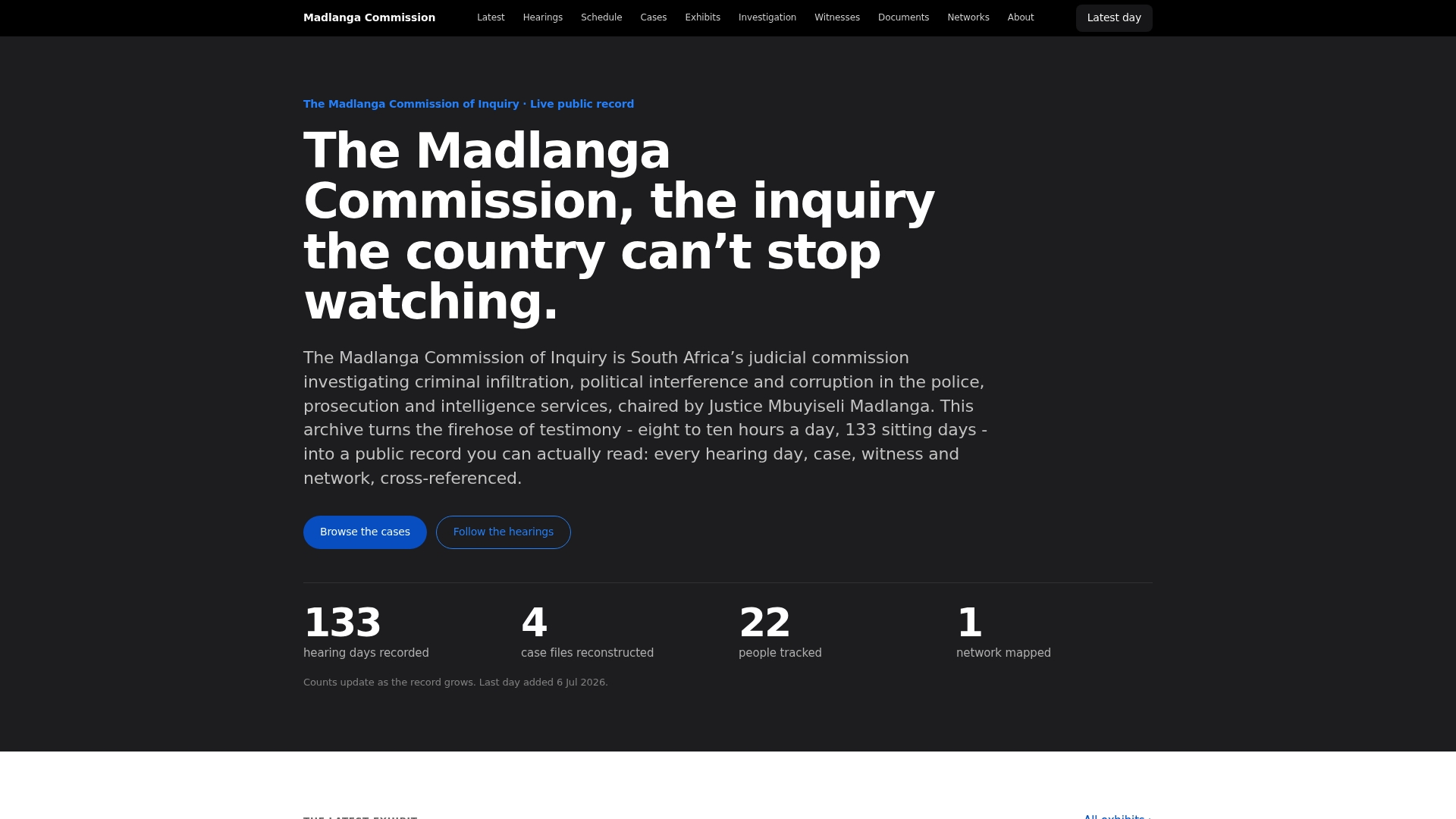
The Madlanga Commission archive covers hearings on criminal infiltration, political interference, and corruption within South Africa’s police, prosecution, and intelligence sectors. Its methodology and sourcing standards are publicly documented, making it a credible reference for anyone researching how judicial investigations handle evidence and procedural fairness. Advocates working on equality law cases will find the Commission’s approach to witness testimony and document management directly relevant to understanding what rigorous legal accountability looks like.
FAQ
What is an equality court?
An equality court is a specialized judicial body that hears cases involving unfair discrimination, hate speech, and harassment. In South Africa, these courts operate under the Promotion of Equality and Prevention of Unfair Discrimination Act 4 of 2000.
How do I file an equality claim?
Submit a written petition to the relevant equality court or tribunal, clearly identifying the discriminatory act, the legal ground invoked, and the remedy sought. Most forums require filing within two years of the incident.
Does filing an equality claim cost money?
Petition submission carries no filing fee in most equality forums, including the Finnish National Non-Discrimination and Equality Tribunal. Petitioners bear any costs from hiring legal representation independently.
What remedies can an equality court order?
Equality courts can order financial damages, formal apologies, policy changes, and mandatory training programs. The 2026 Australian Federal Court ruling awarded $20,000 in damages in a gender identity discrimination case.
How long does an equality court case take?
Processing times vary by jurisdiction. The Finnish National Non-Discrimination and Equality Tribunal averages around 12 months from petition submission to decision, with the process conducted almost entirely through written submissions.