Eugene de Kock: Apartheid’s “Prime Evil” Explained
TL;DR:
- Eugene de Kock was a South African Police commander convicted of ordering apartheid-era murders and kidnappings. His testimony revealed high-level government authorization of violence, contradicting the rogue officer narrative. His parole and social media activity continue to stir controversy and reflection on transitional justice in South Africa.
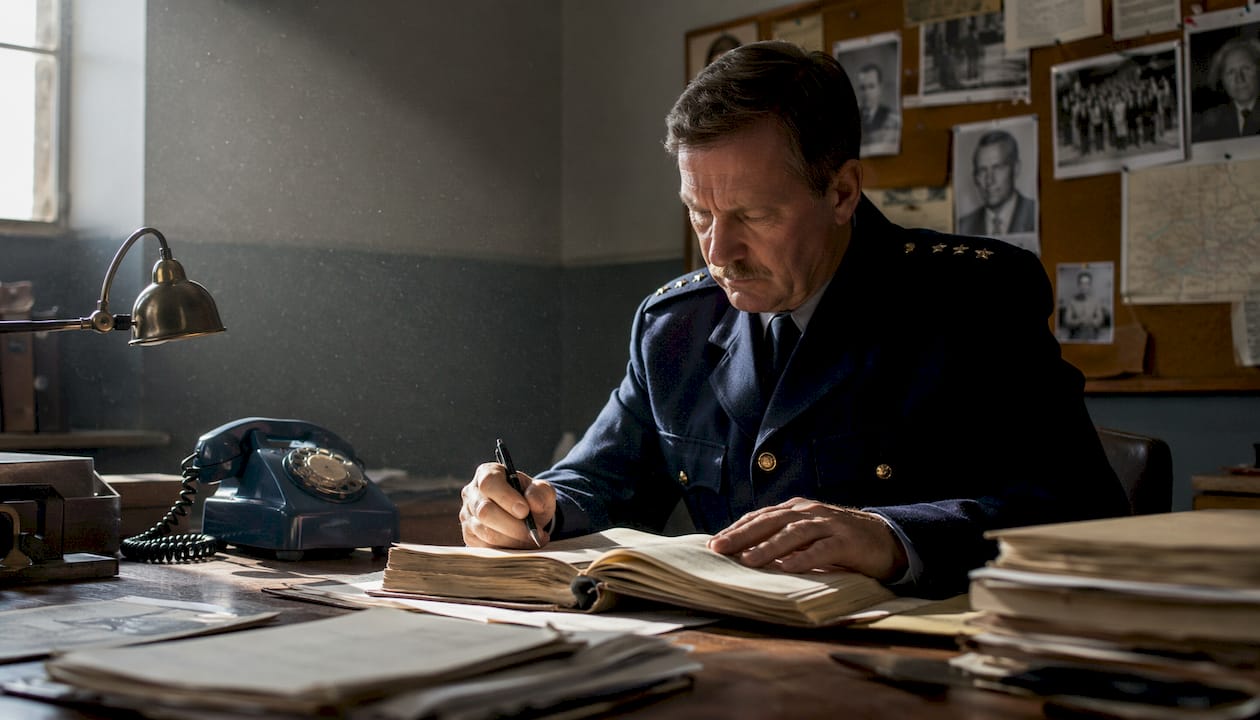
Eugene de Kock is defined as the former South African Police colonel who commanded the Vlakplaas death squad and became the most convicted perpetrator of apartheid-era state violence. Known by the nickname “Prime Evil,” he ordered and carried out murders, kidnappings, and torture against anti-apartheid activists throughout the 1980s and early 1990s. His 1996 trial, subsequent imprisonment, and ongoing public presence make him one of the most studied figures in South African history. For researchers tracking government accountability and police misconduct, his story cuts to the core of how state power authorizes atrocity.
What crimes was Eugene de Kock convicted of?
De Kock’s 1996 conviction stands as one of the most sweeping criminal judgments in South African legal history. A Pretoria court found him guilty of murder, attempted murder, kidnapping, fraud, and illegal weapons possession, among other charges. The scale of the verdict reflected the scale of the crimes.
The sentencing was equally extraordinary. Sentenced in 1996 to two life terms plus 212 years, De Kock served 20 years before receiving parole in 2015. That figure, two life sentences stacked on top of more than two centuries of additional time, signaled that the court viewed his crimes as categorically different from ordinary criminal conduct.
His specific acts included:
- Ordering and participating in the murder of anti-apartheid activists and informers
- Orchestrating the bombing of Khotso House, the headquarters of the South African Council of Churches
- Running cross-border assassination operations into neighboring countries
- Overseeing the torture and killing of suspected informers within his own unit
The parole decision in 2015 drew sharp criticism from victims’ families. The government justified it partly on the basis of his cooperation with accountability processes, including testimony before the Truth and Reconciliation Commission. His release did not signal rehabilitation so much as a calculated exchange: information for freedom.
How did De Kock’s testimony reveal the chain of command?
The most significant contribution De Kock made after his conviction was not remorse. It was evidence. His courtroom testimony and subsequent public statements dismantled the “rogue officer” defense that senior apartheid officials had relied on for years.
De Kock testified that orders came from the highest levels of the apartheid government, including former president P.W. Botha. He described formal approval processes for operations that would otherwise be classified as murder. The bombing of Khotso House, for example, was not a freelance act. It was authorized through official channels.
“De Kock’s diaries show orders from top officials; the chain of command was strict and documented. His testimony revealed systemic state-sanctioned murder with formal approval at multiple bureaucratic levels, directly undermining the rogue-actor narrative that protected senior officials for decades.”
This matters because it shifts moral and legal responsibility upward. De Kock was the instrument. The architects sat in cabinet offices. His testimony named a structure called the “Staff of Excellence,” an internal approval mechanism that routed lethal operations through bureaucratic sign-off. That detail alone transformed how historians and prosecutors understood apartheid violence.
Police also held photographs of approximately 6,000 activists marked as “terrorists” targeted for elimination. That list was not De Kock’s creation. It was institutional. He also presented handwritten hit lists of people he refused to kill, including prominent figures, which adds a layer of complexity to any flat reading of his role.
Pro Tip: When researching apartheid-era accountability, cross-reference De Kock’s testimony with the Truth and Reconciliation Commission’s published records. The two sources together reveal gaps that neither covers alone.
His testimony also clarified the distinction between his role and that of other security police members. De Kock was an operational commander, not a policy designer. Other officers followed similar orders but escaped prosecution because they lacked his visibility and paper trail.
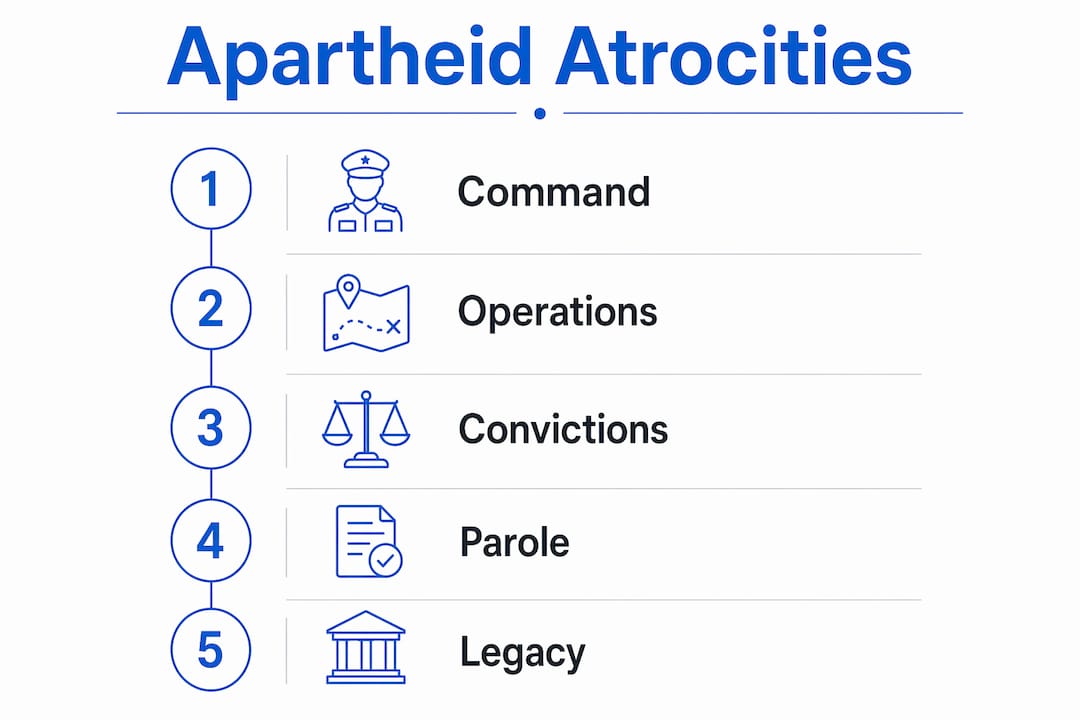
What controversies surround De Kock’s parole and public presence?
The decision to release De Kock on parole in 2015 was controversial from the start. The controversy has not faded. As of july 2026, he remains on parole with no reported violations, but his public social media activity has reopened wounds that many families believed were beginning to close.
His Facebook posts recount and, in some cases, defend his actions during the apartheid era. Victims’ families describe the posts as a form of ongoing harm. The legal system has no mechanism to silence him as long as he does not breach his parole conditions. That gap between legal compliance and ethical responsibility sits at the center of current debates about his public role.
The key points of ongoing controversy include:
- Victims’ families report psychological distress from his social media posts recounting apartheid-era killings
- The ANC-led government that authorized his parole faces criticism for underestimating the impact of his public presence
- His parole conditions do not restrict public commentary, leaving families without legal recourse
- Political analysts note the paradox of an ANC government releasing the man who killed ANC activists
The paradox of De Kock’s release by an ANC-led government reflects the broader tension in South Africa’s transitional justice model. The Truth and Reconciliation Commission prioritized disclosure over punishment. That trade-off produced information but not always closure.
What shaped De Kock’s path to becoming an apartheid assassin?
Understanding De Kock’s biography requires looking at the system that produced him, not just the man himself. He was born in 1949 and trained at the South African Police College, where anti-communist ideology was embedded into every aspect of officer formation. The Cold War framing of apartheid resistance as Soviet-backed terrorism gave officers like De Kock a moral framework for violence.
His early military service and psychological conditioning enabled him to compartmentalize killing as patriotic duty. He co-founded Koevoet, a counterinsurgency unit operating in Namibia known for extreme brutality, before taking command of Vlakplaas, the farm outside Pretoria that served as the base for South Africa’s most lethal security unit. Biographers emphasize that his indoctrination into violence challenges the simple “monster” narrative, pointing instead to a system that deliberately cultivated men capable of state-sanctioned murder.
His career progression followed a clear pattern:
- Police College training under anti-communist doctrine
- Deployment to Namibia with Koevoet counterinsurgency forces
- Command of Vlakplaas C1 unit, the apartheid state’s primary assassination squad
- Operational authorization of cross-border killings and domestic bombings
| Career stage | Unit | Primary function |
|---|---|---|
| Early career | South African Police College | Ideological and tactical training |
| Mid-career | Koevoet | Counterinsurgency, Namibia |
| Peak operational role | Vlakplaas C1 | Assassination and covert operations |
| Post-apartheid | Prisoner, then parolee | Witness and controversial public figure |
De Kock’s psychological profile reveals a soldier who justified extreme violence as a defense of order. That profile was not unique to him. It was the intended output of a security apparatus designed to produce exactly that kind of operator.
Key Takeaways
Eugene de Kock’s case proves that apartheid-era state violence was authorized at the highest levels of government, not carried out by rogue officers acting alone.
| Point | Details |
|---|---|
| Conviction and sentence | Sentenced in 1996 to two life terms plus 212 years; paroled after 20 years in 2015. |
| Chain of command | Testimony confirmed P.W. Botha and senior ministers authorized killings through formal approval processes. |
| Institutional scale | Police held photos of approximately 6,000 activists marked for elimination, showing systemic targeting. |
| Ongoing impact | His social media posts cause documented distress to victims’ families, despite full parole compliance. |
| Systemic origins | Koevoet and Vlakplaas were state-designed units, not rogue operations, shaped by anti-communist ideology. |
De Kock as witness and wound: a difficult legacy
I have spent years reading testimony from South Africa’s accountability processes, and the De Kock case remains the most difficult to categorize cleanly. He is simultaneously the most documented perpetrator of apartheid violence and one of its most valuable witnesses. That combination does not resolve into a tidy moral verdict.
What strikes me most is the paradox of perpetration and exposure that his role embodies. He committed atrocities that destroyed families. He also named the officials who ordered those atrocities, which no one else was willing to do on the record. South Africa’s transitional justice model needed both facts. It got them from the same man.
The “Judas goat” framing used by some analysts is apt. A Judas goat leads others to slaughter while appearing cooperative. De Kock led his own men into operations that destroyed them morally and legally, while the officials who gave the orders walked free. His current frailty, widely reported in 2026 coverage, adds another layer. The man who once commanded lethal operations now posts on Facebook from parole. Victims watching that unfold experience something that has no clean name.
The harder question for South African society is not whether De Kock deserves sympathy. It is whether the accountability process that used his testimony actually delivered justice, or whether it delivered information at the cost of justice. Those are not the same thing. Researchers tracking figures like De Kock through the key figures archive at Madlanga Commission will find that this tension runs through nearly every major apartheid-era case.
— Meriol Lainchyon
Madlanga Commission resources on apartheid accountability
Researchers who want to go beyond De Kock’s individual case will find that the Madlanga Commission of Inquiry offers one of the most structured public records of how apartheid-era misconduct connects to present-day failures in South Africa’s police, prosecution, and intelligence sectors.
The Commission, chaired by Justice Mbuyiseli Madlanga, transforms dense testimony and case files into navigable public records. Its apartheid accountability explainers cover figures, events, and institutional patterns that shaped the security apparatus De Kock operated within. For researchers who need to understand the methodology behind how testimony is evaluated and evidence is weighed, the Commission’s sourcing and corrections page sets out those standards clearly. This is where documented history meets current accountability work.
FAQ
Who is Eugene de Kock?
Eugene de Kock is a former South African Police colonel who commanded the Vlakplaas death squad during the apartheid era. He was convicted in 1996 of murder, kidnapping, and other crimes and earned the nickname “Prime Evil.”
What sentence did Eugene de Kock receive?
De Kock was sentenced to two life terms plus 212 years in prison in 1996. He served 20 years before being released on parole in 2015.
What did De Kock’s testimony reveal about apartheid crimes?
His testimony confirmed that killings and illegal operations were authorized by senior government officials, including former president P.W. Botha, through formal approval processes. This directly contradicted the “rogue officer” defense used by apartheid-era officials.
Is Eugene de Kock still alive in 2026?
As of july 2026, De Kock remains on parole with no reported violations. His public social media activity has drawn renewed attention and caused distress among victims’ families.
What was Vlakplaas?
Vlakplaas was a farm outside Pretoria that served as the operational base for South Africa’s C1 security unit, the apartheid state’s primary assassination squad. De Kock commanded the unit and directed cross-border killings and domestic bombings from that base.
Recommended
- Key Figures in the Madlanga Commission - Who’s Who
- Lieutenant Colonel Jakobus Prinsloo (retired) - Lieutenant Colonel (retired), KZN Hawks, Madlanga Commission
- The R200 million Durban port cocaine that vanished from police custody - Madlanga Commission
- Case Files of the Madlanga Commission of Inquiry - The Madlanga Commission Archive