Government Accountability in South Africa: How It Works and How to Track It

Government accountability in South Africa means that those who hold public power must explain and justify what they do, answer for mistakes and take steps to stop them recurring. The Constitution demands it, Parliament is meant to enforce it, and ordinary people can check it using audit reports, access-to-information requests and the public record of commissions of inquiry. This guide explains each layer and shows where to look.
TL;DR
- Accountability is a founding constitutional value in South Africa, alongside responsiveness and openness, and Parliament carries the main duty to oversee the executive.
- You can follow public money through Auditor-General reports, and request records from public bodies through a PAIA request.
- Commissions of inquiry add a public evidence trail, but testimony is not a finding: read allegations as allegations until a commission reports or a court rules.
- Our archive of the Madlanga Commission hearings lets you follow testimony, witnesses and exhibits without watching live proceedings.
Table of Contents
- What accountability means under the Constitution
- Who holds the executive and public service to account
- Why accountability fails: what recent evidence shows
- How to read inquiry evidence responsibly
- Laws and reforms that shape accountability
- How to track government accountability yourself
- What each public record is good for
- Our perspective
- Follow the Madlanga Commission record
- Making accountability work in your own community
- FAQ
- Sources
What accountability means under the Constitution
Section 1(d) of the 1996 Constitution commits South Africa to a multi-party system of democratic government that ensures accountability, responsiveness and openness. That is not decoration. It sits among the founding values, which means every other power in the state is read against it.
Legal scholar Hugh Corder, writing in The Conversation, describes accountability as having three parts: a person explains and justifies decisions or actions against set criteria, makes amends for errors, and takes steps to prevent the same errors happening again. The same article notes that nearly 40 provisions of the Constitution give Parliament the authority and obligation to oversee how public power is used and to hold the executive to account.
That three-part test is useful in practice. When a scandal breaks, ask three questions:
- Has anyone explained the decision in public, against a rule or standard?
- Has anyone been made to put right the harm, whether by repaying money, resigning, or facing disciplinary or criminal action?
- Has anything changed so it cannot happen again?
Many South African controversies get a partial answer to the first question and stall on the second and third. Knowing which step has stalled tells you where to apply pressure.
Who holds the executive and public service to account
Parliament and its committees
The Parliament of South Africa describes oversight as a constitutional function to monitor government action. It covers all organs of state, including those at provincial and local level. Parliament says oversight focuses on how laws are implemented, how budgets are applied, whether the law and Constitution are observed, and whether departments are managed effectively. Its stated purposes include detecting and preventing abuse, protecting citizens’ rights, holding government answerable for taxpayers’ money and making government operations more transparent.
Parliament and its committees can also summon people or institutions to give evidence or produce documents. For a citizen, that means committee meetings and their records are a primary source: ministers and directors-general answering questions on the record is accountability in its most visible form.
The Auditor-General
The Auditor-General of South Africa (AGSA) reports on how public money is managed. Its national and provincial PFMA reports are published for anyone to read. They show how governments manage public finances and how key service delivery departments spent their budgets and performed in the year under review. The page lists consolidated general reports for the years 2014-15 to 2019-20 and a citizen’s report for 2020-21, and newer reports are published on the same site.
If you read only one thing from an audit report, read what the Auditor-General says about the outcome for each department and whether the same problems recur year after year. Repetition is the clearest sign that point three of the accountability test (preventing recurrence) is failing.
Commissions of inquiry and the courts
When ordinary oversight is thought to be compromised, the President can appoint a judicial commission of inquiry. A commission can take evidence under oath, call witnesses and gather documents, then make findings and recommendations. It does not prosecute. Prosecution and discipline remain with the National Prosecuting Authority, employers and the courts. That division matters when you read the news, and we return to it below.
Why accountability fails: what recent evidence shows
Public service dysfunction is usually described in general terms. Inquiry evidence makes it concrete. The following are allegations and testimony reported by the media from the Madlanga Commission’s hearings, not findings of the commission.
The Mail & Guardian reported on 21 August 2026 that the commission heard evidence that NCC MP Fadiel Adams opened seven fraud and corruption cases against members of crime intelligence within four days in October 2024. It also reported that WhatsApp messages shown to the commission had businessman Brown Mogotsi telling alleged cartel leader Vusimuzi “Cat” Matlala that the police unit which raided his house would be dealt with. Police Minister Senzo Mchunu disbanded the Political Killings Task Team on 31 December 2024. The paper’s account describes allegations and testimony about political interference and criminality inside the police.
Business Day reported on 13 August 2026 that the commission heard from Ipid KwaZulu-Natal investigation deputy director Len John that task teams in some cases had become tools for drug dealers and gang members to kill rivals in turf wars. The same report described cash deposits made by a task team commander towards a property worth more than R2.5m, around the time of a killing linked to a tow truck company.
The pattern across both accounts is the one accountability systems are built to catch: a specialised unit with wide powers, a decision that benefits someone outside the state, and little visible explanation. These matters are being tested through the commission’s process, and the people named are entitled to respond. What the reports show is how an accountability gap looks from the inside.

How to read inquiry evidence responsibly
A commission’s hearings produce a large volume of material very quickly. Reading it well takes a few habits.
- Separate testimony from findings. A witness statement is evidence. A finding is the commission’s conclusion after weighing all evidence, usually in a report to the President.
- Look for corroboration. Messages, bank records, exhibits and other witnesses are what turn a claim into something a commission can rely on.
- Note who is responding. Implicated people usually have the opportunity to give their version. A fair reading includes it.
- Follow the recommendations. The test of accountability is what happens after the report: referrals, prosecutions, disciplinary steps and law reform.
- Check dates. Evidence given early in a commission can be qualified, corrected or contradicted later.
Journalists and researchers will recognise these as ordinary source discipline. For citizens following the news, they are the difference between informed scrutiny and rumour.
Laws and reforms that shape accountability
After the State Capture Commission, the President’s office has tracked what has been done with its recommendations. The Presidency’s progress report of July 2025 contains two items that bear directly on accountability.
Lifestyle audits
The report states that lifestyle audits were made mandatory in April 2021 for all national and provincial departments. By 2024, 138 departments had reported implementation to the Department of Public Service and Administration, and in 2024 seven national and 23 provincial departments referred cases for investigation. A lifestyle audit compares what an official has declared with how they live, so unexplained gaps can be investigated.

The records that support this kind of check, and the premises where officials work and store them, need protecting too. A guide to security for government buildings covers the physical side of that protection, from access control to risk assessments.
The cooling-off period
The same report says the Public Administration Management Amendment Bill was passed by the National Assembly in February 2024 and was then with the National Council of Provinces. It introduces a 12-month cooling-off period for employees involved in procurement decisions, barring them from working with related service providers immediately after leaving. The aim is to close the revolving door between buying decisions and the suppliers who benefit from them. Check Parliament’s bill tracker for its current status.
South Africa’s public service reform has also been in the news through the Public Service Amendment Act of 2025, which commentators have described as a major structural reform. Read the Act and the Public Service Commission’s guidance directly for the detail rather than relying on summaries.
How to track government accountability yourself
You do not need to be a lawyer or a journalist. Here is a practical order of work.
Step 1: Start with the money
Open the latest AGSA report for the department or municipality you care about. Look at the audit outcome, irregular expenditure and any repeated findings. Then compare with the department’s annual report to Parliament.
Step 2: Check the plan against delivery
For municipalities, the Service Delivery and Budget Implementation Plan is the key document. The City of Johannesburg’s PAIA manual explains that the Municipal Finance Management Act defines the SDBIP as a detailed plan for implementing municipal services and the annual budget, linking each service delivery output to the budget. If a ward has no refuse collection or road repairs, the SDBIP tells you what was promised and how much was set aside.
Step 3: Ask for records you cannot find
The Promotion of Access to Information Act (PAIA) lets you request records from public bodies. According to the Information Regulator, you submit the prescribed Form 2 to the information officer of a public body, and each body must make its PAIA manual publicly available, with contact details. The Regulator also says a body may refuse a request depending on the nature of the records, but must give reasons based only on the grounds PAIA allows. The Johannesburg manual notes that its Deputy Information Officer has 30 days to process and respond to a request.
A good request is narrow and specific: name the document, the period and the office that likely holds it. Keep proof of submission, and if you are refused, use the internal appeal route set out in the Regulator’s guidance.
Step 4: Follow committees and commissions
Parliamentary committee meetings and commission hearings put officials on the record. Follow the committee that oversees the department in question, and, where a commission is sitting, use a structured record of its evidence so you can see who said what, when, and which exhibits support it.
Step 5: Watch for follow-through
Accountability ends with consequences. Track whether referrals to the NPA, disciplinary processes and recommended reforms actually happen. Keep a simple log with the date, the decision and the source.
What each public record is good for
| Source | Best for | Limit to keep in mind |
|---|---|---|
| Auditor-General reports | How public money was managed and repeated failings | Reports look back at a completed financial year |
| Parliamentary committees | Hearing officials answer questions on the record | Depends on members pressing the questions |
| PAIA requests | Specific documents that are not published | Can be refused on lawful grounds, takes time |
| Commissions of inquiry | Sworn evidence, exhibits and cross-examination | Testimony is not a finding until the commission reports |
| Court judgments | Binding determinations of legal responsibility | Slow, and limited to the legal question before the court |
No single source is enough. The strongest scrutiny cross-checks two or three of them.
Our perspective
Transparency is only useful when people can actually use it. A commission can sit for hundreds of hours, and the public rarely has time to watch them all. The result is that the loudest clip wins, and the careful detail is lost.
That is why we built the Madlanga Commission archive around structure rather than volume. We link daily hearing records, witness profiles, exhibits, rulings, statements and media briefings, so a reader can move from a claim to the witness who made it and the document that supports it. Our approach is designed to let a citizen follow developments without following the live proceedings.
We think this matters for accountability in three ways. It lets journalists and researchers check a claim against the record quickly. It lets legal professionals compare evidence across hearings. And it gives citizens the same starting point as the experts, which is the foundation of informed public pressure.
Accountability is not one dramatic moment. It is a long chain of explanation, correction and reform, and each link needs a public record. We see our archive as one such record, kept clear enough to be used.
Meriol Lainchyon
Follow the Madlanga Commission record
The Madlanga Commission is examining alleged criminal infiltration, political interference and corruption in South Africa’s police, prosecution and intelligence sectors, under the chairmanship of Justice Mbuyiseli Madlanga. Our free, searchable archive brings together daily hearing records, case files, witness profiles, exhibits, official documents, rulings, statements and media briefings, cross-referenced so you can follow a case from claim to evidence.
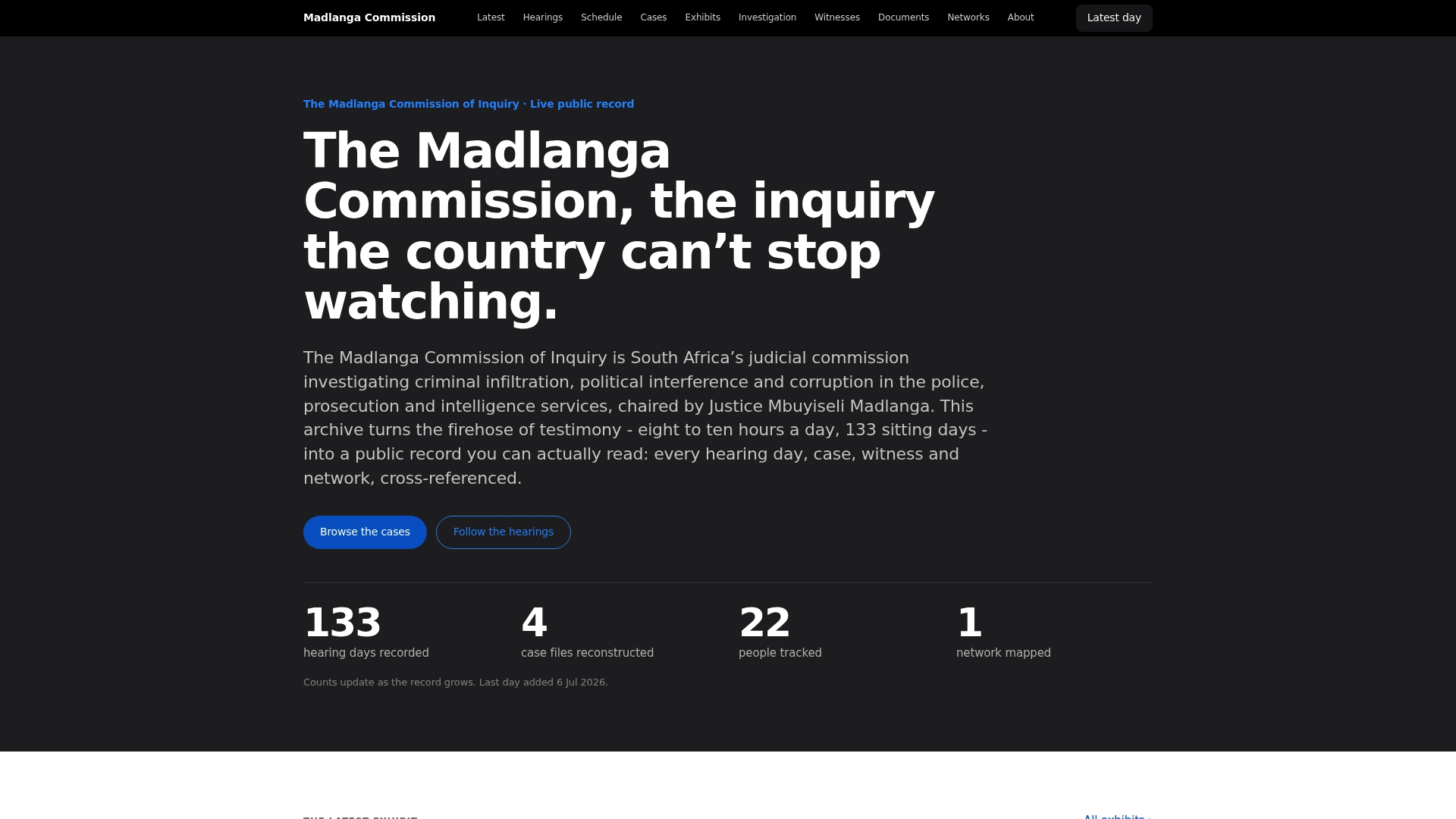
Browse the full record at the Madlanga Commission archive and follow developments at your own pace.
Making accountability work in your own community
National inquiries draw attention, but accountability is often won locally. A ward committee asking for the SDBIP, a community group tracking a clinic’s budget, or a journalist filing a PAIA request on a tender can all produce results. The methods in this guide scale down to a single school or a single road.
Three habits help most:
- Be specific. A named document and a named office get answers. A general complaint rarely does.
- Keep records. Dates, reference numbers and copies of what you sent are your protection and your evidence.
- Share what you find. Findings that stay in one inbox change nothing. Take them to a ward councillor, a portfolio committee, a journalist or a civil society organisation.
The Constitution’s promise of accountability, responsiveness and openness is only as strong as the number of people willing to use the tools it creates.
FAQ
What does accountability in government mean in South Africa?
It means public officials must explain and justify their decisions, make amends for errors and act to prevent repetition. It is a founding value in section 1(d) of the Constitution, and Parliament has the main duty to oversee the executive.
How can I track government accountability as an ordinary citizen?
Start with Auditor-General reports for money, then check committee records and, for municipalities, the SDBIP. If a record is not published, submit a PAIA request using Form 2 to the body’s information officer.
What is the difference between testimony at a commission and a finding?
Testimony is evidence given by a witness, which may be challenged or corroborated. A finding is the commission’s conclusion after weighing everything, normally set out in its report. Prosecutions and discipline happen separately, through the NPA, employers and the courts.
How does transparency help expose corruption?
Published audits, budgets, procurement records and hearing evidence let outsiders compare what was promised, what was spent and what was delivered. Gaps between those three are where corruption is usually found. Records are most useful when they are searchable and cross-referenced.
Can I follow the Madlanga Commission without watching the hearings?
Yes. Our archive provides daily hearing records, witness profiles, exhibits and rulings in one searchable place, so you can follow developments without watching live proceedings.
Sources
- South Africa’s new parliament needs to do a better job of holding cabinet to account, The Conversation
- Oversight, Parliament of South Africa
- National and Provincial Government reports (PFMA), AGSA
- How the commission nailed Adams, Mail & Guardian
- Police task team suspected in R2.5m KZN tow truck hit, Business Day
- Progress report on implementation of actions in the President’s response to the State Capture Commission recommendations, The Presidency
- City of Johannesburg PAIA Manual, March 2026
- PAIA, Information Regulator
- Security for government buildings: a decision-maker’s guide