Five Step Check to Confirm Madlanga Recommendations in South Africa

You know recommendations are being implemented when three things line up: the Presidency formally accepts or notes them, the SAPS special investigations task team opens a matching case with a docket number, and that case produces a visible outcome, such as a suspension, a charge sheet, or an official progress report citing the same referral. Anything short of that is a signal worth watching, not proof. This guide shows you where those signals appear and how to verify them before you report or act on them.
TL;DR:
- Verifying implementation requires linking specific referrals to documented outcomes like court charges, suspensions, or official progress reports.
- Presidential acceptance or noting of reports signals intent, but only directives to law enforcement agencies activate operational processes.
- A reliable tracker should include detailed fields such as referral text, case references, statuses, and evidence sources, updated regularly on a fixed schedule.
- A task-team arrest confirms progress only if it matches a specific Commission referral; otherwise, it may relate to unrelated misconduct cases.
- Official records from the Presidency, court files, and SAPS or IPID communications provide the most concrete evidence for tracking progress.
Table of Contents
- How do you verify a claim that a recommendation has been implemented?
- How should you read official language about implementation?
- What should a tracker for commission recommendations look like?
- How should you publish and share tracker findings responsibly?
- What has the President actually accepted or directed so far?
- What is the SAPS special investigations task team’s role?
- Who has been referred for investigation so far?
- How do referrals become investigations, charges or discipline?
- How long does implementing commission recommendations usually take?
- What commonly derails implementation, and how do you work around it?
- Who is responsible for what in the implementation process?
- What legal steps turn a recommendation into policy or prosecution?
- How do you know if implementation actually worked?
- What does success and failure actually look like here?
- Why the archive matters for anyone doing this work
- Where to start tracking on the Madlanga Commission archive
- Sources
- FAQ
How do you verify a claim that a recommendation has been implemented?
Verification means matching a named referral to a specific, checkable outcome. It’s a five-step process, and skipping any step is how false claims of progress end up in print.
- Pull the primary text. Read the exact wording in the Commission report or Presidency statement, and note the paragraph or clause number so you can quote it precisely later.
- Search for a matching SAPS case reference. A task-team case number or docket tied to the same name or allegation is the first real sign of movement, not just intent.
- Check court records for formal charges. An indictment or charge sheet naming the same individual confirms the matter has reached prosecution, which is a materially different stage from “under investigation.”
- Confirm disciplinary action independently. A suspension or disciplinary notice usually comes through departmental HR or an official SAPS statement, not through the Commission itself.
- Log the verification metadata. Record the date you checked, the document ID, and the name of any spokesperson quoted, so another researcher can retrace your steps.
The special investigations task team does investigate evidence from the Commission, but it also handles other cases of serious misconduct. An arrest by that team is not automatic proof that a specific referral has been acted on.
Pro Tip: Keep a single spreadsheet row per named referral, and only mark it “confirmed” when you can link to a court document or official notice, not just a news report repeating the allegation.
How should you read official language about implementation?
Government and Commission language rewards close reading. The gap between “noted” and “actioned” is where most misreporting happens.
Presidency wording matters more than it looks. “Accepts” and “directs” signal intent to act; “noted” is weaker and doesn’t guarantee movement on its own. Ramaphosa’s acceptance of the first interim report came paired with a direct instruction to the Minister of Police and the SAPS National Commissioner to form a task team, which is what turned acceptance into a mobilized process.
A task-team arrest doesn’t automatically confirm a specific referral was implemented; it may relate to a different case entirely. Interim reports are also iterative. The Commission’s second interim report confirmed some referrals from the first report while adding new ones, which means today’s referral list may not match tomorrow’s.
Watch for phrases that should trigger deeper checking before you repeat them as fact:
- “Incorporated into the task team’s work” (direction, not outcome)
- “Under investigation” (no timeline or docket implied)
- “Recommended for disciplinary action” (recommendation, not a completed process)
- “Welcomed” or “noted” (acknowledgment, not commitment to a specific step)
What should a tracker for commission recommendations look like?
A usable tracker is built around one row per named referral, updated on a fixed schedule rather than whenever something dramatic happens in the news.
Each row needs specific fields to be useful months from now: the exact recommendation text, a reference ID, the named person or persons involved, the source document and its URL, the date of referral, any SAPS case or docket number, current disciplinary or prosecution status, the date you last verified it, who verified it, and a link to the supporting evidence.
Use a simple four-part status taxonomy so entries are comparable over time: confirmed (documented outcome exists), in progress (case open, no outcome yet), no action (no visible movement since referral), and superseded (revised or replaced by a later report). This mirrors the approach used in the Presidency’s own State Capture Commission progress reporting, which used clear categories and a public annexure rather than vague progress narratives.
Statistic Callout: The State Capture Commission’s own progress-reporting model, built on itemized actions and named status categories, offers the closest South African precedent for how a Madlanga tracker should be structured and published.
- Update the tracker on a fixed cadence, weekly or biweekly, not only after headline events
- Keep a change log so you can show when a status shifted and why
- File a Promotion of Access to Information Act request when a document isn’t public
- Contact official spokespeople directly for confirmation before publishing a status change
How should you publish and share tracker findings responsibly?
Publish only what your sources actually support, and always show your evidence rather than asking readers to trust your summary.
Cite the primary source and link the exact document or statement behind every claim. Define what “implemented” means in your own tracker, and reserve that word for entries with a documented outcome. Rolling tracker pages, short weekly updates, and simple status tables work better than long narrative reports, because readers can scan them for what changed.
- Never call something “implemented” without a case number, charge sheet, or official notice behind it
- Publish a correction log alongside the tracker itself
- Redact personal contact details of witnesses even when their testimony is public
- Flag every entry that relies on a single source until it’s corroborated
Pro Tip: Publish your tracker’s status definitions once, at the top of the page, so readers don’t have to guess what “confirmed” or “in progress” means each time you update it.
What has the President actually accepted or directed so far?
President Ramaphosa’s response to the Commission has moved in two distinct steps. First came acceptance of the initial interim report, where he welcomed the findings and directed the Minister of Police and the SAPS National Commissioner to set up a dedicated investigative structure targeting the individuals the Commission had named.
The second step, formal noting of the second interim report, went further by explicitly directing that its recommendations and referrals be folded into the ongoing work of that same task team rather than treated as a fresh, separate process.
That distinction matters for anyone tracking implementation. Acceptance of a report is a political and administrative signal. Direction to a specific agency, with a specific instruction, is what actually starts an operational process. Expect a lag between the announcement and any visible court or HR outcome, since a directive doesn’t produce a case number overnight. Track the announcement date and the date of the first concrete indicator, whether that’s a case reference or a suspension notice, as two separate data points rather than one event.
What is the SAPS special investigations task team’s role?
The task team exists to give the Commission’s referrals somewhere to go once the hearings move from testimony to law enforcement action. It was constituted on the President’s direction, and its mandate covers both the individuals named in Commission evidence and other cases of serious misconduct that surface during its work.
That dual mandate is important for anyone reporting on it. A task-team arrest or operation can be newsworthy without being the direct implementation of a specific named referral from a Commission report. The two things often get conflated in headlines.
To confirm a task-team action actually maps to a Commission referral, match names, not just headlines. If the person arrested or charged matches a name in an interim report, and the allegation matches the recommendation, that’s a real link. If the connection is only that both involve police misconduct broadly, treat it as related context rather than confirmed implementation. This is exactly the kind of gap a disciplined tracker is built to catch.
Who has been referred for investigation so far?
The Commission’s second interim report is the current authoritative list, and it both confirmed earlier referrals and added new names. Officials referred for investigation or disciplinary action include Lieutenant General Shadrack Sibiya, Sergeant Fannie Nkosi, and Brown Mogotsi, among others named across the two reports.
Each of these referrals carries a specific recommended action, whether that’s criminal investigation, disciplinary proceedings, or both, and the exact wording differs by individual. That’s why a tracker needs to record the recommendation text itself, not just the name, since two people referred in the same report can face very different processes.
Treat this list as version-controlled. The second report already changed some details from the first, and nothing rules out a third report adjusting it again. When you write about “officials referred by the Commission,” specify which report and which date you’re citing, and check whether a more recent report has confirmed, modified, or added to that referral before you publish. Names without dates invite exactly the kind of confusion this whole monitoring exercise is meant to prevent.
How do referrals become investigations, charges or discipline?
A referral is a recommendation, not a legal action. It has to travel through separate institutional channels before it becomes anything enforceable, and each channel moves at its own pace.
For criminal matters, the referral typically feeds into the SAPS task team’s caseload, which then requires evidence gathering, a docket, and eventually a decision by prosecutors on whether to proceed. For disciplinary matters, the same referral may trigger an internal SAPS or IPID process governed by employment and disciplinary regulations rather than criminal procedure, running on an entirely different timeline.
This is why one referral can produce two parallel outcomes. An official facing both criminal referral and disciplinary referral may be suspended from duty well before any criminal charge is filed, or vice versa. Trackers need separate status fields for prosecution and discipline for exactly this reason, since collapsing them into one “status” column hides real information.
The practical takeaway for anyone verifying progress: a suspension notice confirms disciplinary movement, and a charge sheet confirms prosecutorial movement, but neither confirms the other. Check both independently before describing a referral as “acted on.”
How long does implementing commission recommendations usually take?
Set your expectations around months, not weeks. Formal acceptance or noting by the Presidency can happen within days of a report’s release, but the operational steps that follow, docket creation, investigation, prosecutorial decision-making, disciplinary hearings, unfold over a much longer horizon.
Expect roughly four phases: acceptance and direction (fast, often days), task-team assignment and case opening (weeks), active investigation and evidence gathering (months, often the longest phase), and formal outcome, whether charges, suspension, or closure without action (variable, sometimes over a year). A Presidency statement referencing incorporation into the task team’s work marks the start of phase two, not the finish line.
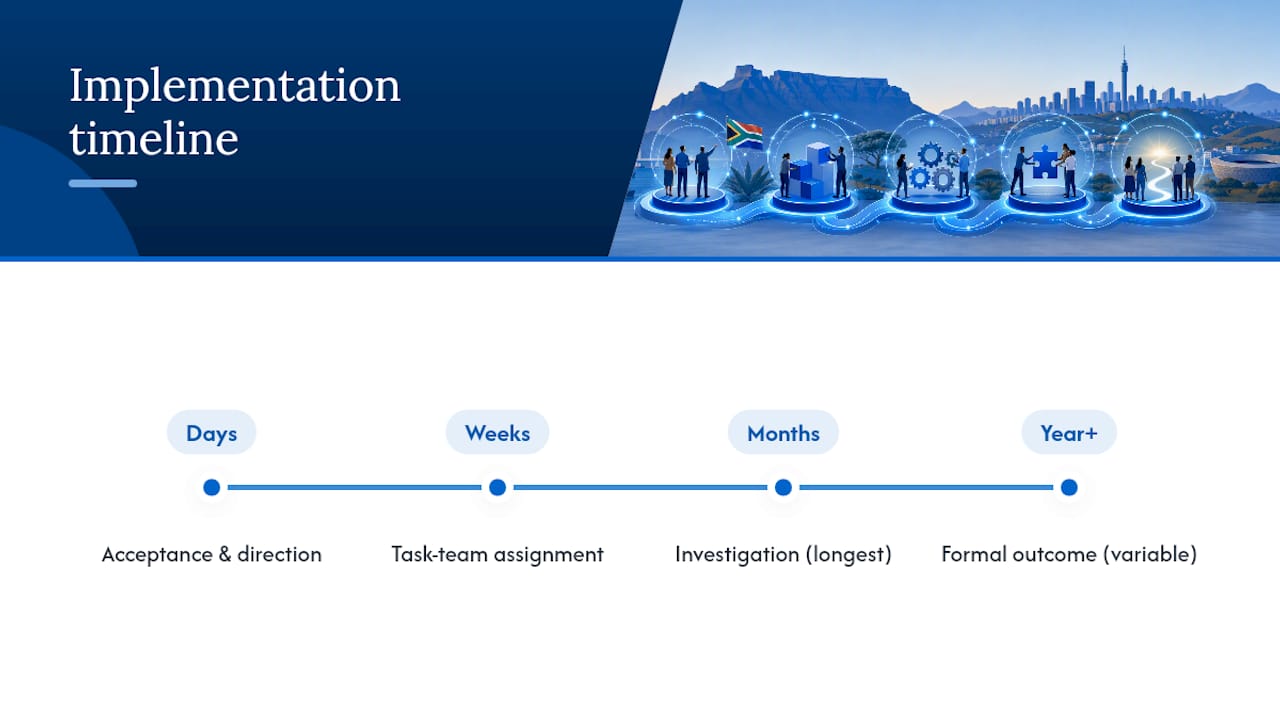
This staged timeline is also why a tracker built only around headline events will look stalled for long stretches even when work is genuinely happening behind the scenes. Recording the announcement date and the first operational indicator as two separate milestones helps readers see that a gap between them is normal, not necessarily a sign of stalling. Patience paired with regular verification checks beats either premature declarations of success or premature declarations of failure.
What commonly derails implementation, and how do you work around it?
The biggest practical obstacle is the lag between an announcement and any document you can actually cite. A Presidency directive or Commission referral is public and easy to quote. The resulting case number, charge sheet, or disciplinary notice often isn’t published for weeks or months, if it’s published at all in a form the public can access.
A second obstacle is jurisdictional overlap. SAPS, IPID, and the National Prosecuting Authority all have distinct roles, and a case can stall simply from unclear handoffs between them rather than any deliberate obstruction. A third is the sheer number of parallel referrals moving through the same limited investigative capacity, which naturally slows individual cases.
Work around these by widening your source net rather than waiting on one agency. Court rolls, parliamentary committee minutes, and IPID’s own statements often surface information before a headline Presidency update does. File Promotion of Access to Information Act requests early rather than as a last resort, since they take time to process. And when a case genuinely appears stalled, say so plainly in your tracker as “no action since [date]” rather than omitting the entry, since a documented gap is itself useful information for other researchers.
Who is responsible for what in the implementation process?
Several institutions share this work, and confusing their roles is one of the most common reporting errors.
The Presidency accepts or notes Commission reports and issues directives to law enforcement leadership, functioning as the political trigger for action rather than an investigator itself. The SAPS special investigations task team carries out the actual investigative work on referred individuals and other related misconduct cases uncovered along the way.
IPID independently investigates police misconduct and can run parallel to or separate from task-team work, particularly on complaints against officers that predate or sit outside the Commission’s specific referrals. Prosecutors within the National Prosecuting Authority decide whether investigative evidence supports formal charges, a decision point entirely outside the Commission or SAPS’s control.
Parliament, through relevant portfolio committees, provides oversight and can question the Minister of Police or SAPS leadership on implementation progress, creating another public record worth monitoring. And the Madlanga Commission itself continues producing reports and hearing evidence throughout, meaning its role isn’t finished once a referral is made. Each institution generates its own paper trail, and a serious tracker checks all of them rather than relying on whichever one issues the most press statements.
What legal steps turn a recommendation into policy or prosecution?
A recommendation carries no legal force on its own. It becomes binding only once it passes through the procedure that matches its type, criminal, disciplinary, or policy.
For criminal referrals, the path runs from SAPS investigation to a docket, then to a prosecutorial decision on whether to charge, then to court proceedings if charges are filed. For disciplinary referrals against police officers, the applicable internal regulations and IPID’s own investigative powers govern the process, typically ending in a suspension, a hearing, and a final departmental decision.
Where a recommendation touches broader policy rather than an individual, for instance a call to reform vetting procedures within SAPS or intelligence structures, it may require ministerial regulation, a policy directive, or in some cases legislative amendment, none of which happen on the Commission’s own authority. That’s a materially slower and more visible process, usually surfacing in Cabinet statements or parliamentary bills rather than court records.
The practical rule for verification: know which category a given recommendation falls into before you decide what kind of document should eventually confirm it. Expecting a court record to confirm a policy reform, or expecting a policy announcement to confirm a criminal case, will send you looking in the wrong place every time.
How do you know if implementation actually worked?
Measuring effectiveness means looking past whether a process started and asking whether it produced a real outcome that matches the original recommendation.
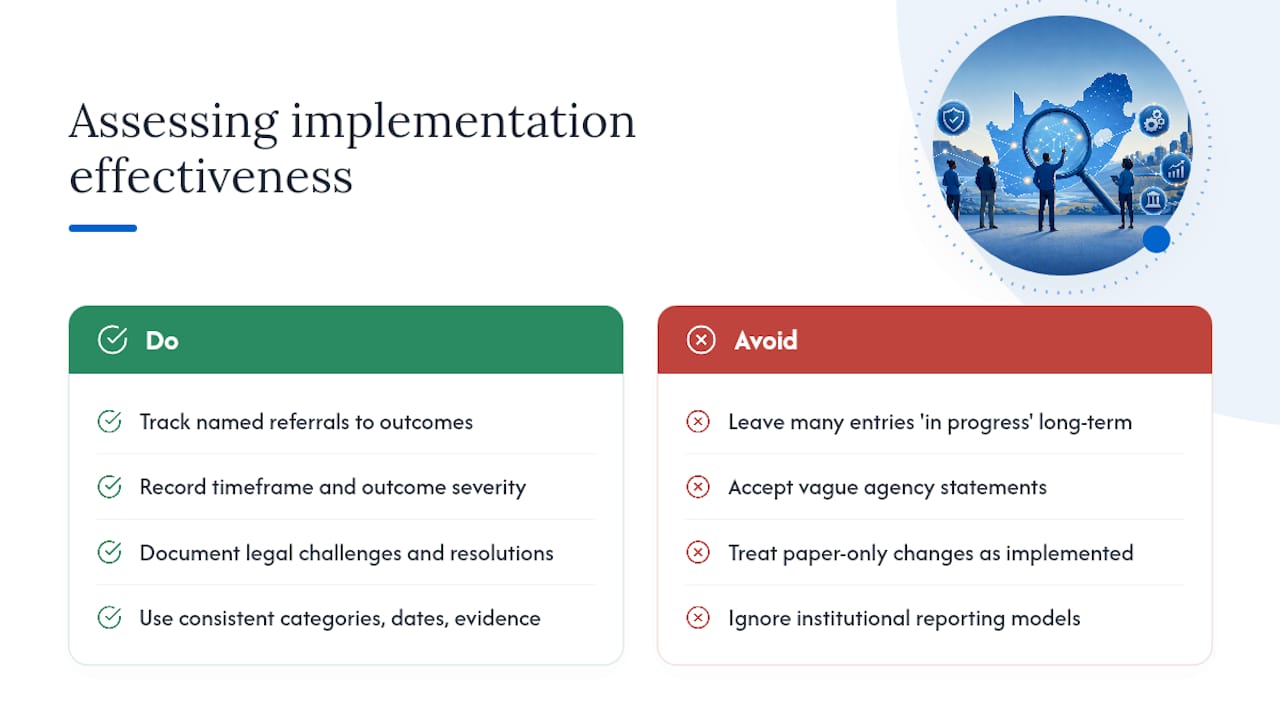
Useful, checkable indicators include: whether a named referral resulted in a formal charge or a disciplinary finding within a reasonable timeframe; whether the outcome matches the severity the Commission recommended, rather than a lesser administrative slap; and whether the case survived legal challenge rather than being withdrawn or dismissed on technical grounds. A tracker with a full column of “in progress” entries eighteen months after referral is itself a finding worth reporting, since sustained inaction is a measurable outcome too.
Broader, harder-to-quantify measures matter as well. Have vetting or oversight procedures actually changed inside SAPS or intelligence structures, or has the Commission’s recommendation stayed on paper? Independent analysis of institutional reporting models, including assessments of implementation tracking practices, consistently finds that centralized, clearly categorised progress reporting produces better public visibility than scattered agency statements. Applying that same discipline to your own tracker, consistent categories, dated entries, and named evidence, is the closest a journalist or researcher can get to an honest effectiveness assessment without waiting years for a final verdict.
What does success and failure actually look like here?
The clearest recent example of forward movement is the sequence from acceptance to task-team formation. Ramaphosa’s direction to constitute a special investigations task team, followed by the Presidency’s later confirmation that referrals were being folded into that team’s active caseload, is a documented chain you can point to and cite by date.
A more ambiguous case is any referral that remains listed across both interim reports without an accompanying case number or disciplinary notice. That’s not necessarily failure. Investigations take time, and complex corruption cases involving senior officials rarely move quickly. But it is a case that shouldn’t be described as “implemented” simply because it was mentioned twice.
The clearest failure pattern, based on precedent from other South African commissions, is a referral that quietly disappears from later reporting with no explanation, superseded without documentation, or simply dropped. The State Capture Commission’s own progress-reporting history shows both outcomes side by side: some recommendations produced traceable action with named dates and documents, while others sat in “in progress” status report after report with no visible movement. That contrast is exactly why a rigorous, dated tracker matters more than any single headline claiming victory or failure.
Why the archive matters for anyone doing this work
The Commission was set up to investigate criminal infiltration, political interference, and corruption across South Africa’s police, prosecution, and intelligence structures. Its public archive turns hearing transcripts, exhibits, and rulings into material you can search and cite, instead of material you’d otherwise have to sit through hours of proceedings to find. For anyone building a tracker, that lower friction between a claim and its source document is what separates a defensible report from a guess.
— Meriol Lainchyon
Where to start tracking on the Madlanga Commission archive
Everything in this guide depends on having a reliable, searchable source to check claims against, and that’s precisely the gap the Madlanga Commission archive was built to close for you.
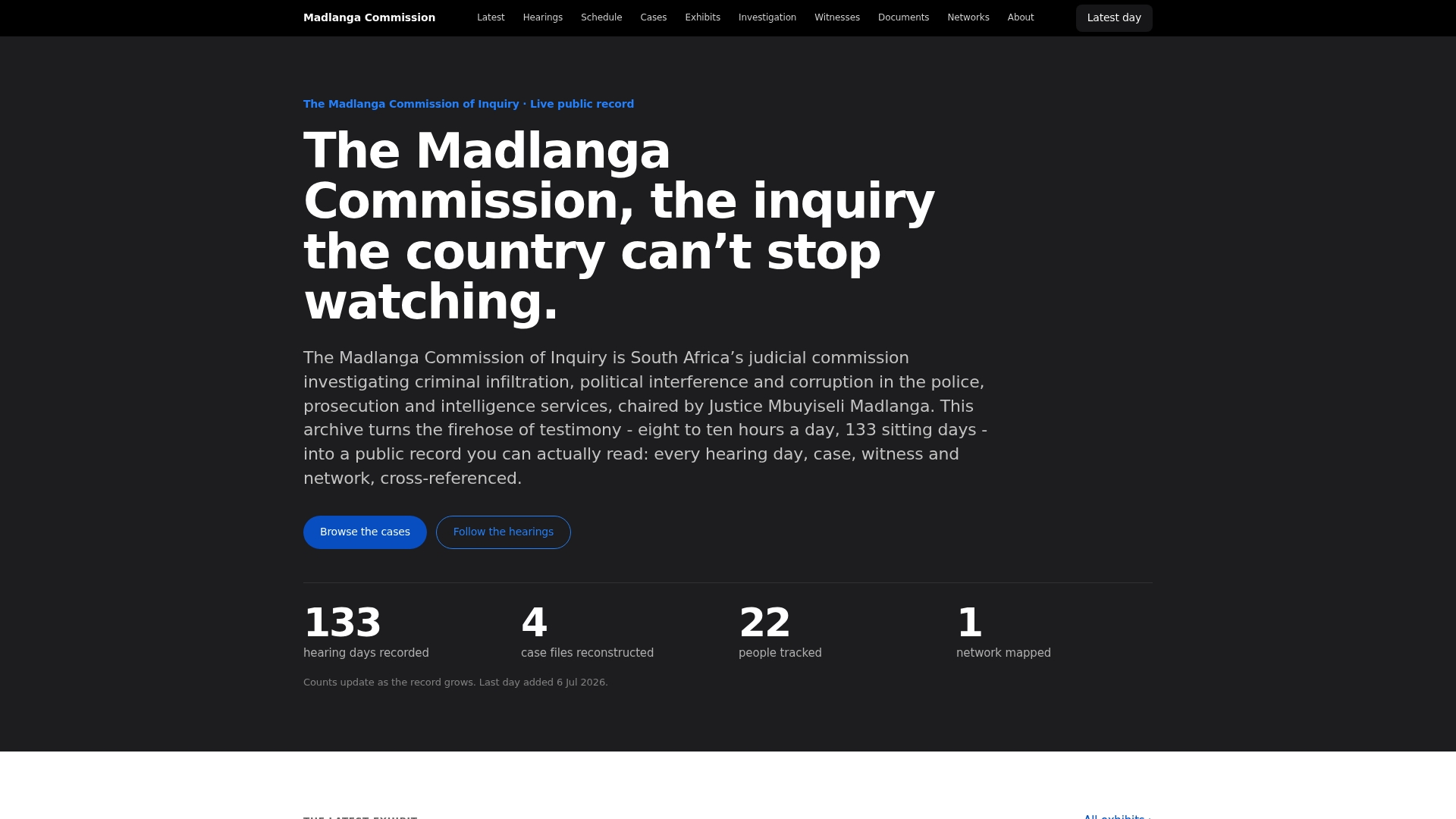
Start with the witnesses list, which lets you identify named individuals and pull their testimony records directly, rather than relying on secondhand summaries of what was said in a hearing. If you’re new to the Commission’s structure or terminology, the explainers section walks through process and sourcing conventions, and the methodology page sets out exactly how documents are compiled and verified before they’re published on the archive.
For ongoing tracking, bookmark hearing pages and rulings as they’re published so you have dated citations ready when a referral moves. Open the witnesses page now and start building your tracker against real testimony records instead of news summaries.
Sources
Tracking implementation of commission recommendations starts with knowing where the paper trail actually lives. Five source types matter, and they rarely say the same thing at the same time.
Presidency statements and progress reports carry the most weight because they show executive-level acceptance. As of August 2026, the President formally noted the Commission’s second interim report and directed that its recommendations and referrals be folded into the SAPS task team’s work. That kind of direction is the clearest early evidence that machinery is actually moving.
Commission interim and final reports are the primary referral documents. Every named referral, every recommended disciplinary or prosecutorial step, originates here. Treat each report as a dated snapshot rather than a final word, since later reports can revise it.
SAPS task-team communications and IPID statements show whether investigative capacity has been assigned and what it is producing. These often arrive as brief media briefings rather than full documents, so archive them the day they’re issued.
Court records and parliamentary updates confirm whether a referral has crossed from investigation into formal legal process. Court rolls, charge sheets, and portfolio committee minutes are public and searchable.
When you cite any of these, save a dated copy or screenshot, not just a link.
- President Ramaphosa welcomes the Madlanga Commission Interim Report | The Presidency
- Madlanga task team swings into action: Arrests made as commission investigations deepen | EWN
- Second Madlanga recommendations: Here are all the officials referred for investigation | The Citizen
FAQ
What counts as proof a Madlanga Commission recommendation has been implemented?
Proof requires a documented outcome tied to the same named referral, such as a court charge sheet, a suspension notice, or an official progress report, not just a Presidency statement of acceptance.
Does a SAPS task-team arrest always confirm a Commission referral was acted on?
No. The task team also investigates other cases of serious misconduct, so an arrest only confirms implementation when the name and allegation match a specific referral in a Commission report.
Who did the second interim report refer for investigation?
Named officials included Lieutenant General Shadrack Sibiya, Sergeant Fannie Nkosi, and Brown Mogotsi, alongside other referrals confirmed or added from the first interim report.
How long does it typically take to see results after a referral?
Expect months rather than weeks; acceptance and task-team assignment can happen quickly, but investigation, prosecution decisions, and disciplinary outcomes take considerably longer to surface publicly.
Where should I start if I want to verify a claim myself?
Begin with the Madlanga Commission’s own witness records and hearing documents, then cross-check any claim against SAPS, IPID, or court sources before treating it as confirmed.