Start with Madlanga: get South African inquiry transcripts faster

Check the commission’s own archive first, such as the Madlanga Commission hearings page, then gov.za, Court Online, or Parliament’s records if it is a parliamentary matter. If nothing turns up, contact the commission secretariat directly or file a PAIA Form 2 with the relevant Information Officer, and budget for a fee and a 30-day wait.
TL;DR:
- Most published inquiry transcripts are available immediately on commission websites, especially the Madlanga Commission, reducing the need for formal PAIA requests.
- Search by hearing date, witness, or exhibit number, and expand monthly lists for more accurate results before submitting a request.
- When requesting via PAIA, provide precise details like case number and witness name to avoid delays and unnecessary back-and-forth clarifications.
- Public bodies usually charge small fees and must respond within 30 days, but responses can be delayed due to complex requests or redactions based on privacy or security reasons.
- Reviewing the commission’s online archive first streamlines research and often negates the need for formal requests, especially when fast access is critical for accountability journalism.
Table of Contents
- Where to find published inquiry transcripts
- How to request a transcript under PAIA
- Fees, timing and formats: what to expect
- Why a request can be denied or redacted, and how to appeal
- How to read, verify and use a transcript
- Using the Madlanga Commission archive effectively
- Why timely public access to transcripts matters
- Start with the Madlanga Commission archive before you file anything
- Sources
- FAQ
Where to find published inquiry transcripts
Most South African commissions of inquiry now publish daily hearing material themselves rather than waiting for requesters to ask. The Madlanga Commission’s own archive is a working example: it posts transcripts, statements and exhibits as hearings happen, organized by hearing day. That habit alone resolves most searches before a PAIA request is ever needed.
Beyond a commission’s own site, four repositories cover most of what South African researchers need:
- Commission websites publish daily hearing transcripts, witness profiles, and supporting exhibits, often browsable by month.
- ConCourt Collections and Court Online (CaseLines) hold transcripts tied to judicial matters, useful when inquiry evidence feeds into litigation.
- Parliament posts records for committee hearings and inquiries held in public session.
- Media briefings and press statements from the commission itself often summarize or link to the underlying transcript.
Search technique matters as much as knowing where to look. Use the hearing date, case or file number, and the witness’s name together, since transcript file names usually follow a consistent pattern (date first, then witness surname or exhibit reference). Expand the monthly hearing list rather than relying on a generic search bar, and check media statements from the same week if the transcript itself has not yet been uploaded.
How to request a transcript under PAIA
Before filing anything formal, contact the commission secretariat directly. A short email asking whether a specific day’s transcript is publicly available often gets a faster answer than a statutory request, and it costs nothing.
If that does not work, the Promotion of Access to Information Act gives you the right to request any record held by a public body, and inquiry transcripts qualify. Here is the practical sequence:
- Identify the right contact. Every public body has an Information Officer, and larger ones appoint a Deputy Information Officer who can guide you through the form.
- Complete Form 2, the prescribed PAIA request form. You need proof of identity, enough detail to identify the record (hearing date, witness name, exhibit reference), your preferred format of access, and your contact details.
- State your capacity to act, if you are requesting on behalf of someone else, such as a newsroom or a legal client.
- Submit and pay the prescribed request fee where one applies, then wait for written acknowledgement.
- Watch for a transfer notice. If the body holding the record is not the correct one, it must transfer your request within 14 days and tell you it has done so.
You do not have to explain why you want the record. PAIA does not require requesters to disclose their reasons for requesting, which matters if you are working on a sensitive investigation and would rather not tip off the subject of your inquiry.
Pro Tip: Include the exact case number, hearing date, witness name, and exhibit reference in your first message to the secretariat. Vague requests (“the transcript from last month”) get bounced back for clarification, and that alone can cost you a week.
Fees, timing and formats: what to expect
Expect a small upfront fee just to lodge the request, then possible extra charges depending on what you ask for.
- A request fee applies at many public bodies; Stats SA’s PAIA manual lists R35 for non-personal requesters as its published example.
- Access, search, and transcription fees may apply on top of that, sometimes with a deposit required before work begins.
- Response time is fixed by statute: public bodies must reply within 30 days, though extensions are possible for complex requests.
- Format options typically include a printed copy, a PDF, or audio/video files, and if the body can produce a transcription with equipment it already has, it generally must provide it in that format.
Manuals that publish per-page transcription fees usually charge per A4 page, so a lengthy multi-day hearing transcript can add up. Ask for a cost estimate before you commit if the request looks large.
Why a request can be denied or redacted, and how to appeal
Refusals are not random. PAIA and the Protection of Personal Information Act both carve out grounds a body can lean on: protecting a third party’s privacy, security concerns, ongoing investigations, or legally privileged material. A commission mid-hearing may also withhold material tied to a witness still under cross-examination.
If your request is refused or the transcript comes back heavily redacted, you have a structured path forward:
- Lodge an internal appeal with the same public body first, within the timeframe its manual specifies.
- If that fails, escalate to the relevant minister overseeing the body, or take the matter to the Information Regulator.
- Courts remain the final option, particularly where a body has ignored statutory deadlines outright.
Keep every scrap of paper if you think you will need to escalate: your original request form, proof of payment or fee waiver, all correspondence with the Information Officer, and evidence you tried the secretariat informally first. Courts weigh whether you exhausted the internal remedies before running to litigation, so a thin paper trail hurts your case.
How to read, verify and use a transcript
Orient yourself with the metadata before you read a single line of testimony. Every reliable transcript should open with the hearing date, case or reference number, the parties involved, and a clear label for each speaker, usually by role (Chair, Evidence Leader, Witness).
Transcripts carry their own shorthand, and misreading it leads to bad quotes:
- [Inaudible] or [indistinct] markers mean the transcriber could not make out the word or phrase. Never fill that gap with a guess.
- Editorial notes in brackets describe non-verbal moments, like a pause or an objection being raised, not spoken testimony.
- Stage directions (“Witness steps down”, “Commission adjourns”) mark procedural breaks, useful for timeline reconstruction but not evidentiary content.
- Cross-check against audio or video wherever the commission publishes it. Transcription quality varies, and a contested quote deserves a listen before you publish it as fact.
For anyone working through dozens of hearing days at once, build a simple keyword index as you go: witness name, exhibit number, and date, cross-referenced against your own notes. That turns a pile of PDFs into something searchable in seconds rather than something you re-read from scratch every time a new allegation surfaces.
Pro Tip: When two witnesses describe the same meeting differently, pull both transcripts side by side and check the exhibit references each one cites. Discrepancies in exhibit numbers are often the fastest way to spot an inconsistency worth investigating further.
Using the Madlanga Commission archive effectively
The Madlanga Commission’s public archive is built to answer most of these questions before you ever touch a PAIA form. It may update with transcripts, witness profiles, exhibits, formal rulings, and media briefings as hearings close.
Navigating such an archive is straightforward:
- Search by hearing date to find transcripts and exhibits.
- Search by witness name to locate appearances and cross-reference statements.
- Search by evidence leader to follow lines of questioning.
- Download transcripts and referenced exhibits.
If something you need is missing from the public archive, contact the commission secretariat first. File PAIA only once you have confirmed the record genuinely is not publicly available.
Why timely public access to transcripts matters
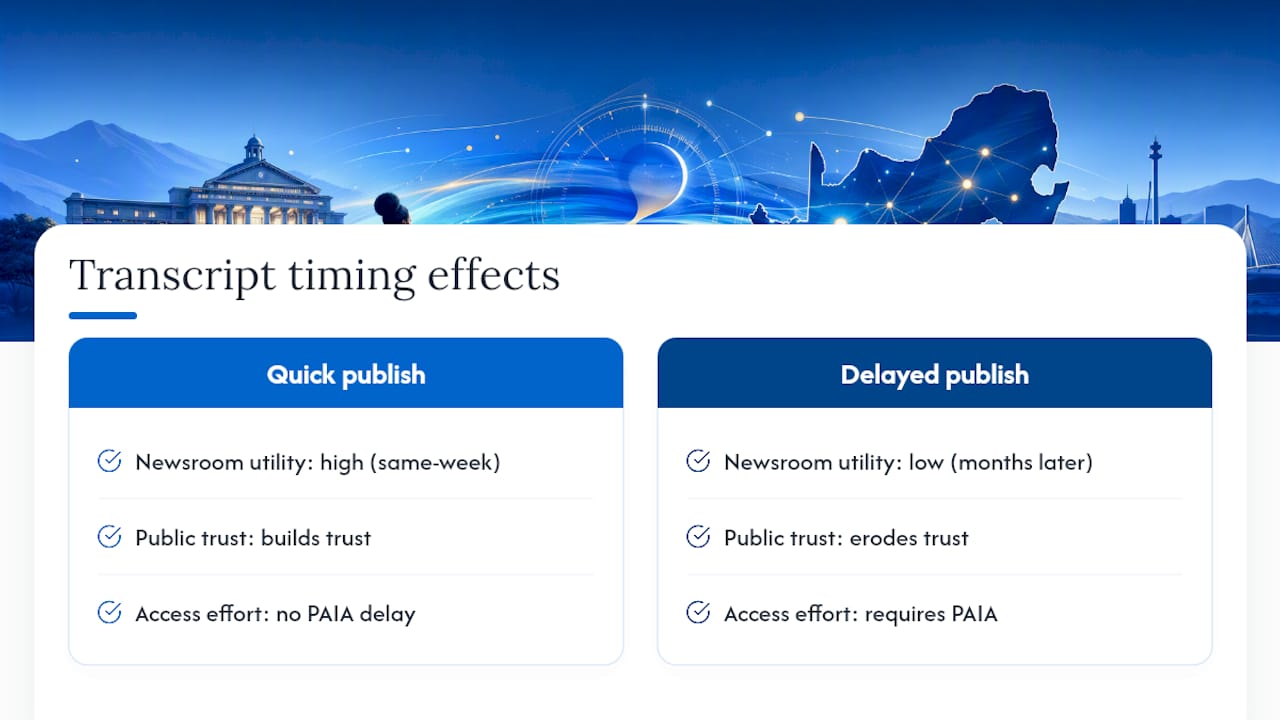
Accountability journalism in South Africa depends on speed as much as accuracy. A transcript that surfaces six months after a hearing is far less useful to a newsroom chasing a live story than one available the same week, and that gap is exactly what proactive archives are meant to close. Commissions that publish quickly, rather than making every requester run the full PAIA gauntlet, do more for public trust than any number of closing statements.
Read more on how commissions operate in our explainer on what a commission of inquiry actually does.
— Meriol Lainchyon
Start with the Madlanga Commission archive before you file anything
If you are hunting for a specific hearing day, witness statement, or exhibit, the Madlanga Commission archive is the fastest and only free starting point built specifically for that search, before any PAIA form enters the picture.
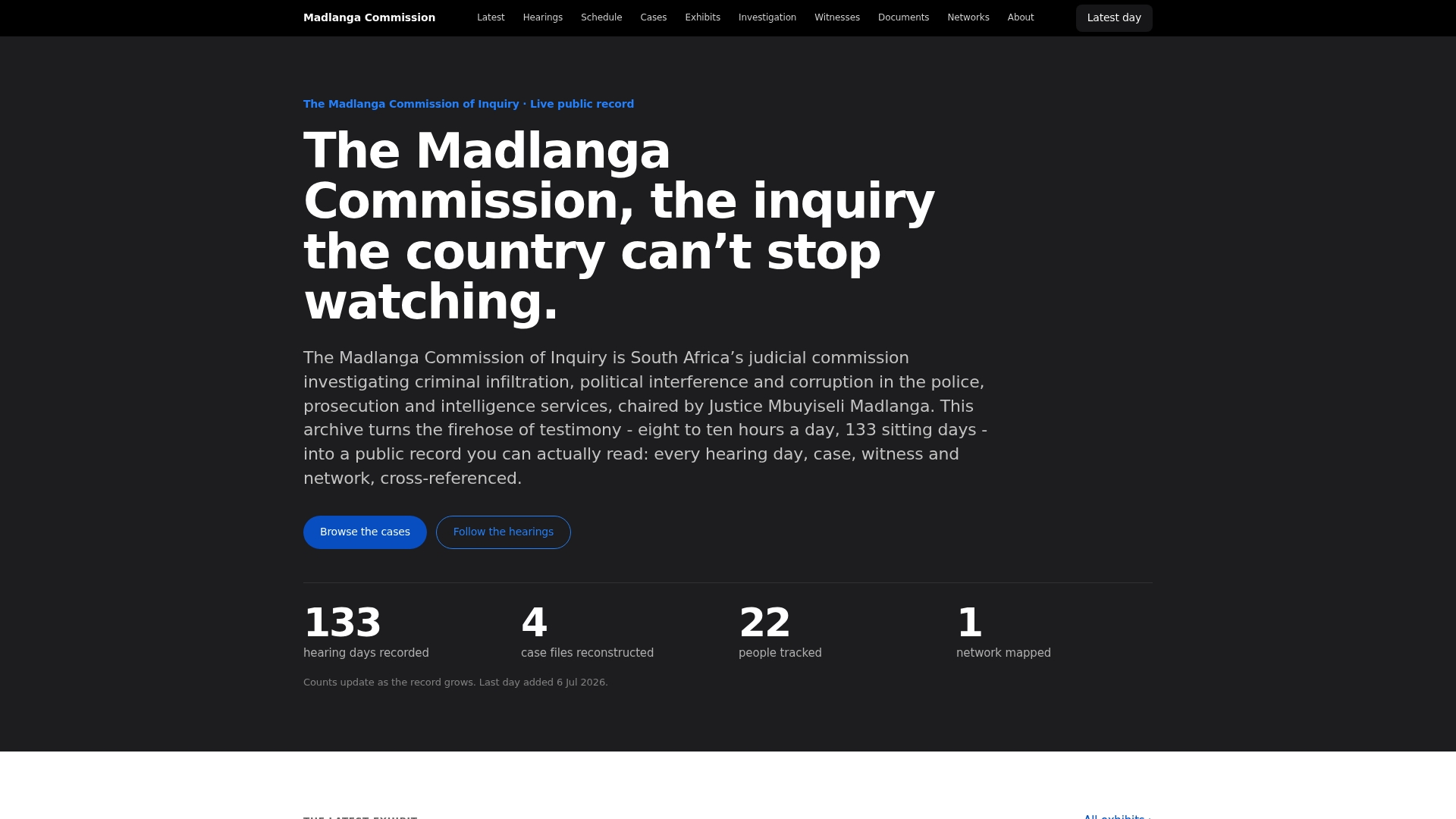
The archive’s latest hearings page tracks new uploads as they happen, so you are not waiting on a request to move through a queue. Want context on who is asking the questions? The evidence leaders profiles explain who is running each line of testimony, which helps when you are trying to work out why a particular witness was called. And if you are cross-checking a specific witness’s account against the exhibits cited during their testimony, pages like Witness I’s hearing record show exactly how the archive links testimony to supporting documents.
Search the archive first. If what you need genuinely is not there, you will already have the case number and date ready to hand to the Information Officer, and that alone will shave days off your PAIA request.
Sources
- Access to information | South African Government
- Stats SA PAIA manual 2022
- PAIA FAQs (Education Department)
- Hearings - Madlanga Commission
FAQ
Can I apply for my transcript online?
Yes, for most commission and court hearings you can search the relevant public archive online first; if the transcript is not posted, you submit a PAIA Form 2 request to the Information Officer either online, by email, or in person, as described in gov.za’s access to information guidance.
What does a commission of inquiry do?
A commission of inquiry investigates a specific matter of public concern, hears witness testimony under oath, gathers documentary evidence, and reports findings and recommendations, as the Madlanga Commission’s own hearings demonstrate through its published record of testimony on police, prosecution, and intelligence failures.
How long does it take to get a transcript?
Public bodies must respond to a PAIA request within 30 days, though transcripts already published on a commission’s own archive, like Madlanga Commission’s, are typically available the same week as the hearing.
Is a matric certificate a transcript?
No. A matric certificate confirms your school-leaving qualification, while an inquiry transcript is a verbatim or summarized written record of testimony and proceedings from a hearing, entirely separate documents with different issuing bodies and purposes.