Meaning of Sub Judice: What It Is and Why It Matters

TL;DR:
- Sub judice refers to current legal cases that are under active court consideration and have not yet been decided. It protects judicial integrity by restricting prejudicial commentary, lasting from case initiation until the final judgment.
Sub judice is defined as the legal status of a case that is currently before a court and has not yet been decided. The term comes from Latin, meaning “under a judge,” and it signals that judicial consideration is actively underway. Understanding the meaning of sub judice matters because it directly shapes what the public, the media, and individuals can legally say about an ongoing case. Get it wrong, and the consequences range from contempt of court charges to compromised trial outcomes.
What does “meaning of sub judice” actually tell us?
Sub judice refers to any legal matter currently before a court and not yet decided. The status begins the moment formal proceedings start and ends only when a final judgment is delivered. Black’s Law Dictionary and standard judicial practice across common law systems recognize this as a foundational principle of fair trial rights. The core idea is simple: a case under judicial consideration must be shielded from outside pressure until the court reaches its verdict.

The Latin origin carries real legal weight. “Sub” means “under,” and “judice” means “a judge.” Together, the phrase describes a matter that sits within the authority of the court. That authority demands protection from interference, whether from newspapers, politicians, or social media users.
When does a case become sub judice, and how long does the status last?
Sub judice status is triggered the moment a court takes jurisdiction over a matter, regardless of case type or court level. Filing charges, making an arrest, or formally initiating civil proceedings all qualify as trigger events. The status does not require a trial to be underway. Jurisdiction alone activates the protection.
The table below maps the typical lifecycle of sub judice status across different proceedings.
| Stage | Event | Sub judice status |
|---|---|---|
| Pre-proceedings | Investigation, no charges filed | Not active |
| Commencement | Charges filed, arrest made, or case initiated | Active |
| Trial | Hearings, evidence, arguments | Active |
| Appeal | Case referred to appellate court | Active |
| Final judgment | Court delivers binding decision | Ends |
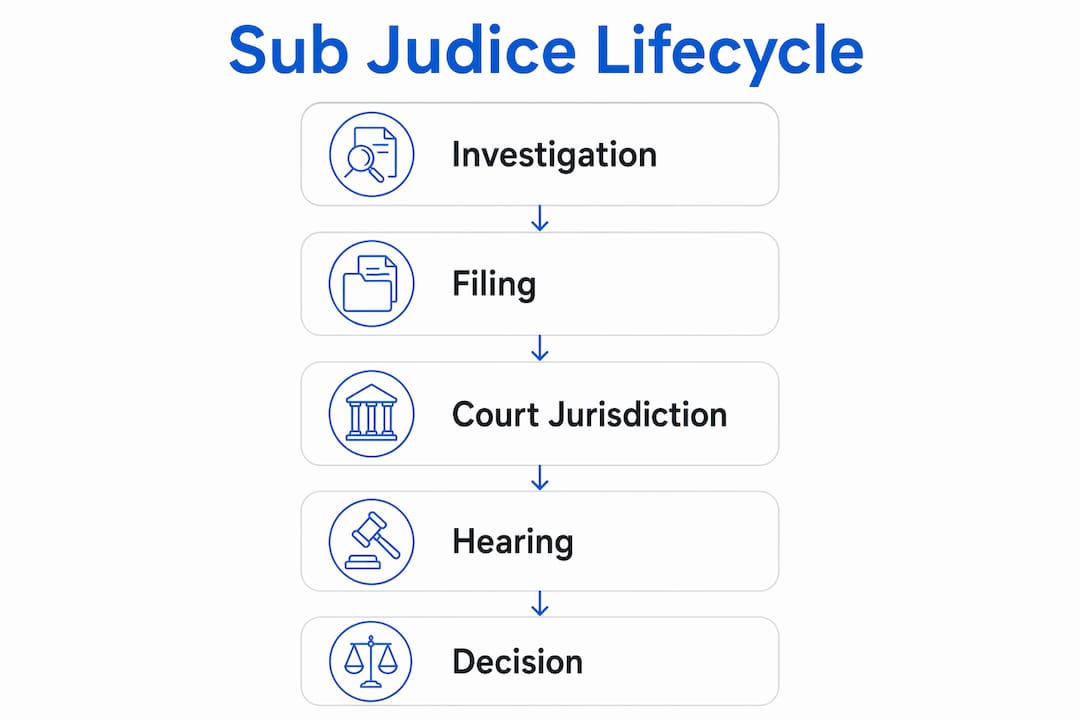
Sub judice covers all pending legal matters, including criminal trials, civil lawsuits, appeals, and administrative hearings. This broad scope surprises many readers who assume the rule applies only to high-profile criminal cases. A civil dispute over a contract or a regulatory appeal before an administrative tribunal carries the same protection. The critical factor is active judicial consideration, not the category of the case.
Jurisdictional variations do exist. Some legal systems enforce stricter media restrictions to uphold sub judice rules, with the United Kingdom’s contempt laws being notably more stringent than those in many other jurisdictions. That said, the underlying principle holds across common law systems: the status lasts from commencement to final judgment.
What legal restrictions does sub judice impose on public discussion?
The sub judice rule restricts public commentary to protect fair trial rights and prevent undue influence on judges or juries. The restriction is not a blanket ban on all speech about a case. It targets commentary that could prejudice the outcome. Think of it, as one legal guide puts it, like a “do not disturb” sign placed over the proceedings.
The rule prohibits:
- Publishing opinions on the guilt or innocence of a party before a verdict
- Speculating about likely outcomes or the strength of evidence
- Sharing information that was excluded from court proceedings
- Running campaigns that pressure courts toward a particular result
- Broadcasting witness statements in ways that could influence other witnesses
Factual reporting on the existence of a case, the charges filed, or the date of a hearing does not violate sub judice. Sub judice does not prevent factual reporting that avoids influencing case merits. A journalist can report that a defendant appeared in court. That same journalist cannot publish an editorial arguing the defendant is guilty before the verdict arrives.
Violating the sub judice rule carries serious legal consequences. Breaking these restrictions can result in contempt of court charges, which courts treat as direct interference with the administration of justice. Penalties range from fines to imprisonment, depending on the jurisdiction and the severity of the interference.
Pro Tip: Before posting about an ongoing legal case on social media, ask yourself one question: does this comment express an opinion on guilt, innocence, or likely outcome? If yes, hold it until the verdict is in.
How does sub judice compare to related legal terms?
Sub judice describes a pending status. It does not describe a resolved one. Several related legal terms cause confusion because they sound similar but mean something entirely different.
| Term | Meaning | When it applies |
|---|---|---|
| Sub judice | Case is under active judicial consideration | During proceedings, before final judgment |
| Res judicata | Matter already decided by a court | After final judgment is delivered |
| Nolle prosequi | Prosecution declines to proceed | Before or during trial, case dropped |
| Sub silentio | Decided without explicit discussion | After judgment, implied ruling |
Res judicata is the most commonly confused term. Where sub judice means a case is still live, res judicata means it is finished and cannot be relitigated. The two terms sit at opposite ends of the same timeline. Sub judice protects the process while it runs. Res judicata protects the outcome once it is done.
A common misconception is that sub judice applies only to criminal trials. Sub judice covers civil lawsuits, appeals, and administrative matters as well. Any proceeding where a court or tribunal holds active jurisdiction qualifies. This matters for readers following regulatory inquiries, employment disputes, or government accountability cases, not just criminal prosecutions.
Practical implications of sub judice for individuals and the media
Sub judice status shapes behavior for anyone who discusses, reports on, or comments about an active legal case. The rule applies to private individuals, journalists, public officials, and organizations alike. Ignorance of the rule is not a defense in contempt proceedings.
Individuals should avoid:
- Posting opinions about a defendant’s guilt or innocence on social media
- Sharing leaked documents or excluded evidence from ongoing cases
- Signing or promoting petitions that call on courts to reach a specific verdict
- Repeating prejudicial commentary from others, even by sharing or retweeting
The media carries a heightened responsibility. News organizations operate under editorial standards that require them to distinguish between reporting facts and editorializing about outcomes. Social media commentary about sub judice cases can trigger legal risks if deemed prejudicial under contempt laws. A tweet from a private citizen carries the same legal exposure as a newspaper column if it meets the threshold for prejudicial commentary.
Application and enforcement of sub judice rules vary by jurisdiction, with some areas imposing heavier penalties for violations, especially via social media. South African courts, for example, treat contempt of court seriously and have the authority to act against individuals whose public statements threaten trial fairness. Advocates like Adila Hassim SC, who leads evidence at the Madlanga Commission, operate within a framework where procedural integrity and the protection of ongoing proceedings are central to the inquiry’s credibility.
Pro Tip: When covering or discussing an active case, stick to confirmed facts already on the public record. Avoid predicting outcomes, assigning blame, or amplifying unverified claims. That discipline protects both the proceedings and you.
Key Takeaways
Sub judice is a legal status that protects active judicial proceedings from outside influence, lasting from the start of a case until the court delivers its final judgment.
| Point | Details |
|---|---|
| Core definition | Sub judice means a case is under active judicial consideration and not yet decided. |
| Trigger and duration | Status begins when proceedings start and ends only at final judgment. |
| Scope | Applies to criminal, civil, appellate, and administrative proceedings equally. |
| Key restriction | Prejudicial commentary and speculation are banned; factual reporting is permitted. |
| Consequences | Violating sub judice can result in contempt of court charges and serious penalties. |
Why sub judice matters more than most people realize
I have spent years reading through legal proceedings, commission transcripts, and court records. The sub judice rule is the one principle that most people underestimate until they see it violated in real time.
The instinct to comment is natural. A high-profile arrest happens, and within hours, public opinion has already convicted or acquitted the accused. Social media accelerates that cycle. What most people do not appreciate is that this commentary does not just reflect public sentiment. It can actively contaminate the proceedings. Witnesses read the news. Jurors exist in the same information environment as everyone else. Judges are human.
Sub judice protects judicial impartiality by ensuring decisions rest solely on evidence presented in court, not on the volume of public outrage or the editorial line of a newspaper. That protection is not a technicality. It is the mechanism that separates a fair trial from a public spectacle.
What I find most instructive about bodies like the Madlanga Commission is how they model procedural discipline under intense public scrutiny. The Commission investigates criminal infiltration and corruption within South Africa’s police, prosecution, and intelligence sectors. The cases it handles are exactly the kind that generate public anger and demand for accountability. Yet the process holds. Testimony is recorded. Evidence is tested. The record is built carefully, not reactively. That discipline is sub judice in practice, not just in theory.
The challenge for 2026 is that the boundaries are harder to enforce than ever. A post shared by a private citizen in Johannesburg can reach a juror in Cape Town within seconds. Legal systems built for print media are now contending with platforms that move faster than any court order. The principle has not changed. The enforcement environment has.
— Meriol Lainchyon
Madlanga Commission and the standard of judicial integrity
The Madlanga Commission of Inquiry applies exactly the kind of procedural rigor that sub judice is designed to protect. Chaired by Justice Mbuyiseli Madlanga, the Commission investigates criminal infiltration, political interference, and corruption across South Africa’s security and justice institutions.
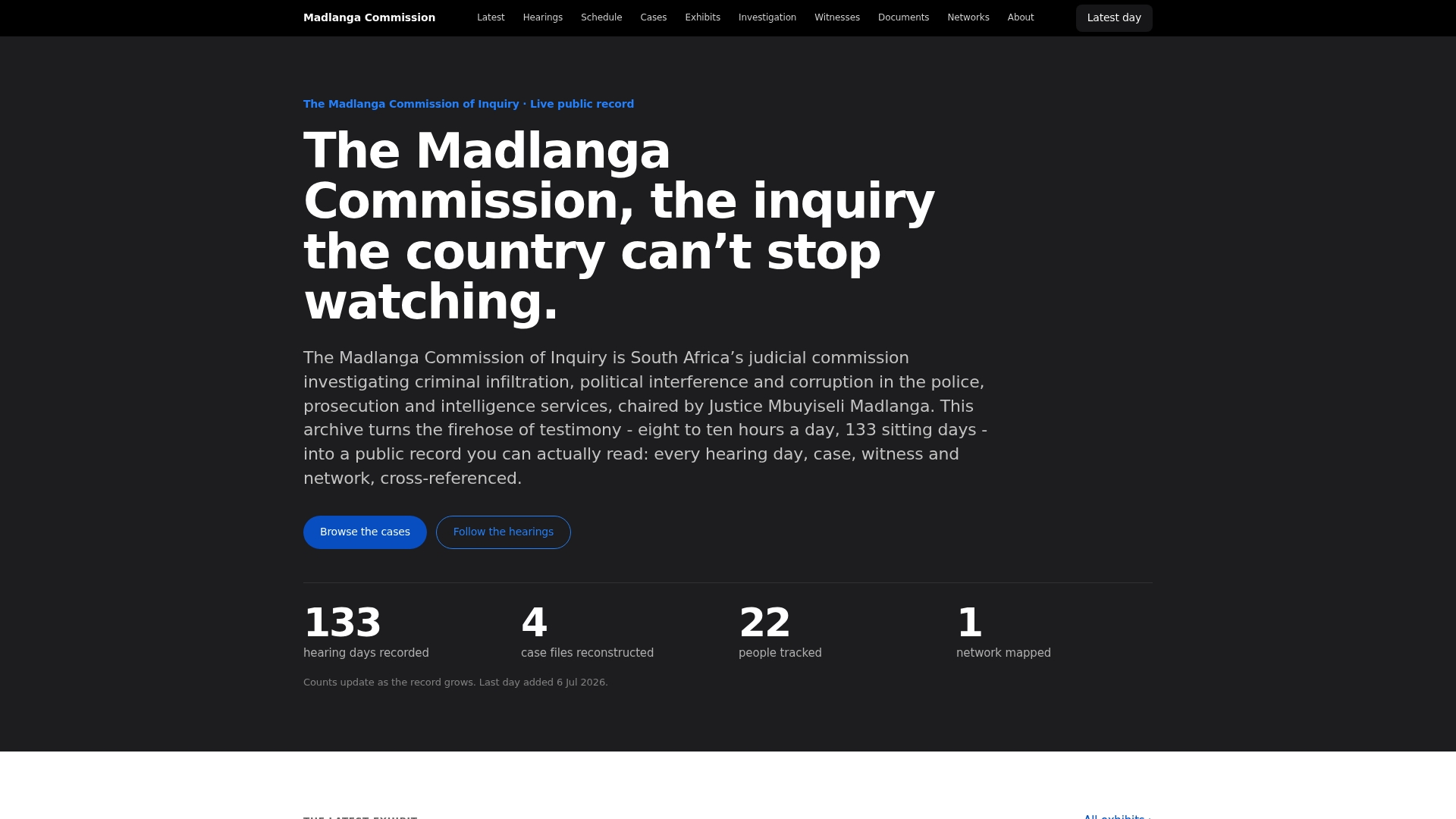
Every hearing is documented, every witness is recorded, and the full archive is publicly accessible. That transparency does not conflict with sub judice principles. It models them. The Commission’s investigative methodology is built on the same foundation: evidence drives conclusions, not public pressure. Readers who want to understand how a serious judicial inquiry handles active proceedings can explore the full case files archive to see that standard applied across dozens of real investigations.
FAQ
What is the sub judice definition in simple terms?
Sub judice means a legal case is currently before a court and has not yet been decided. The term comes from Latin, meaning “under a judge.”
Does sub judice apply only to criminal cases?
Sub judice applies to all active judicial proceedings, including civil lawsuits, appeals, and administrative hearings, not just criminal trials.
What happens if you violate the sub judice rule?
Violating sub judice can result in contempt of court charges, which carry penalties ranging from fines to imprisonment depending on the jurisdiction.
Can journalists report on sub judice cases?
Journalists can report factual information about an ongoing case, such as charges filed or hearing dates, but cannot publish prejudicial commentary or speculation about the outcome.
When does sub judice status end?
Sub judice status ends when the court delivers its final judgment. Until that point, the case remains under judicial consideration and the restrictions apply.