Nolle prosequi in South Africa: what victims and lawyers need to know

A nolle prosequi certificate is a written document issued by a Director of Public Prosecutions confirming the state will not prosecute a particular person for a particular offence. Once validly issued, it opens the door for a qualifying private individual to bring a criminal case themselves, something the state alone is ordinarily empowered to do.
That single certificate carries real legal weight. Here’s what it actually does:
- It hands standing to a narrow class of private persons to prosecute, but only if they fit the statutory categories in section 7.
- It functions as a jurisdictional fact. Without it, a private prosecution under section 7 cannot lawfully proceed at all.
- It lapses if the holder doesn’t act. Under section 9, the private prosecution must be launched within three months, and the court can demand a security deposit before process issues.
- It says nothing about guilt. The certificate only records that the DPP has decided not to prosecute. It is not a finding of fact.
The statutory anchor for all of this sits in the Criminal Procedure Act 51 of 1977, and the security and lapse rules specifically in section 9.
Key Takeaways
A valid nolle prosequi certificate under section 7 of the Criminal Procedure Act gives a narrow class of private persons standing to prosecute, but only within a three-month window and subject to strict judicial scrutiny of the certificate’s particularity.
| Point | Details |
|---|---|
| Certificate is jurisdictional, not evidentiary | It permits a private prosecution to start under section 7 but says nothing about guilt. |
| Section 7 and section 8 differ sharply | Section 7 needs a certificate and a personal interest; section 8 relies on an independent statutory right. |
| Particularity is non-negotiable | Courts, including in Porrit v NPA (2023), set aside certificates that fail to name a specific accused and charge. |
| The three-month clock is strict | Under section 9, the prosecution must start within three months of the certificate’s date, or it lapses. |
| Weigh cost against alternatives | A civil claim, renewed NPA request, or public advocacy may achieve the same goal for less resource risk. |
Table of Contents
- What the Criminal Procedure Act actually says about private prosecution
- Who can actually get and use a certificate?
- What must a valid nolle prosequi certificate contain?
- How do you start a private prosecution on a certificate?
- What does the certificate change, and what doesn’t it change?
- How have South African courts treated defective certificates?
- Is a private prosecution worth the cost and risk?
- Where to find primary sources on private prosecution in South Africa
- When a certificate is challenged, what happens next?
- Sources
- FAQ
What the Criminal Procedure Act actually says about private prosecution
Three sections of the Criminal Procedure Act do the heavy lifting here, and confusing them is the most common mistake practitioners make.
Section 7 is the certificate route. It lets a private person with a “substantial and peculiar interest” in the outcome, arising from injury suffered, prosecute an offence once the DPP has certified in writing that they decline to prosecute. This is the classic nolle prosequi mechanism, and it’s built for individuals, not institutions.
Section 8 is a different animal entirely. It preserves private prosecution rights that certain bodies or persons already hold under other statutes, independent of any certificate from the DPP. A statutory body empowered by its own enabling legislation to prosecute doesn’t need to go through the section 7 certificate process at all.
Section 9 governs the mechanics once a section 7 prosecution starts: the private prosecutor must furnish security with the court (an amount the court fixes, aimed at covering costs if the prosecution fails or is deemed vexatious), and the prosecution lapses if not instituted within three months of the certificate being issued.
The practical contrast matters:
- Section 7: certificate-dependent, available to individuals with a personal stake, time-limited, security required.
- Section 8: statutory right independent of any certificate, reserved for bodies or persons named in other legislation.
De Rebus has flagged this distinction repeatedly because practitioners keep conflating the two, sometimes with costly procedural consequences for their clients. Academic reviews of the Act’s drafting history note that private prosecution has always been treated as a narrow, deliberately constrained carve-out from the state’s prosecuting authority, not a parallel system.
Who can actually get and use a certificate?
Not everyone who feels wronged by a crime qualifies. Section 7(1) limits standing to a specific list:
- A private person who has a substantial and peculiar interest in the outcome, arising from injury suffered because of the offence.
- A husband, if the offence was committed against his wife.
- The wife or child of a deceased person, or, if there’s no wife or child, any of the deceased’s near relatives, where the death is alleged to have been caused by the offence.
- A guardian or curator, where the injured party is a minor or is otherwise incapable of pursuing the matter.
“Substantial and peculiar interest” is doing a lot of work in that list. Courts read it narrowly: the interest must be personal to the applicant and different from the general interest every citizen has in seeing crime punished. A rape survivor, a family whose relative died in police custody, or the parent of an assaulted child typically meets that bar. A concerned bystander or a member of the public with no direct connection to the harm generally does not.
This is exactly why juristic persons, NGOs, and advocacy groups usually can’t rely on section 7 no matter how invested they are in a case. OUTA’s private prosecution guidance confirms that the NPA remains the only body ordinarily authorised to prosecute, and organisations without a personal, peculiar interest sit outside the section 7 gateway entirely. Their route, if one exists, runs through section 8 and whatever statute might specifically empower them.
What must a valid nolle prosequi certificate contain?
Courts scrutinise these certificates closely, and a poorly drafted one gets set aside. Before relying on a certificate, or requesting one, check it against this list:
- Named or clearly identifiable accused. A certificate referring vaguely to “any person” involved in an incident won’t hold up.
- A specific offence or charge. The certificate must tie to a particular crime, not a general description of wrongdoing.
- Reference to the date and nature of the alleged offence, where relevant to identifying the matter.
- The DPP’s signature, confirming the decision was actually taken at the correct level of authority.
- A statement that the DPP has seen the relevant statements or affidavits underlying the complaint, showing the decision wasn’t made blind.
- An express declination to prosecute, not an ambiguous holding statement or a request for further investigation.
The most common defect is vagueness. A certificate that doesn’t pin down who is being accused of what invites a challenge, and courts have shown little patience for wording broad enough to cover multiple possible suspects. Missing signatures and certificates that fail to confirm the DPP actually reviewed the underlying evidence are the next most frequent problems.
Pro Tip: If you’re requesting a certificate on behalf of a client, ask the DPP’s office in writing to confirm both the accused’s identity and the specific charge in the certificate itself. A generic acknowledgment letter is not the same thing, and courts will treat it that way.

How do you start a private prosecution on a certificate?
Getting the certificate is only step one. The sequence that follows matters just as much:
- Request the certificate. Write to the relevant DPP, laying out the facts, the harm suffered, and why the case meets the section 7 threshold. Attach whatever statements or affidavits support the complaint.
- Wait for the decision and obtain the signed certificate. If the DPP declines to prosecute and issues a nolle prosequi certificate, check it immediately against the checklist above.
- Produce the certificate to the Registrar of the relevant court when applying for the summons or indictment that begins the private prosecution.
- Act within three months. Section 9 sets a hard lapse period from the date of the certificate. Miss it, and you’re back to requesting a fresh certificate.
- Arrange security if the court requires it. The court fixes the amount under section 9, and process generally won’t issue until it’s paid or arranged.
A few practical notes worth flagging to clients:
- The DPP’s certificate reflects a review of the evidence already submitted. If new evidence surfaces afterward, it’s worth raising with the DPP before assuming the certificate route is your only option.
- The three-month clock runs from the certificate’s date, not from when you decide to act on it, so don’t sit on a signed certificate.
- Courts expect the summons or indictment to match the certificate’s stated accused and charge exactly. Any drift between the two is an easy target for a defence challenge.
What does the certificate change, and what doesn’t it change?
The certificate does real legal work, but it’s narrower than many people assume.
What it does:
- Establishes one of the jurisdictional facts a private prosecution needs to proceed under section 7.
- Allows the Registrar to issue summons or an indictment once produced alongside the application.
- Triggers the section 9 obligations: the three-month window and, where the court orders it, security for costs.
What it doesn’t do:
- It doesn’t decide guilt or innocence. It records a prosecutorial decision, nothing more.
- It doesn’t permanently bar the state from acting. Commentary on the certificate process notes the DPP can, in some circumstances, revisit a declined case if new evidence emerges, even after issuing a certificate.
- It doesn’t survive a successful jurisdictional challenge. If a court finds the certificate defective, the private prosecution built on it falls away with it.
The certificate sits inside a broader web of prosecutorial discretion, not outside it. A DPP’s decision to decline prosecution and issue a certificate is itself reviewable as an administrative act, which is exactly the ground courts have used to test certificates that look procedurally rushed or poorly reasoned.
How have South African courts treated defective certificates?
The clearest recent guidance comes from the Gauteph High Court’s handling of the dispute in Porrit and Another v National Prosecuting Authority of South Africa and Others, decided in 2023. The court examined whether a certificate that failed to identify a clear accused and charge with sufficient particularity could sustain a private prosecution, and found it could not.
Certificates that rely on broad or generic wording, rather than naming a specific person and a specific offence, do not meet the particularity the law demands, and a private prosecution cannot lawfully rest on one.
A related 2023 judgment, cited on SAFLII as North Gauteng High Court, Pretoria [2023] ZAGPPHC 136, treated the issuing of a certificate as an administrative act. That framing matters: it means a court can ask whether the DPP genuinely applied her mind to the evidence before declining to prosecute, not just whether a signed piece of paper exists.
Read together, these decisions teach three practical lessons:
- Particularity beats convenience. A certificate drafted to cover a range of possible suspects, rather than naming one, is vulnerable from the outset.
- The DPP’s review has to be real, not procedural box-ticking. Courts want evidence the DPP actually engaged with the statements and affidavits submitted, not a rubber stamp.
- Strict interpretation is the default. Because private prosecution carves out an exception to the state’s ordinary prosecuting monopoly, courts read section 7’s requirements narrowly rather than generously.
Anyone drafting or challenging a certificate should treat these cases as the current benchmark, not historical curiosities. The pattern across the SAFLII record is consistent: courts protect the certificate mechanism by holding it to a high formal standard, and they set aside anything that looks like an administrative shortcut.
Is a private prosecution worth the cost and risk?
Before instructing counsel, weigh the resource demands honestly. A private prosecution isn’t a cheaper, faster version of a state case. Commentary from practitioners is blunt on this point: sustaining a private trial takes comparable resources to a full state prosecution, not a fraction of them.
Expect these cost drivers:
- Counsel’s fees for the duration of a full criminal trial, not just the application stage.
- Expert evidence costs, particularly in cases involving forensic or medical testimony.
- The section 9 security deposit, which the court sets and which is separate from legal fees.
- Witness availability and, often, the logistics of keeping witnesses engaged over a long process.
There are non-financial risks too: an unsuccessful prosecution can expose the private prosecutor to a costs order, and a poorly run case can do reputational damage to the complainant as much as the accused.
Before committing, it’s worth exploring whether a renewed request to the NPA, a civil claim, or public advocacy achieves the same underlying goal at lower cost.
Pro Tip: Ask three questions before instructing counsel: Do I have funding for a full trial, not just the application? Are there evidence gaps the DPP flagged that I can actually fill? And is my real goal a conviction, or accountability that a civil claim or public pressure could deliver just as well?
Where to find primary sources on private prosecution in South Africa
Relying on secondhand summaries of case law is risky in this area, given how fact-specific the courts have been. Go to the primary material where possible:
- SAFLII carries full judgment text for Porrit and related certificate disputes, searchable by court and year.
- The Criminal Procedure Act itself, for the exact wording of sections 7 to 9, rather than a paraphrase.
- De Rebus, for practitioner-level commentary distinguishing the s7 and s8 routes.
- OUTA’s private prosecution FAQ, for a civic-society explanation of the mechanics and who typically qualifies.
- The Madlanga Commission’s case archive, for related material on how prosecutorial decisions and police conduct are being examined in a live public inquiry.
Always check whether a judgment has been appealed before treating it as settled law. Case-law in this area moves quickly, and a High Court finding from 2023 could be qualified or overturned on appeal.
When a certificate is challenged, what happens next?
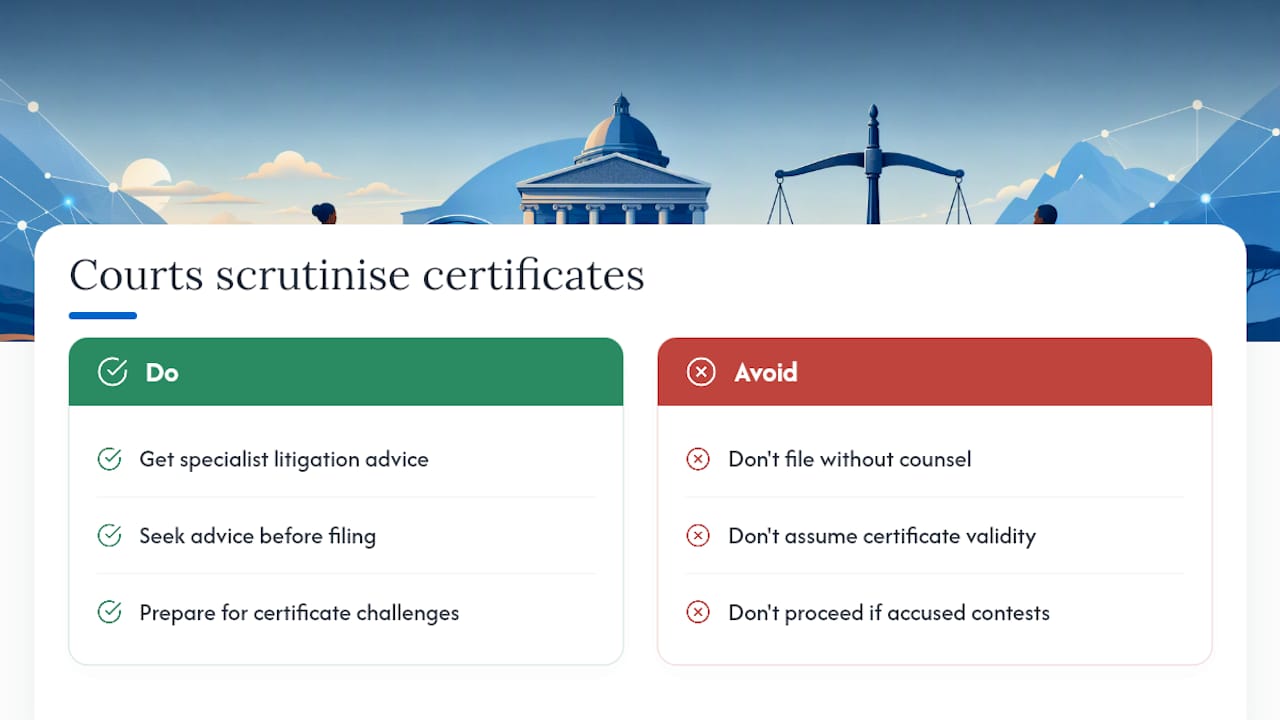
Private prosecution sits at the strict end of South African criminal procedure. Courts treat it as a narrow exception to the state’s authority, and that shows in how carefully they test every certificate that reaches them. Anyone weighing this route, particularly where the stakes are high or the accused is contesting the certificate’s validity, should get specialist litigation advice before filing anything with the Registrar.
Sources
- Criminal Procedure Act 51 of 1977 (RSA)
- Porrit and Another v National Prosecuting Authority of South Africa and Others 2023 ZAGPJHC 783
- Exploring statutory requirements for private prosecution under the Criminal Procedure Act (De Rebus)
- PRIVATE PROSECUTION FAQ (OUTA)
This article is general information, not a substitute for advice from a qualified lawyer. Consult a qualified legal professional about your own circumstances before acting on anything here.
FAQ
What is the legal effect of a certificate nolle prosequi being issued?
It confirms the DPP has declined to prosecute the named accused for the specified offence, and it creates the jurisdictional fact needed for a qualifying private person to institute a prosecution under section 7 within three months.
What does “nolle prosequi” mean in South African law?
It refers to the DPP’s formal decision not to pursue a criminal charge, recorded in a certificate that a private person with a substantial and peculiar interest can then use to prosecute the matter themselves.
Can “nolle prosequi” be used in a sentence?
Yes: “The DPP issued a nolle prosequi certificate after reviewing the affidavits, allowing the victim’s family to consider a private prosecution under section 7.”
Is there a synonym for “nolle prosequi” in South African practice?
The closest working equivalent is simply “the DPP’s declination to prosecute”, though the certificate itself has no true synonym since it is a specific statutory instrument under section 7.
Does a nolle prosequi certificate stop the state from ever prosecuting?
Not necessarily. Practical commentary notes the DPP can reconsider and prosecute later if new evidence emerges, so the certificate is not an absolute bar to future state action.
How long do you have to act once a certificate is issued?
Three months from the date of the certificate, under section 9 of the Criminal Procedure Act; missing that window means the private prosecution lapses and a fresh certificate would be needed.