How to file a PAIA request in South Africa
To make a valid PAIA request, complete the prescribed Form 2 under Regulation 7, address it to the Information Officer of the body holding the records, and include your ID, a precise description of what you want, and your preferred manner of access. Keep proof of submission. The body has 30 calendar days to respond, and it can extend that once by another 30 days if the request is complex or requires wide consultation.
- Use Form 2 (Regulation 7), not a generic letter
- List your contact details, ID/proof of identity, and exact record description
- State your preferred manner of access (copy, inspection, digital file)
- Keep a stamped receipt, registered post slip, or email confirmation
Statutory clock: the 30 calendar day response window starts the day your request is properly received, and a single 30-day extension is allowed for extensive searches or third-party consultations. Miss the deadline, and the request is deemed refused, which opens the door to an internal appeal or a complaint to the Information Regulator.
Key Takeaways
A valid PAIA request requires Form 2, a precise record description, and submission to the correct Information Officer, with a 30-day statutory response window that can be extended once by 30 days.
| Point | Details |
|---|---|
| Use the correct form | Always use Form 2 (Regulation 7) rather than a plain letter to avoid technical rejection. |
| Be specific, not broad | Include dates, reference numbers, and department names to prevent refusal for vagueness. |
| Track the 30-day clock | Response is due within 30 calendar days, extendable once by 30 more days for complex requests. |
| Keep proof of submission | Stamped receipts, registered post slips, or email confirmations are essential if you need to appeal. |
| Check the Madlanga Commission archive first | Many hearing records, exhibits, and witness statements are already public, often making a PAIA request unnecessary for Commission-related material. |
Table of Contents
- Where to find the official PAIA forms and manuals
- How do you fill out Form 2 correctly?
- What are the deadlines, extensions, and fees involved?
- What happens if your PAIA request is refused or ignored?
- Building your evidence trail before you even file
- Quick checklist and sample structure for your request
- Why check the archive before you file
- A faster route than PAIA for Commission-related records
- Sources
- FAQ
Where to find the official PAIA forms and manuals
You don’t need a lawyer to draft a PAIA request from scratch. The Information Regulator publishes the prescribed forms directly on its site: Form 01, Form 02 (the actual request form), Form 04 (internal appeal), and Form 05 (complaint to the Regulator). Download Form 2 as a fillable PDF and use it as is. Rewriting it as a plain letter risks a body rejecting it on a technicality, even though the substance is identical.
Every public and private body covered by PAIA must maintain a manual listing its Information Officer and, often, a deputy or administrative contact. That manual matters more than most requesters realize: it tells you exactly who to address, which saves the days otherwise lost when a request lands with the wrong person and gets forwarded internally.
Submission channels typically accepted include:
- Email to the Information Officer’s listed address
- Postal delivery (registered mail is safer)
- Hand delivery with a stamped receipt
- Fax, where the body still lists one
SARS follows the same structure. Its PAIA guidance confirms Form 2 is mandatory for anyone requesting SARS-held records, along with proof of identity and, where applicable, payment of the prescribed fee.
How do you fill out Form 2 correctly?
Most PAIA requests don’t fail because of a legal technicality. They fail because the description of the record is too vague for anyone to act on. Here’s how to fill Form 2 so the Information Officer can identify exactly what you want on the first read.
- State your particulars clearly. Full name, ID number, postal or email address, and a phone number. If you’re requesting on behalf of an organization, name the organization and your role in it.
- Describe the record with precision. Include dates, the department or unit involved, a file or reference number if you have one, and the document’s title if known. “All records relating to the tender process” invites a refusal. “The evaluation scorecards for Tender REF-2025-114, dated between March and June 2025” does not.
- Choose your manner of access. Form 2 asks whether you want a copy, an opportunity to inspect the original, a transcription, or an electronic file. Pick one; don’t leave it blank.
- Select your preferred language, if the body offers a choice, and note it on the form rather than assuming.
- Attach proof of identity — a certified copy of your ID or passport.
- If you’re requesting on someone else’s behalf, attach a signed letter of authority from that person. Bodies routinely reject third-party requests that skip this step.
- Attach supporting documents that help identify the record: correspondence referencing a case number, a media report naming a file, or a previous acknowledgment letter from the same body.
The official Form 2 PDF builds in fields for all of this, including a fee declaration section and a signature block, so working directly from the form rather than a paraphrased version avoids missing a mandatory field.
Pro Tip: Vague requests are the single most common reason for refusal. Before you submit, reread your record description and ask whether a stranger with no context could locate the exact document from your wording alone. If the answer is no, narrow it further.

What are the deadlines, extensions, and fees involved?
The response clock runs for 30 calendar days from the day a body receives a properly completed request. That’s calendar days, not business days, so weekends and public holidays count. A body can extend that period once, by another 30 days, but only for defined reasons: the request covers a large volume of records, requires consulting a third party, or needs input from another department.
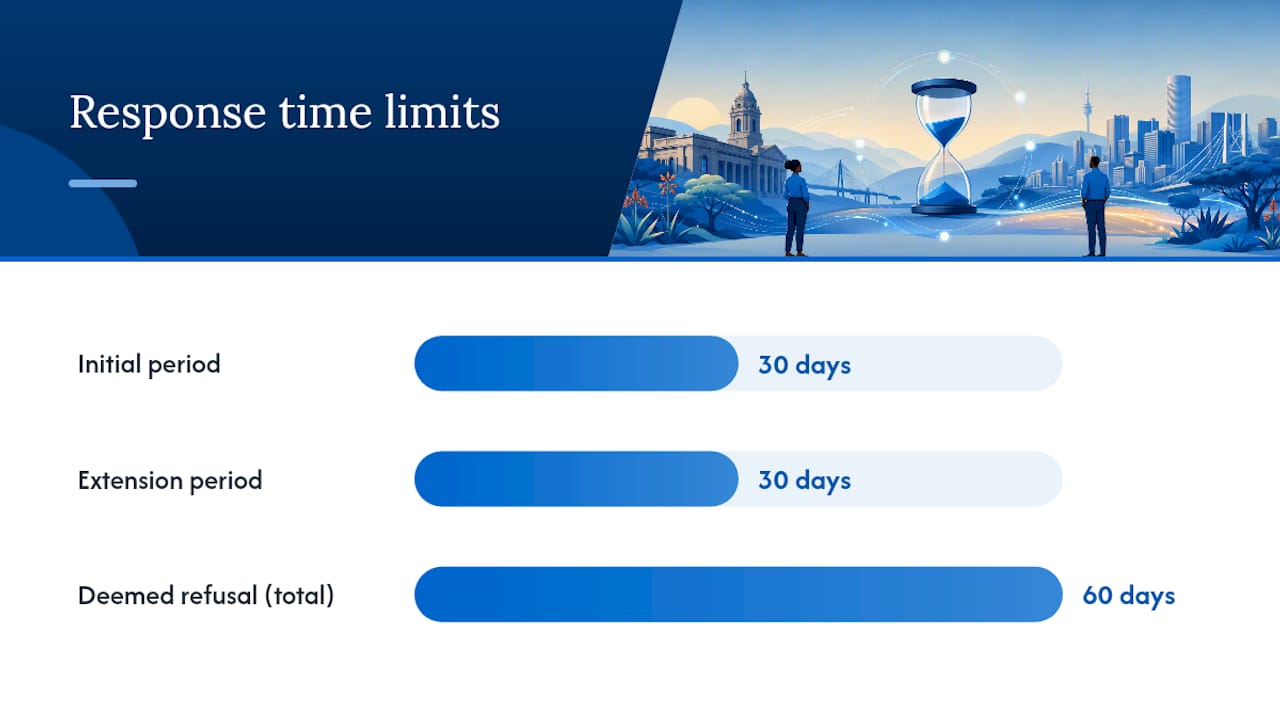
If no response arrives within the initial period or the extended one, the request is deemed refused. That deemed refusal isn’t a dead end. It’s actually a trigger: it gives you standing to lodge an internal appeal (for public bodies) or a complaint to the Information Regulator, without waiting any longer for a reply that may never come.
Fees work differently depending on what you’re asking for and who you’re asking:
- Request fees apply to most requests to public bodies, but personal-information requests (asking for records about yourself) are generally exempt from the request fee.
- Access fees cover the actual cost of reproduction, such as per-page photocopying charges, and apply once access is granted.
- Deposit rules can require partial payment upfront for larger or more complex searches, refundable or offset against the final fee.
- Income-based exemptions exist for individuals who can show they can’t afford the prescribed fees, though this needs to be motivated in writing.
Private bodies can also charge these fees, though the exemption categories and amounts differ slightly from the public-body schedule, so check the specific body’s PAIA manual before assuming a fee applies.
What happens if your PAIA request is refused or ignored?
A refusal or a deemed refusal isn’t the end of the process. PAIA builds in two escalation routes, and using the right one at the right time matters more than most requesters expect.
- File an internal appeal using Form 04, but only against public bodies. Private bodies don’t have an internal appeal step; a refusal from a private body goes straight to a complaint with the Information Regulator.
- Lodge a complaint using Form 05 with the Information Regulator if the internal appeal fails, if the body is private, or if you’d rather skip the internal appeal entirely. The Information Regulator’s PAIA guide sets a 180-day window from the date of refusal or deemed refusal to lodge this complaint. Miss that window, and you’ll need to apply for condonation explaining the delay.
- Attach your evidence. Include proof of your original submission, a timeline showing when the 30-day (and, if applicable, extended) period lapsed, and a short explanation of why the record matters to you or what right depends on it.
- Expect mediation or investigation from the Regulator once the complaint is accepted, and understand that court action remains available if the Regulator’s process doesn’t resolve the matter or if you need urgent relief.
Requesters who skip the paperwork trail regret it later. A complaint without a stamped receipt or an email timestamp showing exactly when the body received the request is a much harder case to argue.
Building your evidence trail before you even file
Before drafting anything, search what’s already public. If a record sits in an accessible archive, filing PAIA for it wastes time and, depending on the body, may cost you a fee for something you could have found in minutes. The Madlanga Commission’s own archive publishes daily hearing records, exhibits, and witness testimony as proceedings unfold, and checking there first is standard practice before triggering a formal request anywhere else.
Once you’ve confirmed a PAIA request is genuinely necessary, treat the submission itself as evidence-generation, not just paperwork:
- Send your request to both the named Information Officer and any administrative PAIA contact listed in the manual; the administrative contact often processes faster than a senior officer buried in other duties.
- Request a read receipt on email, or ask for a stamped copy if hand-delivering.
- Keep registered post slips and delivery confirmations; these are what start and prove the 30-day clock in any later appeal.
- If you’re submitting on behalf of someone who can’t read or write, the Information Officer is required to provide reasonable assistance, including completing Form 2 on the requester’s behalf, free of charge.
Pro Tip: Screenshot your email’s sent timestamp and any delivery confirmation the moment you submit. That single screenshot has settled more than one dispute over whether a body actually received a request on time.
Quick checklist and sample structure for your request
Before you hit send, run through this:
- Form 2, fully completed
- Certified ID copy attached
- Letter of authority attached, if requesting on someone else’s behalf
- Reference numbers or dates included wherever you have them
- Manner of access clearly selected
Structure the request itself in this order: your particulars and ID reference first, then the exact record description (dates, department, file number), then your chosen manner of access, then contact details, then your signature and date.
- Be narrow, not broad
- Name specific dates instead of a date range spanning years
- Include any reference number you already have
- Avoid open-ended phrasing like “all records about X”
Why check the archive before you file
Many of the records people chase through PAIA are already sitting in the Madlanga Commission’s public archive: hearing transcripts, exhibits, rulings, and witness statements published as the inquiry proceeds. Checking there first often answers the question in minutes, at no cost and with no 30-day wait.
PAIA still matters for anything the Commission hasn’t published, or for records held by other bodies entirely. But skipping the archive check first is, in practice, the single most avoidable delay in the whole process.
— Meriol Lainchyon
A faster route than PAIA for Commission-related records
If what you’re after relates to the Madlanga Commission itself, rather than another government body, you may not need to file anything at all. Madlanga Commission maintains a searchable public record of hearing transcripts, exhibits, rulings, and witness testimony, updated as proceedings continue, which covers a large share of what people typically submit PAIA requests to obtain from inquiry-related bodies.
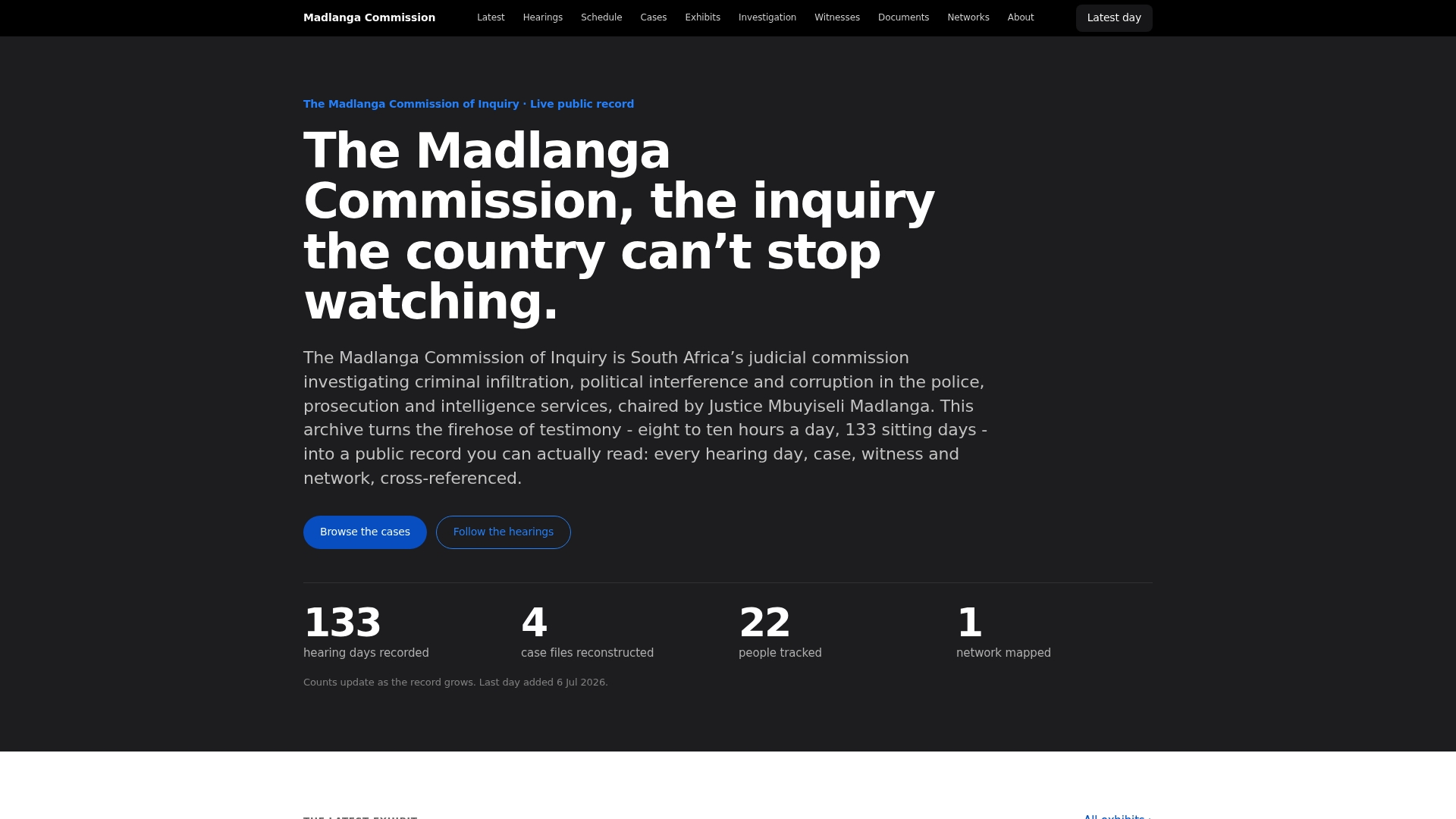
The archive includes profiles of witnesses who have testified, such as the evidence leaders directing the inquiry’s investigative work, alongside daily rulings and case files organized by hearing date. Search the archive first by witness name, date, or case reference. If the record you need genuinely isn’t there, that’s your cue to file a formal PAIA request with the relevant body using the steps above. Start by browsing the evidence leaders page to see how the Commission’s investigative structure maps to the records already published.
Sources
- PAIA FAQs — Department of Basic Education
- PAIA forms — Information Regulator (South Africa)
- Promotion of Access to Information Act, 2000 (PAIA) — SARS
FAQ
What qualifies as a valid PAIA request?
A valid request uses Form 2, includes your ID and contact details, describes the record precisely enough to be located, and states your preferred manner of access.
How do I file a PAIA request with SARS?
Complete Form 2 and submit it with proof of identity to SARS’s designated PAIA contact, and expect acknowledgment and a response within the standard statutory window.
How long does a body have to respond to a PAIA request?
Bodies must respond within 30 calendar days, with one further 30-day extension permitted for complex or consultation-heavy requests.
Who is required to submit PAIA manuals?
Both public and private bodies covered by PAIA must maintain and make available a manual listing their Information Officer, as published by the Information Regulator.
What happens if a body ignores my PAIA request?
If no response arrives within the 30-day window (or the extended 60-day period), the request is deemed refused, which lets you file an internal appeal or a complaint to the Information Regulator within 180 days.