PIC Corruption: South Africa’s Governance Crisis Explained

The Public Investment Corporation is Africa’s largest asset manager, responsible for investing the retirement savings of a substantial number of South African public servants through the Government Employees Pension Fund (GEPF). The PIC corruption scandal is not a single incident. It is a pattern of politically driven investments, suppressed whistleblower reports, boardroom warfare, and incomplete reforms that have persisted for years despite a landmark commission of inquiry.
Key facts at a glance:
- The Mpati Commission, established in October 2018 and chaired by Justice Lex Mpati, produced numerous recommendations targeting systemic corruption and governance failures.
- CEO Patrick Dlamini was placed on precautionary suspension amid whistleblower allegations of corruption, mismanagement, and executive overreach.
- The Isibaya Fund, a politically connected vehicle prioritizing Black capitalist financing, resulted in reckless investments and significant estimated losses to the GEPF.
- The Financial Sector Conduct Authority (FSCA) formally intervened under Section 135 of the Financial Sector Regulation Act after the PIC withheld whistleblower reports from regulators.
- Finance Minister Enoch Godongwana insists the Mpati recommendations have been implemented. The Association for the Monitoring and Advocacy of Government Pensions (AMAGP) calls that claim dishonest.
The stakes are not abstract. Every public servant whose pension sits inside the GEPF is exposed to the consequences of these failures.
What did the PIC Commission and Mpati inquiry actually investigate?
The Mpati Commission of Inquiry was established in October 2018 after mounting allegations of impropriety at the PIC reached a point where the government could no longer ignore them. President Cyril Ramaphosa appointed retired Judge President Justice Lex Mpati to lead the inquiry, giving it a broad mandate to examine corruption, governance failures, and improper investment decisions at Africa’s largest asset manager. The PIC Commission operated as a formal judicial body with the authority to compel testimony and examine internal records.
The commission’s terms of reference covered three core areas: whether PIC investments were made in breach of fiduciary duties, whether political interference shaped investment decisions, and whether governance structures were adequate to protect beneficiaries. That last question turned out to be the most damaging finding of all.

| Commission element | Detail |
|---|---|
| Established | October 2018 |
| Chaired by | Justice Lex Mpati |
| Mandate scope | Corruption, governance failures, improper investments |
| Recommendations produced | 276 recommendations |
| Key structural finding | Deputy Minister as ex officio board chair enables political interference |
| Recommended chair profile | Independent, non-executive, with pension fund expertise |
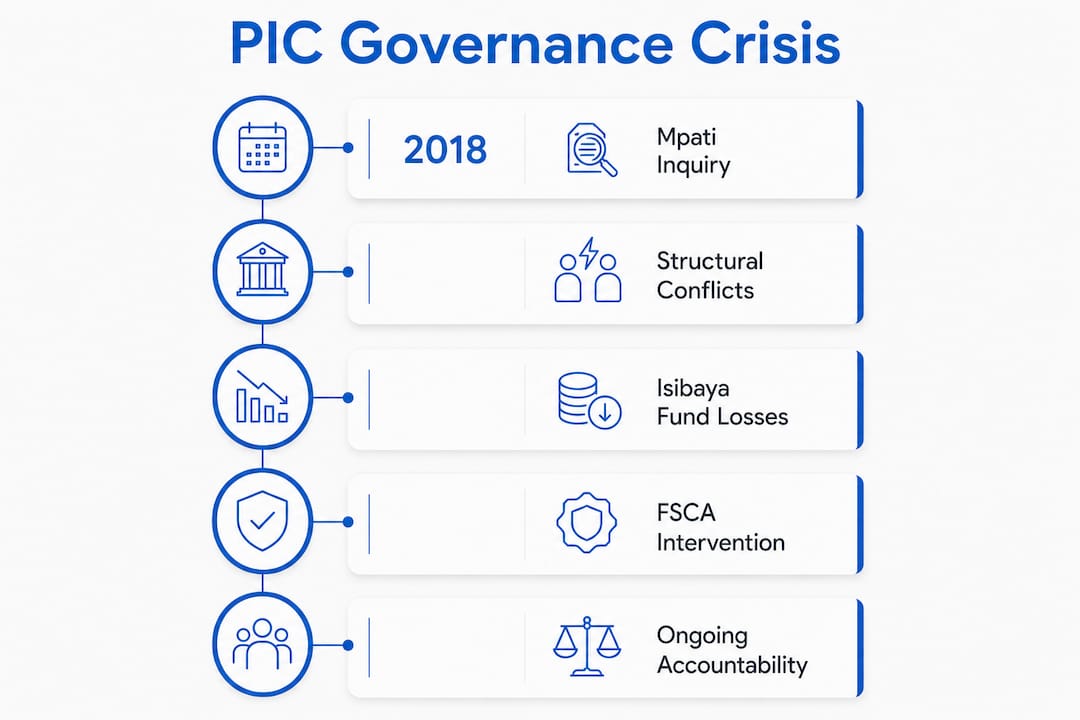
The commission also directed the PIC board to formally reconsider governance structures surrounding the reinstatement of Company Secretary Bongani Mathebula. Following the report, the former executive head of Risk Management was dismissed in 2018 for dealings in the VBS Mutual Bank saga. Former CFO Matshepo More was fired in October 2021 for misconduct linked to institutional irregularities, though the PIC is currently appealing an arbitration ruling that ordered her reinstatement.
Parliamentary oversight sits alongside the commission process. The Standing Committee on Finance (SCOF) has repeatedly demanded accountability from PIC leadership, and its role in pressing for disclosure of the GEPF investment mandate has become one of the most visible pressure points in the ongoing accountability effort.
Key commission outcomes:
- Identified the Deputy Minister’s automatic board chairmanship as a structural flaw enabling political capture.
- Recommended an independent, non-executive chairperson with specialized expertise in finance, pension funds, and corporate governance.
- Produced numerous recommendations covering investment governance, executive accountability, and whistleblower protections.
- Triggered dismissals of senior executives implicated in the VBS Mutual Bank scandal and other misconduct.
How the Isibaya Fund became a symbol of PIC mismanagement
The Isibaya Fund was designed to channel PIC capital into developmental and transformation investments, particularly those supporting Black economic empowerment. In practice, it became a vehicle for politically connected deals that prioritized ideological goals over fiduciary discipline. The Democratic Alliance estimates the PIC lost significant amounts through failed Isibaya investments, compromising the GEPF’s financial soundness.
The fund’s failures were not simply the result of bad market timing. Investments were described as reckless and politically driven, with due diligence processes bypassed or overridden. Parliamentary critics pointed to a pattern where the PIC’s mandate to generate returns for pension beneficiaries was subordinated to the goal of financing a preferred class of politically connected businesses.
The consequences for GEPF beneficiaries are real, even if the GEPF itself remains technically solvent. Finance Minister Godongwana has stated that “the GEPF remains a financially sound and well-funded pension fund,” but added that “recurring governance concerns at the PIC inevitably undermine the confidence of public servants whose retirement savings are entrusted to the institution.” That erosion of confidence is itself a form of harm, particularly for workers who have no alternative fund.
Key Isibaya Fund failure points:
- Investments prioritized political connectivity over fiduciary returns.
- The DA publicly estimated losses in the billions, citing compromised GEPF soundness.
- Parliamentary criticism focused on bypassed due diligence and opaque reporting.
- The fund’s failure became a central exhibit in the broader case for governance reform at the PIC.
Separately, a contested investment transaction involving Lanseria Airport reportedly incurred a large overvaluation error, illustrating how individual deal failures compound into systemic credibility damage. For those tracking the documentary evidence behind these transactions, the Madlanga Commission exhibits archive provides a useful reference point for how similar evidence is handled in formal inquiry settings.
Why governance at the PIC keeps failing
The root cause of PIC’s governance crisis is structural, not incidental. The Mpati Commission found that placing the Deputy Finance Minister in the role of ex officio board chair creates an inherent conflict of interest, enabling political interference that destabilizes executive leadership and compromises fiduciary obligation. That structural flaw has never been corrected.
The consequences show up in predictable ways. Board factionalism intensifies whenever a politically sensitive investment decision reaches the table. Whistleblower reports get used internally against the people who filed them rather than triggering independent investigations. And anti-corruption frameworks that look credible on paper fail to change actual behavior because the culture that produces misconduct remains intact.
Pro Tip: When evaluating any state institution’s governance claims, check whether structural conflicts of interest have been removed, not just whether new policies have been written. Policy documents without structural change are performance, not reform.
AMAGP chairman Zirk Gous put it plainly: the PIC’s claim that all Mpati recommendations were fully implemented, as reported to SCOF in December 2025, “is dishonest, which has destroyed trust by its actions.” The persistence of cronyism and political patronage renders anti-fraud frameworks performative, regardless of what the compliance reports say.
Current governance failure indicators:
- Deputy Minister David Masondo remains board chair, maintaining the structural flaw the Mpati Commission explicitly recommended removing.
- CEO Patrick Dlamini suspended in 2026 amid corruption and mismanagement allegations.
- Acting Chief Investment Officer August van Heerden removed amid the same boardroom conflict.
- Two board members, Thabi Nkosi and Nosiphiwo Balfour, resigned in July 2026, citing material governance disagreements.
- A source described the board as effectively split into two factions, with some members reporting to the minister and others to the chair.
- The Ethics Office established post-Mpati monitors conduct but has not demonstrably changed organizational culture.
The Lanseria Airport overvaluation and the Isibaya Fund losses are symptoms of a board that cannot make independent decisions because independence was never built into its design.
What is being done to hold the PIC accountable?
The FSCA’s intervention in 2026 represents the most direct regulatory pressure the PIC has faced since the Mpati Commission itself. Acting under Section 135 of the Financial Sector Regulation Act, the FSCA engaged the PIC over severe concerns about governance, transparency, and leadership stability. The trigger was specific: the PIC had withheld whistleblower reports from the regulator despite an explicit request made at a supervisory meeting on June 29, 2026.
FSCA Commissioner Unathi Kamlana wrote directly to board chair David Masondo, noting that the reports had been promised but never delivered. Masondo’s response revealed something striking: the board itself had not been told about the FSCA’s request. The executive had filtered out the regulator’s demand before it reached the board. That breakdown in information flow is not a minor procedural lapse. It is evidence of exactly the kind of opacity the Mpati Commission warned against.
| Accountability mechanism | Status in 2026 |
|---|---|
| FSCA regulatory intervention | Active, under Section 135 of the Financial Sector Regulation Act |
| SCOF parliamentary oversight | Demanding full GEPF investment mandate disclosure |
| Whistleblower protections | Formally revised but functionally contested |
| Mpati recommendations | 276 produced; implementation disputed by AMAGP |
| CEO suspension | Patrick Dlamini suspended pending investigation |
| Board restructuring | Nine new members appointed in september 2026, creating factions |

The Standing Committee on Finance has called for full disclosure of the GEPF investment mandate, particularly regarding unlisted investments historically linked to corruption. Gous of AMAGP argues this should be the first document released. Unlisted assets are the category where due diligence is hardest to verify and political influence is easiest to hide.
Civil society groups, investigative journalists, and parliamentary watchdogs have all intensified scrutiny since the 2026 suspension of Dlamini. Media coverage has shifted from periodic scandal reporting to sustained institutional analysis, with outlets tracking board meeting outcomes, regulatory correspondence, and executive movements in real time. For those conducting deeper research into how South African commissions of inquiry handle this kind of institutional evidence, the Madlanga Commission case files offer a structured reference for how testimony and documentary evidence are formally processed.
Accountability efforts currently underway:
- FSCA formal intervention demanding governance and transparency improvements.
- SCOF pressing for GEPF mandate disclosure on unlisted investments.
- AMAGP publicly contesting PIC’s compliance claims and calling for structural reform.
- Investigative media tracking board correspondence and regulatory letters in real time.
- Civil society demanding removal of political appointees from board leadership roles.
For those assessing whether the PIC’s governance reforms are substantive or cosmetic, the framework developed by specialists in regulatory compliance offers a useful benchmark for what genuine institutional accountability looks like in practice.
How the Madlanga Commission connects to PIC accountability
The Madlanga Commission of Inquiry, chaired by Justice Mbuyiseli Madlanga, investigates criminal infiltration, political interference, and corruption within South Africa’s police, prosecution, and intelligence sectors. While its direct mandate differs from the Mpati Commission’s focus on the PIC, the institutional dynamics it examines overlap significantly. Political capture of state institutions, suppression of internal accountability, and the gap between stated compliance and actual conduct are patterns the Madlanga Commission documents across multiple sectors of South African governance.
Citizens, journalists, and activists tracking PIC corruption will find the Madlanga Commission’s searchable archive of hearings, case files, witness profiles, and exhibits a useful model for how formal inquiry evidence is structured and made publicly accessible. Understanding what a commission of inquiry can and cannot compel, and how its recommendations translate into legal and institutional outcomes, is foundational knowledge for anyone following the PIC accountability process.
Key Takeaways
The PIC corruption crisis is structural, not incidental: the Deputy Minister’s role as board chair has never been removed despite the Mpati Commission’s explicit recommendation, and political interference continues to drive executive instability and compromised investment decisions.
| Point | Details |
|---|---|
| Mpati Commission scope | Produced 276 recommendations targeting systemic corruption and governance failures at the PIC. |
| Isibaya Fund losses | The DA estimates billions lost through failed, politically driven Isibaya investments compromising the GEPF. |
| FSCA intervention | The regulator formally intervened under Section 135 after the PIC withheld whistleblower reports in 2026. |
| Structural flaw unresolved | The Deputy Minister remains board chair, the root cause the Mpati Commission identified for political capture. |
| Implementation disputed | AMAGP calls the PIC’s claim of full Mpati compliance dishonest, citing persistent governance lapses. |
FAQ
What is the PIC corruption scandal about?
The PIC corruption scandal centers on politically driven investments, governance failures, and suppressed accountability at the Public Investment Corporation, Africa’s largest asset manager. The Mpati Commission produced 276 recommendations after finding systemic corruption and improper investment decisions that put GEPF beneficiaries’ retirement savings at risk.
What are examples of public sector corruption at the PIC?
The Isibaya Fund represents the clearest documented case: a politically connected investment vehicle that resulted in billions in estimated losses through reckless, due-diligence-bypassing deals. The PIC also withheld whistleblower reports from the FSCA in 2026, a direct example of institutional opacity obstructing regulatory oversight.
What causes political corruption in state institutions like the PIC?
Structural conflicts of interest are the primary driver. At the PIC, placing the Deputy Finance Minister as ex officio board chair gives the executive branch direct influence over an institution that is supposed to operate independently in the interests of pension beneficiaries.
What is the role of the FSCA in the PIC investigation?
The FSCA intervened formally under Section 135 of the Financial Sector Regulation Act in 2026, demanding governance improvements and transparency after the PIC failed to provide whistleblower reports that had been explicitly requested at a june 2026 supervisory meeting.
Has anyone been held accountable for PIC corruption?
Yes, though accountability has been incomplete. The former executive head of Risk Management was dismissed in 2018 for VBS Mutual Bank dealings, and CFO Matshepo More was fired in october 2021 for misconduct. CEO Patrick Dlamini was suspended in 2026, but broader structural reforms recommended by the Mpati Commission remain contested and unfinished.