Where to find every Madlanga Commission hearing record
The Madlanga Commission of Inquiry into the Criminal Justice System keeps its entire public record at Madlangacommission, organized as a searchable archive rather than a scattered pile of PDFs. Chaired by Retired Justice Mbuyiseli Madlanga, with Advocate Sesi Baloyi SC and Advocate Sandile Khumalo SC leading evidence, the Commission has built a public record covering testimony from figures like Lieutenant-General Nhlanhla Mkhwanazi, and its second interim report went to the President on 29 May 2026.
The archive holds:
- Daily hearing transcripts and verbatim video recordings
- Exhibits and supporting attachments filed as evidence
- Interim and final reports
- Witness lists, case files, and formal rulings
You can search by hearing day, witness name, exhibit number, or keyword. After 152 sitting days, the archive contains more than 40 official documents, giving journalists and legal professionals a single reliable point of reference instead of hunting through press releases.
Key Takeaways
Reliable research on the Madlanga Commission depends on distinguishing tested evidence from raw allegation, and citing the exact hearing day and phase behind every claim.
| Point | Details |
|---|---|
| Start at the source | Use Madlangacommission directly rather than secondhand news summaries of testimony. |
| Match evidence to its phase | Phase-three cross-examination carries more weight than untested phase-one allegations. |
| Use PAIA for restricted records | File a written request naming the exact hearing, witness, or exhibit for faster turnaround. |
| Cite with full metadata | Record hearing day, witness, exhibit number, and access date for every citation. |
| Treat Madlanga Commission as the archive of record | It holds 152 sitting days and over 40 official documents, more comprehensive than any single news report. |
Table of Contents
- Requesting additional or restricted records from police oversight bodies
- What is the current status of the Madlanga Commission?
- How should you cite Madlanga Commission documents?
- How do I access hearing videos and audio in the archive?
- What is the Madlanga Commission’s mandate and structure?
- What conventional wisdom about accountability gets wrong
- Use the Commission’s own archive as your primary source
- Primary sources worth opening first
- Sources
- FAQ
Requesting additional or restricted records from police oversight bodies
Most of what the Commission generates is already public, but some material sits behind protections, particularly testimony tied to witness safety. If you need something the archive doesn’t show, your first move is a written request to the Commission’s secretariat identifying the exact hearing day, witness, or exhibit number you’re after. Vague requests (“everything about SAPS corruption”) get deprioritized; specific ones move faster.
For records the Commission has withheld on confidentiality or safety grounds, South Africa’s Promotion of Access to Information Act gives you a formal mechanism. A PAIA request must specify the record, the reason for access, and the form in which you want it delivered. Public bodies generally have 30 days to respond, though that clock can extend if the request needs referral or if third parties (like a named witness) must be consulted before release.
Court orders come into play only when the Commission or a government body invokes a specific legal exemption and refuses release outright. That path is slow, sometimes taking months, and usually needs a lawyer.
Pro Tip: File your PAIA request in writing with the exact hearing date and witness name attached. Requests tied to a specific record move faster than open-ended fishing expeditions.
What is the current status of the Madlanga Commission?
President Cyril Ramaphosa established the Commission in July 2025 to investigate whether criminal syndicates and political actors infiltrated policing, intelligence, the National Prosecuting Authority, and parts of the judiciary. Public hearings opened on 17 September 2025, and the Commission has worked through a phased structure ever since.
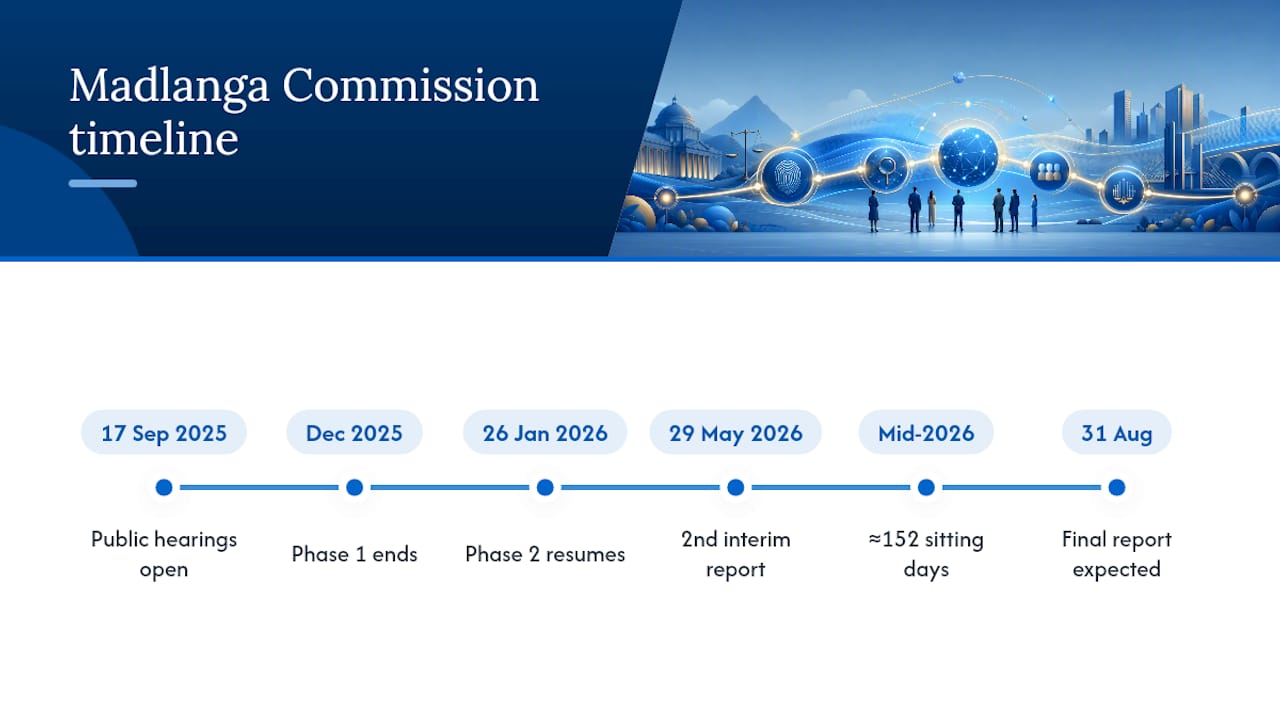
Phase one, which ran to December 2025, laid the factual groundwork for Lieutenant-General Mkhwanazi’s original allegations. Phase two, which resumed on 26 January 2026, gave implicated individuals and institutions room to respond. Phase three is where cross-examination tests that evidence directly, and it’s the phase producing the sharpest, most reliable material for anyone building a case or a story.
By mid-2026 the Commission had logged roughly 152 sitting days, and its second interim report reached the President on 29 May 2026. Reporting at the time pointed to a final report expected by 31 August. If you’re tracking the inquiry’s trajectory, the archive’s daily hearing pages are the most current source, updated faster than most news coverage can keep pace with.
For citation purposes, always note which phase a record comes from. A phase-one allegation and a phase-three cross-examination finding are not equivalent evidence, even when they concern the same witness or the same claim.
How should you cite Madlanga Commission documents?
Treat Commission records the way you’d treat any primary legal or parliamentary source: cite the specific document, not the Commission generally. A proper citation includes the hearing day, the witness or party involved, the transcript page or video timecode, and the exhibit number if one applies, along with the archive URL and the date you accessed it.
This matters more than it might seem. Commission testimony is not automatically proven fact. Evidence presented in phase one is often an allegation awaiting response; only after cross-examination in phase three does a claim get properly tested. Academic and legal writing should flag which stage a piece of testimony reached, since conflating an unchallenged allegation with a tested finding is a factual error, not a stylistic one.
Journalists face an added wrinkle: some individuals named in testimony have not been charged or convicted of anything. Reporting an allegation as established fact, without noting its untested status, carries real defamation risk under South African law. Legal professionals citing Commission material in court filings should similarly distinguish sworn testimony from documentary exhibits, since courts weigh them differently.
The Methodology, Sourcing & Corrections page on the archive explains how records are compiled and corrected, and citing it alongside a specific document shows a reader or a court exactly how the underlying material was sourced. That single habit does more for your credibility than any amount of hedging language.
How do I access hearing videos and audio in the archive?
Every hearing-day page pairs a written transcript with the corresponding video recording, so you can read along or verify a specific quote against the actual footage. The videos stream through a standard web browser, no special plugin or subscription required, and they work on desktop, tablet, and most modern smartphones.
If a video won’t load, the usual culprits are a slow connection or an outdated browser. Try refreshing on Chrome, Firefox, or Safari’s current version before assuming the file itself is broken. On mobile data, streaming a full day’s hearing can consume a meaningful chunk of data, so downloading over Wi-Fi is worth doing if you need offline access for later reference or a newsroom deadline.
Transcripts are available as searchable text, which makes them far more useful than the video alone when you’re hunting for a specific exchange. Search a witness’s name or a keyword and jump straight to the relevant passage, then cross-check the timecode against the video if you need the exact wording or tone.
Exhibits attached to a hearing day usually come as scanned documents or images, viewable directly in the browser without a separate download. Older or lower-bandwidth devices sometimes render these slowly given file size, so patience helps, particularly with multi-page exhibits.
If a specific clip or document genuinely won’t open after multiple attempts, that’s worth flagging to the archive directly rather than assuming the record isn’t public. Broken links get fixed faster when someone reports them.
What is the Madlanga Commission’s mandate and structure?
The Commission functions as a formal judicial inquiry, not a criminal court, which shapes everything about how its archive should be read. It cannot convict anyone. What it can do is gather sworn testimony, subpoena documents, and hand findings to the President and, where warranted, to prosecutors.
Retired Justice Mbuyiseli Madlanga chairs the proceedings, with Advocate Sesi Baloyi SC and Advocate Sandile Khumalo SC serving as evidence leaders who question witnesses and present documentary material. You can see full profiles of the chair and counsel alongside other named participants in the archive’s people pages, useful when you need to attribute a specific ruling or line of questioning correctly.
The mandate itself covers five broad themes that Commission watchers now shorthand as the “Big Five”: political interference in police investigations, corruption inside SAPS, the NPA, and the judiciary, the disbandment of specialised units, infiltration by organised crime networks, and whether prima facie evidence should trigger disciplinary or criminal follow-up. Testimony has already led to real consequences, including the dismissal of Major-General Richard Shibiri.
Understanding this structure matters for law enforcement accountability more broadly. A judicial commission like this one operates differently from a standing civilian oversight committee. It has a fixed mandate, a defined end date, and a public archive built specifically so citizens can verify its work without attending hearings in person. For readers used to thinking about interagency police oversight in the abstract, the Madlanga Commission is what that accountability looks like in practice, documented and downloadable.
What conventional wisdom about accountability gets wrong
Most public discussion of police oversight bodies treats a commission of inquiry as a courtroom drama: dramatic testimony, a headline, done. That framing misses the actual value of what the Madlanga Commission has built, which is a working archive that lets law enforcement accountability move at a slower, more careful pace than the news cycle allows.
The bigger error is treating phase-one allegations as settled conclusions. A claim made by Lieutenant-General Mkhwanazi in his opening testimony is not the same evidentiary weight as a finding that survives phase-three cross-examination. Reporters and even some legal commentary have blurred that line, and it does real damage to individuals named before they’ve had a chance to respond.
What the research here actually supports is a simple discipline: always check which phase a piece of testimony belongs to before citing it as fact. That single habit separates careful research from recycled headlines, and it’s the one thing conventional coverage of this inquiry consistently skips.
Use the Commission’s own archive as your primary source
Skip the secondhand summaries. The Madlanga Commission archive at Madlangacommission is the authoritative, searchable record of every hearing, transcript, video, and exhibit the inquiry has produced, and it’s free to use.
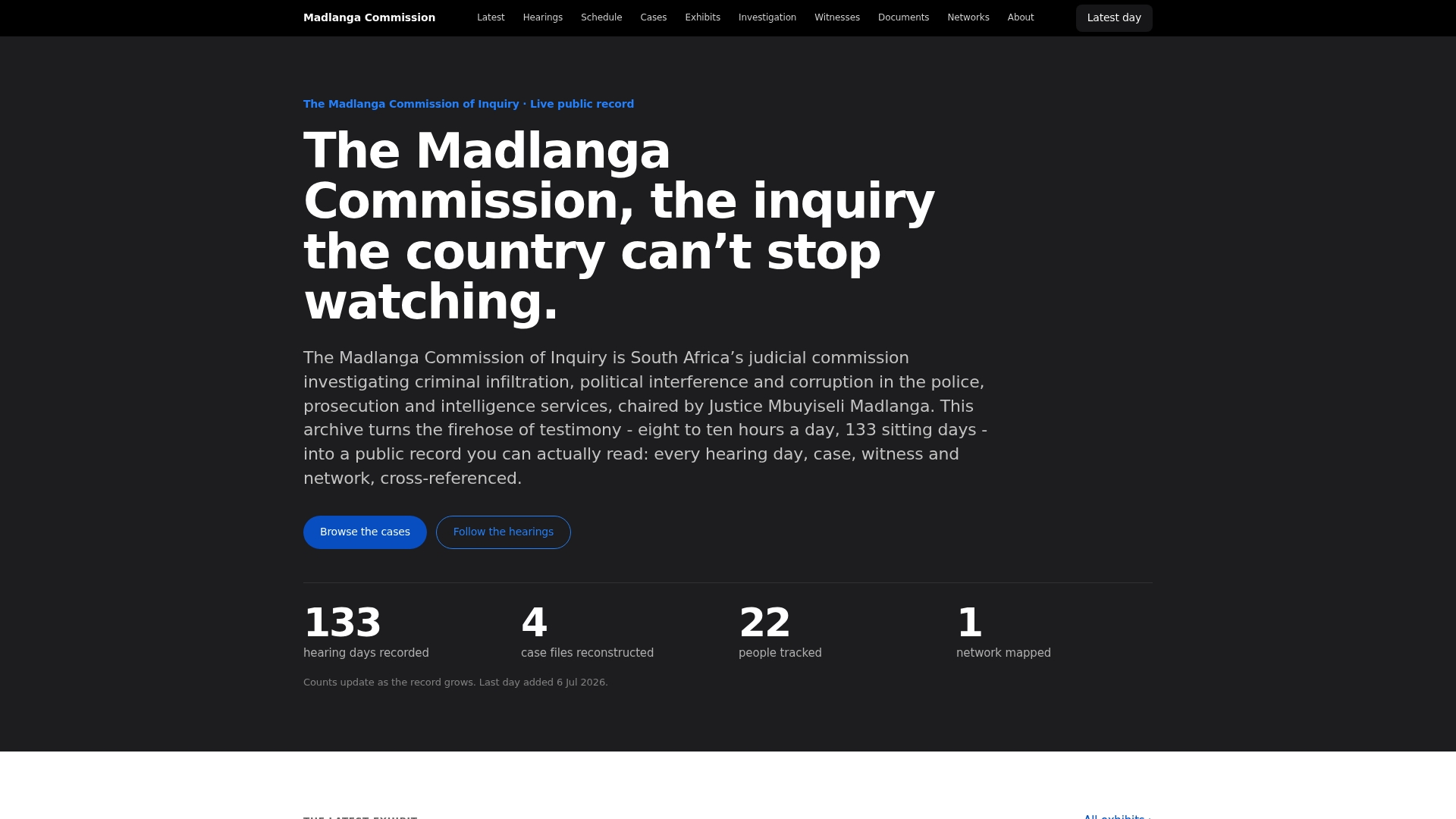
Journalists get verbatim transcripts and video clips they can quote directly instead of relying on wire summaries. Legal professionals get official exhibits and rulings formatted for citation in filings. Researchers and activists get cross-referenced case files that link witness profiles, exhibits, and rulings across related investigations, so tracing a network of allegations doesn’t mean opening forty separate tabs.
Start with a single hearing day, such as Day 123, from 22 June 2026, open the transcript, and download the exhibit you need directly from the page.
Pro Tip: Save the hearing date, witness name, and exhibit number together for every document you pull. That trio, combined with the archive’s URL, is everything a proper citation needs.
Primary sources worth opening first
Start with the interim report from 29 May 2026, the methodology page, and daily hearing pages covering testimony from Lieutenant-General Nhlanhla Mkhwanazi and Lieutenant-General Dumisani Khumalo.
- Highest-priority witness pages: Mkhwanazi’s opening testimony, Khumalo’s crime-intelligence evidence, and exhibits naming Vusimusi “Cat” Matlala
- Also check records tied to Major-General Richard Shibiri and Major-General Lesetja Senona for personnel-impact context
- Watch for pseudonymous testimony or closed-session notes, which flag witness-safety redactions
- For every citation, copy: hearing day, transcript page or timecode, exhibit number, URL, and access date
This article is general information, not a substitute for advice from a qualified lawyer. Consult a qualified legal professional about your own circumstances before acting on anything here.
Sources
- A year of Madlanga: the inquiry investigating corruption, crime and political interference
- 152 days later, the three legal minds continue probing allegations of criminality | Conviction
- Madlanga Commission update: Next phases and what lies ahead
FAQ
Where can I access Madlanga Commission hearing records?
The full public archive is at Madlangacommission, organized by hearing day, witness, and exhibit number, with transcripts and video for each session.
How many sitting days has the Commission held?
The Commission had completed roughly 152 sitting days by mid-2026, generating more than 40 official documents in its public record.
Can I request records not in the public archive?
Yes, through a written request to the Commission’s secretariat or a formal PAIA request specifying the exact record, though witness-safety protections may limit what’s released.
When is the Commission’s final report expected?
Its second interim report went to the President on 29 May 2026, with reporting at the time pointing to a final report by 31 August.
Is testimony in the archive proven fact?
No. Phase-one testimony is often an untested allegation; only evidence that survives phase-three cross-examination carries confirmed evidentiary weight.