Richard Mdluli: SAPS Crime Intelligence Corruption Explained

TL;DR:
- Richard Mdluli led South Africa’s Crime Intelligence from 2009 to 2011 and became involved in a corruption scandal. His case revealed political abuse, financial misconduct, and delayed legal proceedings that lasted over a decade. The Madlanga Commission offers a transparent record of misconduct and highlights political interference influencing police accountability.
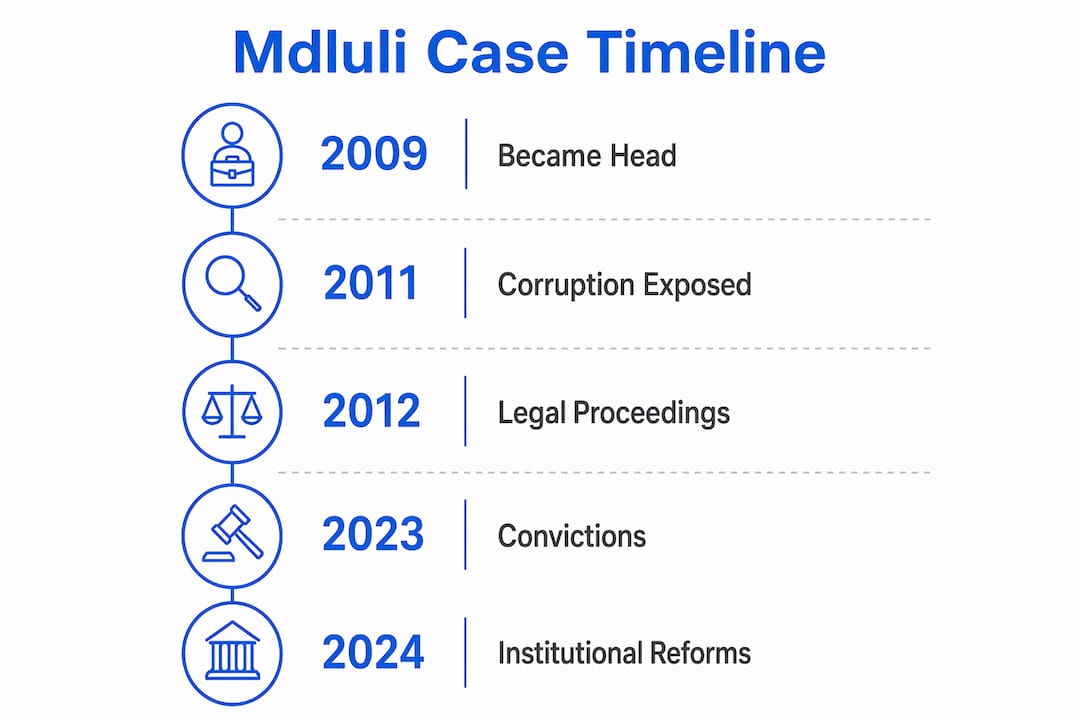
Richard Mdluli is the former head of South African Police Service (SAPS) Crime Intelligence, widely recognized as a central figure in one of South Africa’s most damaging corruption scandals. He served in that role from 2009 to 2011, during which time he allegedly transformed a national security body into a political instrument. His case spans kidnapping, assault, fraud, and murder charges, and it directly implicates senior political figures including former president Jacob Zuma. The Madlanga Commission of Inquiry has placed his conduct under renewed public scrutiny, making his story a defining reference point for anyone studying political corruption in South African policing.
What was Richard Mdluli’s role in weaponizing SAPS Crime Intelligence?

Crime Intelligence is supposed to gather and analyze threats to national security. Under Mdluli, that mission was redirected. Mdluli transformed Crime Intelligence into a politically loyal unit that served Jacob Zuma’s interests rather than the public. The unit’s resources, personnel, and covert access were all bent toward protecting allies and neutralizing political opponents.
The most concrete evidence of this abuse centers on slush funds. Crime Intelligence operates with off-the-books budgets that are shielded from standard auditing processes. Slush fund abuses formed a “friends and family” system that diverted covert funds toward luxury lifestyle expenses, including personal benefits for Mdluli and those close to him. That kind of financial opacity is exactly what makes intelligence units vulnerable to this type of corruption.
Testimony at parliamentary hearings added further detail. A former Crime Intelligence official named Dotyeni told parliament that Mdluli promoted his girlfriend within the unit, using his position to reward personal relationships at the expense of merit and institutional integrity. This pattern of nepotism compounded the broader political abuse.
Key documented abuses within Crime Intelligence under Mdluli include:
- Diverting covert operational budgets for personal and political use
- Using intelligence resources to monitor and intimidate political opponents of Zuma
- Promoting personal associates into positions of influence within the unit
- Shielding allies from internal disciplinary processes through his command authority
Pro Tip: When researching SAPS Crime Intelligence corruption, cross-reference parliamentary testimony with commission hearing transcripts. The two sources often reveal contradictions that expose the full scope of misconduct.
How did legal proceedings against Richard Mdluli unfold over the years?
The legal saga against Mdluli spans more than a decade and stands as one of the most protracted criminal cases in South African policing history. The timeline reveals not just legal complexity, but deliberate obstruction.
- Charges filed: Mdluli faced charges including murder, kidnapping, assault, and intimidation, stemming from incidents dating back to 2008 and 2009.
- Legal fee deadlock: Mdluli delayed trial proceedings by insisting that SAPS cover his legal fees. This demand created a legal deadlock that produced multiple withdrawals and reinstatements of charges over several years.
- Corruption trial begins: The trial involving corruption, fraud, and theft began in april 2025, with Mdluli and his co-accused pleading not guilty.
- Conviction: After a 13-year legal saga, Mdluli was sentenced to 5 years for kidnapping, assault, and intimidation.
- Murder charges dropped: The murder charges were struck off the roll due to the circumstantial nature of the evidence.
The murder charge outcome drew significant attention. Prosecutor Andrew Chauke defended the decision not to prosecute for murder, citing evidence that was too circumstantial to meet the required legal threshold. Critics argued that the investigation itself had been compromised, making a stronger evidentiary case impossible to build.
| Charge Category | Outcome |
|---|---|
| Kidnapping, assault, intimidation | Convicted; sentenced to 5 years |
| Murder | Struck off the roll; evidence deemed circumstantial |
| Corruption, fraud, and theft | Trial commenced april 2025; not guilty plea entered |
The legal fee dispute is the detail most analysts overlook. It was not a minor procedural issue. It functioned as a years-long stalling mechanism that kept the most serious charges in legal limbo while Mdluli remained in a senior position. The Madlanga Commission case files document similar delay tactics across multiple policing corruption matters.
Pro Tip: The legal fee dispute tactic is not unique to Mdluli. Tracking how state-funded legal representation is granted or denied in high-profile cases reveals a consistent pattern of institutional protection for senior officials.
What does Mdluli’s case reveal about political interference in South African policing?
Investigators view Mdluli’s case as a masterclass in executive overreach, where deliberate political interference prevented accountability at every stage. That assessment is not rhetorical. The documented record shows interference operating at multiple levels of government simultaneously.
The most direct example involves Police Minister Nathi Mthethwa. Evidence points to alleged instructions from Mthethwa to withdraw charges against Mdluli, effectively using ministerial authority to shield a subordinate from criminal accountability. That kind of top-down interference corrupts the entire chain of command below it.
“Political interference protected Mdluli from disciplinary actions at every level. Police leadership acted under government instructions to overlook evidence, turning the chain of command into a shield rather than a check on misconduct.”
The Madlanga Commission has heard testimony that connects Mdluli’s protection to the broader state capture network. The key figures documented by the Commission show how political loyalty, not legal compliance, determined who faced consequences within SAPS during the Zuma era.
The protection mechanisms that shielded Mdluli followed a recognizable pattern:
- Ministerial intervention to withdraw or delay charges
- Police leadership refusing to act on internal disciplinary findings
- Covert intelligence resources used to monitor and discredit investigators
- Legal fee disputes weaponized to stall proceedings indefinitely
This pattern did not exist in isolation. Parallel structures within the State Security Agency (SSA) operated under similar political logic during the same period. Mdluli’s case is the most documented example, but it reflects a systemic condition rather than a single bad actor.
What impact has Mdluli’s saga had on public trust and institutional reform?
The Mdluli affair caused measurable damage to public confidence in South African police intelligence. When a unit responsible for national security is revealed to have operated as a political protection racket, the credibility of every operation it ran comes into question. That damage does not repair itself when a single conviction is handed down.
The Madlanga Commission plays a direct role in rebuilding that credibility. By making witness testimony publicly accessible, the Commission gives citizens a way to track accountability without relying on official press releases. That transparency is a structural reform in itself, because it removes the information monopoly that allowed misconduct to persist for so long.
Reform efforts connected to the Mdluli case include:
- Calls for independent oversight of Crime Intelligence budgets, specifically the covert funds that enabled slush fund abuse
- Parliamentary scrutiny of how senior SAPS appointments are made and reviewed
- Proposals to limit ministerial authority over criminal prosecutions involving police officials
- Renewed debate over the independence of the National Prosecuting Authority (NPA) from executive influence
The conviction on kidnapping and assault charges matters symbolically, even if the sentence falls short of what critics demanded. It establishes that senior intelligence officials are not untouchable. That precedent is fragile, but it exists. The ongoing corruption and fraud trial, which began in april 2025, will test whether the legal system can sustain that precedent under continued political pressure.
Key Takeaways
Richard Mdluli’s case proves that political interference, not evidentiary weakness, is the primary obstacle to accountability in South African policing corruption.
| Point | Details |
|---|---|
| Crime Intelligence weaponized | Mdluli redirected SAPS Crime Intelligence to serve Jacob Zuma’s political interests rather than national security. |
| Slush fund abuse documented | Covert budgets were diverted to personal and political expenses through an off-the-books “friends and family” system. |
| 13-year legal delay | Legal fee disputes and political interference stalled proceedings for over a decade before conviction. |
| Conviction secured, murder dropped | Mdluli was sentenced to 5 years for kidnapping and assault; murder charges were struck off due to circumstantial evidence. |
| Madlanga Commission role | The Commission provides public access to testimony and case files, creating an independent record of policing corruption. |
The Mdluli case and what it actually tells us about power
By Meriol Lainchyon
I have followed South African policing corruption for years, and the Mdluli case still stands out for one reason: the delay was the strategy. Most corruption cases fail because of weak evidence or poor prosecution. This one was different. The evidence existed. The problem was that the people responsible for acting on it were the same people protecting him.
What strikes me most is how the legal fee dispute was treated as a procedural nuisance rather than what it actually was: a deliberate tactic to exhaust prosecutors and buy time. Independent oversight bodies like the Madlanga Commission matter precisely because they create a public record that political actors cannot quietly erase. Without that record, the Mdluli story would have been buried in procedural footnotes.
The lesson for South African governance is not complicated. Intelligence units need budgets that are auditable by bodies outside the executive chain. Ministerial authority over prosecutions involving police officials needs hard legal limits. And commissions of inquiry need teeth, not just microphones. The Mdluli conviction is a start. It is not a solution.
— Meriol Lainchyon
The Madlanga Commission archive on policing corruption
The Madlanga Commission of Inquiry holds one of the most detailed public records of criminal infiltration and political interference within South African policing. For anyone researching the Mdluli affair or related corruption cases, the Commission’s archives go far beyond news coverage.
The Commission’s full witness testimony archive includes disclosures from officials across SAPS, the NPA, and intelligence structures. These transcripts reveal the internal mechanics of how misconduct was enabled and concealed. The Commission’s methodology page explains how evidence is sourced, verified, and presented, giving readers a clear standard for evaluating every claim. For anyone serious about understanding how South Africa’s justice institutions were compromised, this is the most authoritative starting point available.
FAQ
Who is Richard Mdluli?
Richard Mdluli is the former head of SAPS Crime Intelligence, who served in that role from 2009 to 2011 and became central to investigations into political corruption and misuse of police intelligence resources.
What was Richard Mdluli convicted of?
Mdluli was convicted of kidnapping, assault, and intimidation and sentenced to 5 years. Murder charges against him were struck off the roll because the evidence was deemed circumstantial.
Why did the Richard Mdluli trial take so long?
The trial was delayed for over 13 years primarily because Mdluli demanded that SAPS cover his legal fees, creating a legal deadlock that produced multiple withdrawals and reinstatements of charges before proceedings formally began in april 2025.
How did political interference affect the Richard Mdluli case?
Evidence presented at parliamentary hearings and before the Madlanga Commission shows that Police Minister Nathi Mthethwa allegedly instructed officials to withdraw charges, and that police leadership acted under government direction to overlook evidence against Mdluli.
What role does the Madlanga Commission play in the Mdluli case?
The Madlanga Commission of Inquiry investigates criminal infiltration and political interference in South African policing and prosecution, and its public hearings provide an independent record of testimony and evidence related to cases like Mdluli’s.
Recommended
- The R360 million SAPS Medicare24 tender - and Cat Matlala’s guilty plea - Madlanga Commission
- Case Files of the Madlanga Commission of Inquiry - The Madlanga Commission Archive
- The R200 million Durban port cocaine that vanished from police custody - Madlanga Commission
- Key Figures in the Madlanga Commission - Who’s Who