Robert McBride South Africa: Career, Controversy, and Legacy

TL;DR:
- Robert McBride is a South African police official and former anti-apartheid militant with a controversial career marked by political interference and legal battles. His story highlights systemic issues in South Africa’s policing and accountability institutions, illustrating ongoing struggles with transparency and governance.
Robert McBride is defined by contradiction: a man convicted of murder who became the head of South Africa’s police oversight body. Born on July 6, 1963, in Durban, McBride’s trajectory from anti-apartheid militant to senior law enforcement official places him at the center of every major debate about accountability, political interference, and institutional integrity in democratic South Africa. His roles at the Independent Police Investigative Directorate (IPID), the Ekurhuleni Metropolitan Police, and the State Security Agency (SSA) make him one of the most consequential and divisive figures in South African police history. The Madlanga Commission of Inquiry, which investigates criminal infiltration and political interference in South Africa’s security sector, provides critical context for understanding how figures like McBride shape and are shaped by institutional failures.
What were the major events in Robert McBride’s career?
McBride’s career is a sequence of high-stakes appointments, legal battles, and public controversies that few South African officials can match. Each chapter reveals something different about the country’s political culture and its relationship with its liberation past.
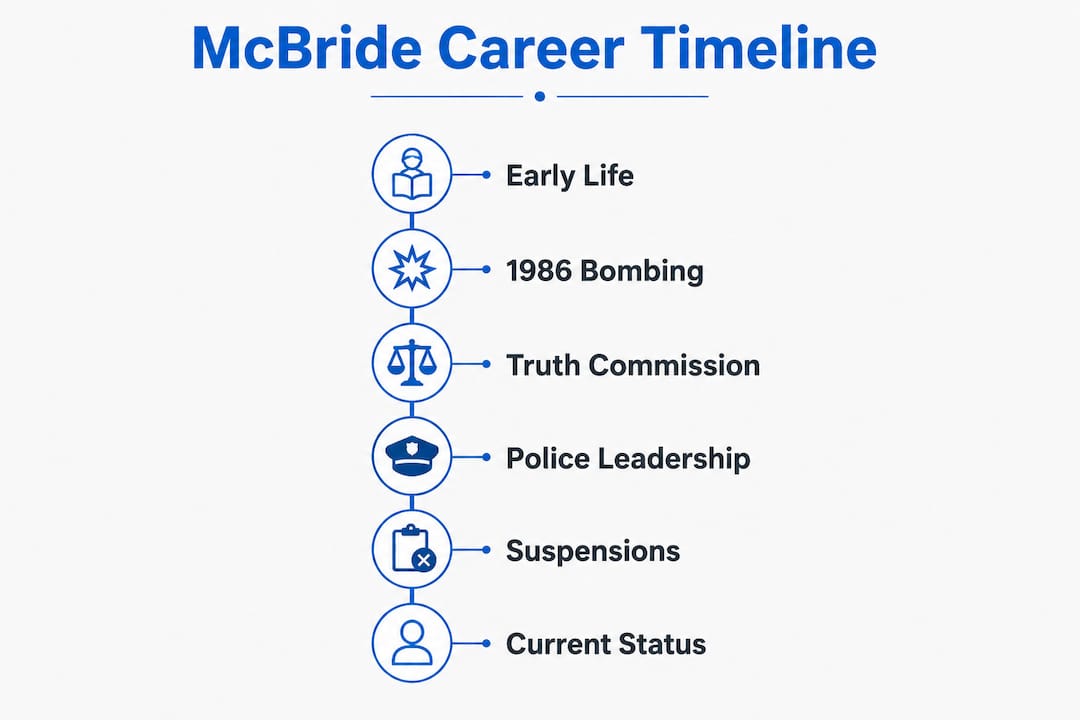
The 1986 bombing and Truth and Reconciliation Commission amnesty
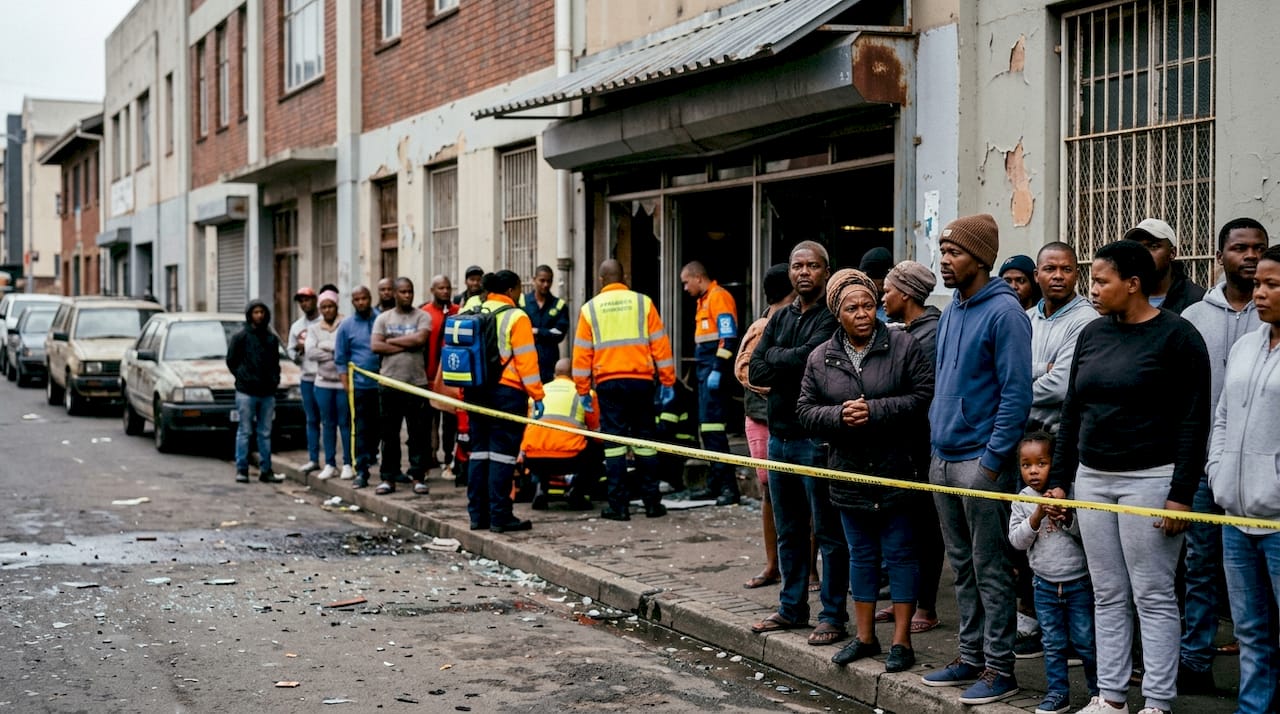
The defining event of McBride’s early life was the june 1986 bombing of Durban’s Why Not Bar, a car bomb attack he carried out as an operative of Umkhonto we Sizwe, the armed wing of the African National Congress. The bombing killed three people) and injured many more. McBride was convicted and sentenced to death, but his sentence was commuted and he was released in 1992. The Truth and Reconciliation Commission later granted him amnesty, classifying the act as politically motivated. That amnesty did not end the controversy. Critics have never accepted the moral equivalence, and the bombing remains the lens through which many South Africans assess everything McBride does in public life.
Appointments, suspensions, and Constitutional Court rulings
After 1994, McBride moved into law enforcement leadership. He served as chief of the Ekurhuleni Metropolitan Police, a role that brought its own controversies. His most prominent appointment came when he was named head of IPID, the body responsible for investigating misconduct and criminality within the South African Police Service (SAPS). That tenure was interrupted by a suspension that ultimately reached the Constitutional Court, which ruled in his favor and reinstated him. The pattern of appointment, suspension, and legal challenge became a signature feature of his career, reflecting both his willingness to confront powerful interests and the political resistance he generated.
In 2020, McBride was appointed head of SSA’s foreign branch for a three-year term. That appointment ended abruptly in 2021 when he was suspended following a failed intelligence operation in Mozambique, during which operatives were reportedly stranded in Maputo. The episode added another layer of institutional embarrassment to a career already defined by conflict.
Pro Tip: When researching McBride’s legal battles, track the Constitutional Court rulings separately from parliamentary proceedings. The two tracks reveal different dimensions of how political interference operates in South African law enforcement.
Why has McBride’s parliamentary testimony been so contentious?
McBride’s january 2026 appearance before an Ad Hoc parliamentary committee generated significant tension and media coverage. The session illustrated how security sector accountability breaks down when legal confidentiality collides with democratic oversight.
The core dispute centered on three specific failures of transparency:
- McBride submitted an outdated CV to the committee, which members quickly identified as incomplete and potentially misleading.
- He refused to disclose his current employment, citing the Intelligence Services Act 39 of 1994 as the legal basis for nondisclosure.
- Chairperson Soviet Lekganyane pressed McBride to name the specific provision preventing disclosure. McBride cited the Act but did not satisfy the committee’s demand for specificity.
“Witnesses in security hearings typically require explicit clearance from a director-general before revealing state security employment details. That procedural requirement, while legally grounded, creates a structural conflict with parliamentary committees that expect full disclosure as a condition of accountability.”
The legal justification McBride offered is not without merit. The Intelligence Services Act does impose confidentiality obligations on individuals connected to state security structures. Clearance from a director-general is the standard requirement before disclosure. The problem is that invoking this protection in a parliamentary hearing, without offering any alternative form of accountability, reads to most observers as evasion rather than compliance.
Submitting an outdated CV compounds that perception. Parliamentary committees treat document accuracy as a baseline condition of good faith. An outdated CV is not a neutral administrative error. It signals either carelessness or a deliberate attempt to limit the committee’s information base. Neither interpretation reflects well on a figure whose career has been built on the premise of holding others accountable.
Pro Tip: When analyzing parliamentary testimony disputes, distinguish between legally protected nondisclosure and procedural bad faith. The two are not the same, and conflating them obscures the real accountability question.
How does McBride’s career reflect broader South African policing failures?
McBride’s individual controversies are symptoms of a systemic problem. South African police leadership has been persistently unstable since 1994, with no national commissioner completing a full term except one. That statistic is not an anomaly. It reflects a governance environment where political interference, factional loyalty, and institutional weakness combine to make sustained leadership nearly impossible.
The table below maps the key institutional patterns McBride’s career illustrates:
| Pattern | How it appears in McBride’s career |
|---|---|
| Political appointment over merit | Multiple senior roles awarded through political networks rather than competitive process |
| Suspension as political weapon | Repeated suspensions that required Constitutional Court intervention to resolve |
| Legal confidentiality as shield | Intelligence Services Act invoked to limit parliamentary oversight |
| Accountability body capture | IPID leadership itself became subject to the same political pressures it was designed to investigate |
| Leadership churn | Appointment to SSA foreign branch followed by suspension within one year |
The Madlanga Commission of Inquiry, chaired by Justice Mbuyiseli Madlanga, exists precisely because these patterns have become entrenched. The Commission investigates criminal infiltration, political interference, and corruption across South Africa’s police, prosecution, and intelligence sectors. Figures like McBride appear in this context not as isolated bad actors but as products of a system that has consistently failed to separate political loyalty from professional accountability. Witnesses at the Commission, including IPID investigators and senior Hawks officers, have testified to the same structural pressures McBride’s career embodies.
Security sector scandals and leadership churn are symptoms of systemic political interference and weak accountability, not isolated incidents. That framing matters because it shifts the analytical focus from individual misconduct to institutional design. South Africa does not have a McBride problem. It has a governance architecture that produces McBrides.
What is the ongoing significance of McBride’s role in South Africa’s security sector?
McBride occupies a specific and uncomfortable position in South African public life: the inconvenient hero. His supporters view him as someone who fought the apartheid state at personal cost and then spent decades trying to hold its successor institutions accountable. His critics see a man whose methods, both in 1986 and in his subsequent career, reflect a consistent disregard for rules he finds inconvenient.
Both readings contain truth. That is what makes him significant.
The key dimensions of his ongoing relevance include:
- Liberation memory and selective accountability. South Africa’s public discourse on McBride reflects unresolved tensions about which acts of the liberation struggle deserve continued moral credit and which should be subject to ordinary legal and ethical standards.
- Exposing institutional weakness. Every suspension McBride survived, and every legal challenge he won, revealed gaps in the governance frameworks meant to regulate senior officials. Those gaps remain open.
- The limits of oversight bodies. McBride’s tenure at IPID demonstrated that placing a controversial figure in charge of a watchdog body does not automatically compromise that body. But it does create political vulnerabilities that opponents exploit.
- National security confidentiality versus democratic transparency. His january 2026 testimony crystallized a tension that South Africa has not resolved: how much confidentiality can intelligence-connected officials claim before it becomes incompatible with democratic governance?
The key figures who appear before bodies like the Madlanga Commission carry these same tensions into every hearing. McBride’s career is a case study in how South Africa’s liberation history, its governance failures, and its accountability institutions interact in ways that produce neither clean heroes nor clean villains.
Key Takeaways
Robert McBride’s career is the clearest single illustration of how political interference, liberation legacy, and institutional weakness combine to undermine accountability in South Africa’s security sector.
| Point | Details |
|---|---|
| Early conviction and amnesty | McBride’s 1986 bombing conviction and TRC amnesty permanently shaped public perception of his later roles. |
| Pattern of suspension and reinstatement | Repeated suspensions, including one resolved by the Constitutional Court, reveal political interference in oversight bodies. |
| Parliamentary transparency failure | Submitting an outdated CV and invoking the Intelligence Services Act 39 of 1994 created a credibility crisis in the 2026 hearings. |
| Systemic leadership instability | No SAPS national commissioner except one has completed a full term since 1994, reflecting a broken governance environment. |
| Inconvenient hero status | McBride polarizes opinion precisely because his career forces South Africans to confront unresolved questions about liberation morality and institutional accountability. |
The uncomfortable truth about McBride and South African accountability
By Meriol Lainchyon
I have followed South African policing controversies for years, and the McBride case consistently exposes something the governance debate tends to avoid: accountability institutions in South Africa are only as strong as the political will to protect them from the people they are supposed to oversee.
McBride’s IPID tenure is the clearest example. He was appointed to investigate police misconduct. He was then subjected to the same political pressures, suspensions, and legal battles that his office was designed to prevent others from using against ordinary officers. The irony is not accidental. It reflects a deliberate pattern in which powerful political actors neutralize oversight by turning its tools against the overseers.
What I find most revealing about the january 2026 parliamentary hearing is not the outdated CV or the Intelligence Services Act citation. It is the committee’s visible frustration. That frustration signals that parliamentary oversight has not developed the procedural muscle to compel accountability from intelligence-connected witnesses. Until it does, figures like McBride will continue to operate in the space between legal protection and democratic expectation.
His story is not a morality tale about one man. It is a diagnostic of a system that has not decided whether liberation credentials are a permanent exemption from accountability or a historical fact with no bearing on present conduct. South Africa needs to make that decision explicitly, not case by case.
— Meriol Lainchyon
The Madlanga Commission archive on policing and accountability
The Madlanga Commission of Inquiry offers the most detailed public record available on criminal infiltration, political interference, and corruption in South Africa’s security sector.
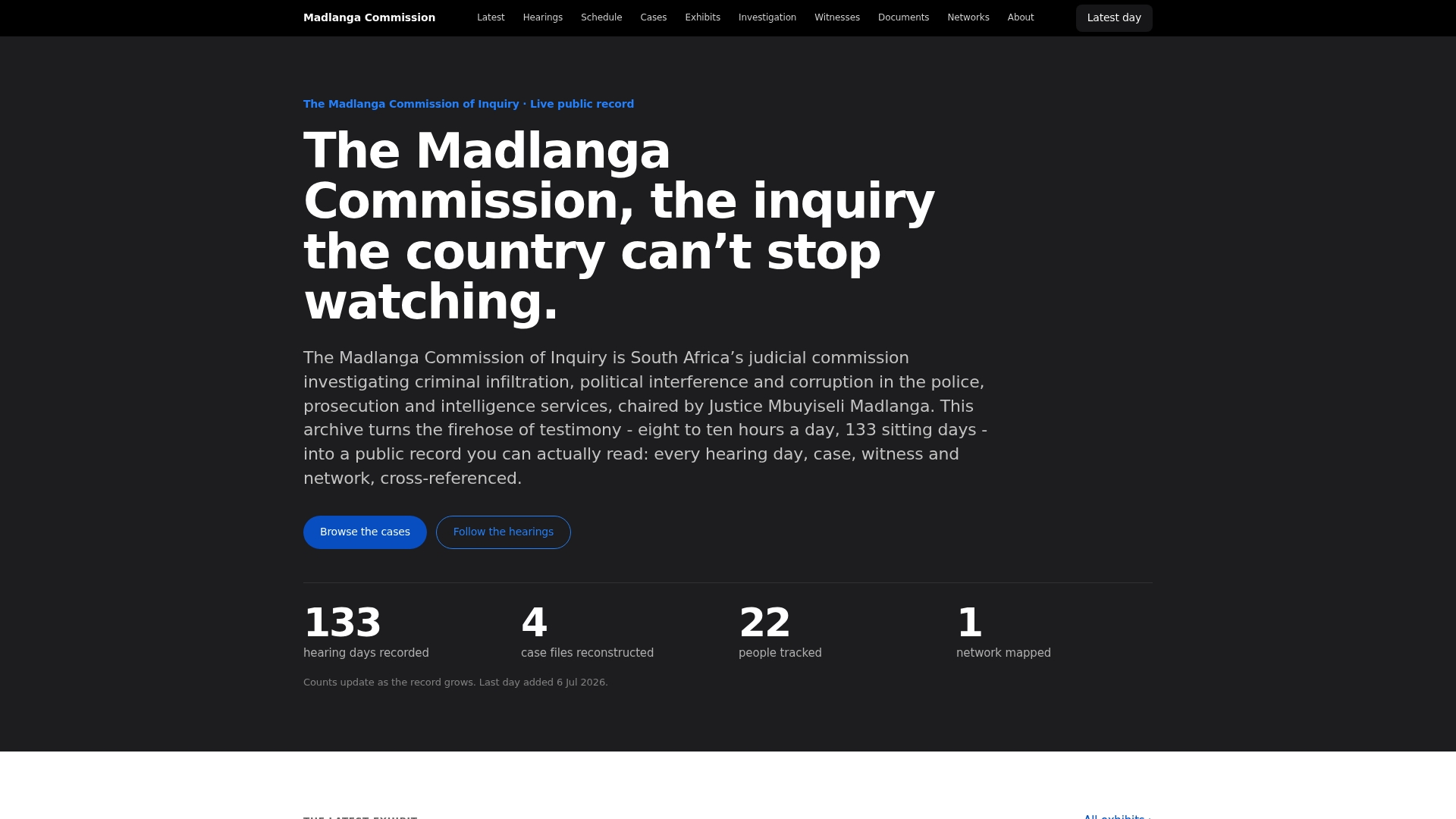
For researchers tracking figures like McBride and the institutions he led, the Commission’s witness testimony archive provides direct access to sworn accounts from IPID investigators, Hawks officers, and intelligence officials. The full case files document the specific allegations, evidence, and procedural history that parliamentary committees often cannot access in real time. If you want to understand how South Africa’s accountability failures developed and where they stand today, the Commission’s public record is the place to start.
FAQ
Who is Robert McBride?
Robert McBride is a South African law enforcement official born on July 6, 1963, in Durban. He is known for his anti-apartheid activism, his conviction for the 1986 Why Not Bar bombing, his TRC amnesty, and his subsequent leadership roles at IPID and the State Security Agency.
Why did McBride refuse to disclose his employment in parliament?
McBride cited the Intelligence Services Act 39 of 1994 as the legal basis for nondisclosure, stating that clearance from a director-general is required before revealing state security employment details. Parliamentary committee members challenged this justification as insufficient.
What was the Mozambique operation that led to McBride’s suspension?
McBride was appointed head of the SSA’s foreign intelligence branch in 2020 and suspended in 2021 after a failed operation in which intelligence operatives were reportedly stranded in Maputo, Mozambique. The suspension ended his three-year appointment prematurely.
How does McBride’s career connect to broader South African policing problems?
South African police leadership has been persistently unstable since 1994, with no national commissioner except one completing a full term. McBride’s repeated suspensions and legal battles reflect the same pattern of political interference and weak institutional accountability that defines SAPS leadership more broadly.
What is the Madlanga Commission’s relevance to McBride’s story?
The Madlanga Commission of Inquiry investigates criminal infiltration, political interference, and corruption in South Africa’s police, prosecution, and intelligence sectors. It provides the institutional framework for understanding how figures like McBride operate within, and are shaped by, a governance environment that has consistently failed to separate political loyalty from professional accountability.
Recommended
- Advocate Ofentse Motlhasedi - Evidence leader, Madlanga Commission - The Madlanga Commission Archive
- Michael van Wyk - Chief Executive, Medicare24 Holdings, Madlanga Commission
- Advocate Mahlape Sello SC - Evidence leader, Madlanga Commission - The Madlanga Commission Archive
- Justice Mbuyiseli Madlanga - Chairperson, Madlanga Commission - The Madlanga Commission Archive