Prove Selective Prosecution in South Africa With Madlanga and Case Law

Selective prosecution is a real and documented problem in South Africa, not a partisan grievance. Case law, academic research, and commission testimony all point to the same fault lines inside the National Prosecuting Authority (NPA) and the office of the National Director of Public Prosecutions (NDPP). Courts can intervene, but only in narrow circumstances, which leaves most decisions effectively unreviewable and erodes public trust in equal justice.
TL;DR:
- Proving selective prosecution requires demonstrating procedural irregularities, irrational decisions, bad faith, or ulterior motives, rather than just unequal treatment.
- High-profile cases like Zuma and Nzuza hinge on whether prosecutorial decisions followed rational processes grounded in evidence and proper procedures.
- Judicial review is limited to procedural issues, with courts hesitant to second-guess prosecutors’ merits decisions unless clear misconduct or procedural breaches are shown.
- Chronic prosecutorial instability and political interference undermine trust, highlighting the need for reforms like clearer legislation and independent accountability mechanisms.
- Transparency initiatives, like the Madlanga Commission’s searchable records, are essential for building evidence and holding authorities accountable.
Table of Contents
- What does selective prosecution mean in South Africa?
- Legal framework and limits on judicial review
- Notable South African case studies and patterns
- How courts and litigants can (and cannot) prove selective prosecution
- Institutional causes, effects and the role of accountability mechanisms
- What reforms would actually reduce selective prosecution?
- Why archival transparency matters for accountability
- Where to find the primary hearing records
- Selected primary sources and key reports
- Sources
- FAQ
What does selective prosecution mean in South Africa?
Selective prosecution happens when a decision to charge, delay, or drop a case is driven by who the person is or what they represent, not by the strength of the evidence. That is different from ordinary prosecutorial discretion, which the Constitution and the National Prosecuting Authority Act protect as a legitimate function of the NDPP and the NPA.

The dividing line sits at motive. Section 9 of the Constitution guarantees equality before the law, and a prosecutor’s mandate under section 179 assumes decisions rest on the merits of a case, not on political convenience.
A few distinctions matter here:
- Lawful discretion: declining a weak case for lack of evidence, or prioritising a backlog by seriousness.
- Selective prosecution: pursuing or dropping a case because of the accused’s political affiliation, position, or connections.
- Ulterior purpose: using prosecution (or its threat) to intimidate, silence, or punish rather than to secure a conviction on the facts.
Legal framework and limits on judicial review
The National Prosecuting Authority Act gives the NDPP broad review powers over lower prosecutors’ decisions, including the authority to issue binding directives. Section 179 of the Constitution sits above that Act, framing the NPA as independent but accountable to Parliament through the Minister of Justice.
Courts, though, tread carefully. Judicial review of a prosecutorial decision succeeds only where the litigant shows:
- The decision was irrational, with no logical link between the evidence and the outcome
- It was taken mala fide, in bad faith
- It served an ulterior purpose unrelated to justice
- It breached a mandatory procedure, such as consultation before a decision to prosecute or not
The Nzuza and Others v NDPP judgment from 2024 confirmed this rationality test explicitly: the court asks whether there is a rational connection between the evidence on the docket and the decision reached, not whether it would have decided differently.
Pro Tip: Separation of powers means judges are reluctant to substitute their own judgment for a prosecutor’s. Winning a review case almost always turns on procedure, not persuading a judge the charge was simply “wrong.”
Notable South African case studies and patterns
Several recent matters illustrate how selective prosecution allegations actually play out in South African courts and commissions.
- Zuma-related litigation: The Zuma v NDPP appellate judgment set the modern benchmark, ruling that reinstating prosecution required proper process and could not be driven by political timing alone. It remains the leading precedent on NDPP review powers and procedural fairness for the accused.
- The Nzuza review application: Linked to the Marikana-era prosecutorial fallout, this case tested whether the NDPP’s review decision followed a rational process grounded in the evidence, rather than external pressure.
- The Mnikathi example: An IEC electoral official was prosecuted over a police-escort requirement the IEC itself said did not exist in law. He was later acquitted after a protracted and costly process, a pattern critics cite as evidence that weak legal premises can still trigger prosecution.
Across these cases, the same signals recur: long delays between initial complaint and charge, abrupt reversals in prosecutorial posture, and starkly different treatment of similarly situated individuals depending on political exposure.
How courts and litigants can (and cannot) prove selective prosecution
Proving selective prosecution in South Africa is genuinely hard, and that difficulty is by design. Courts protect prosecutorial independence, so litigants cannot simply argue the decision was unfair or that a differently positioned person got better treatment.
What actually works:
- Documenting a procedural irregularity, such as failure to seek representations from the accused before a charging decision, a requirement under NPA policy
- Showing the decision has no rational connection to the evidence on file, per the standard set in Nzuza
- Gathering primary documentary evidence, including dockets obtained through disclosure requests, exhibits filed in related litigation, or commission exhibits that establish a pattern of conduct
Pro Tip: Requesting the full docket early, and comparing it against how similar cases were handled elsewhere, builds the paper trail a court actually needs to find irrationality.
Institutional causes, effects and the role of accountability mechanisms
NPA instability sits at the root of most selective prosecution complaints. Repeated changes in NDPP leadership, politically contentious appointments, and chronic under-resourcing have left the authority vulnerable to interference, according to research from the Dullah Omar Institute.
The democratic cost is not abstract. When prosecution looks politically selective, it chills political participation before a single verdict is reached.
The rule of law depends on the equal application of legal rules across all persons. When prosecutorial power appears to bend toward political convenience, opponents begin to fear litigation itself, independent of any trial outcome.
Two accountability mechanisms are meant to address this gap:
- The Office for Ethics and Accountability (OEA), created inside the NPA in 2023, handles internal complaints, but it reports monthly to the NDPP and sits inside the very office it is meant to check, which limits its perceived independence.
- Commissions of inquiry, including the Madlanga Commission, fill a different gap by generating a public, searchable record of testimony and exhibits that neither the NPA nor the OEA is built to produce.
What reforms would actually reduce selective prosecution?
Fixing this problem needs legal and institutional change, not just individual court wins. Three categories of reform come up consistently in policy research and legal commentary.
- Legislative clarity: Amend the NPA Act to define NDPP review powers more precisely, impose transparency obligations on charging and withdrawal decisions, and stagger Directors of Public Prosecutions’ terms so leadership turnover doesn’t track political cycles.
- Institutional strengthening: Give the NPA an independent complaints structure that reports to Parliament rather than internally, alongside sustained investment in prosecutorial skills and staffing.
- Civil society pressure: Sustained litigation, academic scrutiny, and public commission testimony create the record that eventually forces legislative attention, even when individual court cases fail on narrow procedural grounds.
Why archival transparency matters for accountability
Public trust in prosecution depends on records citizens can actually check, not just official statements. The Madlanga Commission exists to make hearing transcripts, case files, and exhibits searchable rather than buried in transcripts nobody reads.
If you’re researching a pattern, start with the exhibits and witness statements tied to the case that concerns you, then cross-reference dates against the public record. Cite what you find; that is how commission testimony becomes leverage in complaints and litigation.
— Meriol Lainchyon
Where to find the primary hearing records
Reading about selective prosecution in the abstract only goes so far. What actually strengthens a complaint, a research paper, or a piece of journalism is a citable, dated record, and that’s the gap the Madlanga Commission archive is built to close.
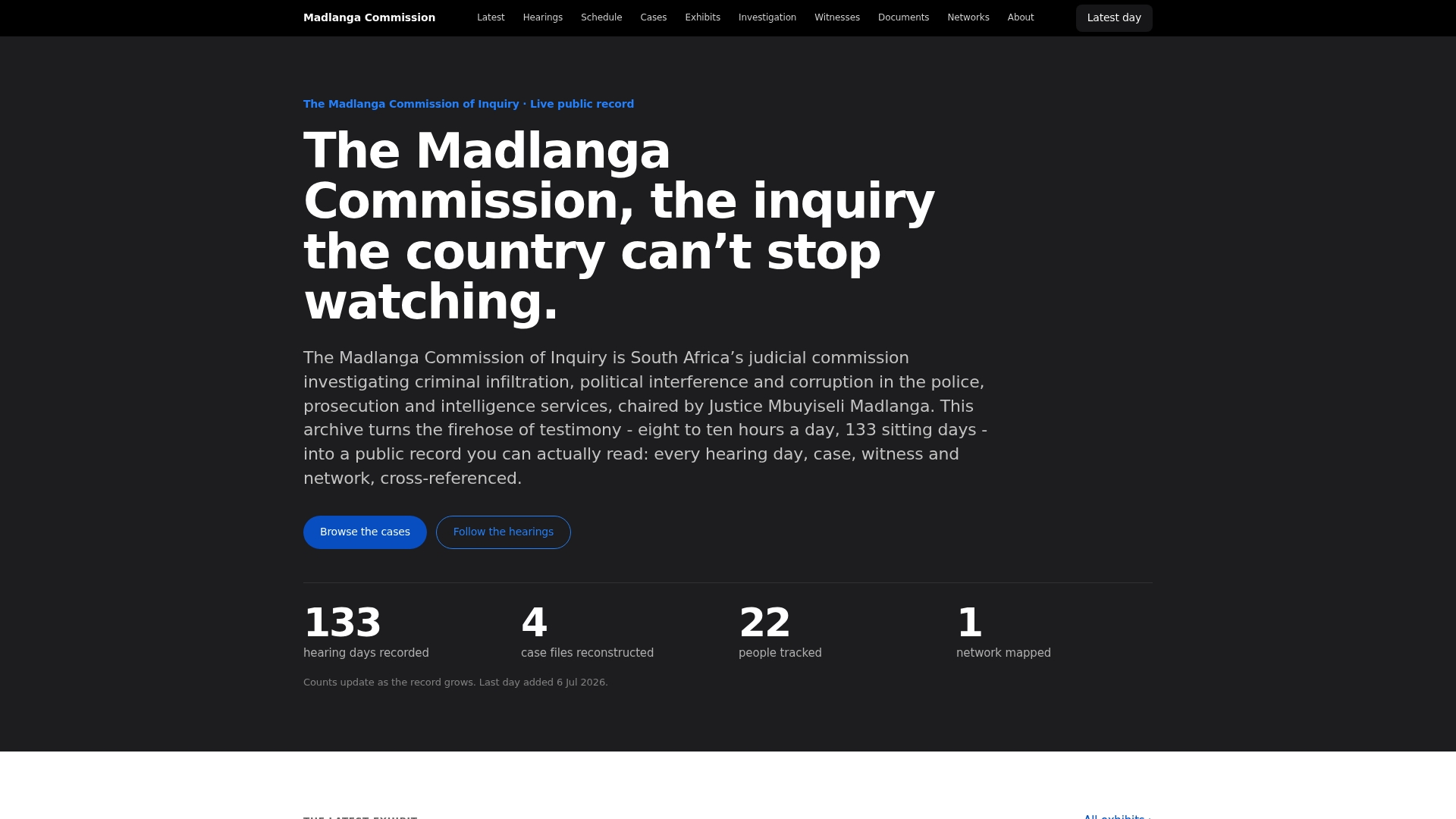
The archive holds daily hearing transcripts, witness profiles, exhibits, and rulings from a commission investigation into criminal infiltration and political interference in law enforcement and intelligence sectors. Unlike a live broadcast, you can search past testimony directly. Start with the explainer on what a commission of inquiry actually does if you need the procedural context first, then move to a recent sitting, such as the Day 124 hearing from June 2026, to see how exhibits and witness testimony get entered into the record. If you’re building a complaint or a story, cite the specific day and exhibit number rather than a general reference. That’s what makes the record usable, not just readable.
Selected primary sources and key reports
For readers who want to go straight to the source material: the NPA Act itself sets out statutory powers; Zuma v NDPP and Nzuza v NDPP are the leading judicial review cases; and the Dullah Omar Institute’s report on prosecutorial independence remains the sharpest academic critique of NPA structure.

This article is general information, not a substitute for advice from a qualified lawyer. Consult a qualified legal professional about your own circumstances before acting on anything here.
Sources
- Nzuza and Others v National Director of Public Prosecutions and Others (2024) ZAGPPHC 335
- Prosecutorial independence and the prosecution of corruption (Dullah Omar Institute)
- The dangers of selective prosecution for democracy and the rule of law (Saturday Star, 2026-05-18)
FAQ
What is section 27 of the Criminal Procedure Act?
Search warrant regulations govern when and how police may search premises or persons and seize evidence relevant to a criminal investigation.
What does a prosecutor earn in South Africa?
Prosecutor salaries vary by rank and experience within the NPA’s public service pay scales, and the exact current figures are not publicly listed here; the Dullah Omar Institute’s research notes that resourcing and pay gaps contribute to skills attrition inside the authority.
Can you go to jail for malicious damage to property?
Yes. Malicious damage to property is a criminal offence in South Africa, and a conviction can carry a prison sentence depending on the value of the damage and the circumstances of the case.
What is section 49 of South African law?
The Criminal Procedure Act regulates the use of force during an arrest, limiting when police may use force, including lethal force, against a suspect resisting arrest or fleeing.
How do you prove selective prosecution in South Africa?
You need to show the decision was irrational, taken in bad faith, served an ulterior purpose, or breached a mandatory procedure, as set out in the Nzuza judgment; simply showing unequal treatment on its own is not enough.