South African Intelligence Agency: 2026 Reform Guide

TL;DR:
- South Africa is restructuring its intelligence services to improve oversight and accountability. The State Security Agency will split into domestic and foreign agencies, coordinated by the new National Centre for Intelligence Coordination. These reforms aim to restore trust after past abuses and increase transparency in national security operations.
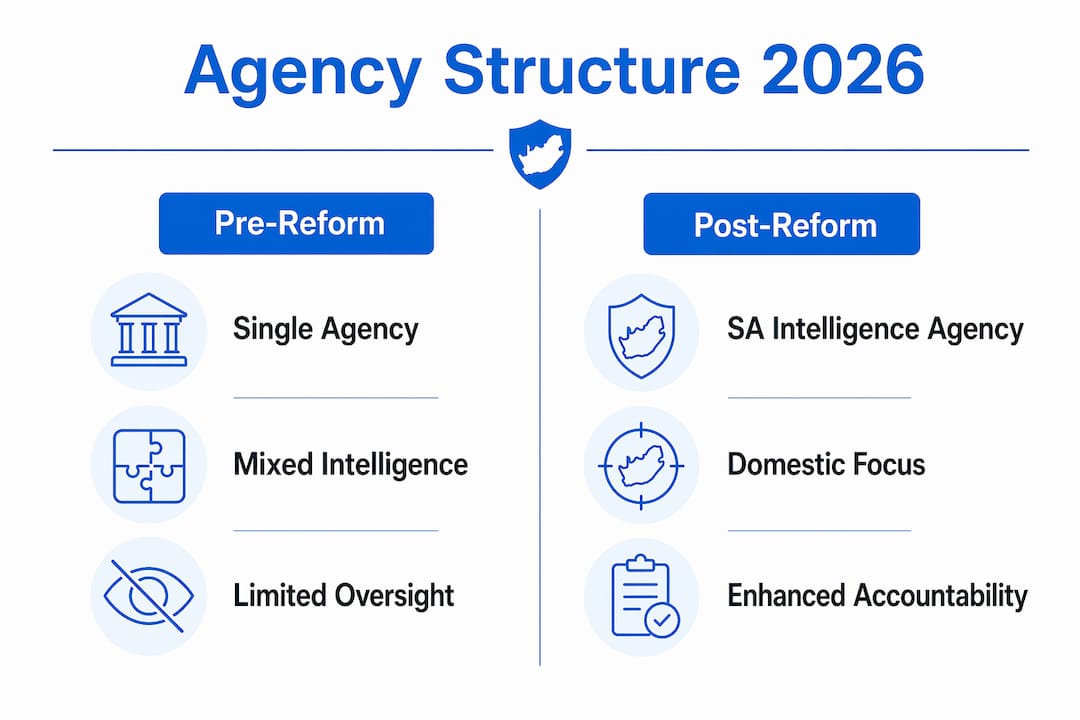
South Africa’s intelligence agency is the government body responsible for gathering, analyzing, and acting on information that protects national security at home and abroad. The State Security Agency (SSA), the formal name for this function until recently, is being disestablished in 2026/27 and replaced by two distinct entities: the South African Intelligence Agency for domestic operations and the South African Intelligence Service for foreign intelligence. Alongside this split, the government launched the National Centre for Intelligence Coordination (NCIC) in april 2026 to unify all intelligence functions under one decision-making hub. These changes represent the most significant restructuring of intelligence services in South Africa since the post-apartheid era.
What is the current structure of South Africa’s intelligence services?
The SSA was created in 2009 by merging the former domestic and foreign intelligence agencies into one body. That merger was meant to improve coordination, but it created a single, unwieldy institution that proved easy to politicize. The General Intelligence Laws Amendment Act now sets the legal framework for reversing that decision and separating the two functions again.
The 2026 split produces a cleaner division of labor:
- South African Intelligence Agency: Handles domestic threats including terrorism, organized crime, and economic sabotage
- South African Intelligence Service: Focuses on foreign intelligence gathering and overseas operations
- NCIC: Acts as the coordination hub, integrating domestic, foreign, defense, and crime intelligence into unified threat assessments
- Joint Standing Committee on Intelligence (JSCI): Provides parliamentary oversight of all intelligence bodies
- Auditor-General: Conducts financial and compliance audits of intelligence spending
The NCIC is the structural innovation that makes the split workable. Without a coordination layer, two separate agencies risk duplicating effort or missing threats that cross the domestic/foreign boundary. Minister in the Presidency Khumbudzo Ntshavheni stated that intelligence without coordination leaves the state exposed, and that the NCIC exists to make intelligence operationally decisive rather than passive.
| Body | Primary Function |
|---|---|
| South African Intelligence Agency | Domestic intelligence and threat monitoring |
| South African Intelligence Service | Foreign intelligence and overseas operations |
| NCIC | Cross-agency coordination and unified threat response |
| JSCI | Parliamentary oversight and accountability |
| Auditor-General | Financial audits and compliance checks |
How does the agency ensure accountability after past abuses?
The accountability crisis in South Africa’s intelligence community is well documented. During the Zuma administration, the SSA was weaponized for factional politics), used to shield the president’s interests and block Auditor-General oversight. That history created a deep crisis of institutional trust that the current reforms are designed to fix.
The High-Level Review Panel (HLRP), which reported in 2019, found the SSA structurally compromised) and described its abuses as bordering on organized crime. That finding was not rhetorical. The panel documented how resources, personnel, and legal powers were redirected away from national security and toward protecting political factions. The HLRP’s core recommendation was to split the agency and enforce genuine civilian oversight, which is exactly what the 2026 reforms implement.
Current accountability mechanisms include:
- Re-vetting: Senior police and intelligence officials are undergoing mandatory security re-vetting in the 2026/27 financial year to identify compromised personnel
- Lifestyle audits: Officials must account for assets and income that do not match their declared salaries
- National Security Strategy (2024–2029): The first publicly released strategy of its kind, setting measurable goals for the intelligence community
- National Intelligence Estimate (2019–2024): Released alongside the strategy, this document represents a paradigm shift in how South Africa engages the public on intelligence matters
- JSCI oversight: The Joint Standing Committee on Intelligence reviews agency activities and receives classified briefings from the Director-General
Pro Tip: If you want to track how accountability measures are being applied in real proceedings, the Madlanga Commission case files document active investigations into corruption and political interference across South Africa’s security sector.
What recent incidents highlight the challenges of South African intelligence operations?
The 2026 reforms did not arrive in a vacuum. Several incidents in recent years exposed the gap between what intelligence services in South Africa are supposed to do and what some officials actually did.
-
The brigadier general case (2026): A former South African Air Force brigadier general was sentenced in the United States for acting as an unregistered foreign agent. The individual provided secret reports on think-tank events to South African officials in exchange for payment, then made false statements about her security clearances. This case illustrates how South Africa espionage operations can cross legal and diplomatic lines when oversight is weak.
-
Covert intelligence gathering at open events: The same case revealed that South African agents were collecting intelligence at foreign policy forums and academic events in Washington. This practice carries serious diplomatic risk. When a foreign government discovers that its open intellectual spaces are being monitored by another country’s agents, the diplomatic fallout can damage bilateral relationships for years.
-
False security declarations: The brigadier general pleaded guilty to making false statements about her security history. This points to a systemic gap in vetting. If senior officials can misrepresent their backgrounds without detection, the integrity of the entire personnel system is compromised.
These cases confirm that the re-vetting and lifestyle audit programs are not bureaucratic exercises. They are responses to documented failures that have already caused international embarrassment and legal consequences for South African officials operating abroad.
What practical impact will the intelligence reforms have on national security?
The structural changes now underway are designed to produce four concrete outcomes for South Africa’s national security posture.

The first is faster threat detection. The NCIC integrates domestic, foreign, defense, and crime intelligence into a single picture. Before the NCIC, each agency produced its own assessments, and gaps between them created blind spots. A drug trafficking network with foreign financing and domestic police contacts, for example, would previously fall between jurisdictions. The NCIC closes that gap.
The second is a cleaner chain of accountability. When one agency handled both domestic and foreign intelligence, it was easy for political interference to hide inside the complexity. Two separate agencies with distinct mandates are harder to capture. Each has a defined mission, and deviation from that mission is easier to detect and challenge.
Pro Tip: The Madlanga Commission witnesses page lists firsthand testimony from law enforcement and intelligence-adjacent officials. Reading these accounts gives you a ground-level view of how institutional failures actually play out.
The third outcome is personnel integrity. Re-vetting and lifestyle audits are already underway for senior officials. The goal is to remove individuals whose financial profiles suggest corruption or whose security histories contain undisclosed risks. This process is uncomfortable for the institutions involved, but it is the only credible way to rebuild public trust after the Zuma era abuses.
The fourth is public engagement. The release of the National Security Strategy (2024–2029) and the National Intelligence Estimate (2019–2024) signals that the government now accepts some degree of public accountability for how intelligence resources are used. Citizens and stakeholders can read these documents and hold the government to the commitments they contain. That is a meaningful change from the era when intelligence operations were entirely opaque.
Key Takeaways
South Africa’s intelligence reforms are the most structurally significant since 1994, and their success depends entirely on whether oversight mechanisms are enforced rather than performed.
| Point | Details |
|---|---|
| Agency split in 2026/27 | The SSA is being replaced by two separate bodies for domestic and foreign intelligence. |
| NCIC as coordination hub | Launched in april 2026, the NCIC unifies all intelligence streams to close operational blind spots. |
| HLRP findings drove reform | The 2019 panel found SSA abuses bordered on organized crime, making structural change unavoidable. |
| Re-vetting is active now | Senior officials face mandatory security re-vetting and lifestyle audits in the 2026/27 financial year. |
| Transparency is now documented | The National Security Strategy (2024–2029) gives citizens a public benchmark to hold the government accountable. |
Why reform alone will not fix South Africa’s intelligence problem
I have followed South Africa’s intelligence sector for long enough to know that structural reforms are necessary but not sufficient. The SSA’s problems during the Zuma era were not primarily structural. They were cultural and political. Officials who understood exactly what the law required chose to ignore it because the political cost of compliance was higher than the political cost of corruption. A new org chart does not change that calculus on its own.
What gives me cautious optimism about the current reforms is the combination of structural change and public documentation. The release of the National Security Strategy and the National Intelligence Estimate is genuinely significant. It creates a paper trail. When a government publishes its security priorities in a document that citizens can read, it becomes harder to quietly redirect resources toward factional interests without someone noticing the gap between stated goals and actual behavior.
The re-vetting and lifestyle audit programs are the other piece I watch closely. Vetting is only as good as the people running it. If the vetting process itself is captured by the same networks it is supposed to expose, it becomes theater. The key figures being scrutinized through judicial proceedings like the Madlanga Commission provide an external check that internal vetting cannot replicate.
The honest assessment is this: South Africa has the right reform architecture in place. Whether it produces real change depends on whether the political will to enforce it survives the next election cycle.
— Meriol Lainchyon
How the Madlanga Commission documents intelligence accountability
Citizens and stakeholders who want to understand how South Africa’s intelligence failures actually unfolded in practice have a resource that no government press release can match.
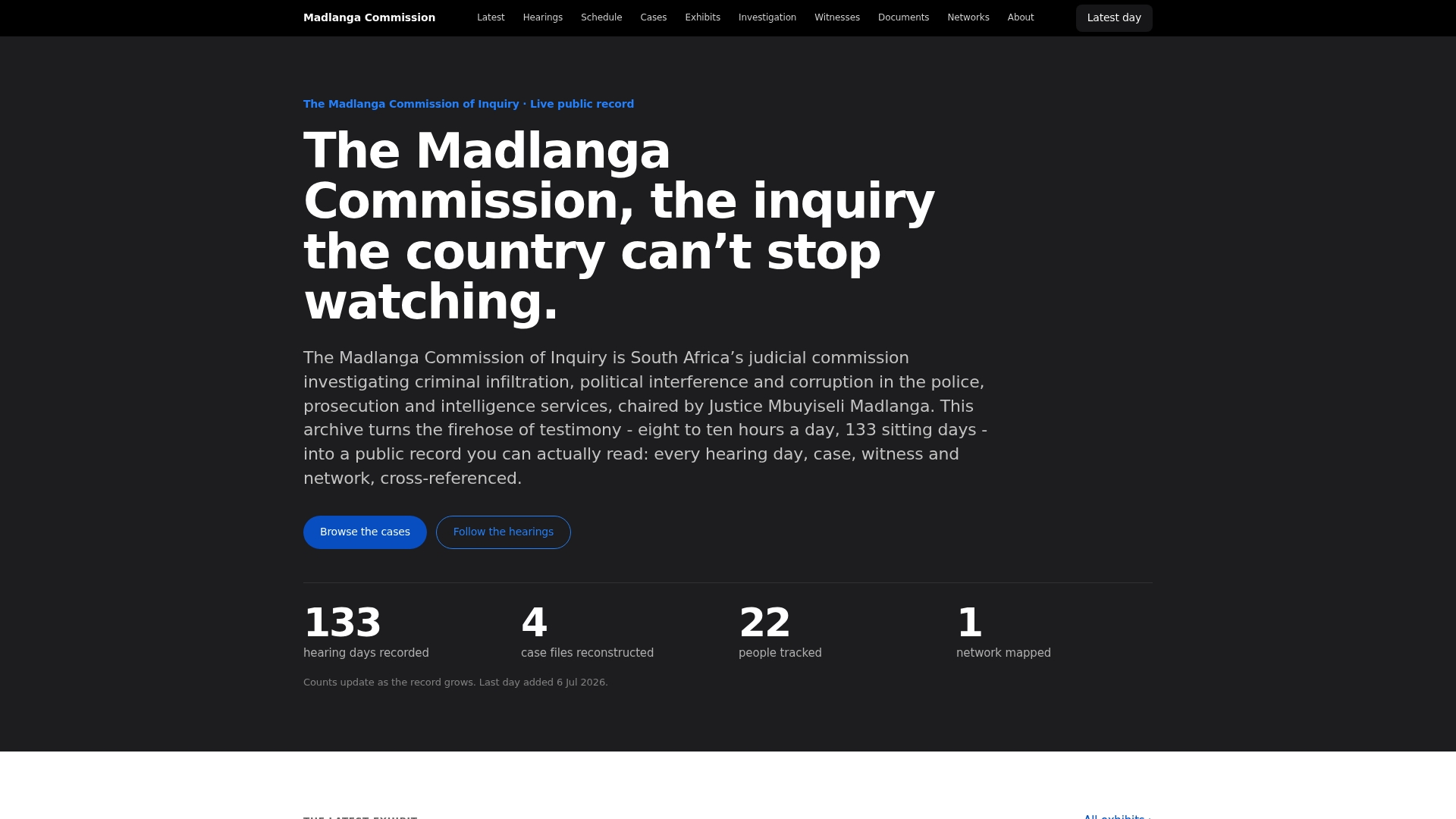
The Madlanga Commission of Inquiry, chaired by Justice Mbuyiseli Madlanga, investigates criminal infiltration, political interference, and corruption across South Africa’s police, prosecution, and intelligence sectors. Its public archive includes witness testimonies, case files, and hearing transcripts that document misconduct in granular detail. You do not need to follow live proceedings to stay informed. The commission’s complete public record is organized so that any citizen can track specific cases, read evidence submissions, and understand how the failures described in the HLRP report played out in real institutions. For anyone serious about intelligence accountability in South Africa, this archive is the most detailed public record available.
FAQ
What is the South African Intelligence Agency?
The South African Intelligence Agency is the new domestic intelligence body being created from the split of the State Security Agency in the 2026/27 fiscal year. It will handle internal threats including terrorism, organized crime, and economic sabotage.
How does South African intelligence work after the 2026 reforms?
The reformed structure separates domestic and foreign intelligence into two agencies and coordinates them through the NCIC, which integrates all intelligence streams for unified threat assessment and faster response.
What did the High-Level Review Panel find about the SSA?
The HLRP reported in 2019 that the SSA was structurally compromised and that its abuses under the Zuma administration bordered on organized crime, directly driving the current reform agenda.
What are lifestyle audits and why do they matter for intelligence officials?
Lifestyle audits require officials to account for assets and income that exceed their declared salaries. They are a key tool for identifying corruption among senior intelligence and police personnel currently undergoing re-vetting.
Where can citizens follow South African intelligence accountability proceedings?
The Madlanga Commission’s public archive at madlangacommission.co.za provides hearing transcripts, case files, and witness testimony covering corruption and political interference in South Africa’s security sector.
Recommended
- Madlanga Commission Today - Latest Hearings, Rulings & Live Updates
- Case Files of the Madlanga Commission of Inquiry - The Madlanga Commission Archive
- Key Figures in the Madlanga Commission - Who’s Who
- Madlanga Commission Members - Commissioners, Evidence Leaders & Panel - The Madlanga Commission Archive