State witness South Africa: your rights and next steps
A state witness in South Africa is someone the prosecution calls to give evidence against a co-accused, often under Section 204 of the Criminal Procedure Act, in exchange for the possibility of discharge from prosecution on that specific offence. Becoming a state witness is never automatic. The prosecutor decides, based on the strength of your evidence and the needs of the case.
If you think you might be asked to testify this way, act before you say anything further to police or co-accused:
- Speak to the prosecutor handling the case, not just the investigating officer.
- Get your own legal advice before agreeing to anything in writing or on record.
- Ask directly whether an application to the Office for Witness Protection is appropriate for your situation.
Pro Tip: Never assume protection or indemnity is guaranteed just because an investigator mentions Section 204. Only the court, at the end of the trial, decides whether you were “frank and honest” enough to earn discharge.
Cases involving organised crime and corruption, as documented daily in the Madlanga Commission’s public archive, are where Section 204 gets used most often because inside testimony is frequently the only way to break a criminal network open.
Key Takeaways
Section 204 discharge is never automatic. It depends on a court finding, made only after your testimony is complete, that you answered frankly and honestly.
| Point | Details |
|---|---|
| Section 204 is discretionary | The prosecution chooses who testifies this way, and the court decides discharge only at trial’s end. |
| Protection has temporary coverage | Temporary protection can cover you for a short period while a full application is assessed. |
| Discharge is narrow | It covers only the specific offence tied to your testimony, not unrelated charges or dishonest evidence. |
| Courts can recall witnesses | New evidence or unsatisfactory testimony can bring you back to the stand even after you’ve finished. |
| Follow real cases at Madlanga Commission | The Commission’s public archive, including hearing day 123, documents how witness testimony plays out in live corruption inquiries. |
This article is general information, not a substitute for advice from a qualified lawyer. Consult a qualified legal professional about your own circumstances before acting on anything here.
Table of Contents
- What does it mean to be a state witness in South Africa?
- What statutory protections exist for a state witness?
- What happens in court when you testify as a state witness?
- How do you apply for witness protection in South Africa?
- Can a state witness still be charged, and what are the other legal limits?
- What recent cases shape how courts treat state witnesses?
- What should a state witness do to stay safe and prepared?
- Why protected testimony matters beyond the courtroom
- Where to follow related testimony and public hearings
- Sources
- FAQ
What does it mean to be a state witness in South Africa?
Becoming a state witness usually starts with Section 204, a provision that lets someone who could incriminate themselves give evidence for the prosecution anyway. The court warns the witness before they testify, and if the witness answers honestly, the court may discharge them from prosecution for that specific offence. That discharge is a court decision, not something the police or prosecutor can promise in advance.
The prosecution alone decides who becomes a Section 204 witness and informs the court of that intention before evidence is led. It is a tactical call, and legal commentary notes it tends to surface in complex organised crime and corruption prosecutions where a single insider’s testimony can unlock an entire case.
Section 204 is not the same thing as a plea and sentence agreement under Section 105A. The two get confused constantly:
- Section 204 applies to a witness giving evidence in someone else’s trial, with discharge decided at the end based on credibility.
- Section 105A applies to an accused negotiating their own sentence, agreed and finalized before trial concludes.
Practitioners warn against treating an early promise of indemnity as settled fact. Courts generally prefer to assess a witness’s credibility only after all the evidence has been heard, which means a witness can spend months testifying without knowing for certain how the story ends for them.
What statutory protections exist for a state witness?
South Africa’s Witness Protection Act created the Office for Witness Protection specifically to manage the risk that comes with testifying against dangerous people. It sits separately from the police and handles applications, placement, and ongoing security decisions for witnesses whose safety is at risk because of what they know.
Temporary protection can be granted for up to 14 days while an application is assessed, giving a threatened witness immediate cover without waiting for a full evaluation. An investigating officer or another interested party can apply on a witness’s behalf if the witness cannot do it themselves, and in some circumstances an application for a minor can proceed without parental consent.
The Act does not protect everyone who testifies. It applies to witnesses connected to specified categories of serious offences, and the Director of the Office for Witness Protection retains discretion over who qualifies and what level of protection is warranted.
Protection under the Act can take several forms:
- Temporary safe housing while risk is assessed.
- Relocation to a different area, sometimes with a new identity.
- Change of identity, in the most serious, long-term cases.
- Security detail for witnesses facing an immediate, specific threat.
Anonymity has real limits, though. Legal scholars point out that total anonymity for a witness can clash with an accused person’s right to a fair trial, so courts weigh safety against fairness case by case rather than applying a blanket rule.
What happens in court when you testify as a state witness?
The Section 204 process in court follows a set sequence:
- The prosecutor tells the court, before evidence begins, that a witness will testify under Section 204.
- The presiding officer warns the witness about the implications of the section and the obligation to answer questions fully.
- The witness gives evidence, including anything that might incriminate them, and can be cross-examined like any other witness.
- At the end of the trial, the court decides whether the witness answered “frankly and honestly,” and rules on discharge accordingly.
You are legally obliged to answer once you’ve taken the oath or affirmation under Section 204. Refusing, or shading answers to protect yourself, undermines the entire basis for discharge.
- Discharge, when granted, only covers the specific offence connected to that testimony.
- Answers given honestly generally can’t be used to prosecute you for a different, unrelated offence.
- Dishonest or evasive testimony can strip away the protection and expose you to perjury charges.
Indemnity is conditional, not automatic, and courts typically withhold judgment on it until the trial is over — meaning a state witness often testifies without knowing their own legal fate for weeks or months.
Separately, evolving rules on hearsay and absent witness statements, discussed in recent commentary on the Law of Evidence Amendment Act, can affect how much weight a state witness’s prior statements carry if they can’t appear in person later in the process.
How do you apply for witness protection in South Africa?
Start with the people already involved in your case rather than searching for a separate application process from scratch.
- Tell the investigating officer or prosecutor immediately if you feel threatened, and be specific about the nature of the threat.
- Ask them to refer you, or apply on your behalf, to the Office for Witness Protection if you cannot approach them directly yourself.
- Expect a rapid initial assessment. Temporary protection can be granted for up to 14 days while your full application is evaluated.
- If you’re applying for a minor connected to a case, note that consent from a parent or guardian isn’t always required, depending on the circumstances.
What to have ready:
- A clear account of the threat, including dates, names, and any evidence (messages, witnesses to the threat, prior incidents).
- Case reference numbers connecting you to the relevant prosecution.
- Contact details the Office for Witness Protection can use securely, without routing through people you don’t trust.
Can a state witness still be charged, and what are the other legal limits?
Can a state witness be charged? Yes, if they fail to testify honestly, commit perjury, or face charges for a separate offence not covered by the Section 204 discharge. Discharge is narrow. It protects you against prosecution for the specific offence connected to your testimony, nothing broader.
Can a court recall a state witness? Courts retain the power to recall a witness if new evidence emerges or if earlier testimony needs clarification, and can treat evidence as unsatisfactory if it doesn’t hold up under scrutiny.
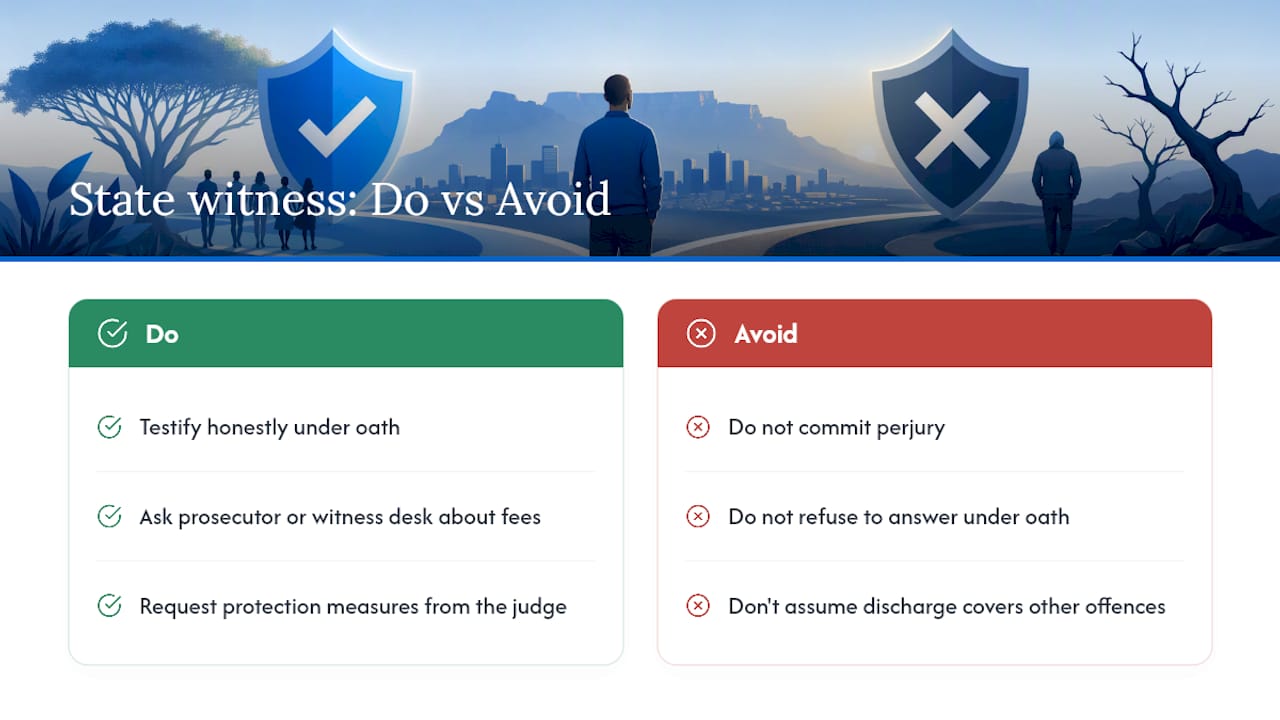
What happens if you refuse to testify? Refusing to answer once under oath as a Section 204 witness can itself carry legal consequences, and it forfeits any chance of discharge tied to that testimony.
How do you claim witness fees? Ask the prosecutor or the court’s witness administration desk about the process. Fees for attendance and, where applicable, travel are generally claimed through the court that heard the matter, not through the police.
Scholarly commentary stresses that absolute anonymity for a witness sits in tension with the accused’s fair trial rights, which is exactly why judges decide protection measures case by case instead of granting blanket secrecy.
What recent cases shape how courts treat state witnesses?
Makala v S is a recent High Court decision addressing the state’s duty to call essential witnesses and how courts scrutinise the handling of witness evidence, a reminder that judges actively police whether the prosecution’s use of witnesses was fair, not just procedurally correct.
Reporting on high-profile trials, including commentary on a Section 204 witness seeking indemnity in a widely watched case, shows how public scrutiny and legal process intersect once a witness’s identity becomes known mid-trial.
- Courts continue to test Section 204 evidence against fairness to the accused, not just its usefulness to the prosecution.
- Debate around hearsay admissibility, particularly for witnesses who can’t testify in person, remains active in legal commentary.
The tension is structural, not accidental: organised crime and corruption cases need insider testimony to succeed, but insider testimony from a self-interested witness needs careful judicial scrutiny to stay fair.
What should a state witness do to stay safe and prepared?
- Do tell your prosecutor and investigating officer about any threat immediately, however small it seems.
- Do keep records of intimidation attempts, messages, or suspicious contact.
- Don’t discuss your testimony with anyone connected to the accused, even casually.
- Don’t post about the case or your role on social media.
Prepare for cross-examination with your legal representative well before the trial date. Ask specifically how your prior statements will be used and whether hearsay rules could affect your evidence.
Pro Tip: Ask the Office for Witness Protection about psychological support and counselling early. Testifying against people you may have known for years takes a toll that legal protection alone doesn’t address.

Why protected testimony matters beyond the courtroom
Protected, honest testimony is often the only thing standing between an organised crime network and a conviction. That’s not abstract. It’s why bodies like the Madlanga Commission exist, to build a public record of testimony so citizens can see how justice systems succeed or fail, without needing to sit through months of live hearings themselves.
Where to follow related testimony and public hearings
None of the courtroom mechanics above tell you what’s actually happening in South Africa’s current investigations into police, prosecution, and intelligence failures, and that’s a different kind of information gap entirely. Madlanga Commission exists to close it. The Commission is not a protection service. It’s a public information archive, so if you’re facing an active threat, your first call is still SAPS or your prosecutor, not this website.
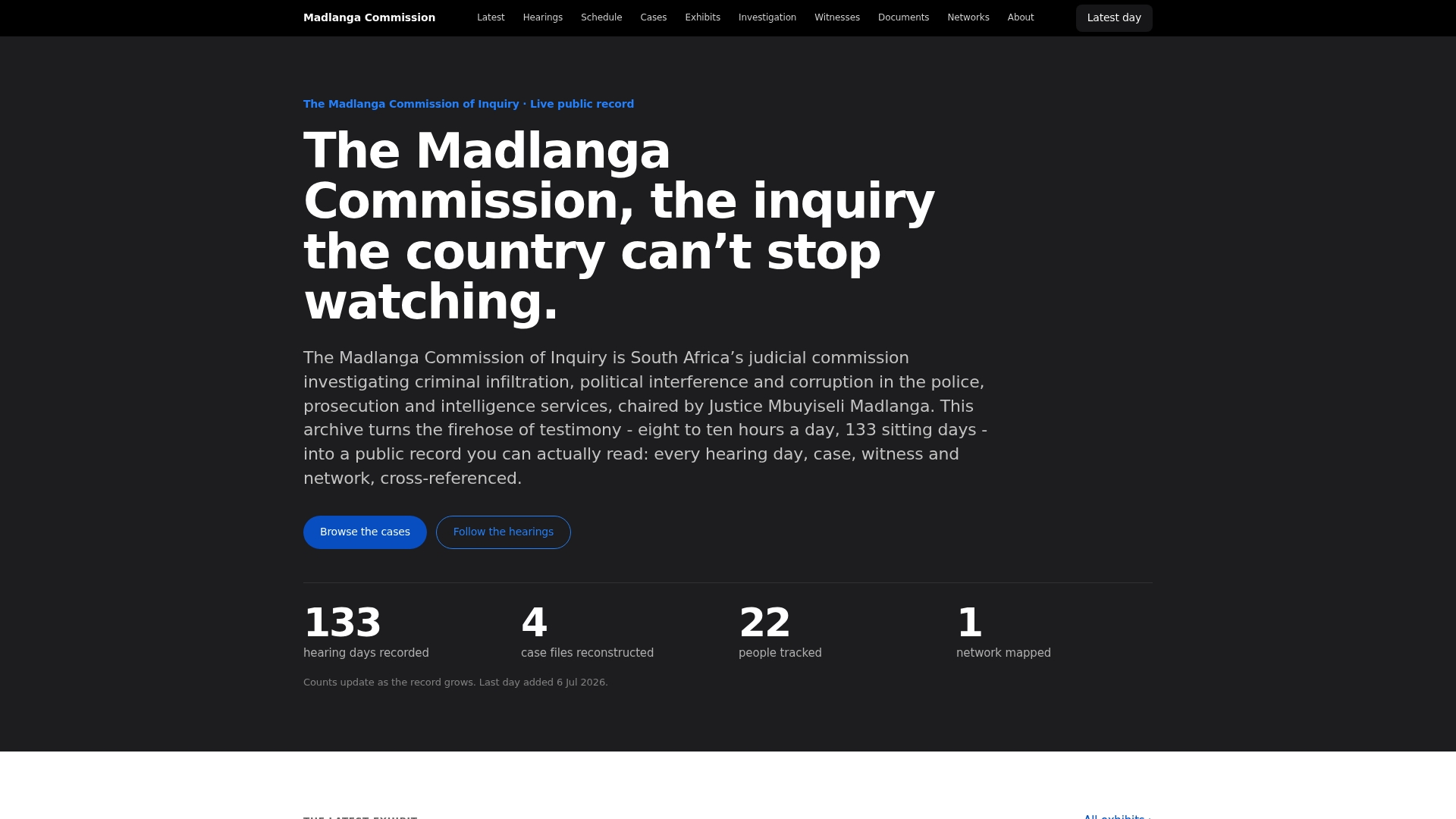
What Madlanga Commission gives you is something no law firm or protection unit offers: a searchable, ongoing record of hearing days, witness profiles, and case files tied to organised crime and corruption in the very institutions meant to protect witnesses in the first place. If you want to understand how testimony from figures like investigators and insiders actually plays out in a live inquiry, start with Day 123 of the Commission’s hearings, where recent testimony and exhibits are posted in full. Browse the case files archive to see how these investigations connect to the broader accountability picture.
Sources
- Section 204 – Incriminating evidence by witness for prosecution (Criminal Procedure Act)
- Witness Protection Act No. 112 of 1998 (South Africa)
- Key witness in Joshlin Smith trial seeks indemnity: What is a Section 204 witness?
- Makala v S (A114/2022) 2023 ZAFSHC 283 (24 July 2023)
- Admitting absent witness statements: The law on hearsay evidence (De Rebus)
FAQ
Can a state witness be charged?
Yes. Discharge under Section 204 only covers the specific offence tied to your testimony, and dishonest or evasive evidence can expose you to prosecution, including perjury.
Can a court recall a state witness in South Africa?
Yes. Courts can recall a witness if new evidence emerges or if their earlier testimony needs clarification or was found unsatisfactory.
What happens if I refuse to be a witness?
Refusing to answer once you’ve taken the oath under Section 204 can carry its own legal consequences and forfeits any possibility of discharge linked to that testimony.
How do I claim witness fees?
Ask the prosecutor or the court’s witness administration desk handling your case. Attendance and travel fees are typically claimed through that court, not through SAPS.
Where can I read real testimony from South African corruption cases?
Madlanga Commission’s public archive publishes daily hearing records, witness profiles, and case files, including Day 124 of its hearings, for readers who want to follow real proceedings rather than summaries.