Administrative Action Explained: Law, Rights, and Accountability

TL;DR:
- Administrative action includes decisions or failures to decide by public authorities that legally affect individual rights. South Africa’s PAJA and U.S. law govern such actions, focusing on decisions with direct external legal effects and exercising public power.
What is administrative action, and why does it matter?
Administrative action is any decision, or deliberate failure to decide, made by a public authority that legally affects a person’s rights. That definition sounds dry until you realize it covers everything from a permit denial to a deportation order to a police agency’s refusal to investigate a complaint. The legal effect is what separates administrative action from ordinary government activity.
South Africa’s Promotion of Administrative Justice Act (PAJA) defines it as any decision taken, or failure to take a decision, by an organ of state or a private person exercising public power, which adversely affects rights and carries a direct, external legal effect. In the United States, 5 U.S.C. § 551 defines agency action broadly to include rules, orders, licenses, sanctions, and failures to act.
Core elements shared across both systems:
- A decision or failure to decide by a public authority or delegated body
- Exercise of public power under an empowering legal provision
- An adverse effect on the rights or legitimate expectations of a person
- A direct, external legal effect, meaning the decision binds someone outside the agency itself
- The action must fall outside purely legislative or judicial functions
Table of Contents
- How South Africa and the United States regulate administrative action
- Why defining administrative action is harder than it looks
- What administrative actions actually look like in practice
- How the Madlanga Commission holds administrative action accountable
- How an administrative action typically proceeds
- How to challenge or appeal an administrative decision
- How administrative actions affect individual rights and the public interest
- Case studies in accountability: lessons from South African oversight
- Key Takeaways
- FAQ
How South Africa and the United States regulate administrative action
Both countries anchor administrative action in statute, but the architecture differs considerably.
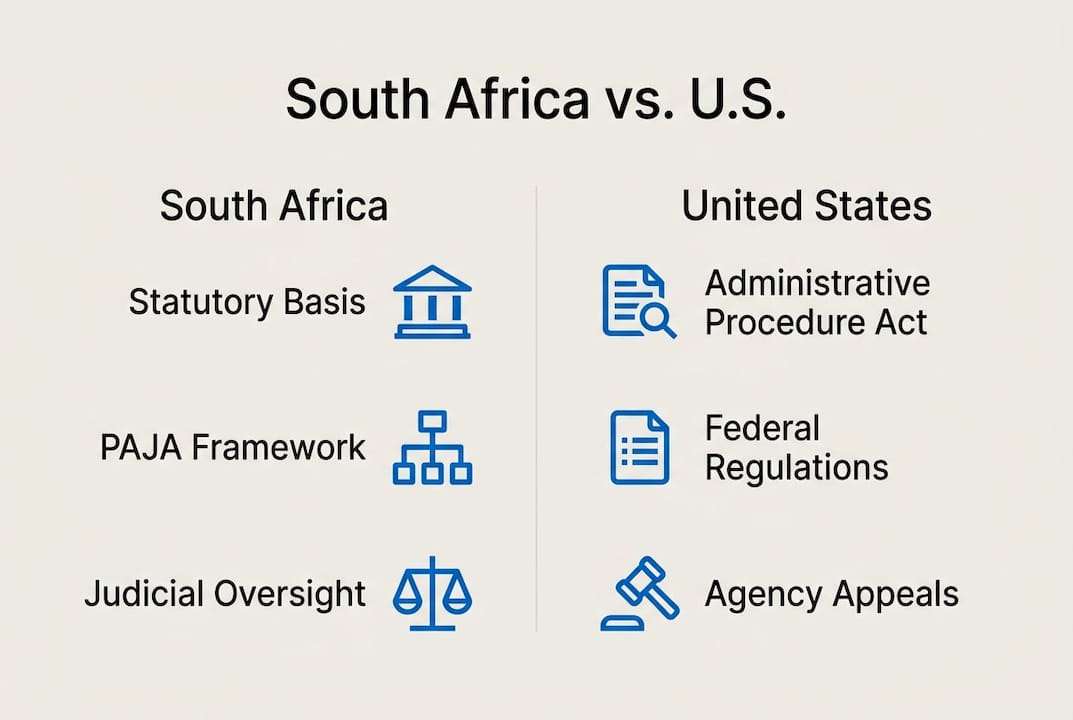
South Africa’s PAJA, enacted under section 33 of the Constitution, guarantees everyone the right to administrative action that is lawful, reasonable, and procedurally fair. Anyone whose rights are adversely affected also has a constitutional right to written reasons within 90 days of becoming aware of the action. PAJA applies to organs of state and, critically, to private entities exercising public power under delegated authority, which matters enormously when tracking outsourced government functions.
Key PAJA principles and procedural features:
- Legality: the action must have a lawful basis in an empowering provision
- Reasonableness: the decision must be rationally connected to the facts and purpose
- Procedural fairness: affected parties must receive adequate notice and an opportunity to be heard
- Written reasons: available on request within the 90-day window
- Judicial review: any person may bring review proceedings in a High Court or designated Magistrate’s Court
In the United States, the Administrative Procedure Act (codified at 5 U.S.C. § 551 and following sections) governs federal agency conduct. Agencies must follow notice-and-comment rulemaking, publish proposed rules in the Federal Register, and allow public input before finalizing regulations. The Congressional Budget Office tracks the budgetary effects of administrative actions, incorporating them into baseline projections once a rule is finalized.
Why defining administrative action is harder than it looks
The phrase “direct, external legal effect” in PAJA has generated more litigation than almost any other clause in South African administrative law. Legal scholars have identified the definition as seriously flawed, partly because it conflates the infringement of the right to administrative justice with the act itself, and partly because it was adapted from German administrative law with only one of five constitutive elements carried over.
The practical result: courts have sometimes excluded decisions that most lawyers would instinctively call administrative, simply because the external effect was indirect or the decision was classified as internal to the department. Researchers tracking misconduct in law enforcement need to watch for this. An agency’s refusal to act can be just as consequential as a formal order, yet it may escape PAJA’s reach if a court decides the effect was not sufficiently “external.”
Pro Tip: When assessing whether a government decision qualifies as administrative action, ask two questions before anything else: Does the decision bind someone outside the agency? And does it flow from a specific legal power? If both answers are yes, PAJA or its U.S. equivalent almost certainly applies.
What administrative actions actually look like in practice
US administrative agencies perform three broad functions: implementing legislation, delivering entitlements, and enforcing compliance. Each generates distinct types of administrative action.
Common examples across both jurisdictions:
- Licensing and permits: the EPA issuing or revoking an environmental permit; a South African municipality granting a business license
- Benefit decisions: the Social Security Administration approving or denying disability benefits
- Enforcement orders: the EPA ordering a company to remediate a contaminated site
- Immigration proceedings: U.S. Immigration and Customs Enforcement initiating deportation through the Executive Office for Immigration Review
- Regulatory sanctions: the Securities and Exchange Commission filing civil enforcement actions for securities violations
- Refusals to act: a police agency declining to investigate a complaint, which under PAJA can itself constitute reviewable administrative action
PAJA explicitly excludes the executive powers of the National Executive, legislative functions of Parliament, judicial functions of courts, and decisions to institute or continue a prosecution. That last exclusion is particularly significant for anyone monitoring South Africa’s prosecutorial conduct.
How the Madlanga Commission holds administrative action accountable
The Madlanga Commission is a judicial inquiry chaired by Justice Mbuyiseli Madlanga, mandated to investigate criminal infiltration, political interference, and corruption across South Africa’s police, prosecution, and intelligence sectors. Its work sits at the intersection of administrative accountability and public oversight.
| Aspect | Detail |
|---|---|
| Mandate | Corruption and misconduct in police, prosecution, and intelligence |
| Chair | Justice Mbuyiseli Madlanga |
| Public access | Full hearing records, case files, witness profiles, exhibits, and rulings |
| Transparency mechanism | Searchable archive replacing the need to attend live proceedings |
| Sectors covered | SAPS, National Prosecuting Authority, State Security Agency |

The Commission’s evidence leaders compile testimony and documentary exhibits into navigable records, making it possible to track how specific administrative decisions were made, by whom, and with what effect. For researchers, that means you can trace a chain of conduct from a field-level decision all the way to senior management without sifting through unstructured transcripts.
How an administrative action typically proceeds
The process usually begins when an empowered authority identifies a need to act under its enabling legislation. In South Africa, the administrator must notify affected parties, give them a reasonable opportunity to respond, and consider their submissions before deciding. In the United States, formal rulemaking requires publication of a proposed rule, a public comment period, and a reasoned final rule that addresses significant comments received.
Once a decision is made, the affected party receives written notice. Under PAJA, that notice must include information about any available appeal or review. Affected parties may request written reasons within a specified time window after becoming aware of the action.
How to challenge or appeal an administrative decision
South Africa offers two main routes. Internal remedies, such as departmental appeals, must generally be exhausted before approaching a court. Judicial review then proceeds in a High Court, where grounds include unlawfulness, unreasonableness, and procedural unfairness.
In the United States, most agencies have internal appeal structures. After exhausting those, affected parties can seek review in federal district court under the APA’s “arbitrary and capricious” standard, or in specialized Article I tribunals such as the Board of Immigration Appeals.
How administrative actions affect individual rights and the public interest
A single administrative decision can strip a person of a livelihood, a home, or legal status. The right to procedural fairness under PAJA exists precisely because the stakes are that high. When agencies act without proper process, the harm is not just to the individual. Public trust in institutions erodes, and the legitimacy of the entire regulatory system comes into question.
Case studies in accountability: lessons from South African oversight
The Madlanga Commission’s hearings have surfaced patterns of administrative conduct that formal audit processes missed entirely. Testimony has documented instances where senior officials in the South African Police Service directed subordinates to close investigations, a failure to act that qualifies as reviewable administrative action under PAJA. The Commission’s public archive makes these patterns visible in a way that internal disciplinary processes never did.
In the United States, the SEC’s enforcement record against financial institutions shows how administrative action, when properly documented and publicly accessible, creates deterrence beyond the individual case.
Key Takeaways
Administrative action is any public authority decision or failure to decide that directly and legally affects individual rights, governed by PAJA in South Africa and 5 U.S.C. § 551 in the United States.
| Point | Details |
|---|---|
| Core definition | A decision or failure to decide by a public authority that adversely affects rights with direct legal effect. |
| PAJA’s constitutional basis | Section 33 of South Africa’s Constitution guarantees lawful, reasonable, and procedurally fair administrative action. |
| Interpretation challenge | The “direct, external legal effect” criterion is a frequent source of litigation and has been identified as a flaw in PAJA’s definition. |
| Private bodies included | Private entities exercising delegated public power can perform administrative actions subject to PAJA review. |
| Madlanga Commission role | The Commission provides a searchable public record of hearings, enabling citizens to track administrative misconduct in law enforcement. |
FAQ
What is the simplest definition of administrative action?
Administrative action is any decision, or refusal to decide, by a government body or delegated authority that legally affects a person’s rights. Both South Africa’s PAJA and U.S. federal law under 5 U.S.C. § 551 use this core concept.
Can a private company’s decision count as administrative action?
Yes, under PAJA, a private or juristic person exercising a public power under an empowering provision can take administrative action subject to judicial review.
What grounds exist for challenging an administrative action in South Africa?
A court may review an administrative action on grounds of unlawfulness, unreasonableness, or procedural unfairness, and affected parties may request written reasons within 90 days of becoming aware of the decision.
How does the Madlanga Commission relate to administrative action?
The Madlanga Commission investigates whether administrative conduct in South Africa’s police, prosecution, and intelligence sectors involved corruption or political interference, making its hearing archive a primary resource for accountability research.
What is excluded from the definition of administrative action under PAJA?
PAJA excludes the executive powers of the National Executive, legislative functions of Parliament, judicial functions of courts, and decisions to institute or continue a prosecution.