What Is the Special Investigations Unit? A Clear Guide

TL;DR:
- A special investigations unit is a dedicated team that detects insurance fraud or oversees law enforcement conduct. These units operate within insurers or as independent bodies to ensure accountability and protect public trust. They use advanced technology and expert review to investigate complex or sensitive cases, increasing transparency and fairness in their processes.
A special investigations unit (SIU) is a dedicated team that conducts complex or sensitive investigations, either inside insurance companies to detect fraud or as an independent agency that oversees law enforcement conduct. The term “SIU” covers two very different functions depending on the sector and jurisdiction. Understanding what is the special investigations unit in each context helps citizens recognize when these bodies affect their lives directly. The Coalition Against Insurance Fraud estimates that fraud costs the U.S. insurance industry) billions annually, driving up premiums for every policyholder. SIUs exist precisely to stop that drain and to hold powerful institutions accountable.
What is the special investigations unit and what does SIU stand for?
A special investigations unit, abbreviated as SIU, is a specialized investigative team) that handles cases too complex or sensitive for routine review. The term is context-dependent. In the insurance industry, an SIU investigates suspicious claims across auto, health, and property lines. In law enforcement, an SIU functions as an independent civilian body that examines police conduct.

The SIU investigation meaning shifts based on who runs it and why. An insurance SIU answers to a carrier’s compliance and legal departments. A law enforcement SIU answers to the public and, in many jurisdictions, to a civilian oversight board. Both share one core trait: they go deeper than standard procedures allow.
Regulatory bodies reinforce both types. State insurance regulators in the U.S. often require carriers above a certain size to maintain SIUs. Environmental enforcement authorities, such as the California State Water Resources Control Board, operate their own SIUs to investigate illegal pollution discharges. The SIU act requirements vary by state and sector, but the underlying mandate is the same: assign specialists to cases where ordinary review falls short.
How do SIUs operate within the insurance industry?
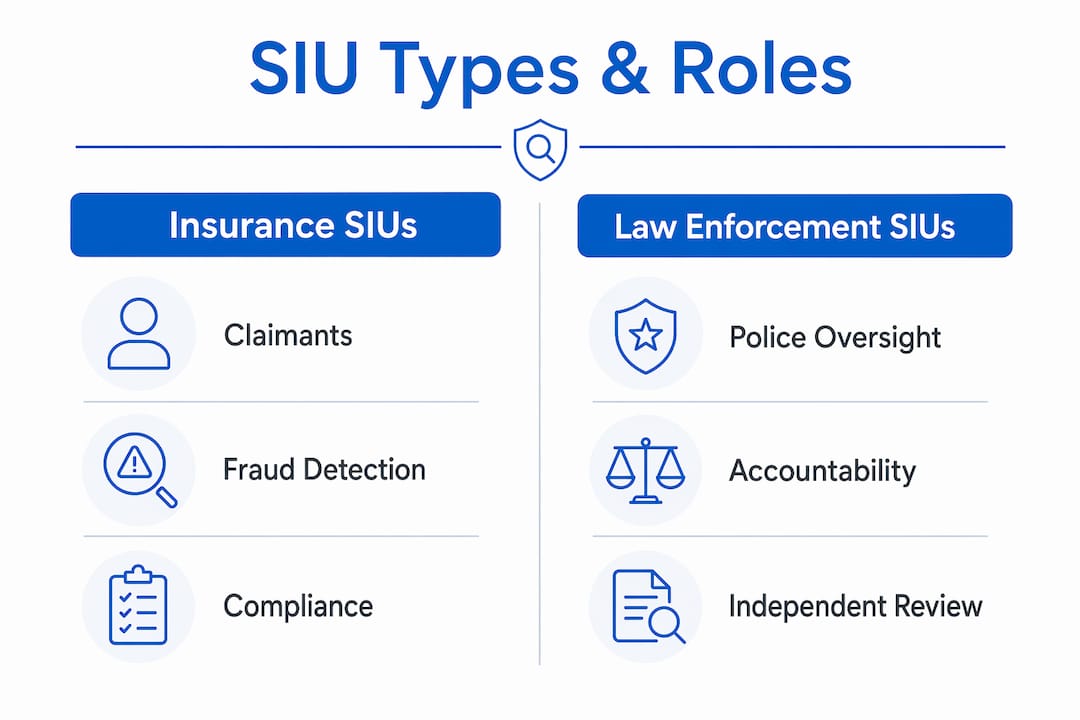
Insurance SIUs act as gatekeepers between a submitted claim and a paid settlement. They use forensic accounting, surveillance, and law enforcement coordination) to identify fraud before it costs the insurer or its policyholders. A claim gets flagged when it shows patterns inconsistent with normal loss events, such as a fire claim filed shortly after a policy increase or a medical claim with duplicate billing codes.
The types of claims most commonly reviewed include:
- Auto claims with staged accidents or inflated repair costs
- Health claims with billing for services never rendered
- Property claims involving suspected arson or exaggerated damage
- Workers’ compensation claims with inconsistent injury timelines
Once flagged, the SIU team may conduct recorded interviews, request additional documentation, or coordinate directly with local law enforcement. State regulators often require) insurance carriers above a certain size to maintain SIUs, reflecting how seriously regulators treat fraud as a threat to premium affordability.
The biggest operational tension in insurance SIUs is the balance between aggressive fraud detection and fair treatment of legitimate claimants. A poorly managed investigation) can delay valid claims unfairly and expose the insurer to bad faith lawsuits with penalties far exceeding the original claim value. SIU investigators must document every step carefully to demonstrate that delays are justified.
Pro Tip: If your insurance claim is referred to an SIU, request written confirmation of the reason for the referral. You have the right to know why your claim is under review, and that documentation protects you if the process extends beyond standard timelines.
What role do SIUs play as independent law enforcement oversight bodies?
Not every SIU works inside a corporation. Some operate as independent civilian agencies that investigate police conduct, separate from the police departments they oversee. Ontario’s SIU is the clearest example: it is a civilian body with the authority to investigate police-involved deaths, serious injuries, and sexual assault allegations against officers.
The distinction from a regular internal affairs investigation matters enormously. Internal affairs units report within the same department they investigate. An independent SIU reports to a civilian director and, ultimately, to the public. That separation is what gives these bodies credibility with communities that distrust police self-policing.
The scope of a law enforcement SIU typically covers:
- Deaths that occur during police contact
- Serious physical injuries caused by police action
- Allegations of sexual assault involving officers
- Incidents where a firearm was discharged at a person
The California Water Boards’ SIU extends this oversight model into environmental enforcement, investigating illegal discharges and regulatory violations with both investigative and technical expertise. This shows how the SIU model travels across sectors wherever specialized, independent review is needed.
| SIU Type | Who It Oversees | Primary Outcome |
|---|---|---|
| Insurance SIU | Claimants and third parties | Fraud confirmed or claim approved |
| Law enforcement SIU | Police officers | Criminal referral or case closed |
| Environmental SIU | Regulated businesses | Enforcement action or compliance order |
The power of these bodies rests on their independence. A commission of inquiry operates on a similar principle: external authority, public record, and findings that carry weight precisely because they come from outside the institution being examined.
How do SIU investigations impact citizens and community members?
Citizens interact with SIUs most often through insurance claims, but the impact of law enforcement SIUs on community trust is equally significant. Understanding what happens after an SIU investigation removes fear and replaces it with realistic expectations.
- Referral and notification. Your claim or complaint is flagged and assigned to an SIU investigator. You should receive notice that a review is underway.
- Information gathering. The investigator may request documents, conduct a recorded interview, or ask for a written statement. Claimants may be asked for additional information as part of a thorough review.
- Analysis and cross-referencing. The SIU checks your submission against public records, prior claims, and other available data.
- Decision. The claim either proceeds normally, or if fraud is confirmed, the insurer may deny the claim and refer the matter to law enforcement.
- Appeal or legal action. If you believe the investigation was mishandled, you can file a complaint with your state insurance regulator or seek legal counsel.
Delays are the most common frustration citizens report. Delays caused by SIU investigations) often frustrate claimants but are legally necessary to avoid bad faith liability for insurers. The law requires a thorough process, not a fast one.
A common misconception is that being referred to an SIU means you are accused of fraud. It does not. Many referrals result in the claim being paid in full after review. The SIU process is a screening mechanism, not a verdict.
Pro Tip: Keep copies of every document you submit to an insurer. If your claim goes to an SIU, that paper trail is your strongest defense against delays or wrongful denial.
How do SIUs use modern technology in their investigations?
Technology has changed SIU work more in the past decade than in the previous fifty years. Automated fraud-scoring algorithms) now flag claims for investigation by cross-referencing social media activity, prior claim histories, and public records. A claim that would have taken a human investigator days to identify as suspicious can be flagged within seconds of submission.
Artificial intelligence enables detection of patterns that manual review misses entirely. A network of claimants using the same repair shop, the same attorney, and the same medical provider across multiple unrelated accidents is a fraud ring signature. AI identifies that network; a human investigator then builds the case.
The ethical challenges are real. Automated systems can produce false positives, flagging legitimate claimants from certain zip codes or demographic groups at higher rates. Sophisticated SIU investigations) increasingly use AI to analyze claimant behavior patterns, but not all investigations rely solely on technology. Human judgment remains the final check before any adverse action is taken.
Surveillance technology, forensic accounting software, and digital record access have also expanded what investigators can verify. A claimant who posts photos of a physically demanding activity while claiming a disabling injury creates a digital record that SIU investigators can legally access and use. Transparency in how these tools are used is the next frontier for SIU regulation.
Key Takeaways
A special investigations unit serves two distinct functions: fraud detection within insurance and independent oversight of law enforcement, and citizens benefit most when they understand which type they are dealing with.
| Point | Details |
|---|---|
| Dual SIU contexts | SIUs operate in insurance fraud detection and as independent law enforcement oversight bodies. |
| Regulatory mandate | State regulators require insurers above a certain size to maintain SIUs to protect premium affordability. |
| Investigation outcomes | After SIU review, a claim proceeds normally or triggers legal action if fraud is confirmed. |
| Technology role | AI fraud-scoring algorithms flag suspicious claims, but human investigators make all final decisions. |
| Citizen rights | Claimants can request written reasons for referral and file complaints with state regulators if mishandled. |
Why the public misunderstands SIUs more than any other investigative body
Most people assume an SIU referral is an accusation. That assumption is wrong, and it causes real harm. Citizens who believe they are being accused of fraud sometimes withdraw legitimate claims rather than face what they perceive as a formal investigation. The insurer benefits from that withdrawal. The citizen loses money they were owed.
The deeper problem is that SIUs operate largely out of public view. Insurance SIUs publish almost nothing about their methods or outcomes. Law enforcement SIUs publish more, but their reports are dense and rarely covered by local media. The result is a public that knows SIUs exist but has no clear picture of what they actually do.
I have spent years watching public inquiries try to fill that gap. The key figures in accountability bodies are rarely household names, yet their decisions shape whether fraud gets stopped or whether misconduct gets buried. The Madlanga Commission takes a different approach by making its hearings and testimony records publicly navigable, which is exactly what SIU oversight bodies should aspire to.
The future of SIUs depends on two things: better technology and more transparency. AI will keep improving fraud detection. But without public reporting standards, citizens will keep fearing a process that is, in most cases, designed to protect them. The SIU that publishes its methodology earns trust. The one that operates in silence breeds suspicion, regardless of how well it performs.
— Meriol Lainchyon
Madlanga Commission: a public record of investigative accountability
The Madlanga Commission of Inquiry investigates criminal infiltration, political interference, and corruption within South Africa’s police, prosecution, and intelligence sectors. It is chaired by Justice Mbuyiseli Madlanga and operates as a fully public record of its hearings, testimony, and case files.
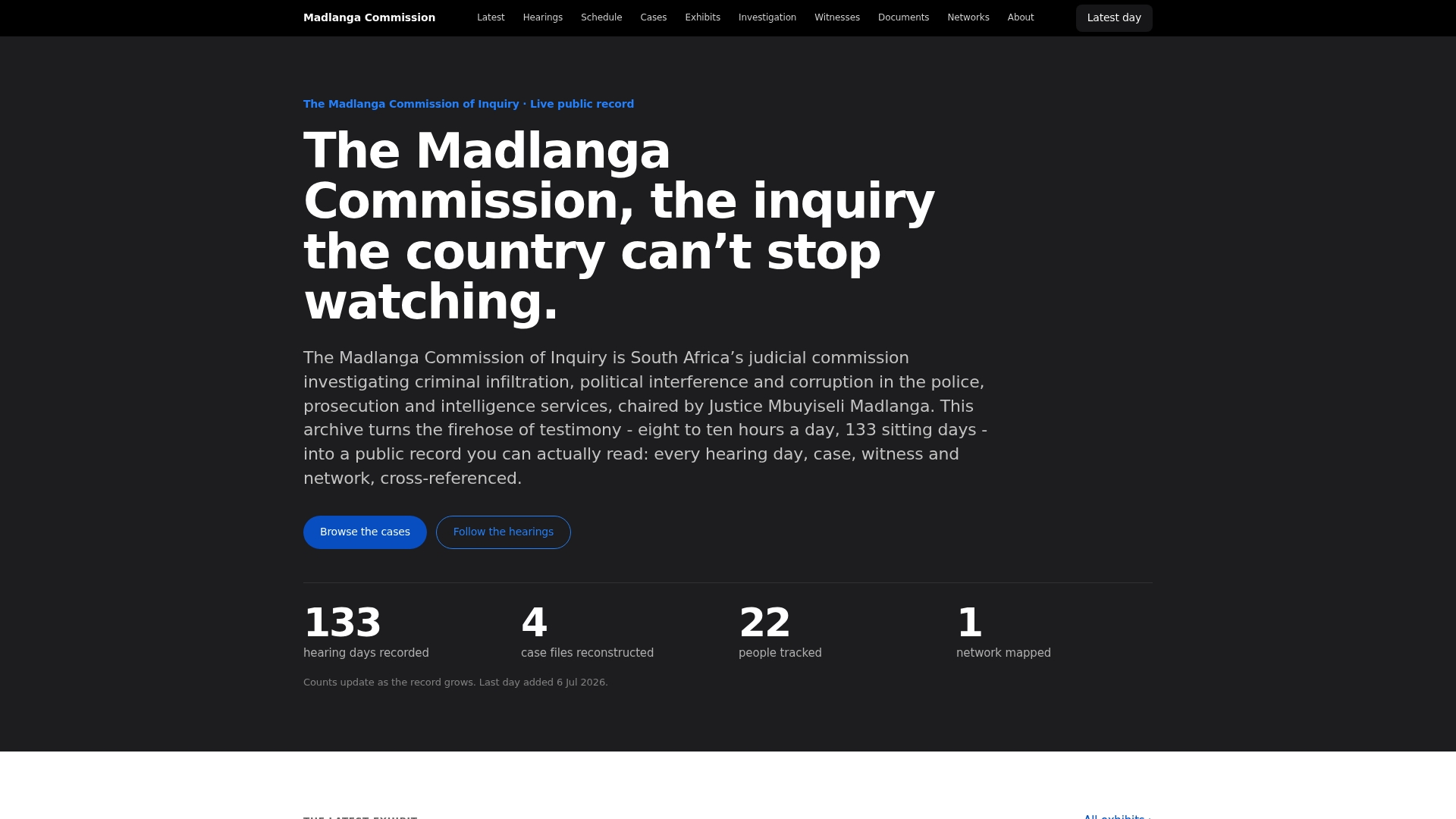
Citizens who want to understand how serious investigative oversight works in practice can explore the Commission’s investigative methodology and sourcing to see how evidence is gathered, verified, and presented. The witness testimony archive documents every person who has testified, giving the public a transparent record that most SIUs never provide. For anyone tracking how accountability bodies operate, the Madlanga Commission is a working example of what open, rigorous investigation looks like.
FAQ
What does SIU stand for in insurance?
SIU stands for Special Investigations Unit. In insurance, it refers to a dedicated team that investigates suspicious claims for potential fraud across auto, health, and property lines.
What happens after an SIU investigation on an insurance claim?
After an SIU completes its review, the claim either proceeds to normal payment or, if fraud is confirmed, the insurer may deny the claim and refer the matter to law enforcement for further action.
Is an SIU the same as the police?
No. An insurance SIU is a corporate unit with no arrest powers. A law enforcement SIU, such as Ontario’s civilian SIU, is an independent oversight body that investigates police conduct but is separate from the police department itself.
What triggers an SIU investigation?
Claims are flagged for SIU review when automated fraud-scoring algorithms or human reviewers detect patterns inconsistent with a normal loss, such as duplicate billing, prior similar claims, or timing anomalies.
How long does an SIU investigation take?
There is no fixed timeline. Investigations vary based on complexity, the volume of documentation required, and whether law enforcement coordination is needed. Delays are legally necessary to meet the standard of a thorough review.