Affidavit vs testimony: the real legal differences

An affidavit is a written, sworn statement signed before a Commissioner of Oaths. Testimony is oral evidence given under oath in court, tested through cross-examination. That distinction decides almost everything else: affidavits drive motion proceedings and administrative applications, while testimony carries the weight in trials where credibility is contested.
- Affidavits work well when facts are largely undisputed or when a statute lets a document stand in for a witness.
- Testimony matters most when a judge needs to watch someone answer hard questions live.
- Statutory shortcuts, like certain expert certificates, can let paper evidence replace a witness box appearance entirely.
Key Takeaways
The core distinction is procedural: affidavits are written sworn statements built for paper-based proceedings, while testimony is oral evidence built for live cross-examination and credibility testing.
| Point | Details |
|---|---|
| Form drives function | Affidavits work on paper; testimony requires a witness present for cross-examination. |
| Statutory shortcuts exist | Section 212(4) certificates can replace oral expert evidence if properly drafted. |
| Weight isn’t automatic | Courts discount affidavit credibility when facts are genuinely disputed and demeanour can’t be assessed. |
| Contradictions cut both ways | A prior affidavit can impeach later testimony that tells a different story. |
| Disputes go to Plascon-Evans | Genuine factual disputes on motion papers can trigger oral evidence, cross-examination, or trial referral. |
Table of Contents
- What is the difference between an affidavit and testimony?
- How do affidavits and testimony compare side by side?
- When do courts rely on affidavits versus testimony?
- How do you properly commission an affidavit?
- Can an affidavit carry the same weight as testimony?
- What happens when affidavits contradict each other?
- How do you challenge or respond to an affidavit?
- What legal authority backs the affidavit and testimony rules?
- When should you trust the paper and when should you insist on the witness?
- Where to verify these rules yourself
- Sources
- FAQ
What is the difference between an affidavit and testimony?
An affidavit is a written statement of facts, sworn or affirmed before an authorized officer, usually a Commissioner of Oaths, and signed under penalty of perjury. It records what the deponent claims to know from personal knowledge, and it becomes part of the court file the moment it’s filed. Lying in one isn’t a minor slip. Making a false statement in an affidavit can lead to a perjury prosecution, the same as lying on the stand.
Testimony, by contrast, is oral evidence given in person, under oath, while the witness sits in front of a judge (and often a jury) and answers questions from both sides. It’s built for scrutiny. Opposing counsel can press, probe, and challenge on the spot, something no piece of paper allows.
Picture a landlord seeking an eviction order. Their affidavit lays out the facts of the lease breach for the court to review on the papers. If the tenant disputes those facts and the matter proceeds to trial, that same landlord may need to appear and give testimony, answering questions a judge or opposing lawyer puts to them directly.
Pro Tip: If you’re drafting an affidavit, write only what you personally observed. A statement built on hearsay or assumption is far easier for the other side to attack, and courts routinely strike out the offending paragraphs.
- An affidavit is essentially a sworn statement frozen in time; testimony evolves in real time under questioning.
- Both carry equal legal weight as sworn evidence, but courts use them for very different jobs.
How do affidavits and testimony compare side by side?
The practical differences come down to six things: how the evidence is delivered, where it’s used, whether it can be tested, what formalities apply, how much weight a court gives it, and what happens if someone lies.
| Dimension | Affidavit | Testimony |
|---|---|---|
| Form | Written, signed, sworn | Oral, spoken under oath in court |
| Where used | Motion papers, applications, administrative filings | Trials, viva voce hearings, contested fact disputes |
| Cross-examination | Not possible on the document itself | Central feature; opposing counsel questions the witness directly |
| Formalities | Commissioning before an authorized officer required | No commissioning; oath administered in open court |
| Evidentiary weight | Strong for undisputed facts; weaker where credibility is contested | Strongest where credibility and demeanour matter |
| Consequence of falsehood | Perjury prosecution | Perjury prosecution |
Two exceptions worth flagging: a properly drawn statutory certificate can stand in as prima facie proof without anyone testifying, and a “confirmatory affidavit” (where a second person confirms another’s account) only counts for something if it contains real, specific detail rather than a rubber-stamp signature.
When do courts rely on affidavits versus testimony?
Affidavits dominate motion proceedings, the paper-based applications where a court decides a dispute without a full trial. Interdicts, urgent applications, and many administrative reviews run almost entirely on affidavit evidence. The founding affidavit is the applicant’s case; get it wrong and there may be no second chance to plead facts later. Affidavits also do heavy lifting in specific statutory and administrative contexts, such as bail applications and protection orders, where speed matters more than live cross-examination.
Oral testimony takes over the moment credibility becomes the real issue. Criminal trials, contested divorces, personal injury claims where liability is disputed. Anywhere the outcome hinges on whether a judge believes one version of events over another, courts want a live witness they can watch, question, and assess.
There’s a middle ground too. Section 212 of the Criminal Procedure Act lets certain state or expert certificates function as prima facie proof the moment they’re produced in court, without the expert ever taking the stand. A forensic analyst’s certificate on drug composition, for instance, can establish that fact automatically unless the defence successfully challenges it. That’s a deliberate efficiency measure, not a loophole, and it only works when the certificate meets strict content requirements.
How do you properly commission an affidavit?
Getting an affidavit right isn’t just about getting a signature. Courts have thrown out affidavits, and entire applications, over sloppy commissioning.
- Confirm the deponent has personal knowledge of every fact stated; maintaining proper chain of custody of documents ensures evidentiary reliability and avoids objections based on document integrity.
- Sign the document in the physical presence of a Commissioner of Oaths, who must also sign, stamp, and date it correctly.
- Keep the content factual. Argument and legal conclusions belong in heads of argument, not the affidavit itself.
- If using a confirmatory affidavit, make sure it adds substantive detail rather than simply “confirming the contents” of someone else’s statement. Courts have criticized confirmatory affidavits that amount to little more than a rubber stamp with no independent factual content.
Remote commissioning has become a live issue since courts started accepting virtual signings in exceptional circumstances, illness or travel restrictions being the usual justification. But it’s discretionary, not automatic. Recent case law shows judges expect a detailed explanation for why physical attendance wasn’t possible, and courts are still working out how much departure from the traditional rules they’ll tolerate before an affidavit becomes vulnerable to challenge.
Pro Tip: If your affidavit was commissioned remotely, attach a short explanatory note covering exactly why, and keep proof of the commissioner’s identity verification. That paper trail is often what saves the document from a technical challenge later.
Can an affidavit carry the same weight as testimony?
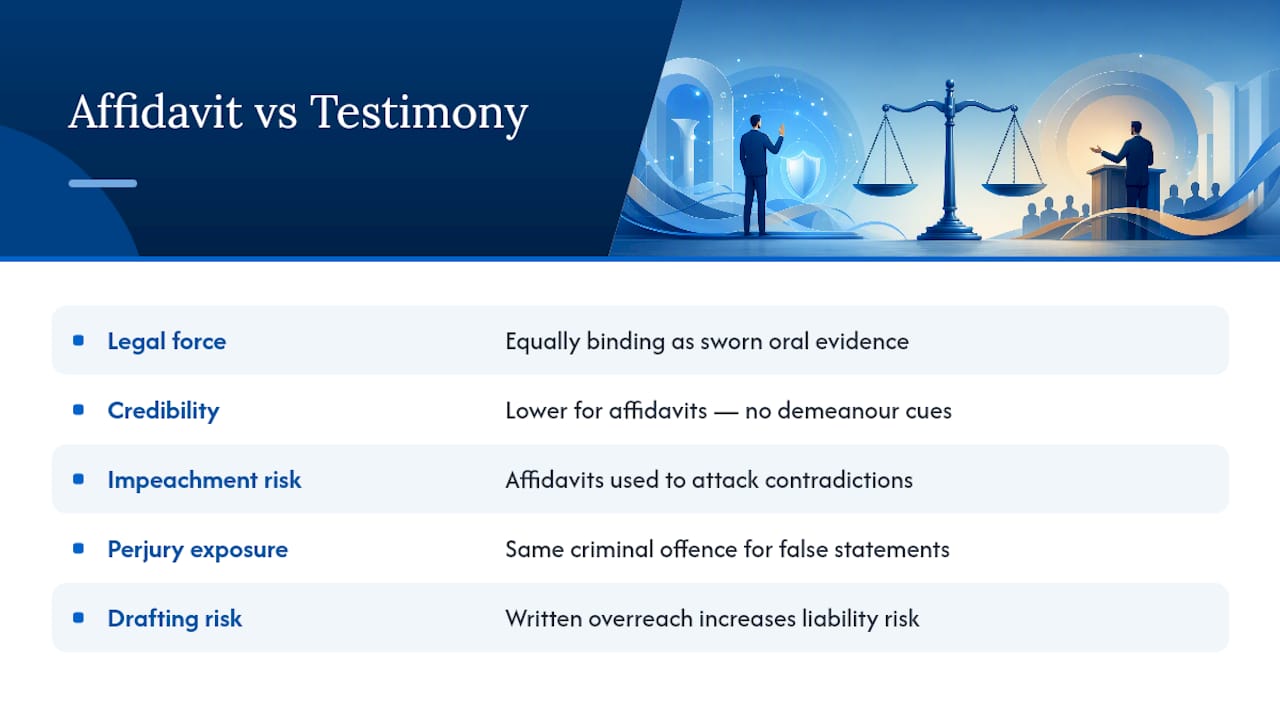
Legally, yes. An affidavit is just as binding as sworn oral evidence, and lying in either exposes the deponent to prosecution. Practically, courts treat them differently the moment credibility is in dispute, because a judge reading a page can’t watch someone hesitate, contradict themselves, or flinch under pressure. Demeanour, tone, and consistency under hostile questioning simply don’t transfer to paper.
That gap creates one of the sharpest tools in litigation: impeachment. If a witness takes the stand and their testimony contradicts something they swore to earlier in an affidavit, opposing counsel can introduce that affidavit to attack their credibility on the spot. A witness who swore one version in writing and then tells a different story under oath in court hands the other side a ready-made weapon.
Perjury exposure runs both directions. Whether the false statement was written and signed or spoken aloud in the witness box, the criminal consequence is the same offence. That equal exposure shapes how careful lawyers draft affidavits in the first place. Every sentence in a sworn statement is a potential liability if it later proves untrue, which is exactly why overreaching or speculative claims in an affidavit are a bigger risk than they might look at drafting stage.
What happens when affidavits contradict each other?
Motion proceedings run into trouble when one side’s affidavit flatly contradicts the other’s on a material fact. Courts don’t just pick whichever version sounds more convincing on paper. The governing approach, known as the Plascon-Evans rule, says a court deciding final relief on motion must generally accept the respondent’s version of disputed facts, unless that version is so far-fetched or clearly untenable that it can be rejected on the papers alone.
A “real, genuine, and bona fide dispute of fact” changes the court’s options entirely. Judges faced with one can refer specific disputed issues to oral evidence, order the parties to trial, or in narrower cases, call the deponents themselves for cross-examination on the contested points only.
For applicants, that means front-loading founding papers with enough specific, credible detail to avoid triggering a genuine dispute in the first place. For respondents, it means a well-drafted answering affidavit that raises a real factual conflict, not a bare denial, can be enough to stop the whole matter being decided on paper.
How do you challenge or respond to an affidavit?
- Check the commissioning first: was it signed properly, by the right official, with the correct wording and date?
- Scrutinize personal knowledge. Flag any paragraph that reads like hearsay, speculation, or legal argument dressed up as fact.
- Where the affidavit is vague or contradictory, address that directly in your own answering affidavit rather than assuming a judge will spot it unprompted.
- If credibility is genuinely in dispute, consider applying for the deponent to be called for cross-examination or for the matter to proceed to oral evidence.
- Preserve your objections early. Waiting until argument to raise a commissioning defect or a hollow confirmatory affidavit often comes too late.
Applicants should avoid the opposite mistake: leaning on template confirmatory affidavits instead of pleading real facts in the founding papers, since inadequate drafting at that stage can sink an otherwise strong case.
What legal authority backs the affidavit and testimony rules?
Section 212(4) of the Criminal Procedure Act is worth reading directly if you’re dealing with expert or forensic evidence. It sets out exactly what a certificate must contain, qualifications, methodology, and results, before it can function as prima facie proof on mere production in court. Miss one of those elements and the certificate becomes vulnerable to rebuttal.
Case law on remote commissioning and confirmatory affidavits is still developing, which matters because it shows judges applying old formalities to new practical realities, video-call signings, pandemic-era workarounds, and template documents that add nothing beyond a signature. Public inquiries illustrate the same tension in real time. Coverage of witnesses called before the Madlanga Commission shows how oral testimony under sustained questioning can surface details no affidavit captured beforehand.
These authorities aren’t academic. They decide, in real cases, whether a document gets accepted at face value or a witness gets called to answer for it in person.
When should you trust the paper and when should you insist on the witness?
Affidavits earn their keep on efficiency. Most disputes don’t need a trial, and forcing oral evidence on every application would grind the courts to a halt. But efficiency has a ceiling. The moment a case turns on whether someone is telling the truth, not just what they claim, paper stops being enough.
My honest read: too many litigants treat affidavits as a formality to get past rather than the actual evidentiary foundation of their case. Read every affidavit filed against you as if it will be the only evidence a judge ever sees, because on the papers, it often is. Object to defects immediately. Waiting rarely helps.
Where to verify these rules yourself
- Review section 212 of the Criminal Procedure Act directly if you’re dealing with expert or forensic certificates.
- Consult the De Rebus analysis on what makes a s 212(4) certificate valid.
- Browse the Madlanga Commission’s hearing archive to see how sworn statements and live testimony interact in an actual public inquiry record.
This article is general information, not a substitute for advice from a qualified lawyer. Consult a qualified legal professional about your own circumstances before acting on anything here.
Sources
- Criminal Procedure Act — section 212 (proof of certain facts)
- Everything you need to know about affidavits — Goldman Schultz
FAQ
Is an affidavit the same as testimony?
No. An affidavit is a written sworn statement, while testimony is oral evidence given in court under oath, typically with the opportunity for cross-examination.
How powerful is an affidavit?
An affidavit is legally binding and can carry significant weight, especially in undisputed motion proceedings, but courts give it less weight than testimony when credibility or demeanour is genuinely in question.
What is the main purpose of an affidavit?
Affidavits let parties present sworn facts to a court or authority in writing, most commonly to support applications, motions, or administrative processes without requiring a live hearing.
Is an affidavit legally binding?
Yes. Signing an affidavit means swearing to its truth under oath, and knowingly including false statements can lead to a perjury prosecution, the same consequence as lying under oath in court.
Can an affidavit replace oral testimony in court?
Sometimes. Statutory certificates under section 212(4) of the Criminal Procedure Act can serve as prima facie proof without a witness testifying, but where facts are genuinely disputed, courts generally require oral evidence instead.
Recommended
- Witness I - Hawks narcotics team leader (SANEB), Madlanga Commission
- Zelda Maphosho - Assistant Director of Investigations, IPID, Madlanga Commission
- Advocate Andrea Johnson - Madlanga Commission
- Witness K - Inspector, VIP Protection Unit, Johannesburg Metro Police Department (JMPD), Madlanga Commission