2021 GBV bail rules: 3 entry points and a checklist for South Africa
Bail is temporary release from custody, secured by money or conditions, granted under the Criminal Procedure Act 51 of 1977. Police, prosecutors, or a court can grant it, depending on the charge, but gender-based violence cases now face stricter rules since 2021. Whoever pays must get and keep a receipt, and every accused person should ask about bail the moment they first appear in court.
TL;DR:
- Bail in domestic-relationship and gender-based violence cases now requires magistrate approval at the first court appearance, not police or prosecutor discretion.
- Courts consider flight risk, witness interference, danger to others, and past bail breaches when deciding whether to grant bail, with higher thresholds for Schedule 6 offences.
- Bail money paid in cash is refundable after case completion if all conditions are met, but only if the original receipt is kept and every hearing attended.
- Breaching bail conditions can lead to immediate arrest warrants, forfeiture of bail money, and potential re-remand without a new hearing.
- Public hearing records from the Madlanga Commission reveal systemic flaws and docket mishandling that can influence bail fairness before the official proceedings begin.
Table of Contents
- How does the South Africa bail process actually start?
- What test do courts use to decide bail?
- How have GBV bail amendments changed the rules?
- How is bail paid, and how do you get it back?
- What happens if bail is broken?
- How do you prepare for a bail hearing?
- What does the Madlanga Commission reveal about bail fairness?
- What I’d tell anyone facing a bail hearing
- Find the hearing records behind South Africa’s justice debates
- Where to verify the law and get help
- Sources
- FAQ
How does the South Africa bail process actually start?
There are three doors into bail, and which one opens depends entirely on the charge. Understanding bail conditions in South Africa starts with knowing who has the power to release you before you even see a magistrate.
- Police bail (section 59): Available for less serious offences, paid in cash directly at the station, and off the table for most domestic-relationship or GBV-related charges.
- Prosecutor-authorised bail (section 59A): A senior prosecutor can grant it for a wider range of offences, usually after checking with the investigating officer, before the matter reaches court.
- Court bail (section 60): The main route once schedule offences, GBV matters, or anything police and prosecutors won’t touch land in front of a magistrate.
Schedule classification decides everything here. A Schedule 5 or 6 charge, or a domestic-relationship offence, strips away the first two doors and pushes the decision straight to a judicial officer under the Criminal Procedure Act 51 of 1977.
What test do courts use to decide bail?
Magistrates weigh one core question: does releasing this person serve the interests of justice more than keeping them in custody harms them? That balancing act sits at the heart of South Africa’s bail process, and it shifts depending on the schedule of the offence.
Schedule 5 offences require the accused to show why release is justified. Schedule 6 raises the bar further, demanding “exceptional circumstances” before a court will even consider bail. Judges lean on a specific set of factors when making that call:
- Flight risk, based on ties to the area, family, and employment history.
- Likelihood of witness interference or evidence tampering.
- Danger the accused poses to any particular person or the public.
- Prior convictions, especially previous bail breaches or failures to appear.
- Whether the state’s case is strong enough to justify the risk of pretrial detention.
Pro Tip: Bring proof of address, a payslip, and a letter from an employer to your bail hearing. Judges rely heavily on these small, boring documents to gauge whether you’ll actually show up for trial.
Every arrested person must reach a court within 48 hours of arrest, and that first appearance is where bail should be raised, according to Vuk’uzenzele’s bail explainer. Delay beyond that window without a court order is itself a rights violation.
How have GBV bail amendments changed the rules?
The Criminal and Related Matters Amendment Act 12 of 2021 rewrote bail for domestic-relationship and gender-based violence cases, and the shift is significant. Police and prosecutors lost the authority to grant bail in many of these matters, meaning a magistrate now decides at the very first appearance rather than at a station or prosecutor’s desk.
- Courts must now conduct a protection-order inquiry as part of the bail hearing itself, tying the complainant’s safety directly to bail conditions.
- In defined GBV categories, the onus flips: the accused must actively show that release serves the interests of justice, rather than the state proving detention is warranted.
- Bail conditions can now include no-contact orders, restrictions on approaching a residence or workplace, and mandatory compliance with any protection order issued.
This changes the calculus for both sides. Accused persons face a heavier evidentiary burden from day one, while complainants gain a formal mechanism for their safety to be weighed before release, not after. The amendment act’s own text makes clear this was a deliberate legislative response to years of GBV-related bail failures, and courts are now expected to raise protection orders even if neither party mentions them.
How is bail paid, and how do you get it back?
Bail money acts purely as a guarantee of court attendance, not a fine, and it is refundable even if the accused is eventually convicted, provided every condition was met, according to the official government FAQ on bail.
- Either the accused or a third party can pay, in cash, at the court or police station handling the matter.
- Insist on a receipt at the moment of payment. Only the person holding that original receipt can reclaim the funds later.
- Attend every scheduled hearing and comply with every bail condition. This is what keeps the money refundable.
- Forfeiture happens if the accused skips a hearing, interferes with witnesses, or breaches a specific condition.
- Once the case concludes, present the original receipt at the relevant court finance office to reclaim the money.
Legal Aid South Africa is blunt about this: lose the receipt and you may lose the ability to prove the money was ever yours.
What happens if bail is broken?
Section 68 of the CPA sets out the grounds for cancelling bail, and the list is narrower than most people assume. It’s really four scenarios: absconding, interfering with witnesses, issuing threats, or breaching a protection order tied to the case.
- A breach can trigger an immediate warrant for arrest, followed by remand back into custody without a fresh bail hearing being guaranteed.
- Failure to appear in court is itself a separate criminal offence, on top of whatever charge the accused was already facing.
- Breached bail almost always means forfeited bail money, regardless of the outcome of the original case.
- Victims, witnesses, or community members can report a breach directly to the investigating officer or the prosecutor handling the matter, prompting a cancellation application.
The system assumes good faith once bail is granted. Breaking that faith carries consequences well beyond losing a deposit.
How do you prepare for a bail hearing?
Preparation decides outcomes more than most accused persons realise, especially where an ability-to-pay inquiry is involved. Section 60(2B) requires the court to specifically probe whether the accused can afford bail, and to consider non-money alternatives such as guarantees or conditions instead of cash, per SAFLII’s consolidated CPA text.
- Gather ID, proof of residence, and proof of employment or income before the hearing date.
- Collect bank statements or an affidavit from an employer or relative confirming financial support.
- If you genuinely cannot pay, prepare to say so clearly. The court must then explore alternatives rather than detain you by default.
- Structure any testimony around stability. Family ties, a fixed address, and a clean compliance record all reduce perceived flight risk.
- Contact Legal Aid South Africa early if you can’t afford a private attorney. Their criminal law desk handles bail applications regularly.
Pro Tip: Don’t wait for the magistrate to ask about your finances. Raise the ability-to-pay inquiry yourself if you’re struggling, since practitioners note that indigent accused persons often stay in custody simply because nobody explicitly requested the alternative.
What does the Madlanga Commission reveal about bail fairness?
Bail decisions don’t happen in a vacuum. They depend on how police handle a docket, how prosecutors frame a charge, and whether procedural steps get followed at all, and that’s exactly where public accountability records earn their value.
Hearings before the Madlanga Commission have surfaced patterns of docket mishandling, delayed disclosure, and prosecutorial decisions that shaped outcomes long before any bail application reached a magistrate. When those upstream failures go unrecorded, the fairness of the bail hearing downstream is compromised before it even starts.
The Madlanga Commission’s case files document exactly this kind of institutional behaviour, and the Khumalo and Mokwele case record offers a concrete look at how arrest and appointment decisions ripple through the system. Readers tracking bail practice can use these public hearing archives to see where accountability breaks down.
What I’d tell anyone facing a bail hearing
Bail law asks the system to hold two things at once: a person’s liberty and a victim’s safety. Getting that balance right means knowing the rules, not hoping a magistrate explains them to you. Keep your receipt, know your rights, and use public hearing archives when you need to understand how institutions actually behave under pressure. That’s not a legal luxury. It’s how ordinary people hold the system accountable.
— Meriol Lainchyon
Find the hearing records behind South Africa’s justice debates
Reading the law is one thing. Seeing how police and prosecutors actually behave in practice is another, and that’s the gap Madlanga Commission’s public archive was built to close. Unlike a news summary or a secondhand court report, the archive gives you direct access to daily hearing records, exhibits, witness lists, and case files, free of charge, with no need to follow live proceedings to stay informed.
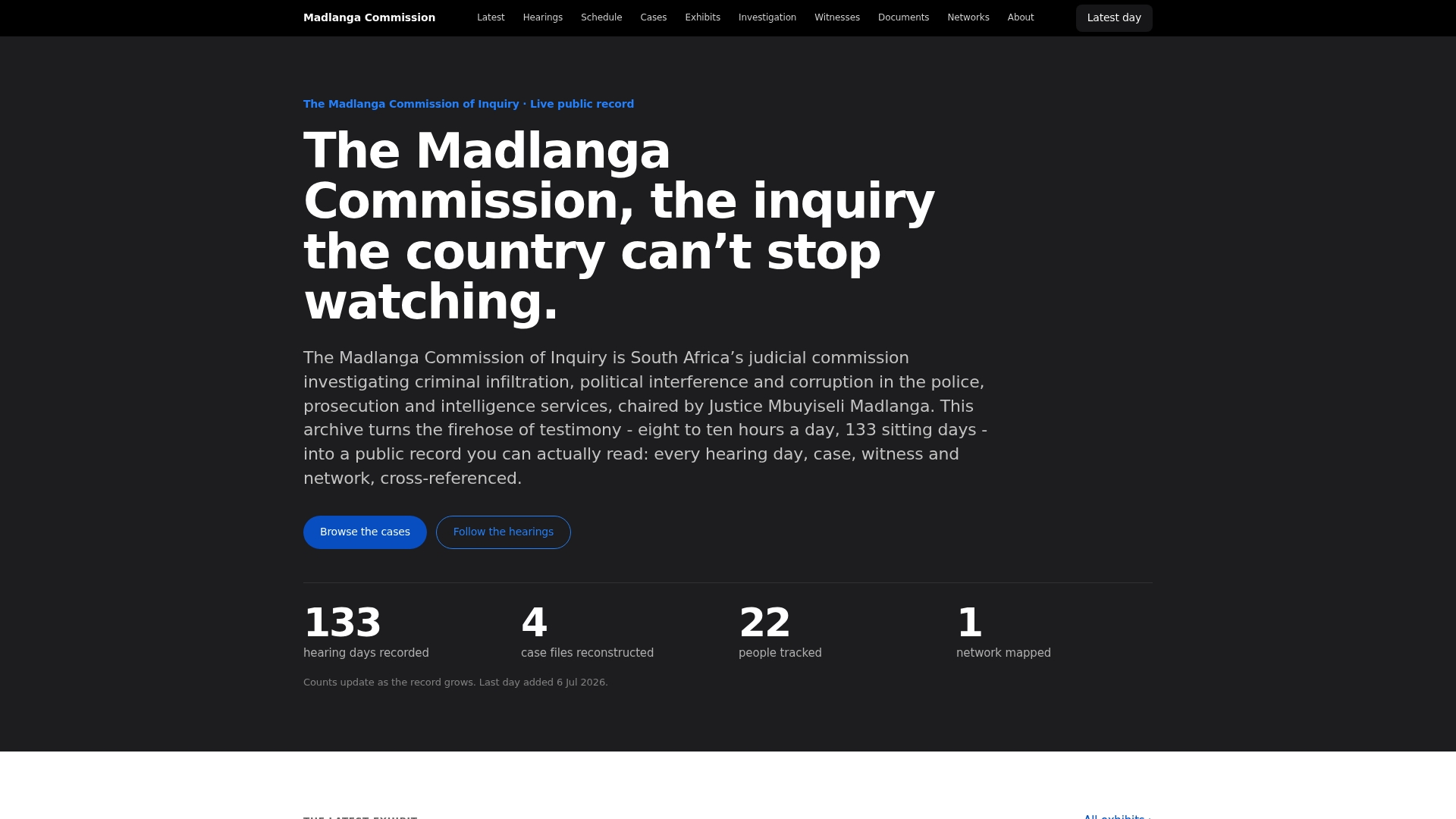
Journalists, legal practitioners, complainants, and researchers use it to trace exactly how docket handling or prosecutorial choices shaped real outcomes, including cases touching on bail practice. Start with the explainers section if the terminology feels unfamiliar, or head straight to the most recent hearing record to see current testimony. If you want to understand how the archive itself is compiled and verified, the methodology page lays out the sourcing process in full. Search the archive today and see what the record actually says.
Where to verify the law and get help
- Criminal Procedure Act 51 of 1977: the full statutory text governing bail, sections 58 to 71.
- Gov: plain-language guidance on how bail works and refund rules.
- Legal Aid South Africa: free legal assistance for bail applications and criminal matters.
- Madlanga Commission: searchable hearing records relevant to policing and prosecutorial conduct.
This article is general information, not a substitute for advice from a qualified lawyer. Consult a qualified legal professional about your own circumstances before acting on anything here.
Sources
- What is bail and how does it work? | South African Government
- Criminal Procedure Act 51 of 1977 (consolidated) | SAFLII
- Gov
- Understanding the bail process | Vuk’uzenzele
- Criminal law – Legal Aid South Africa
FAQ
How is bail paid in South Africa?
Bail is usually paid in cash at the court or police station handling the case, by the accused or a third party, and a receipt must be issued and kept safe for the refund process, per the official government FAQ.
What is the latest case law and legislative change on bail applications in South Africa?
The most significant recent shift is the Criminal and Related Matters Amendment Act 12 of 2021, which restricts police and prosecutor bail for GBV-related offences and requires courts to conduct a protection-order inquiry at the bail hearing itself.
Can you get bail if you have a pending case?
Yes, a pending case does not automatically bar bail, but courts weigh prior charges and any history of bail breaches heavily when assessing flight risk and the interests of justice.
Can you claim your bail money back?
Yes, bail money is refunded once the case concludes, provided the accused attended every hearing and met all conditions, but only the holder of the original payment receipt can reclaim it, according to Legal Aid South Africa.