Cite Madlanga inquiry transcripts: 7 elements for SA journalists

The Madlanga Commission’s searchable public archive is the authoritative source for official hearing transcripts, and it is where you should start before quoting anyone. Open the hearings index or the witnesses index, find the exact day, date and witness, and copy the stable URL. That single link, paired with the day number, is the backbone of any citation you build under the Commissions Act and PAIA.
TL;DR:
- The public archive organizes transcripts by day number and date, making it essential to locate the exact session through the hearings index.
- Building a proper citation requires seven key details, including witness name, day number, date, session title, stable URL, exhibit ID, and time or paragraph reference.
- When transcripts or exhibits are missing, check the archive and corrections page first, then contact the records team or file a PAIA request if needed.
- Use the witness index and methodology page to verify transcripts and exhibits before quoting, ensuring the record hasn’t been amended or redacted.
- Proper citation varies by context but always includes a stable URL, specific identifiers, and clear marker for redactions or unclear testimony.
Table of Contents
- Where to find official transcripts and how the archive is organized
- How do you build a correct citation from a transcript?
- What legal rules govern access to commission transcripts?
- What to do when a transcript or exhibit is missing
- Copy-ready citation examples for common formats
- Why we built the archive this way
- Start with the witness index and methodology page
- Sources
- FAQ
Where to find official transcripts and how the archive is organized
Every credible citation starts with locating the right record, not guessing at it. The Madlanga Commission organizes its public record across a few key landing pages, and knowing which one to check saves you from citing a secondhand summary instead of the primary transcript.
- Hearings index: lists proceedings by day number and date, with links to full transcripts for each session.
- Witnesses index: profiles every person who has testified, cross-linked to their specific transcript pages and exhibits.
- Methodology, Sourcing & Corrections page: flags amended transcripts, redactions, and sourcing notes before you quote anything.
Transcript pages follow a consistent naming pattern. A page like Day 161, a recent year tells you the day number and the exact date in the title itself, and it usually distinguishes a “Full Day” transcript from a partial session that was adjourned early. Exhibit numbers appear inline where evidence is introduced, and speaker labels identify who is talking, whether it’s the witness, evidence leader, or a commissioner.
If you’re hunting for a specific moment, filter by date range on the hearings index, or search a witness’s name directly, as with the profile for Senzo Mchunu. Exhibit numbers also work as search terms if you already know which document you’re chasing.
Pro Tip: Before you copy a quote, right-click the transcript page and copy the actual browser URL rather than a shortened or shared link. A stable, direct URL is what makes your citation verifiable months later.
How do you build a correct citation from a transcript?
A reliable citation needs seven pieces of information, and skipping any one of them makes your reference harder to verify later. Record these before you close the tab:
- Witness name as it appears on the profile or transcript header.
- Day number (for example, “Day 161”).
- Exact date of the hearing.
- Transcript title or session label, including “Full Day” or partial-session notes.
- Stable URL for the specific transcript page.
- Exhibit ID, if the quote references submitted evidence.
- Timecode or page/paragraph number, when the transcript supports it.
With those elements in hand, three formats cover most use cases:
Short inline news citation: “Madlanga Commission, Day 161 (a recent year), testimony of [Witness Name].”
Legal memo reference: “Madlanga Commission of Inquiry, Day 161 Hearing Transcript, testimony of [Witness Name], a recent year, Exhibit [ID], [URL].”
Full academic entry: “Madlanga Commission of Inquiry. Day 161 Hearing Transcript. a recent year. [URL]. Accessed [access date].”

Include exhibit numbers whenever the quote directly references a document, photo, or recording entered into evidence. Note redactions with square brackets, like “[redacted],” and flag uncertain speaker attribution with “[speaker unclear]” rather than guessing. Before publishing a quote, cross-check it against the underlying audio or video where available, and confirm the transcript hasn’t since been amended. The methodology, sourcing and corrections page is the place to check that, and it should be part of your routine before any quote goes to print.
What legal rules govern access to commission transcripts?
Judicial commissions of inquiry in South Africa operate under the Commissions Act, which grants commissions the power to determine their own procedures, including how proceedings are published and made accessible. That’s the legal basis for why Madlanga Commission transcripts are public by default rather than something you need special permission to see. Past commissions have used similar rule-making authority to secure evidence already presented elsewhere, a precedent that reinforces how much latitude a commission has over its own record.
When a record isn’t already published, the Promotion of Access to Information Act, or PAIA, becomes relevant. The PAIA manual recommends contacting the record holder directly before filing a formal request, and the South African Human Rights Commission publishes Section 14 guidance to help requesters navigate the process.
A practical decision flow looks like this:
- Check the archive first: hearings index, witness page, exhibit list.
- Check the methodology and corrections page for known amendments.
- Contact the commission’s records team with a precise reference.
- File a formal PAIA request only if the above steps come up empty.
Expect a PAIA request to take time. Statutory timelines apply, redactions are possible where privacy or safety concerns exist, and some requests may carry fees or fall under specific exemptions depending on the record.
What to do when a transcript or exhibit is missing
Missing records happen, especially during active hearings when uploads lag behind the courtroom by a day or two. Work through this sequence before assuming a document doesn’t exist:
- Re-check the archive and the corrections page. Search variations of the witness name or day number, and confirm the methodology page hasn’t flagged a delay or correction affecting that session.
- Contact the commission’s records or admin team with a precise reference: the day number, date, and witness name, not a vague description of “that testimony from last week.”
- File a PAIA request if the record genuinely isn’t public yet. Include exact identifiers, your preferred format (PDF, plain text), and full contact details so the request isn’t rejected on a technicality.
If you need to cite something before the official transcript lands, use an alternate primary source, such as the archived audio, video, or a commission press release, and say so plainly in your citation. Something like “Madlanga Commission, live audio recording, Day 161, a recent year” is honest about what you’re actually working from.
Pro Tip: Keep a personal log of the exact date and time you checked the archive for a missing record. If a correction appears later, that timestamp shows you cited the best available source at the time.
Copy-ready citation examples for common formats
Different contexts call for different levels of detail, and matching the format to the use case keeps your references clean and consistent.
- News inline quote: “‘The truck was intercepted at the N3 off ramp,’ [Witness Name] told the Madlanga Commission on Day 161 (a recent year).” Full source line: Madlanga Commission of Inquiry, Day 161 Hearing Transcript, [URL].
- Legal memo: “See Madlanga Commission of Inquiry, Day 161 Hearing Transcript, testimony of [Witness Name], Exhibit 14, a recent year, [URL], at [timecode].”
- Academic reference: “Madlanga Commission of Inquiry. Day 161 Hearing Transcript: Testimony of [Witness Name]. a recent year. [URL]. Accessed [date].”
- PAIA/FOI request listing: “Requested record: Madlanga Commission Day 161 transcript, testimony of [Witness Name], a recent year. Request filed [date] under PAIA.”
When a quote includes a gap or an unclear speaker, mark it inline rather than smoothing it over: “[Witness Name] said the vehicle was ‘[inaudible] parked outside the depot for [redacted] hours.’” That bracket convention tells a reader, a judge, or a fact-checker exactly where the record itself was incomplete, not where you filled in a guess. Archival practice generally treats inquiry records as a public asset that deserves careful stewardship, which means balancing open access with sensitivity toward witnesses discussing personal risk or ongoing investigations.
Why we built the archive this way
The Madlanga Commission, chaired by Justice Mbuyiseli Madlanga, exists to turn sprawling testimony into a navigable public record, and that only works if the underlying transcripts are trustworthy enough to cite with confidence. Corrections happen, so the methodology, sourcing and corrections page stays the final check before anything goes to print. If a transcript changes, that’s where you’ll see it first.
— Meriol Lainchyon
Start with the witness index and methodology page
Skipping straight to a search engine for commission testimony is how misquotes end up in print. Madlanga Commission’s advantage over piecing together secondhand summaries is that every transcript, exhibit, and witness profile sits in one indexed, cross-linked archive, so you can verify a quote against its original source in minutes instead of hours.
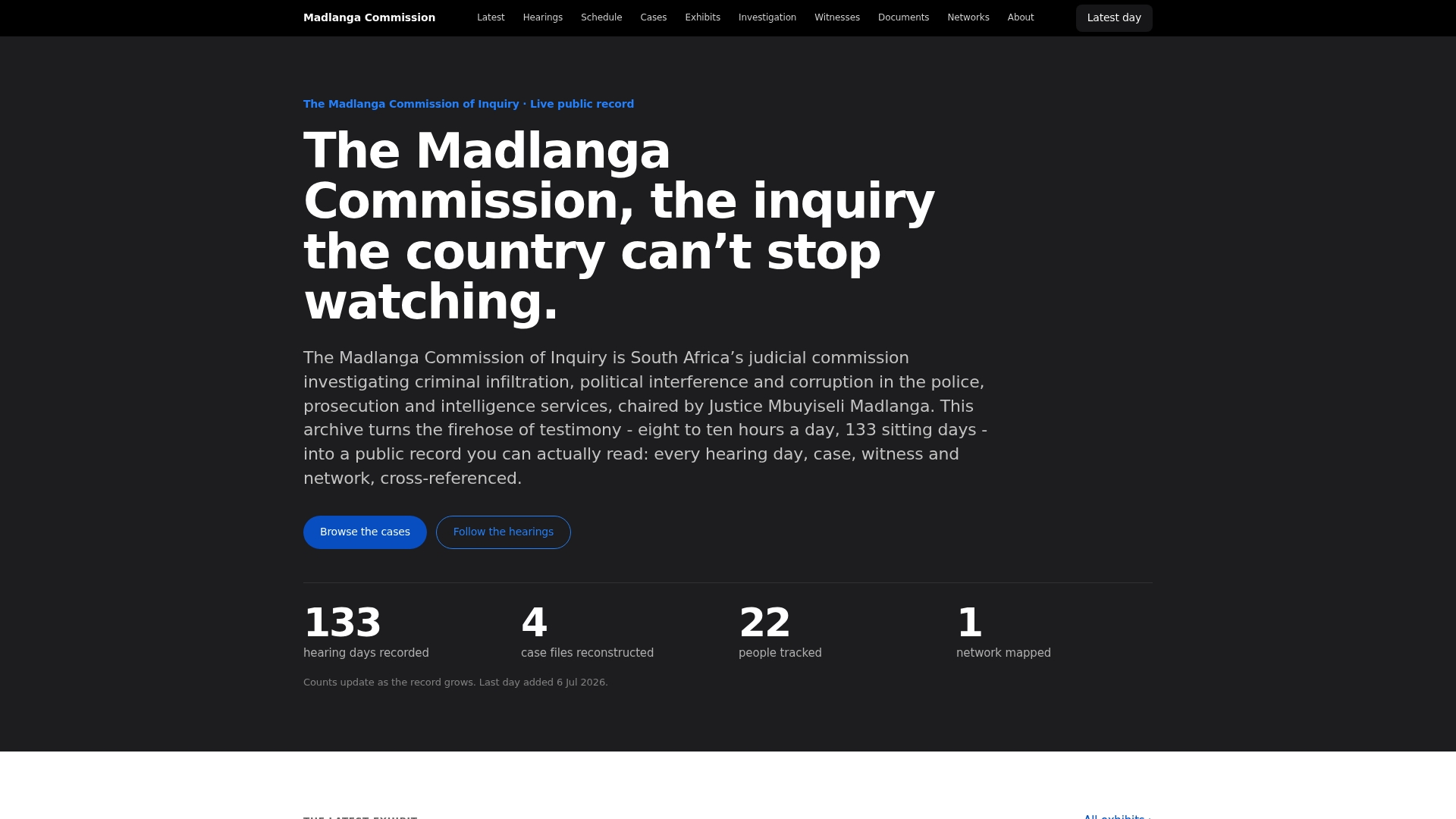
Start at the witnesses index to find the person you need to quote, then confirm the transcript against the methodology, sourcing and corrections page before you publish. If you’re researching a specific role, profiles like Zelda Maphosho’s show exactly how testimony, exhibits, and rulings connect on a single page. Pull the day number, date, and stable URL now, while the record is in front of you.
Sources
FAQ
What is the primary source for Madlanga Commission transcripts?
The commission’s own searchable archive, including the hearings index and witnesses index, is the primary and canonical source for official transcripts.
Do I need permission to quote a Madlanga Commission transcript?
Generally no. The Commissions Act gives commissions authority to make proceedings public, so published transcripts can be quoted directly with proper attribution.
What if the transcript I need isn’t published yet?
Check the methodology and corrections page first, contact the commission’s records team with specific identifiers, and file a PAIA request if the record still isn’t available.
Which citation style should I use for a commission transcript?
Match the format to your context: a short inline attribution for news, a detailed locator with exhibit numbers for legal memos, and a full bibliographic entry with a persistent URL for academic work.
How do I verify a transcript hasn’t been amended?
Check the Methodology, Sourcing & Corrections page before quoting, since that’s where the commission flags corrections and amendments to published transcripts.
What should I do with redacted or unclear testimony?
Mark redactions or uncertain speakers directly in your quote using brackets, such as “[redacted]” or “[speaker unclear],” rather than smoothing over the gap.