Get Madlanga Transcripts the Same Day: Court Records Access in South Africa

The Madlanga Commission’s public archive hosts daily hearing transcripts, exhibits, case files and witness profiles, all searchable by day number, witness name or exhibit code. Most material downloads as PDF the same day a hearing is recorded. The exception: testimony heard in camera, which stays off the public record until the commission announces otherwise.
TL;DR:
- Public in-camera testimony remains inaccessible until the commission grants explicit permission for release, with no fixed timeline for disclosure.
- Exhibit codes like MK2 directly link evidence documents to transcripts, enabling precise cross-referencing with the original PDF files.
- The commission’s announcements, press statements, and the latest page are your main sources for up-to-date information on hearing reopenings and document availability.
- Access requests for unpublished documents should go through the commission’s official latest page and specific inquiry to the press office, referencing exact hearing details.
- The archive is a direct publication by the commission itself, not a court record, giving it broader discretion over what is publicly available or kept in camera.
Table of Contents
- How to access court records in South Africa’s Madlanga Commission archive
- How do I download a specific transcript or exhibit?
- Why does some testimony stay off the public record?
- Verifying and citing commission material properly
- Who do you contact for access requests and inquiries?
- What to do when a document isn’t available online yet
- What else can limit access besides in-camera rulings?
- What law governs access to South African commission records?
- Why this archive matters for public accountability
- Access every hearing, exhibit and case file in one place
- Sources
- FAQ
How to access court records in South Africa’s Madlanga Commission archive
Court records access in South Africa usually means navigating case-law databases or the CaseLines e-filing system, but the Madlanga Commission operates differently. It is a judicial commission of inquiry, not a court, so its record is published directly by the commission itself rather than filed through a court registry. That makes the archive simpler to search than a typical court file, provided you know how it is organised.
The archive groups material into a handful of categories:
- Hearings index — every sitting day, listed chronologically, with a direct link to that day’s transcript and exhibits.
- Exhibits — documents entered into evidence, each carrying a code such as MK2 or MK4 that ties it to the transcript spine referencing it.
- Case files — bundled material organised by investigation thread, filed under labels like “File 1” and “File 2”.
- Witness profiles — background pages on individuals who have testified, including Clive Naicker, Michael van Wyk and Lieutenant Colonel Jakobus Prinsloo.
- Network pages — thematic groupings, such as the Khan network, that pull together every exhibit and transcript touching one investigation strand.
How do I download a specific transcript or exhibit?
Finding one document among hundreds of hearing days gets easier once you know the archive’s search logic. Follow these steps:
- Start at the hearings index and search by day number or hearing date if you already know when the testimony happened. A page like Day 110 gives you the full transcript plus every exhibit entered that day.
- Search by witness name if you don’t know the date. Names like Clive Naicker, Michael van Wyk or Jakobus Prinsloo link directly to their testimony days from the key figures page.
- Search by exhibit code (formatted MK followed by a number) when you’re chasing a specific document referenced in another transcript. The code ties the exhibit back to its file spine.
- Search by network page when your interest is a whole investigation thread rather than one hearing. The Khan network page, for instance, collects related testimony across multiple sitting days.
- Download and label the PDF with the day number, page reference and exhibit code before you file it. That metadata is what lets you find it again in six months.
Pro Tip: Save the exact URL and the date you accessed it alongside the PDF. Commission pages get corrected and re-indexed occasionally, and having your own access-dated copy protects you if a citation is ever challenged.
Why does some testimony stay off the public record?
Not everything the commission hears becomes public immediately, and the reasons are specific rather than arbitrary.
Public access to the entire commission was suspended for several days after the chair granted Witness M an application to testify in camera, with no resumption date set at the time. A similar situation played out with Witness G, where the commission ruled the testimony itself would be heard behind closed doors and left a separate decision pending on whether the written statement would ever be released.
Evidence leader Advocate Teboho Mosikili has been the figure most associated with these affidavit applications, arguing for in-camera protection where witness safety is at stake. The commission doesn’t hide these decisions. It announces them through:
- Updates posted on the commission’s own latest page
- Spokesperson statements carried by outlets like SABC News and Mail & Guardian
- Formal rulings referenced in subsequent public transcripts once a witness’s status changes
If you’re tracking a specific case and the trail goes cold, checking reputable local coverage alongside the commission’s own updates is the most reliable way to know when a hearing reopens.
Verifying and citing commission material properly
Citing a commission document is not the same as citing a news article, and treating it that way is where a lot of reporting and academic work goes wrong.
Every serious citation needs four things: the day number, the page number within that day’s transcript, the exhibit code if one applies, and the URL with your access date attached. Exhibit codes like MK2 or MK4 aren’t decorative. They’re the only reliable way to cross-check a claim made in testimony against the actual document being discussed, since transcripts routinely say things like “as shown in File 2” without repeating the full exhibit name.
A few habits worth building into your workflow:
- Cross-check any exhibit mentioned in testimony against the digital exhibit index rather than trusting a paraphrase.
- Keep the original PDF, not a screenshot or a copied excerpt, so formatting and page numbers stay intact.
- Note explicitly when a document was subject to redaction or when the underlying testimony was in camera. Silence on that point misleads readers into thinking the record is complete.
- Check the methodology page if a document’s provenance or a correction history matters to your story.
Pro Tip: If you’re planning to publish sensitive witness details, particularly anything tied to an in-camera ruling, contact the commission’s press office first. A document being technically accessible doesn’t always mean publishing every detail in it is appropriate.
Who do you contact for access requests and inquiries?
The commission’s spokesperson is the primary point of contact for questions about access status, timing, or clarification on a ruling. Journalists covering the Witness M and Witness G decisions relied on spokesperson statements to confirm what was suspended and why, rather than guessing from the transcript alone.

For most researchers, the practical entry point is the latest page, which functions as the commission’s own announcement channel. It’s updated when a ruling changes access status, when a hearing resumes after a closure, or when new material goes live. Treat it as your first stop before assuming a document is simply missing.
If your question is about a specific document rather than a general access policy, the methodology page explains how the archive team sources, labels and corrects records, and it’s a reasonable starting point before you reach out for a direct answer. For anything the methodology page doesn’t cover, routing your inquiry through the commission’s official press contact rather than a general email is the more effective path. Formal, unofficial channels tend to get slower or no responses, particularly during active hearing weeks when the secretariat is focused on the live proceedings themselves.
Keep your inquiry specific: name the day, the witness, or the exhibit code you’re asking about. General requests for “all documents on X” are harder to action than a pointed question tied to an identifier already used in the public transcript.
What to do when a document isn’t available online yet
Sometimes a record you need simply hasn’t been published yet, either because the hearing is recent or because a ruling on access is still pending. Here’s how to handle that gap without giving up on the material entirely.
First, confirm the document actually exists and isn’t simply mislabeled. Search by witness name and by approximate date rather than relying on a single exhibit code, since indexing can lag a day or two behind the live hearing.
Second, check whether the material falls under an active in-camera ruling, similar to the pending decision on Witness G’s written statement. If it does, there’s often a stated point at which the commission will revisit access, even if no firm date exists yet.
Third, monitor the latest page rather than repeatedly re-searching the same missing document. Announcements about newly released material tend to appear there before the underlying archive pages are fully updated.
Fourth, if none of that resolves it, a direct inquiry to the commission’s press contact, referencing the specific hearing day and witness, is more productive than a general access request. Be precise about what you’re asking for and why, particularly if your use case is journalistic or academic rather than personal curiosity.
Patience matters here. Some material genuinely isn’t public yet because a ruling hasn’t been made, not because of an administrative oversight.
What else can limit access besides in-camera rulings?
In-camera testimony gets most of the attention, but it isn’t the only reason a document might be restricted, and conflating the two leads to wrong assumptions about why something is missing.
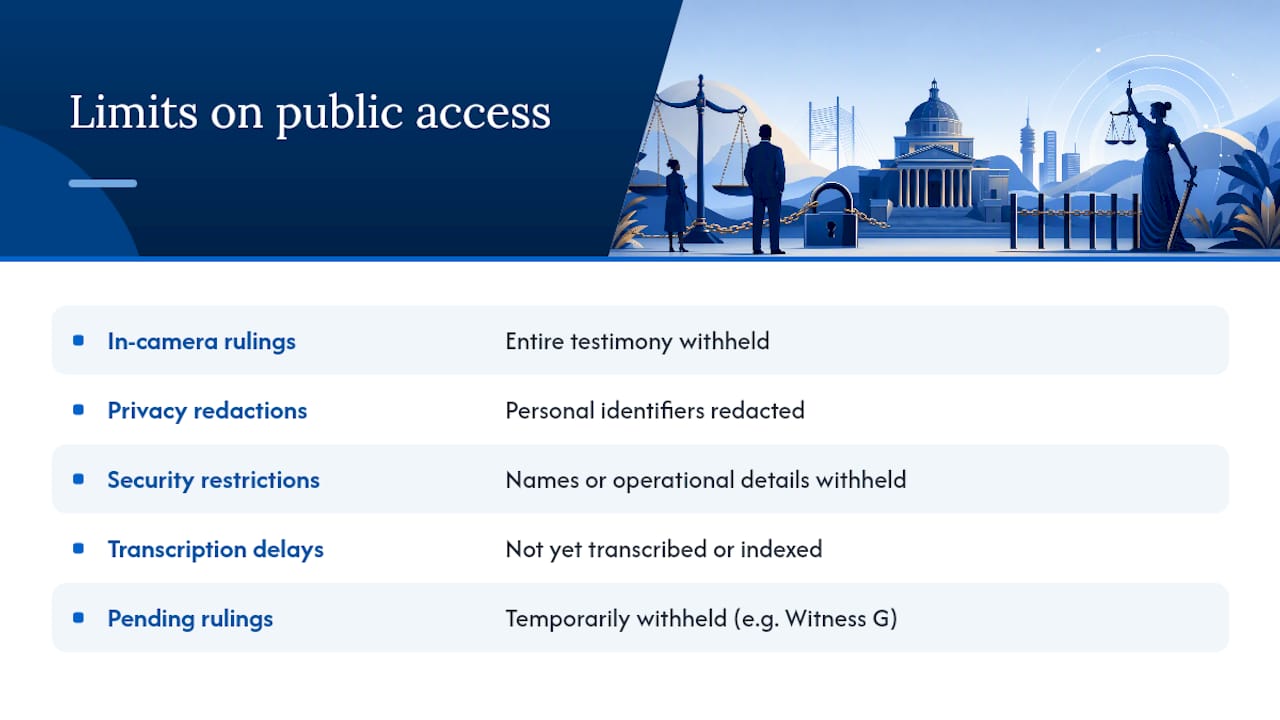
Privacy concerns can restrict specific details within an otherwise public document, even when the broader testimony is available. A witness profile might be published while certain personal identifiers are withheld. Security concerns work similarly. Where testimony touches on ongoing criminal investigations or names individuals not yet charged, the commission may hold back specific names or operational details while releasing the surrounding context.
There’s also a simple timing issue that gets mistaken for restriction: newly heard testimony takes time to transcribe, review and publish. A document that seems “missing” on the day of a hearing may simply not be indexed yet.
Finally, some material may be withheld pending a formal ruling, the way Witness G’s written statement was left in limbo while the commission decided its public status separately from the oral testimony. That’s a deliberate, temporary hold rather than a permanent block, and it’s worth distinguishing the two when you’re explaining a gap to an editor, a client, or a research supervisor.
What law governs access to South African commission records?
Commissions of inquiry in South Africa, including the Madlanga Commission, are established under the Commissions Act and operate under terms of reference set by the appointing authority, typically the President. That framework gives the presiding judge, in this case Justice Mbuyiseli Madlanga, discretion over what proceeds in public and what is heard in camera, generally on grounds tied to witness safety, ongoing investigations, or matters that could prejudice future criminal proceedings.
This differs meaningfully from the access rules governing ordinary court records, where the default presumption of open justice is shaped by constitutional principles and case law specific to the judiciary. A commission of inquiry isn’t a court, and its chair has more latitude to close proceedings than a sitting judge typically does in a criminal trial. That’s precisely why the in-camera rulings on Witness M and Witness G were treated as commission decisions announced through spokespeople, rather than court orders subject to the usual appeal mechanisms.
For readers used to South Africa’s broader court-records landscape, the practical takeaway is this: the commission’s own published rulings and press statements are the authoritative record of what’s restricted and why. There’s no separate court filing to check. What the commission publishes, and what it explicitly withholds, is the complete picture.
Why this archive matters for public accountability
The value of a commission archive isn’t just storage. It’s the difference between a handful of reporters following live proceedings and thousands of citizens being able to check a claim themselves, months later, without having sat through a single day of testimony.
What strikes me most is how the exhibit-code system, clunky as MK2 or MK4 might look at first glance, turns dense testimony into something a non-lawyer can actually cross-reference. A researcher tracing the Khan network’s documents doesn’t need a legal background to follow the thread from allegation to exhibit. That’s a genuine shift from how commissions of inquiry have traditionally operated in this country, where access often depended on who you knew or which newsroom you worked for.
If you’re doing serious work with this material, start with the methodology and case files pages before you build an argument on a single transcript excerpt.
— Meriol Lainchyon
Access every hearing, exhibit and case file in one place
Chasing down a transcript across scattered news reports or half-remembered hearing dates wastes hours that journalists, legal teams and researchers don’t have. Madlanga Commission’s archive puts every day of testimony, every exhibit, and every case file in one searchable place, with no live-stream marathon required to stay current.
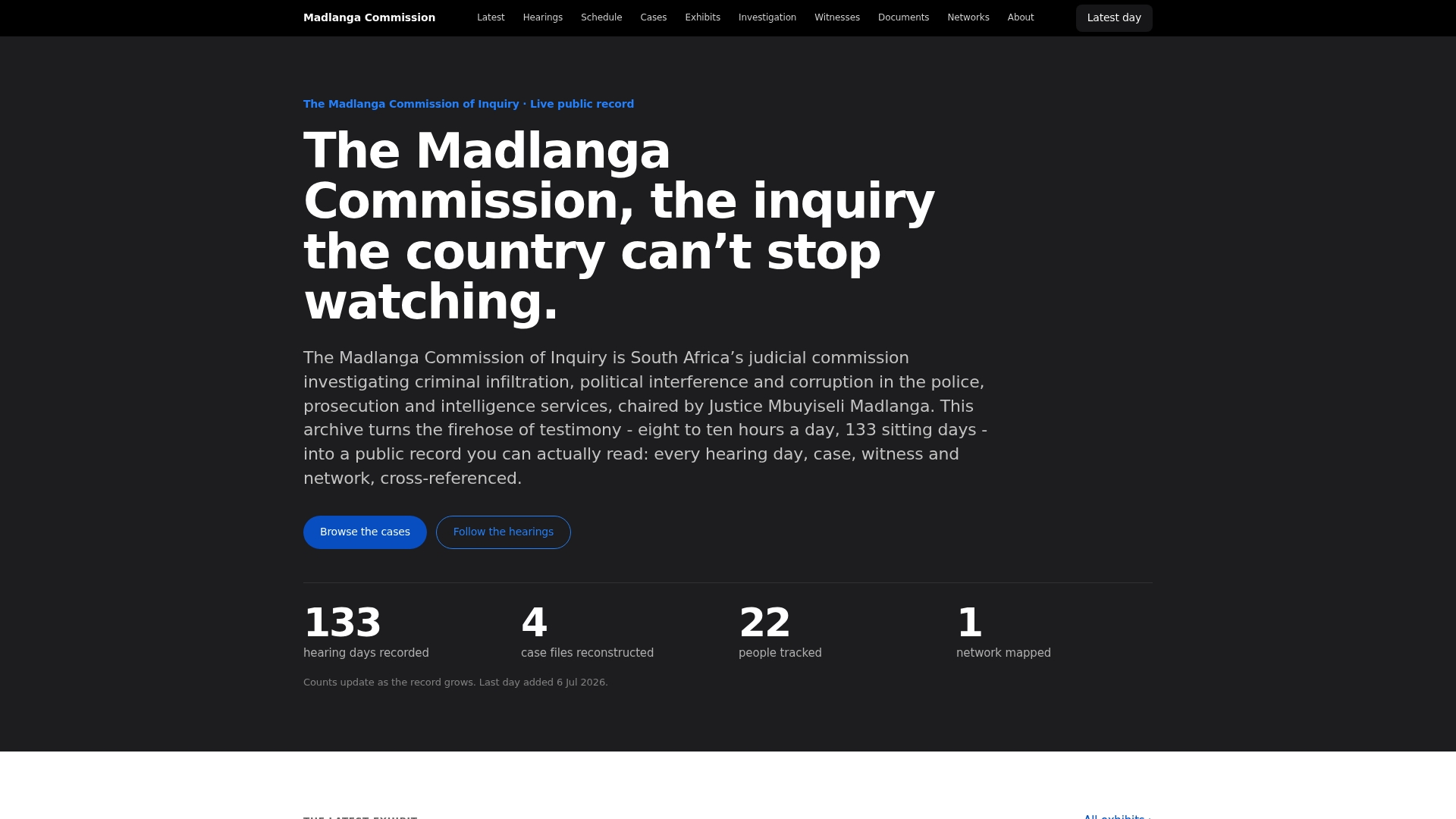
Start with the case files index if you’re building out a story or a research thread, and cross-check any document against the methodology page to understand how it was sourced and labelled. Following one investigation strand end to end? The Khan network page collects everything tied to that thread in one view. Visit the archive, bookmark the latest page for updates, and you’ll know the moment a closed hearing reopens to the public.
Sources
- Witness M testimony shuts public access to Madlanga Commission
- Madlanga to decide on public access to Witness G statement
- MADLANGA COMMISSION RECORD (sample transcript referencing file spines and annexures)
FAQ
Where is the Madlanga Commission’s public archive located?
The archive is hosted at Madlangacommission, where hearing transcripts, exhibits, case files and witness profiles are published and searchable by day, name or exhibit code.
Can I access transcripts from testimony heard in camera?
No. In-camera testimony, such as the sessions involving Witness M and Witness G, is withheld from public access until the commission issues a ruling permitting release, and no fixed timeline applies.
How do exhibit codes like MK2 work?
Exhibit codes tie a specific document to the file spine referenced in testimony, letting you cross-check a claim made in a transcript against the actual exhibit PDF rather than a paraphrase.
Who should I contact if a document I need isn’t published yet?
Check the commission’s latest page for announcements first, then direct specific inquiries, referencing the exact hearing day or witness, to the commission’s press contact.
Is the Madlanga Commission’s record legally equivalent to a court record?
No. The commission operates under the Commissions Act rather than ordinary court procedure, which gives the presiding judge broader discretion over what is heard publicly versus in camera.