Dirk Coetzee: Apartheid Death Squad Commander Turned Whistleblower
Dirk Coetzee was the co-founder and first commanding officer of Vlakplaas, the South African Security Police’s covert assassination unit, and one of apartheid’s most consequential insiders to turn against the system he helped build. Born on April 15, 1945, in Phokwane Local Municipality, he spent nearly two decades inside the security apparatus before going public in 1989 with revelations that shook the apartheid state. His disclosures to the anti-apartheid newspaper Vrye Weekblad confirmed what many suspected but could not prove: that the South African police ran organized death squads targeting activists, lawyers, and political opponents.
Key facts about Coetzee’s life and significance:
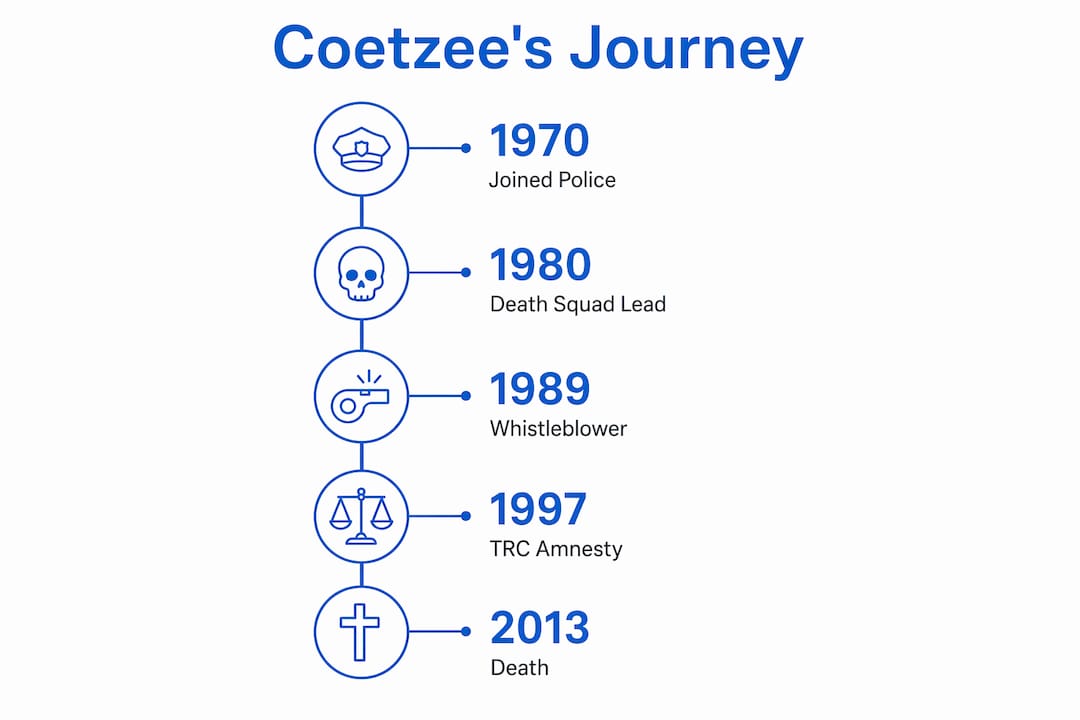
- He commanded Vlakplaas from August 1980, directing extrajudicial killings including the murder of attorney Griffiths Mxenge.
- After being dismissed from the police in 1986, he approached journalists and eventually fled South Africa to escape assassination.
- The African National Congress (ANC), under Jacob Zuma’s intelligence oversight, sheltered him in exile.
- Eugene de Kock, who replaced him at Vlakplaas, later sent a letter bomb to Coetzee’s hideout in Zambia.
- The Truth and Reconciliation Commission (TRC) granted him amnesty for the Mxenge murder, though his confessions remained selective.
- He died in Pretoria on March 7, 2013, from kidney failure and cancer, aged 67.
His story sits at the intersection of perpetration, survival, and partial accountability — a combination that still divides historians and victims’ families today.
Who was Dirk Coetzee before Vlakplaas?
Coetzee’s path into the security police was shaped by a conventional Afrikaner working-class upbringing and a series of institutional choices that funneled him toward state violence. His father worked for the South African Postal Service, and Coetzee himself joined that same organization in January 1964 after matriculating in 1963. Military service followed: he volunteered for the navy in july 1966 and served until march 1967, then returned to the postal service until april 1970.
He joined the South African Police in 1970 and was named best student of his intake year. That early distinction accelerated his career. In the early 1970s, he received counter-insurgency training and was deployed to Rhodesia as part of a South African Police contingent during the Rhodesian Bush War, an experience that normalized cross-border covert operations for him. Back in South Africa by 1975, he was promoted to lieutenant and stationed at Sibasa, then briefly lectured at the police training college in 1976.
His postings through the late 1970s moved him steadily toward the security apparatus. He served at Volksrust, then as border post commander at Oshoek on the Swaziland border, and from December 1979 held the role of Branch Commander of the Security Police in Middelburg. Each posting built the operational experience and institutional connections that made him a candidate for Vlakplaas.
How Coetzee ran the Vlakplaas death squad
Coetzee became Commanding Officer of Section C at Vlakplaas in 1980. The farm outside Pretoria served as the base for a unit that used former ANC guerrillas, known as “askaris,” to track and eliminate anti-apartheid activists. The unit operated outside any public legal framework, answering directly to senior Security Police commanders.
His command lasted for a relatively short period before unraveling. Two of his operatives were arrested during a mission in Swaziland, a failure serious enough to end his tenure. Eugene de Kock replaced him, and Coetzee was transferred to the Narcotics Bureau in 1982, where he served until 1984. During that period, an internal disciplinary inquiry found him guilty of insubordination, making obscene phone calls, and distributing a pornographic video. In the mid-1980s, the police declared him medically unfit due to diabetes and discharged him on a small pension.
The most consequential act of his command came in 1981, when he was assigned to the murder of Griffiths Mxenge, a prominent human rights attorney and ANC member. Mxenge was killed in Durban in a manner designed to look like a robbery. Coetzee later admitted his direct role in organizing the killing, though he consistently framed his actions as following orders from senior officials.
Why Coetzee went public and what happened next
The decision to expose Vlakplaas was not a sudden moral awakening. Journalists Jacques Pauw and Martin Welz first met Coetzee in late 1984, when he had just been suspended after leaking a report about security police phone tapping to opposition leader Frederik van Zyl Slabbert. He described his colleagues’ crimes to the reporters but allowed nothing to be published, since their pro-government newspaper would never have run the story.
The situation changed in october 1989. The Weekly Mail published the story of Butana Almond Nofomela, a former Vlakplaas operative on death row who named Coetzee in a sworn affidavit after his former colleagues refused to help with his clemency appeal. Coetzee suddenly faced exposure without any control over the narrative. He contacted Pauw, now at the independent Vrye Weekblad, and agreed to go on record about his own involvement in murders including Mxenge, Ruth First, and the Marius Schoon family killings. His condition: his family had to be safely out of the country first.
Andre Zaaiman of IDASA brokered contact with the ANC. Jacob Zuma, then the ANC’s intelligence chief, agreed to take Coetzee into safe keeping. Coetzee flew to Mauritius in 1989, completed his newspaper interviews, then arrived in London and met Zuma and members of uMkhonto we Sizwe shortly thereafter. Vrye Weekblad broke the story on november 17, 1989. The revelations were a landmark in investigative journalism that forced the apartheid government onto the defensive.
In exile, Coetzee stayed in numerous houses across several countries. He joined the ANC and publicly expressed support for Nelson Mandela. De Kock, his successor at Vlakplaas, sent a letter bomb to his hideout in Zambia, confirming that the security establishment viewed him as a genuine threat. He returned to South Africa in 1993, ahead of the country’s democratic transition.
What the TRC revealed about his confessions
Coetzee was among the early applicants when the Truth and Reconciliation Commission opened for amnesty applications. The TRC granted him amnesty for the Mxenge murder, ruling that he had acted under higher authority instructions rather than as a rogue operative. That finding was significant: it placed institutional responsibility on the apartheid state’s command structure, not just on individual officers.
His testimony was selective, though. He attributed his actions entirely to orders from senior police and government officials, declining to accept personal moral responsibility. More critically, he refused to disclose the burial site of Sizwe Kondile, an ANC activist killed under his command, leaving Kondile’s family without closure. That refusal became one of the sharpest criticisms of his TRC participation.
The TRC amnesty process was designed to trade full disclosure for legal immunity, but Coetzee’s partial disclosures tested that bargain. Victims’ families argued that amnesty without complete truth was not reconciliation. His relationship with the ANC also deteriorated after his return, and he never fully integrated into post-apartheid political life.
Coetzee’s later years and death in 2013
After the TRC process, Coetzee worked in the government-linked book supply industry. He was employed by EduSolutions, a company that supplied textbooks on behalf of the government to Limpopo province. In July 2012, he went public again, this time telling the media about large quantities of undelivered textbooks piling up in warehouses, a scandal that drew national attention to government procurement failures.
His health had been declining for years. Diabetes, which had ended his police career in 1986, was compounded by kidney failure and cancer. He died on March 7, 2013, in Pretoria, aged 67. A hospital spokeswoman confirmed the death. Public reaction was mixed: some acknowledged his role in exposing apartheid atrocities, while others, particularly victims’ families, noted that his disclosures had always served his own survival as much as any principle.
As he aged, health problems affected his memory, complicating the reliability of his later interviews. Psychologists who assessed him described a man with complex, sometimes manipulative motives, shaped by grievances against the security establishment as much as by any genuine remorse. That complexity is part of his historical record, not a footnote to it.
How the TRC and Madlanga Commission contextualize his role
Coetzee’s case illustrates the limits and possibilities of transitional justice. The TRC’s amnesty ruling treated him as a product of a system, not a lone actor, recognizing that apartheid’s security apparatus operated through institutional orders that implicated far more than individual commanders. That framing was legally necessary for the TRC’s mandate but left many feeling that accountability had been traded away too cheaply.
| Aspect | TRC Finding / Status |
|---|---|
| Amnesty granted | August 4, 1997, for Griffiths Mxenge murder |
| Legal basis | Acted under higher authority instructions |
| Disclosure gaps | Refused to reveal Sizwe Kondile’s burial site |
| Relationship to ANC | Sheltered in exile; later fell out of favor |
| Ongoing investigations | Madlanga Commission archives related testimonies |
The Madlanga Commission continues to investigate apartheid-era police crimes, including testimonies and case files linked to Coetzee’s disclosures. Its publicly searchable archive gives researchers access to hearing records, witness profiles, and official documents that build on the TRC’s incomplete work. For anyone studying how apartheid-era impunity shaped the police and intelligence services that South Africa inherited in 1994, the Commission’s records are a primary resource. You can track key figures connected to these investigations, including those whose conduct echoes the institutional failures Coetzee first exposed.
Historians and legal scholars consistently place Coetzee within a broader pattern of systemic impunity rather than treating him as an exceptional case. The security police culture he operated in rewarded results and punished disclosure, which is precisely why his eventual whistleblowing was so disruptive. Unresolved questions, particularly around undisclosed burial sites, remain a live issue for families and human rights organizations.
Pro Tip: If you are researching Coetzee’s TRC testimony in detail, the justice.gov.za archive holds the original amnesty hearing transcripts and the full amnesty decision, which reveal exactly what he disclosed and what he withheld.
The Madlanga Commission’s ongoing work reflects a recognition that the TRC, for all its achievements, could not fully resolve the institutional rot Coetzee described. Recent hearing records show how corruption and political interference in the police and intelligence sectors persist as structural problems, not historical relics.
For researchers tracking how apartheid-era security crimes connect to present-day accountability failures, the Madlanga Commission’s case file archive provides the most current and searchable public record available.
Key Takeaways
Dirk Coetzee was both a perpetrator of apartheid death squad killings and the whistleblower whose 1989 disclosures forced the first public reckoning with Vlakplaas, making him one of the most contested figures in South African transitional justice history.
| Point | Details |
|---|---|
| Vlakplaas command | Coetzee founded and commanded the Security Police death squad from August 1980, directing killings including Griffiths Mxenge. |
| 1989 whistleblowing | He exposed Vlakplaas to Vrye Weekblad after a fellow operative named him, then fled to ANC protection in exile. |
| TRC amnesty | The TRC granted amnesty on august 4, 1997, ruling he acted under institutional orders, not as a rogue actor. |
| Selective disclosure | He refused to reveal Sizwe Kondile’s burial site, leaving that family without closure and drawing lasting criticism. |
| Death and legacy | He died in Pretoria on March 7, 2013, aged 67, from kidney failure and cancer, his legacy still debated. |
FAQ
Why did Coetzee leave South Africa in 1989?
Coetzee fled in November 1989 after former Vlakplaas operative Butana Almond Nofomela named him in a sworn affidavit, leaving him exposed and at risk of assassination by his former colleagues in the security police.
Where did Coetzee live after leaving South Africa?
He stayed in numerous houses across several countries during his exile, including a period in London, before returning to South Africa in 1993 ahead of the democratic transition.
What nationality was Dirk Coetzee?
Coetzee was South African, born in Phokwane Local Municipality in April 1945 and living in Pretoria until his death in March 2013.
Is Dirk Coetzee the same person as the South African rugby player?
No. Dirk Coetzee the Security Police commander and whistleblower is a separate individual from any South African rugby figures who share the name. The Dirk Coetzee covered here was a police officer, not an athlete.
What did the TRC ultimately decide about his crimes?
The TRC granted Coetzee amnesty for the Mxenge murder on August 4, 1997, finding that he had acted under higher authority instructions, but his partial disclosures and refusal to reveal certain burial sites remained a source of controversy among victims’ families.
Recommended
- Lieutenant Colonel Kwazikwakhe Sibiya - Hawks officer, Durban Serious Organised Crime Unit, Madlanga Commission
- Key Figures in the Madlanga Commission - Who’s Who
- Case Files of the Madlanga Commission of Inquiry - The Madlanga Commission Archive
- Lieutenant Colonel Jakobus Prinsloo (retired) - Lieutenant Colonel (retired), KZN Hawks, Madlanga Commission