6 Document Metadata Types for Records Managers: Preserve Evidence
Document metadata standards are structured element sets, encoding formats, and controlled vocabularies that describe, manage, and preserve digital resources so they stay findable and trustworthy over time. If you’re starting from zero, look first at Dublin Core for basic description, PREMIS and ISO 23081 for preservation and records evidence, and METS, MARC21, DDI, RiC-CM, or OAIS depending on your content type. Pick the smallest schema that fits your material, assign someone to own it, and map fields to preservation needs before you scale up.
TL;DR:
- Using a minimal set of standards like Dublin Core, PREMIS, and ISO 23081, aligned with your content type, ensures effective metadata without overburdening workflows.
- Automate technical and preservation metadata collection through workflows, reserving human effort for descriptive, administrative, and contextual details.
- Employ crosswalks and extensions to enable interoperability when integrating multiple schemas or capturing domain-specific information.
- Consistently apply controlled vocabularies and authority files to maintain value uniformity and improve search and discovery across collections.
- Prioritize clear ownership, ongoing validation, and governance to prevent schema drift, inconsistent values, and legacy data issues.
Table of Contents
- Document metadata standards at a glance
- The six types of metadata you’ll actually manage
- How to choose and implement a metadata standard
- Making metadata from different standards work together
- Preservation metadata: ISO 23081, PREMIS, and OAIS working together
- How a public inquiry archive applies these standards
- Where document metadata standards came from
- Where metadata standards implementation actually breaks down
- Tools that support metadata standards work
- Why digital libraries and archives depend on these standards
- How document metadata standards shape search results
- The bottom line on document metadata standards
- Sources
- FAQ
Document metadata standards at a glance
Every standard was built to solve a different problem, and mixing them up wastes effort. Here’s what each one actually does:
- Dublin Core covers 15 core elements (title, creator, date, subject, and so on) for basic resource discovery. It’s the default starting point for repositories that need broad, cross-domain description without heavy overhead.
- MARC21 encodes bibliographic records for library catalogs. Most integrated library systems still expect it, even as libraries layer newer formats like BIBFRAME on top.
- EAD (Encoded Archival Description) structures finding aids for archival collections, describing hierarchy from collection down to folder or item.
- METS wraps descriptive, administrative, and structural metadata around digital objects, tying together page images, OCR text, and rights statements into one package. Digital libraries lean on it heavily for complex multi-file objects.
- PREMIS defines the preservation metadata that keeps a digital object viable, authentic, and renderable for decades, using four entities: Objects, Events, Agents, and Rights.
- ISO 23081 governs metadata for records management, tying every metadata element back to accountability and evidentiary requirements rather than pure discovery.
- DDI (Data Documentation Initiative) documents research datasets, especially social science surveys, capturing variables, sampling, and methodology.
- RiC-CM (Records in Contexts Conceptual Model) from the International Council on Archives models archival description as a network of entities and relationships rather than a strict hierarchy.
- OAIS (ISO 14721) is the reference model for a preservation repository, not a schema itself. It defines the functional roles that PREMIS and ISO 23081 metadata feed into.
Combining schemas is normal, not a sign you chose wrong. A repository might use EAD at the collection level and Dublin Core or MODS at the item level, exactly the pattern the Getty’s introduction to metadata describes for institutions balancing interoperability against community-specific needs.
The six types of metadata you’ll actually manage
Most confusion about document metadata standards comes from mixing up categories that serve different jobs. Break them out and the picture gets simple fast.
- Descriptive metadata answers “what is this and how do I find it”: title, creator, subject, date, abstract. Curators or catalogers usually supply it by hand, though controlled vocabularies can speed the work.
- Administrative metadata covers ownership, acquisition source, and access restrictions. Collection managers maintain it, often at the point of intake.
- Technical metadata records file format, resolution, checksum, and software dependencies. This should be automated wherever possible; humans shouldn’t be typing in file sizes.
- Structural metadata defines how parts relate, page order in a scanned book, chapters in a transcript. Systems like METS generate much of this during digitization.
- Preservation metadata tracks fixity checks, migration events, and format obsolescence risk, the domain PREMIS was built for.
- Process metadata logs who did what, when, and why, an audit trail that ISO 23081 treats as legally significant in its own right.
At ingest, prioritize descriptive and administrative fields for humans to fill in. Push technical and preservation capture into automated workflows so staff time goes where judgment actually matters.
How to choose and implement a metadata standard
Start with your content and your reuse plans, not with whichever standard sounds most authoritative. A small research archive digitizing survey data has different needs than a library binding decades of periodicals, and the Collibra guidance on metadata management makes the same point: structure follows purpose, not the reverse.
Here’s a working sequence:
- Map your content types to the standards built for them (research data to DDI, archival records to EAD or RiC-CM, preservation packages to PREMIS).
- Define a minimal required field set. Five to ten fields is usually enough at launch; you can always add more later.
- Treat everything beyond that minimum as progressive metadata, optional or automated fields captured as systems mature, rather than blocking ingest on day one.
- Assign explicit roles: an owner who sets policy, editors who enter data, and validators who check it before publication.
- Document your change control process so schema updates don’t silently break older records.
- Build or adopt controlled vocabularies and authority files for names, subjects, and places, and record how you handle multilingual content or sensitive material.
The Adobe Experience Manager best-practices guide warns against over-mandating fields, a mistake that quietly kills adoption. Require too much at ingest and staff either abandon the workflow or fill fields with junk data just to move past validation.
Pro Tip: Automate what a machine can verify (checksums, file format, dimensions) and reserve human effort for what only a person can judge (subject relevance, sensitivity flags, context). That split alone will cut your metadata backlog dramatically.
Making metadata from different standards work together
No single standard covers everything, so interoperability comes down to mapping. A crosswalk translates equivalent fields between two schemas, Dublin Core’s “creator” to MARC’s 100 field, for instance. An extension adds new fields to an existing schema when a crosswalk can’t capture something domain-specific. Use a crosswalk when you’re aggregating records from multiple sources for search; use an extension when your own collection needs a field no standard anticipated.
Publishing as RDF or Linked Open Data pays off once you need machines, not just search boxes, to understand relationships between resources. It turns “creator: Jane Smith” into a link to a stable identifier for that person, so any system can connect her work across collections without guessing at name matches.
Practical tooling matters as much as theory:
- OAI-PMH remains the workhorse protocol for harvesting metadata across repositories.
- Validation tools and application profiles catch malformed records before they propagate downstream.
- Document every mapping you create and preserve its transformation history, since UNC Libraries’ metadata guidance notes that provenance of mapped records is essential for auditability and future reuse.
Preservation metadata: ISO 23081, PREMIS, and OAIS working together
Discovery metadata gets you found. Preservation metadata is what proves your record is still authentic decades later, and that distinction shapes everything downstream.
ISO 23081 requires that records metadata document not just content but every management action taken on a record over its lifecycle, who accessed it, who migrated it, who redacted it. PREMIS operationalizes that requirement through four entities: Objects (the digital files themselves), Events (actions like fixity checks or format migrations), Agents (people or systems responsible for those actions), and Rights (permissions governing use). The PREMIS Data Dictionary also lays out graduated conformance levels, so a repository can state plainly which entities it supports rather than claiming full compliance it hasn’t earned.
OAIS (ISO 14721) sits above both as the conceptual model, defining ingest, archival storage, and access functions that PREMIS events map onto directly. In practice:
- Capture every preservation-relevant event automatically where your systems allow it.
- Log the agent (person or process) behind each event.
- Automate fixity checks on a fixed schedule rather than ad hoc.
- Record rights metadata and renderability notes so future staff know what they can legally do with an object and whether it will still open.
How a public inquiry archive applies these standards
Madlanga Commission’s public archive shows document metadata standards doing real evidentiary work, not just organizing files for convenience. Each hearing record combines descriptive metadata (date, witness, topic) with process metadata tracking corrections and version history, and preservation metadata ensuring exhibits remain retrievable years after testimony closes.
- Witness profiles and hearing transcripts rely on descriptive metadata for search and cross-reference across sessions.
- Rulings, statements, and exhibit chains depend on process metadata, exactly the accountability layer ISO 23081 was designed for.
- Long-term public access rests on preservation principles drawn from PREMIS and OAIS, so a hearing record published today remains legible and authentic years from now.
The commission’s methodology and corrections page documents exactly this kind of governance, showing how sourcing decisions and corrections get tracked as first-class metadata rather than silent edits.
Where document metadata standards came from
Metadata standards didn’t emerge from a single design effort. They accumulated, community by community, in response to specific institutional pressures. Library catalog cards standardized bibliographic description more than a century before anyone said “metadata,” and MARC formalized that practice into machine-readable form starting in the late 1960s so catalog data could move between systems instead of staying locked in one library’s card drawers.
Archives followed a different path, built around hierarchy and provenance rather than item-level cataloging, culminating in EAD during the 1990s as finding aids moved online. Dublin Core arrived in 1995 out of a workshop trying to solve a much narrower problem: how do you describe a web page well enough that a search engine or human can find it, without requiring a professional cataloger. Its 15 elements deliberately traded precision for accessibility.
Preservation concerns came later and grew more urgent as institutions realized digital files degrade, become unreadable, or lose context far faster than paper. OAIS arrived in the early 2000s as a conceptual answer, and PREMIS followed to operationalize it with concrete data elements. ISO 23081 extended that thinking into records management specifically, insisting that accountability metadata deserved the same rigor as content description.
The most recent shift is toward relationship modeling over rigid hierarchy. RiC-CM, developed by the International Council on Archives, represents archival description as a network of linked entities, a response to the recognition that descriptive standards and records-management frameworks increasingly need to interoperate rather than sit in separate silos.
Where metadata standards implementation actually breaks down
The standards themselves rarely cause problems. Implementation does. A few failure patterns show up across nearly every organization that struggles with document metadata standards.
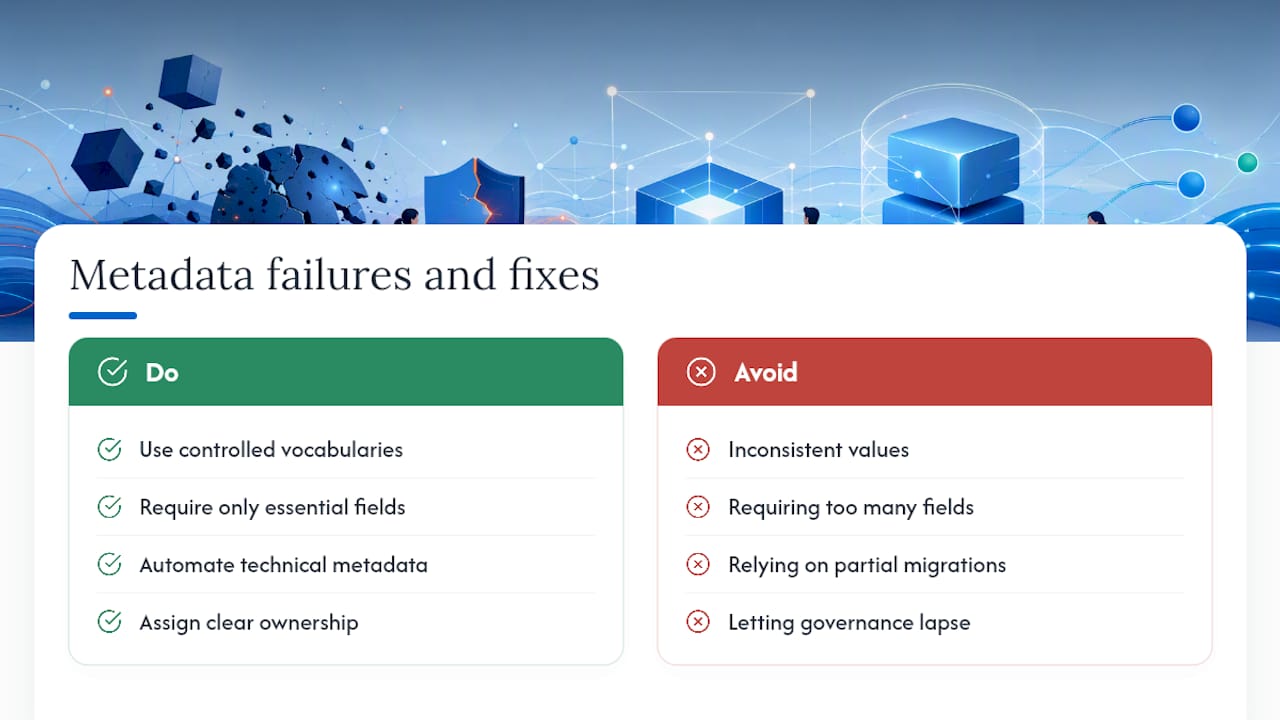
Inconsistent values kill interoperability before schema mismatches even become an issue. Two catalogers describing the same author’s name two different ways will defeat a perfectly designed Dublin Core implementation. The Getty’s metadata guidance is blunt about this: without shared controlled vocabularies and authority files, aggregated search and cross-collection reuse simply fail, no matter how clean the element structure looks on paper.
Over-mandating fields backfires. Teams that require twenty fields at ingest end up with either abandoned records or junk data typed in just to satisfy validation. The fix is progressive metadata: require the essentials, automate the technical fields, and let the rest fill in over time.
Legacy data migration is where most projects lose months. Retrofitting decades of inconsistently cataloged material into a new schema always takes longer than anyone budgets for, and partial migrations create two incompatible systems running in parallel.
Governance drift happens quietly. Metadata policy gets written once, then nobody revisits it as content types change. Ongoing validation and enforcement, not a one-time project, is what keeps a schema useful three years in rather than becoming a compliance checkbox nobody trusts.
Ambiguous ownership compounds every other problem. If nobody is explicitly responsible for correcting bad entries, they simply accumulate.
Tools that support metadata standards work
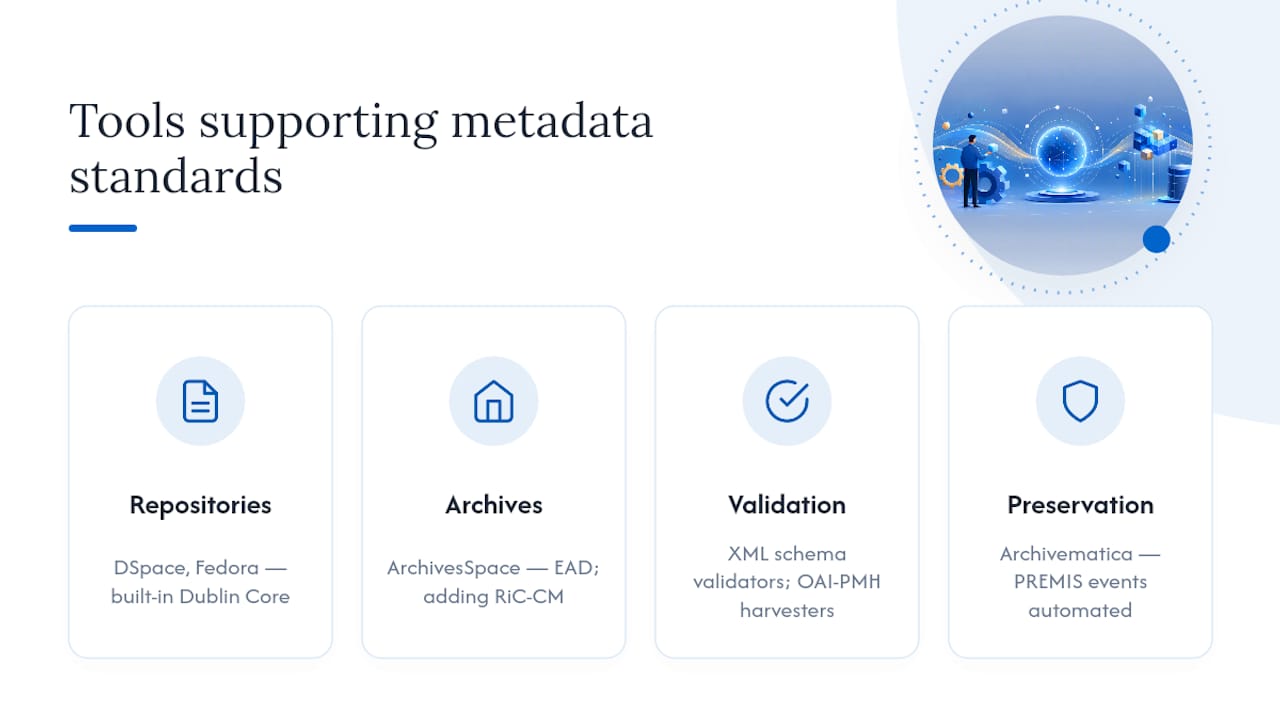
You don’t need custom software to implement most of these standards well. Open-source repository platforms like DSpace and Fedora ship with Dublin Core support built in, and both can be extended to handle PREMIS preservation events. Archival management systems such as ArchivesSpace natively support EAD and are increasingly adding RiC-CM compatibility as archives modernize their description practices.
For validation, XML schema validators and tools built around specific application profiles catch malformed metadata before it enters a production system, a cheap safeguard against the inconsistent-values problem that undermines so many implementations. OAI-PMH harvesters remain the standard mechanism for pulling metadata across repositories into aggregators and union catalogs, letting institutions expose records without building custom APIs for every partner.
Digital preservation systems, including Archivematica, implement PREMIS natively, generating preservation events and rights metadata automatically as objects move through ingest and storage. That automation matters because manually logging every fixity check and format migration doesn’t scale past a handful of objects.
For controlled vocabularies and authority work, name and subject authority files (from national libraries and the Getty vocabularies among them) give smaller institutions a way to align terminology without building their own thesaurus from scratch. The right tool choice depends less on brand and more on which standards your content already assumes: pick software that supports the schema your material needs, not the other way around.
Why digital libraries and archives depend on these standards
Digital libraries and archives run entirely on metadata; without it, a repository is just a pile of files with no way to browse, cite, or trust them. Descriptive metadata is what turns a folder of scanned pages into a browsable, citable collection. Structural metadata, largely handled through METS, is what lets a reader jump to page 47 of a digitized manuscript instead of scrolling through a flat file.
Preservation metadata is what separates a digital archive from a digital dumping ground. Institutions that take long-term access seriously, national libraries, government archives, research data centers, build PREMIS and OAIS principles into their ingest workflows from day one, because retrofitting preservation metadata onto years of undocumented files is far harder than capturing it at intake.
For public-facing institutional archives specifically, metadata does something beyond organization: it establishes an audit trail. When a researcher or journalist needs to verify that a document hasn’t been altered since publication, process metadata (who touched the record, when, and why) is what makes that verification possible rather than a matter of trust.
How document metadata standards shape search results
Search relevance is a direct function of metadata quality, not a separate concern from it. A well-tagged document with accurate subject headings, consistent date formatting, and controlled-vocabulary keywords surfaces reliably; a poorly tagged one, even with identical content, gets buried regardless of how good a search algorithm is.
Faceted search, the filter panels letting users narrow by date, format, or subject, only works because structured metadata fields exist behind the scenes to filter against. Strip out consistent metadata and faceted search collapses into keyword matching against raw text, missing anything the document’s language doesn’t state explicitly.
Cross-collection discovery depends on the same consistency. A researcher searching across multiple archives’ aggregated catalogs will only find everything relevant if each contributing institution mapped its local metadata to shared standards using consistent values, not just similar field names. That’s the practical payoff of the crosswalk work described earlier: search that actually spans institutional boundaries instead of stopping at each one’s front door.
The bottom line on document metadata standards
Pick the smallest standard combination that matches your content, not the most comprehensive one available. Assign real ownership, automate technical and preservation fields, and map everything back to PREMIS or ISO 23081 requirements before you scale. Start small, validate constantly, and check the commission’s methodology page for a working example of governance in practice.
— Meriol Lainchyon
Sources
- ISO 23081 Metadata for records
- PREMIS Data Dictionary v3.0 — Library of Congress
- Metadata management best practices | Collibra
- Metadata management and best practices | Adobe Experience Manager as a Cloud Service
FAQ
What are metadata standards?
Metadata standards are structured frameworks of elements, encoding rules, and controlled vocabularies that let organizations describe, manage, and preserve digital resources consistently enough for interoperability and long-term use.
What are the ISO standards for metadata?
The two most relevant are ISO 23081, which governs records metadata and accountability, and ISO 14721 (OAIS), the conceptual model for digital preservation repositories.
What is document metadata?
Document metadata is the structured information describing a document’s content, context, and management history, including its title, creator, format, and the record of actions taken on it over time.
What are the five (or six) types of metadata?
The commonly cited categories are descriptive, administrative, technical, structural, and preservation metadata; many practitioners add process metadata as a sixth category to capture who did what, when, and why across a record’s lifecycle.