Evidence in inquiries: what witnesses must know
If the Madlanga Commission or any South African public inquiry summons you, it can receive documents, affidavits, audio-visual recordings, physical exhibits, and oral testimony as evidence. You must either comply with that summons or seek the chairperson’s leave to be excused. Refusing to attend, declining to be sworn, or giving false evidence are criminal offences under the Commissions Act, 1947 and the Criminal Procedure Act 51 of 1977. The Promotion of Administrative Justice Act 3 of 2000 (PAJA) also governs how the commission handles evidence, binding it to act fairly even though it is not a court of trial.
Your first 48 hours after receiving a summons:
- Read the summons carefully and note every deadline, document request, and the date you must appear.
- Contact a legal representative immediately, before you respond to the commission or produce any material.
- Identify all documents, records, or objects the summons specifies and secure the originals in a single, controlled location.
- If you need more time or have grounds to object, write to the commission secretary promptly, as silence is not treated as an extension.
Key takeaways
South African commissions can receive documents, affidavits, recordings, and oral testimony as evidence in inquiries, and the Commissions Act, 1947 gives them court-equivalent powers to compel compliance, administer oaths, and punish false evidence.
| Point | Details |
|---|---|
| Commissions are not bound by court rules | They may receive hearsay and non-court material, but must act fairly under PAJA. |
| Summons compliance is mandatory | Refusing to attend, be sworn, or produce documents is a criminal offence under the Commissions Act. |
| Written evidence needs structure | Affidavits require a heading, chronological narrative, exhibits list, and a commissioner of oaths signature. |
| Expert reports need explicit relevance | Include qualifications, opinion summary, methodology, limitations, and a link to the commission’s terms of reference. |
| Evidence becomes public record | Witness statements and transcripts are typically published; apply for restricted access before the hearing if needed. |
| Madlanga Commission archive | The searchable archive at madlangacommission.co.za lets witnesses and researchers trace testimony, exhibits, and procedural directions. |
Table of Contents
- What counts as evidence in a commission?
- How commissions assess and receive evidence
- What statutory powers back a commission’s summons?
- How to prepare written statements, affidavits, and expert reports
- What to expect when giving oral evidence
- How to handle, label, and preserve exhibits
- What happens to evidence after the inquiry?
- A practical checklist for witnesses
- Common legal risks: privilege, self-incrimination, and being implicated
- Why the quality of evidence shapes what an inquiry can actually find
- The Madlanga Commission archive: a resource for witnesses and researchers
- Sources
- FAQ
What counts as evidence in a commission?
South African commissions accept a wider range of material than a criminal court would. The Commission of Inquiry Rules (Government Gazette) define evidence broadly, covering documents, affidavits, video recordings, sound recordings, and oral testimony. In practice, the main categories work like this:
Documentary evidence covers contracts, emails, bank statements, internal memoranda, official reports, and any written record that is relevant to the commission’s terms of reference. Documents should be paginated, clearly identified, and, where possible, accompanied by a covering affidavit confirming their authenticity.
Affidavits and written statements are sworn, signed declarations before a commissioner of oaths. They are the standard vehicle for factual narrative evidence. Each page should be initialled, the deponent’s full name and identity number should appear in the heading, and every exhibit referenced in the text should carry a unique identifier (e.g., “Annexure A”).
Oral testimony is given under oath or affirmation at a hearing. A witness is examined by the commission’s legal team, and the chairperson may allow implicated persons or their representatives to put questions as well.
Expert reports carry specific requirements: a summary of the expert’s qualifications, a concise statement of opinion, the methodology used, the data and assumptions relied on, and a declaration of independence. Background guidance from South African practice confirms that relevance to the commission’s terms of reference must be explicit, not assumed.
Audio-visual recordings (CCTV footage, phone recordings, video files) are accepted, but the chain of custody must be documented. Timestamps and metadata should be preserved, and a covering statement should explain how the recording was obtained and stored.
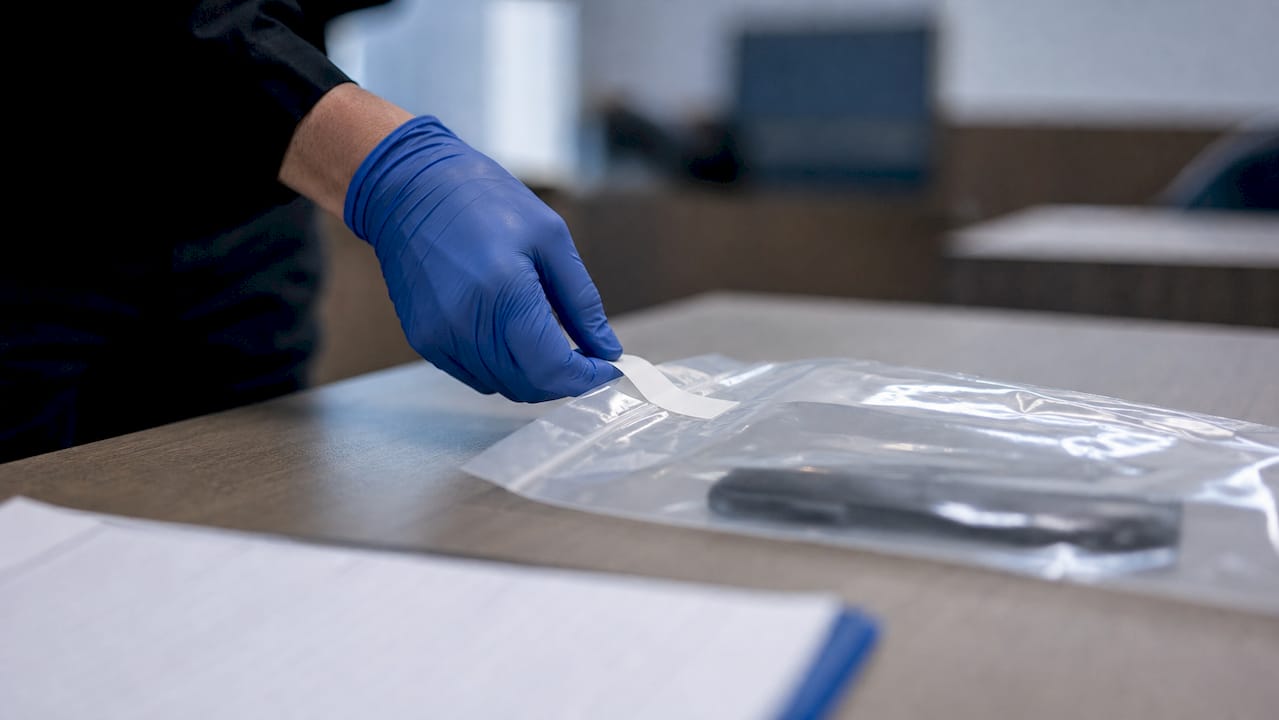
Physical exhibits such as firearms, financial instruments, or seized property are received with a chain-of-custody record. Each item needs a tamper-evident seal and a unique exhibit number before it is handed to the commission.
Digital and electronic evidence (emails, database exports, social media records) requires verified exports rather than screenshots where possible. Hashing the file before and after transfer confirms the data has not been altered.
One point worth knowing: hearsay and second-hand material are not automatically excluded. A commission may receive a media report or a third-party statement as a lead or contextual document, even if it would be inadmissible in a criminal trial. The practical value of such material rises sharply when you attach contemporaneous documents that corroborate it.
How commissions assess and receive evidence
Commissions are not courts of trial. As Nelson Mandela University’s Obiter journal confirms, South African commissions may adopt their own procedures and are not strictly bound by the rules of evidence that govern criminal or civil proceedings. What they cannot do is act arbitrarily. PAJA’s duty to act fairly applies throughout, which means decisions about what evidence to receive or exclude must be reasonable and procedurally sound.
The practical tests a commission applies when deciding whether to receive evidence are:
- Relevance to the terms of reference. Evidence that falls outside the commission’s mandate will not be pursued, regardless of how compelling it might seem.
- Probative value. Does the material actually advance or undermine a factual finding the commission needs to make?
- Fairness to affected parties. An implicated person must receive notice and a reasonable opportunity to respond before adverse findings are made against them.
- Reasonableness of the line of inquiry. A commission cannot pursue a line of questioning that is oppressive or irrelevant simply because it has broad powers.
Hearsay material, media reports, and third-party statements are regularly received as contextual or background evidence. The commission uses them to identify witnesses, frame questions, and corroborate direct testimony. Their weight is limited, but their utility as investigative leads is real.
Pro Tip: If you are submitting material that is technically hearsay, attach every contemporaneous document you have that supports it, name the direct source if you know them, and explain in your covering statement exactly how you came to know the information. This does not transform hearsay into direct evidence, but it substantially increases the commission’s ability to act on it.
What statutory powers back a commission’s summons?
The Commissions Act, 1947 gives a commission powers equivalent to those of a provincial division of the High Court: it can summon witnesses, administer oaths or affirmations, examine witnesses, and require the production of books, documents, and objects. These are not soft requests.
What a valid summons must contain
Under the Regulation Gazette rules for summonsing witnesses, a properly issued summons must state:
- The full name and address of the person summoned
- The date, time, and place of appearance
- A description of any documents, books, or objects to be produced
- The authority under which the summons is issued
- The consequences of non-compliance
Service must be effected personally or in a manner the rules prescribe, and a return of service must be completed to confirm delivery. A summons that does not meet these requirements may be challenged, but you should take legal advice before ignoring any document that purports to be a commission summons.
Penalties for non-compliance
LawFullLiving’s plain-language guide summarises the position clearly: a summonsed person who refuses to attend, refuses to be sworn or affirmed, refuses to answer questions, or fails to produce required documents may commit a criminal offence. Giving false evidence before a commission is separately punishable. The Criminal Procedure Act 51 of 1977 provides the procedural framework for prosecuting such offences, and penalties can include fines or imprisonment.
Practical checklist when you receive a summons:
- Confirm the summons is properly issued (check all required fields above)
- Note the production deadline for documents separately from the hearing date
- Secure all originals immediately; do not destroy, alter, or transfer any item listed
- Contact your legal representative before producing anything or making any statement
- If you need an extension, write to the commission secretary before the deadline, not after
How to prepare written statements, affidavits, and expert reports
Good written evidence does two things: it tells a clear, chronological story, and it makes the commission’s job of verification straightforward. Brodies LLP’s guidance on public inquiry witness evidence stresses that statements should be lucid, paginated, and supported by clearly labelled exhibits.
Standard structure for a witness statement or affidavit
- Heading: Commission name, case reference, deponent’s full name, identity number, and occupation.
- Introduction: How you came to have knowledge of the relevant events; your role or position at the relevant time.
- Chronological narrative: Facts in the order they occurred, each paragraph covering one event or topic. Avoid argument or opinion here.
- Exhibits list: Every annexure listed by identifier (Annexure A, B, C…), a brief description, and the paragraph where it is first referenced.
- Signature block: Deponent’s signature, date, place, and the commissioner of oaths’ details.
Expert report template
| Section | What to include |
|---|---|
| Qualifications | Degrees, professional registrations, relevant experience (brief CV or attached CV referenced) |
| Summary of opinion | One to three sentences stating your conclusion plainly |
| Methodology | Sources consulted, tests or analyses performed, standards applied |
| Data and assumptions | Datasets used, any assumptions made, their basis |
| Limitations | What the analysis cannot determine and why |
| Relevance to terms of reference | Explicit statement linking your findings to the commission’s mandate |
| Declaration of independence | Confirmation that the report reflects your honest professional opinion |
Required disclosures. If you have previously testified to another body (a parliamentary committee, a different commission, a court) on the same or related facts, disclose this at the outset. Conflicts of interest, funding arrangements, and any prior relationship with a party must also be declared. Omitting these details damages credibility and can delay proceedings.
Exhibits and annexures. Number every exhibit sequentially, paginate each one, and cross-reference it to the specific paragraph in your statement where it is discussed. Keep the originals or verified copies in a secure location; the commission may require them at any time.
The Commission Rules set specific procedural expectations for expert evidence at the Madlanga Commission, including notice requirements and timelines for implicated persons to respond to expert findings. Check the current procedural directions issued by the Commission secretary for any filing deadlines that apply to your submission.
What to expect when giving oral evidence
Oral evidence at a South African commission follows a structured sequence, though the chairperson has wide discretion over how proceedings run. The Madlanga Commission’s panel and commissioners page gives context on how the Commission organises its hearings and who sits on the panel.
The typical sequence runs like this: the chairperson calls the witness, the witness takes the oath or affirmation, and the commission’s legal team leads the examination-in-chief. The chairperson may interject with questions at any point. If you are an implicated person, or if the chairperson grants leave, your legal representative may also question you or other witnesses.
Requesting in camera evidence
If your evidence involves genuinely sensitive material (personal safety risks, ongoing criminal investigations, or information that could prejudice third parties), you can apply to the chairperson for the hearing to be held in camera. This application should be made in writing before the hearing date, setting out the specific grounds. The chairperson has discretion to grant it in full, in part, or not at all.
Hearing-day do’s and don’ts
Do:
- Bring your full exhibit bundle, paginated and tabbed, with a spare copy for the commission
- Bring your identity document and a copy of the summons
- Listen to each question fully before answering; ask for clarification if the question is unclear
- Confine your answers to what you personally know or observed
- Consult your legal representative during any adjournment if you are uncertain about a line of questioning
Don’t:
- Volunteer information beyond the scope of the question asked
- Speculate or guess if you do not know the answer
- Argue with the chairperson or the commission’s legal team
- Refer to documents not in your exhibit bundle without flagging this to the commission first
- Attempt to correct your written statement verbally without formally applying to do so
How to handle, label, and preserve exhibits
Evidential integrity depends on what happens to an exhibit before it reaches the commission, not just at the moment of submission.
Physical exhibits
Store physical items in tamper-evident packaging from the moment you identify them as potential evidence. Assign a single custodian responsible for the item, and log every movement. Never allow an exhibit to pass through multiple hands without a written record.
Digital evidence
For electronic files, generate a cryptographic hash (SHA-256 is standard practice) of each file immediately after you identify it. Document the hash value, the date, the tool used, and the person who performed the operation. When transferring files to the commission, repeat the hash check on the received copy to confirm no alteration occurred in transit. Use verified exports from email platforms or databases rather than screenshots, which are easily manipulated.
Chain-of-custody record: minimum fields
| Field | Description |
|---|---|
| Exhibit number | Unique identifier assigned at first handling |
| Description | Brief description of the item (file name, document title, object type) |
| Date and time | When the item was collected, transferred, or accessed |
| Custodian name | Full name and role of the person handling the item |
| Action taken | What was done (collected, sealed, transferred, hashed, copied) |
| Recipient | Who received the item and their signature or acknowledgement |
Exhibit bundles
When preparing your exhibit bundle for submission or for the hearing, arrange exhibits in the order they are referenced in your statement. Number each page of the bundle sequentially (not just each exhibit), and include a cover index. Cross-reference every exhibit to the paragraph number in your statement or expert report where it first appears. The commission’s legal team will use that cross-reference during examination; gaps slow proceedings and raise questions about preparation.
What happens to evidence after the inquiry?
Once submitted, evidence does not stay private by default. Lexology’s guidance on public inquiry evidence confirms that witness statements and transcripts of oral evidence are typically published on the inquiry’s public record. At the Madlanga Commission, hearing records and witness profiles are accessible through the public archive.
Use in later proceedings
Evidence given at a commission is not automatically admissible in a subsequent criminal or civil trial. A court will apply its own rules of evidence to determine whether the material can be used and in what form. However, the fact that you gave certain evidence at a commission is itself a matter of public record, and prior inconsistent statements can be put to you in later proceedings. This is why the accuracy of your written statement and oral testimony matters so much from the outset.
Confidentiality and restricted access
If your evidence contains genuinely sensitive information (personal safety risks, protected third-party data, or material subject to legal privilege), apply to the chairperson for restricted access or redaction before the hearing. The application must identify the specific material, explain the grounds, and propose an alternative (such as a redacted version for the public record). The chairperson has discretion to grant or refuse.
Pro Tip: If you are concerned about self-incrimination, do not rely on the commission process to protect you automatically. Raise the issue with your legal representative before you submit anything in writing. In some circumstances, an application to the chairperson for appropriate conditions can be made, but the scope of protection available at a commission differs from the right to silence in a criminal trial.
A practical checklist for witnesses
Before you submit evidence
- Identify every document, recording, or object relevant to the commission’s terms of reference and secure the originals.
- Prepare your witness statement or affidavit in the standard structure (heading, narrative, exhibits list, signature block).
- Disclose any prior testimony to other bodies on the same facts and any conflicts of interest.
- Number and paginate all exhibits; cross-reference each one to the relevant paragraph in your statement.
- Have your legal representative review the full submission before it is filed.
Before hearing day
- Confirm the date, time, and venue from the summons or the commission’s procedural directions.
- Arrange legal representation and brief your representative on the full content of your written statement.
- Prepare your exhibit bundle with a cover index and a spare copy.
- Rehearse the key points of your evidence with your representative, focusing on scope and accuracy.
- Bring your identity document, the summons, and your exhibit bundle on the day.
After giving evidence
- Request a copy of the transcript of your oral testimony as soon as it is available.
- If you notice an error in the transcript, apply promptly to the commission to correct it through the formal process.
- Preserve copies of all materials you submitted, including your signed affidavit and exhibit bundle.
- Note any deadlines the commission sets for follow-up submissions or responses to other witnesses’ evidence.
- Keep your legal representative informed of any contact from the commission after the hearing.
Common legal risks: privilege, self-incrimination, and being implicated
Legal privilege
Legal professional privilege can survive in a commission context, but its scope is narrower than many witnesses expect. Communications between you and your legal representative for the purpose of obtaining legal advice remain privileged. However, documents that were created for a purpose other than legal advice, even if they later passed through a lawyer’s hands, are generally not protected. If you are unsure whether a document is privileged, do not produce it until your legal representative has assessed it.
Self-incrimination
South African commissions do not offer the same protection against self-incrimination that a criminal trial does. A witness may be compelled to answer questions even where the answers are potentially incriminating. The practical safeguard is to have legal representation present at all times, to answer questions carefully and precisely, and to make any protective application to the chairperson before the hearing rather than refusing to answer mid-testimony. Refusing to answer without a valid legal basis is itself an offence under the Commissions Act.
False evidence
Giving false evidence before a commission is a criminal offence. The LawFullLiving summary of commission obligations makes clear that this applies to oral testimony and, by extension, to sworn written statements. The consequences can include prosecution under the Criminal Procedure Act 51 of 1977.
Being implicated
If the commission’s evidence implicates you in wrongdoing, you are entitled to notice and a reasonable opportunity to respond before any adverse finding is made against you. The Commission Rules set out the notice and response procedures in detail, including the timelines within which you must file a response and the right to apply for leave to cross-examine witnesses whose evidence affects you. Missing these windows has serious consequences. Engage legal representation the moment you receive any notice that you may be implicated.
Why the quality of evidence shapes what an inquiry can actually find
There is a gap between what a commission is empowered to investigate and what it can actually establish, and that gap is almost entirely determined by the quality of evidence submitted to it.
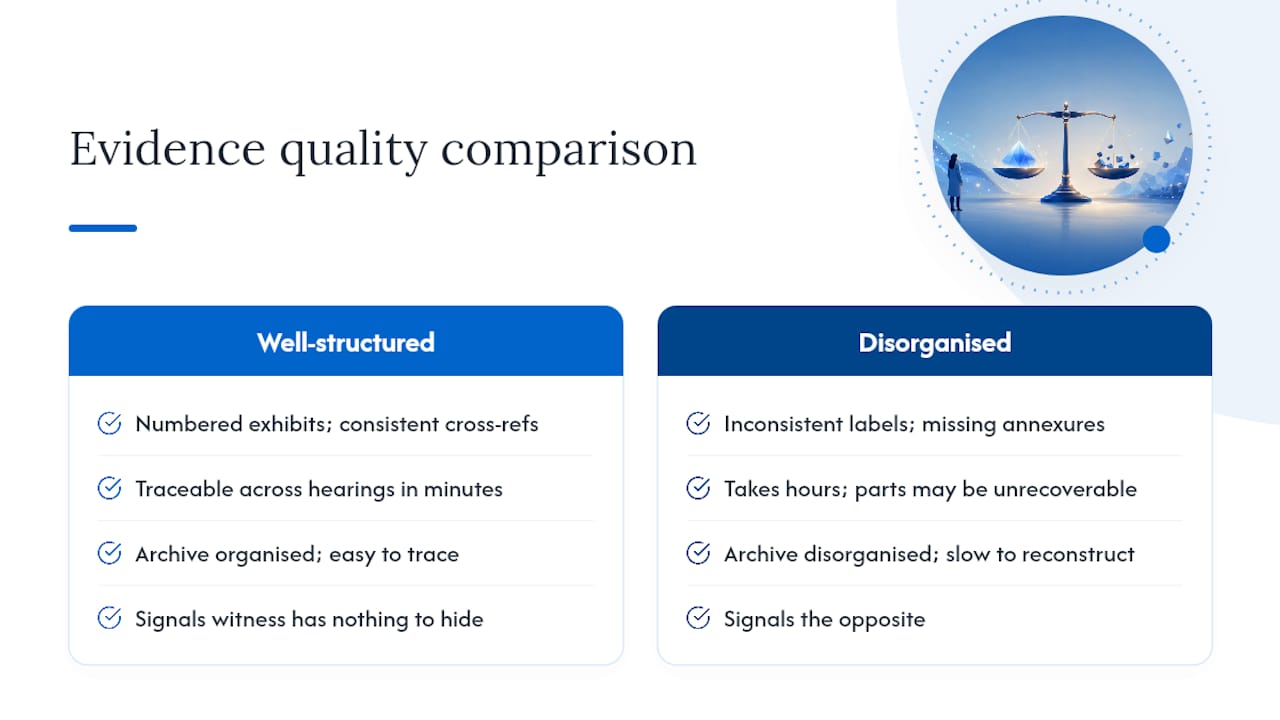
The Madlanga Commission’s public archive is a useful illustration. When witnesses submit well-structured affidavits with clearly numbered exhibits and consistent cross-references, the archive can organise that material so that a journalist, researcher, or legal practitioner can trace a single thread of evidence across multiple hearings in minutes. When submissions are disorganised, inconsistently labelled, or missing key annexures, the same thread takes hours to reconstruct, and some of it may never be recovered at all.
This is not a bureaucratic concern. Commissions like the Madlanga inquiry exist precisely because the institutions under scrutiny failed to maintain reliable records and honest accounts. A witness who submits sloppy evidence is, in a small but real way, repeating the problem the commission was created to address.
There is also a credibility dimension that practitioners sometimes underestimate. A commission’s findings carry public weight partly because the process is transparent and the evidence is traceable. A well-documented submission, with a clear chain of custody and full disclosure of prior testimony, signals to the commission and to the public that the witness has nothing to hide. The opposite signal is equally readable.
The practical implication: treat your submission as if it will be scrutinised by a hostile barrister, a sceptical journalist, and a future court simultaneously. Because, eventually, it may be.
The Madlanga Commission archive: a resource for witnesses and researchers
Preparing evidence for a public inquiry is demanding work, and having access to a reliable, organised record of what has already been submitted makes the process significantly more manageable.
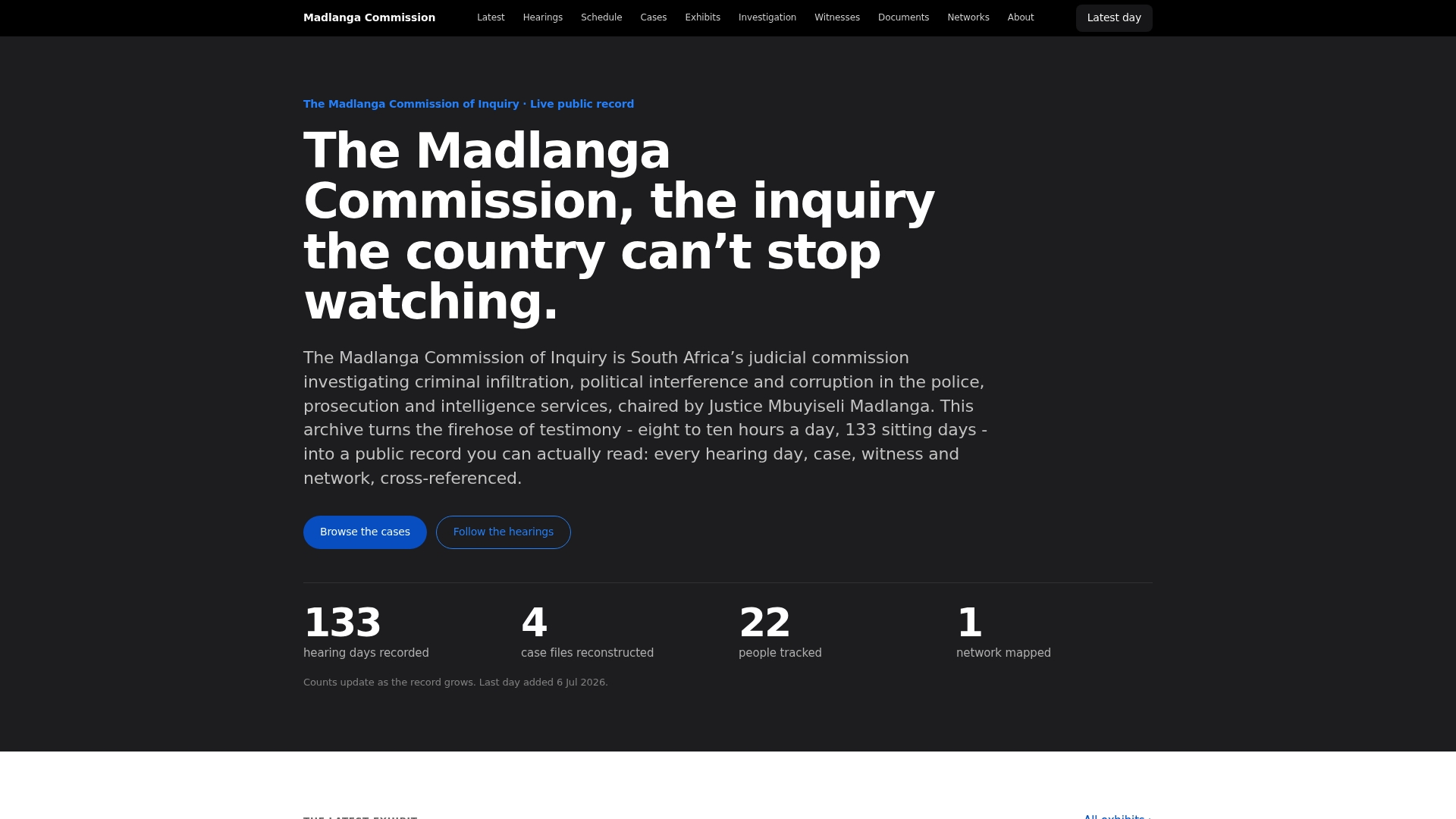
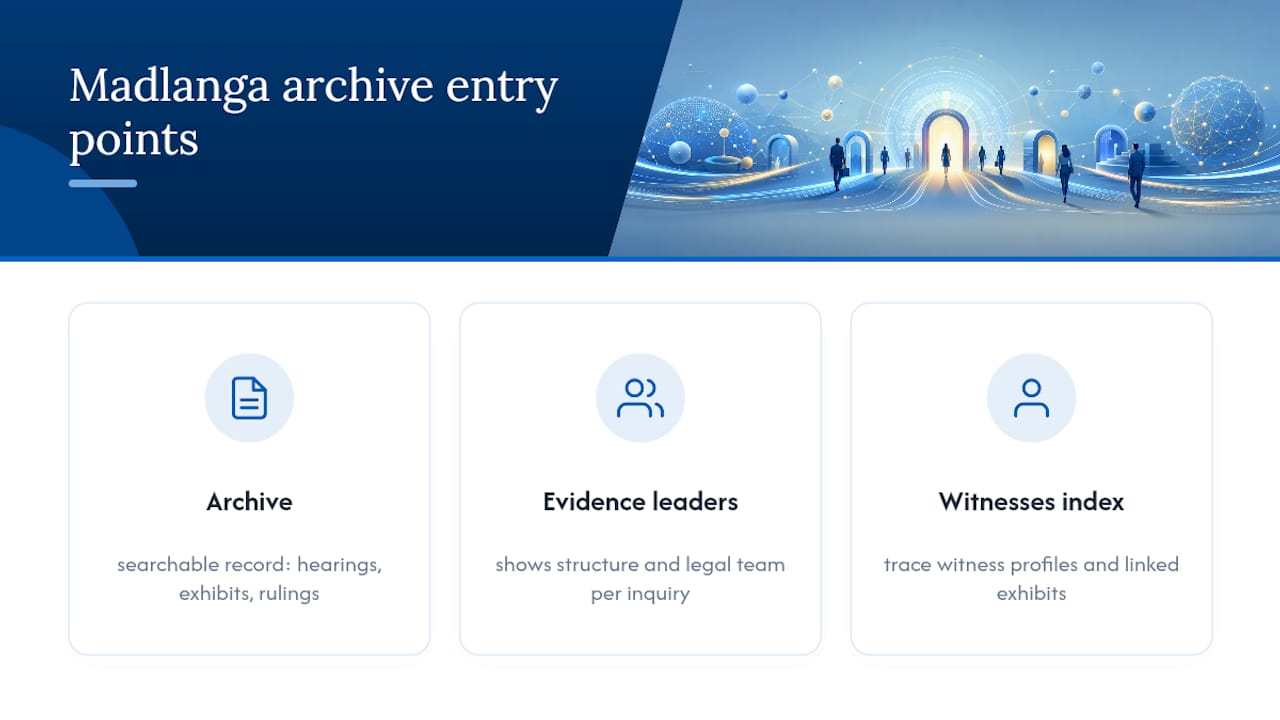
The Madlanga Commission archive is a searchable public record of hearings, witness profiles, exhibits, official documents, rulings, and media briefings from South Africa’s inquiry into criminal infiltration, political interference, and corruption in the police, prosecution, and intelligence sectors. For a witness preparing a submission, the archive lets you check what related testimony has already been given, how exhibits have been labelled and cross-referenced in prior hearings, and what procedural directions the Commission has issued.
The evidence leaders page is the fastest entry point for understanding how the Commission structures and presents evidence, and for identifying the legal team responsible for a particular line of inquiry. The witnesses index lets you trace how individual witness profiles and their linked exhibits are organised in the archive, which is useful when preparing cross-references in your own submission. Visit the archive directly to find hearing records, submission guidance, and contact points for the Commission’s administrative team.
Sources
The primary references below are the authoritative starting points for any witness or legal representative preparing for a South African public inquiry.
- Commissions Act, 1947 (Government of South Africa)
- Commissions of inquiry and the rules of evidence (Obiter, Nelson Mandela University)
- Law Made Simple: Behaviour During Commissions of Inquiry (LawFullLiving)
- What do you do if asked to provide evidence to a public inquiry (Lexology)
This article is general information, not a substitute for advice from a qualified lawyer. Consult a qualified legal professional about your own circumstances before acting on anything here.
FAQ
What types of evidence can a South African commission receive?
Commissions accept documents, affidavits, oral testimony, audio-visual recordings, physical exhibits, and digital evidence. Unlike a criminal court, a commission may also receive hearsay and third-party statements where they are relevant to its terms of reference.
Is a commission of inquiry the same as a criminal investigation?
No. A commission of inquiry is an investigative body that gathers evidence and makes findings or recommendations; it does not convict or sentence anyone. Evidence given at a commission can, however, appear in the public record and may be relevant to later criminal or civil proceedings.
What are the requirements for evidence to be accepted by a commission?
The practical tests are relevance to the commission’s terms of reference, sufficient probative value to assist the inquiry, and procedural fairness to any affected party. Commissions are not bound by the strict admissibility rules of a court, but they must act reasonably and fairly under PAJA.
What happens if you refuse to comply with a commission summons?
Refusing to attend, declining to be sworn, failing to produce required documents, or giving false evidence are criminal offences under the Commissions Act, 1947, and can result in fines or imprisonment under the Criminal Procedure Act 51 of 1977.
What does it mean to be an “implicated person” at a commission?
An implicated person is someone against whom the commission’s evidence may support an adverse finding. The Commission Rules require that such a person receive formal notice and a reasonable opportunity to respond, including the right to apply for leave to cross-examine witnesses whose evidence affects them.