Exhibits in inquiries: a guide for South African practitioners

An exhibit in a South African commission of inquiry is any document, recording, object, or sworn statement that the Commissioner formally admits into the commission record. You can find public exhibits from the Madlanga Commission of Inquiry in its searchable online archive, where each hearing day page lists admitted exhibits alongside transcripts and witness profiles.
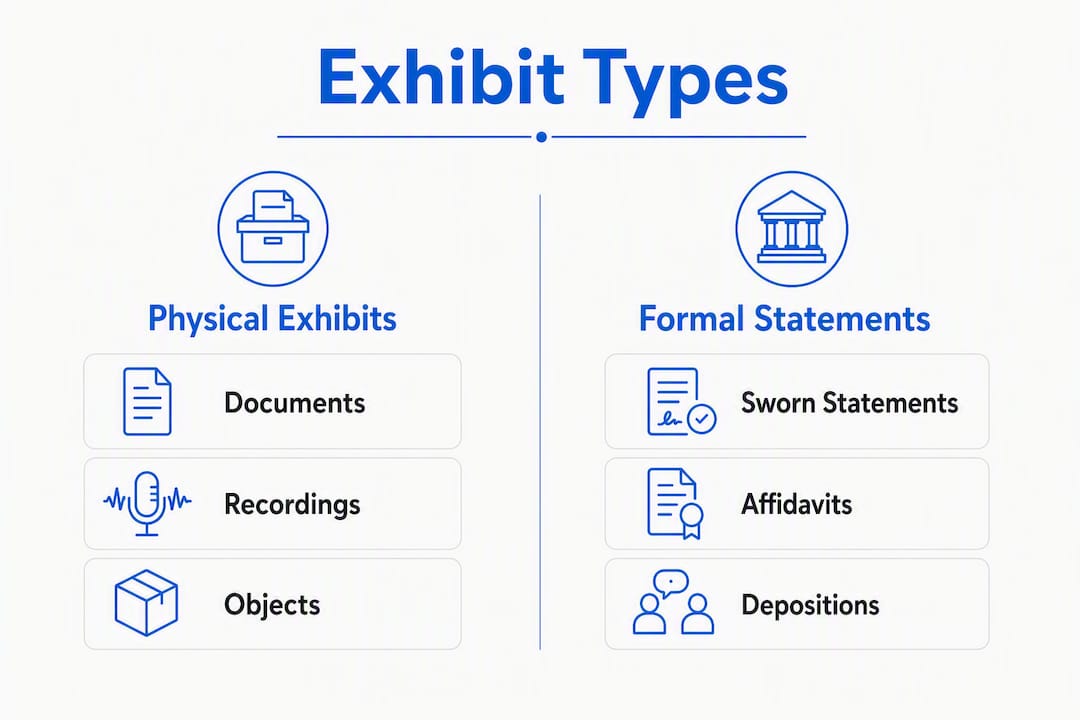
Common exhibit formats include written documents, affidavits, photographs, audio and video recordings, emails, hard drives, and physical objects. Before relying on any exhibit, check two things separately: whether the document is authentic (genuinely what it claims to be) and whether its contents have been proved through testimony. Those are distinct hurdles, and confusing them is the most common mistake researchers make.
Table of Contents
- What counts as an exhibit in an inquiry: types and examples
- How commissions treat exhibits differently from courts
- How exhibits are submitted, marked, admitted and recorded
- How to find exhibits in the Madlanga Commission archive
- How to verify or challenge an exhibit during proceedings
- Best practices for citing inquiry exhibits
- Common mistakes and warning signs when using inquiry exhibits
- Key takeaways
- Why the archive matters more than the hearing room
- The Madlanga Commission archive: your starting point for inquiry exhibits
- Useful sources
- FAQ
What counts as an exhibit in an inquiry: types and examples
Commissions are authorised to receive a wide range of evidence, including material that would be inadmissible in a court of law, provided it relates to the commission’s terms of reference. That statutory breadth means the exhibit categories are genuinely wide.
| Exhibit type | How it is typically produced | Common authentication challenge |
|---|---|---|
| Written document | Submitted by legal team or witness | Verifying origin and chain of custody |
| Affidavit / sworn statement | Deposed before a commissioner of oaths | Confirming deponent identity |
| Photograph or image | Produced from device or file | Establishing when and where captured |
| Audio / video recording | Submitted as digital file or physical media | Hash verification, timestamp integrity |
| Email or digital file | Extracted from device or server | Email headers, export logs, chain of custody |
| Physical object | Seized or produced under warrant | Continuity of possession |
| Oral testimony transcript | Generated by commission stenographer | Cross-reference with audio record |
In the Madlanga Commission archive, exhibits from law enforcement witnesses such as Witness I, the Hawks narcotics team leader, typically include operational reports and surveillance records. Corporate witnesses like Michael van Wyk have produced emails and company documents as exhibits. Police witnesses from the Johannesburg Metro Police Department, including Witness K from the VIP Protection Unit, illustrate how municipal law enforcement exhibits enter the record.
“There is a fundamental distinction between a document’s authenticity and the accuracy of information within it; competent testimony is usually needed to verify contents unless an exception applies.” — Mondaq, South Africa
Pro Tip: When you first encounter an exhibit in the archive, note the exhibit marker (e.g., “Exhibit A3”), the hearing day, and the witness who introduced it. That trio is your citation anchor for everything that follows.
How commissions treat exhibits differently from courts
South African courts apply strict rules of evidence. Commissions do not. A commission appointed under the Commissions Act 8 of 1947 may adopt its own procedures for receiving evidence, including hearsay and newspaper reports, as long as those procedures stay within the commission’s terms of reference and comply with administrative-law duties of fairness under the Promotion of Administrative Justice Act 3 of 2000 (PAJA).
The Commissioner’s role is also fundamentally different from a judge’s. A defining feature of inquiry proceedings is the Commissioner’s active role: Justice Mbuyiseli Madlanga leads the investigation, decides what evidence to admit, and questions witnesses directly. That is not how a High Court trial works.
The practical consequence is important. An exhibit may be admitted because it is relevant and the Commissioner considers it useful, but admission alone does not prove the truth of its contents. A leaked email admitted as an exhibit still requires a witness to confirm it was sent, received, and unaltered before its contents can be treated as established fact. Courts will intervene if a commission departs unreasonably from its mandate, what the case law calls going on a “frolic of its own.”
“A commission may consider hearsay and newspaper reports but must keep a reasonable connection to its terms of reference; courts will intervene where a commission is unreasonable.” — Obiter, Nelson Mandela University
Pro Tip: If you are relying on an exhibit for a published story or legal submission, check whether the Commissioner admitted it for the limited purpose of showing it exists, or whether a witness also confirmed its contents. The hearing transcript will say.
How exhibits are submitted, marked, admitted and recorded
The commission’s legal team typically drives the submission process, though parties and implicated persons may also produce documents. Here is the standard sequence:
- Disclosure or production. The legal team or a witness produces the document, recording, or object before or during a hearing session.
- Marking. The Commissioner or a designated officer assigns an exhibit marker (a letter, number, or alphanumeric code). That marker becomes the permanent identifier in the record.
- Formal admission. The Commissioner rules the exhibit admitted, often after brief oral confirmation of its origin.
- Indexing. The exhibit is logged in the commission record with its marker, date of admission, the witness who produced it, and any notes on format or condition.
- Filing. Physical documents are filed; digital files are stored with metadata intact.
For digital exhibits, the Government Gazette guidance requires that electronic data be authenticated and readable. Practically, that means submitting the original file, export logs, a checksum or hash value, and email headers where applicable.
Applications not otherwise provided for must generally be made on reasonable notice; the Chairperson may condone late filings for good cause. Missing that window without a compelling reason can delay or block an exhibit’s admission.
| Metadata field | Why it matters |
|---|---|
| Date of creation / receipt | Establishes timeline and relevance |
| Custodian name | Anchors chain of custody |
| File format and hash | Detects tampering in digital files |
| Exhibit marker | Links document to hearing transcript |
| Witness who produced it | Enables cross-examination and verification |
Pro Tip: Always request a copy of the commission’s exhibit index at the start of any research project. It maps every marker to a hearing day and witness, saving hours of transcript searching.
How to find exhibits in the Madlanga Commission archive
The Madlanga Commission archive organises public records by hearing day, witness profile, and document type. Start your search here:
- Hearing day pages. Each page lists the witnesses who appeared, exhibits admitted, and a downloadable transcript. Day 2 (18 September 2025) is a useful reference for understanding how exhibits are indexed on a typical day.
- Witness profiles. The witnesses index links each person to their testimony sessions and the exhibits they produced or were questioned about.
- Exhibit markers in transcripts. Search the transcript text for the marker (e.g., “Exhibit B”) to jump directly to the moment of admission and the surrounding testimony.
- Keyword search. Use document metadata keywords (organisation name, date, file type) to narrow results before opening individual hearing pages.
Pro Tip: If you know the witness’s name but not the hearing day, go to their profile page first. It lists every session they appeared in, which cuts your search to two or three hearing days at most.
How to verify or challenge an exhibit during proceedings
Verification and challenge are two separate tracks. Verification is something you do before relying on an exhibit; challenge is a formal step taken during hearings.
- Check the exhibit marker and admission record. Confirm the marker in the transcript matches the filed document.
- Trace the chain of custody. Identify every person who handled the document from its origin to its production before the commission.
- Verify digital integrity. For electronic files, compare the hash value in the submission record against the file you downloaded.
- Link the exhibit to a witness. Identify who produced it and whether that person confirmed its contents under questioning.
- Request corroborating evidence. If the exhibit is hearsay or lacks a clear custodian, ask whether a corroborating witness or forensic report was also admitted.
- Lodge a formal objection. Objections must be raised promptly, ideally at the moment of admission. State the ground clearly: authenticity, relevance, or prejudice. The Commissioner rules on it; the record reflects the ruling.
“Practitioners frequently emphasise that inclusion of an exhibit in the record needs corroboration through testimony or forensic proof before its contents can be treated as fact.” — Mondaq, South Africa
Pro Tip: When digital authenticity is genuinely in dispute, brief a digital forensics expert with three specific questions: Was this file altered after its stated creation date? Does the hash match the original? Are the metadata timestamps consistent with the claimed chain of custody? A narrow brief gets a usable answer faster.
Best practices for citing inquiry exhibits
A citation that cannot be independently verified is a liability. Use this format for Madlanga Commission exhibits:
Madlanga Commission of Inquiry, [Witness Name], Exhibit [Marker], [Hearing Day Number], [Date], [Permalink URL].
Example: Madlanga Commission of Inquiry, Witness I, Exhibit A2, Day 2, 18 September 2025, https://madlangacommission.co.za/hearings/day-2.
| Material type | Citation elements to include |
|---|---|
| Transcript excerpt | Hearing day, date, witness, page/line reference, permalink |
| Exhibit document | Exhibit marker, witness, hearing day, file format, permalink |
| Audio / video file | Exhibit marker, timestamp, hearing day, permalink |
| Photograph | Exhibit marker, description, hearing day, permalink |
Beyond citation, preserve what you download. Save a date-stamped copy of the file, record the hash value, and note the URL alongside the date you accessed it. Permalinks in the Madlanga archive are stable, but a local copy with a checksum protects you if a file is later updated or restricted.
Common mistakes and warning signs when using inquiry exhibits
Not every exhibit in a public record is reliable, and not every use of a reliable exhibit is responsible.
- Missing metadata. No creation date, no custodian, no file hash on a digital exhibit is a red flag. Treat it as unverified until a witness confirms it.
- Unexplained custody gaps. A document that moved from an organisation to the commission without a clear handover record may have been altered in transit.
- Anonymous submissions. Exhibits with no identified producer are difficult to test and should not be treated as established fact without corroboration.
- Inconsistent witness linkage. If the transcript shows an exhibit was admitted but no witness confirmed its contents, its evidentiary weight is limited.
- Selective quotation. Pulling a single line from a multi-page exhibit without its context can reverse the document’s meaning. Always cite the full exhibit marker and hearing day so readers can check.
On the ethics side: some exhibits contain the names or identifying details of protected witnesses or private individuals. Publishing that information, even when technically accessible in a public record, may breach privacy obligations and undermine the commission’s witness protection arrangements. Where a hearing day record is partially redacted, respect the redaction rather than seeking to reconstruct what was removed.
“A commission may consider hearsay and newspaper reports but must keep a reasonable connection to its terms of reference.” — Obiter
Pro Tip: If you suspect an exhibit has been altered, do not publish the allegation based on the exhibit alone. Request the commission’s original submission record and, if necessary, file a formal query with the evidence leaders before going to print.
Key takeaways
Exhibits in South African commissions of inquiry are formally admitted items spanning documents, recordings, and physical objects, with authenticity and proof of contents treated as separate requirements throughout.
| Point | Details |
|---|---|
| Admission does not equal proof | An exhibit’s admission into the record does not prove the truth of its contents; testimony or forensic evidence is still required. |
| Seven-day notice rule | Applications must generally be made on at least seven calendar days’ notice; late filings require good cause for the Chairperson to condone. |
| Digital exhibits need a hash | Electronic files must be authenticated with a checksum or hash value, export logs, and a witness who can confirm the chain of custody. |
| Cite with a permalink | Always include the exhibit marker, hearing day, witness name, and the Madlanga archive permalink in any citation. |
| Madlanga Commission archive | The archive’s hearing day pages, witness profiles, and exhibit index are the primary public resource for locating and citing South African inquiry exhibits. |
Why the archive matters more than the hearing room
Most commentary on commissions focuses on the drama of live testimony. The more durable resource is the archive, and that is where the real analytical work happens.
A transcript read cold, weeks after a hearing, often reveals things that live coverage missed: the precise moment an exhibit was admitted, the exact question that tested its authenticity, the ruling that limited its weight. Researchers who skip straight to the exhibit file without reading the surrounding transcript are working with half the picture.
The Madlanga Commission’s public record is unusually detailed by South African standards. Witness profiles link directly to the sessions in which each person appeared, and hearing day pages carry both the transcript and the exhibit index. That structure means a journalist can trace a document from its first mention in testimony through to the Commissioner’s ruling on its admissibility, all without attending a single hearing day.
What the archive cannot do is substitute for legal advice when an exhibit is contested, or for editorial judgment when sensitive material is involved. Those calls still belong to qualified professionals.
The Madlanga Commission archive: your starting point for inquiry exhibits
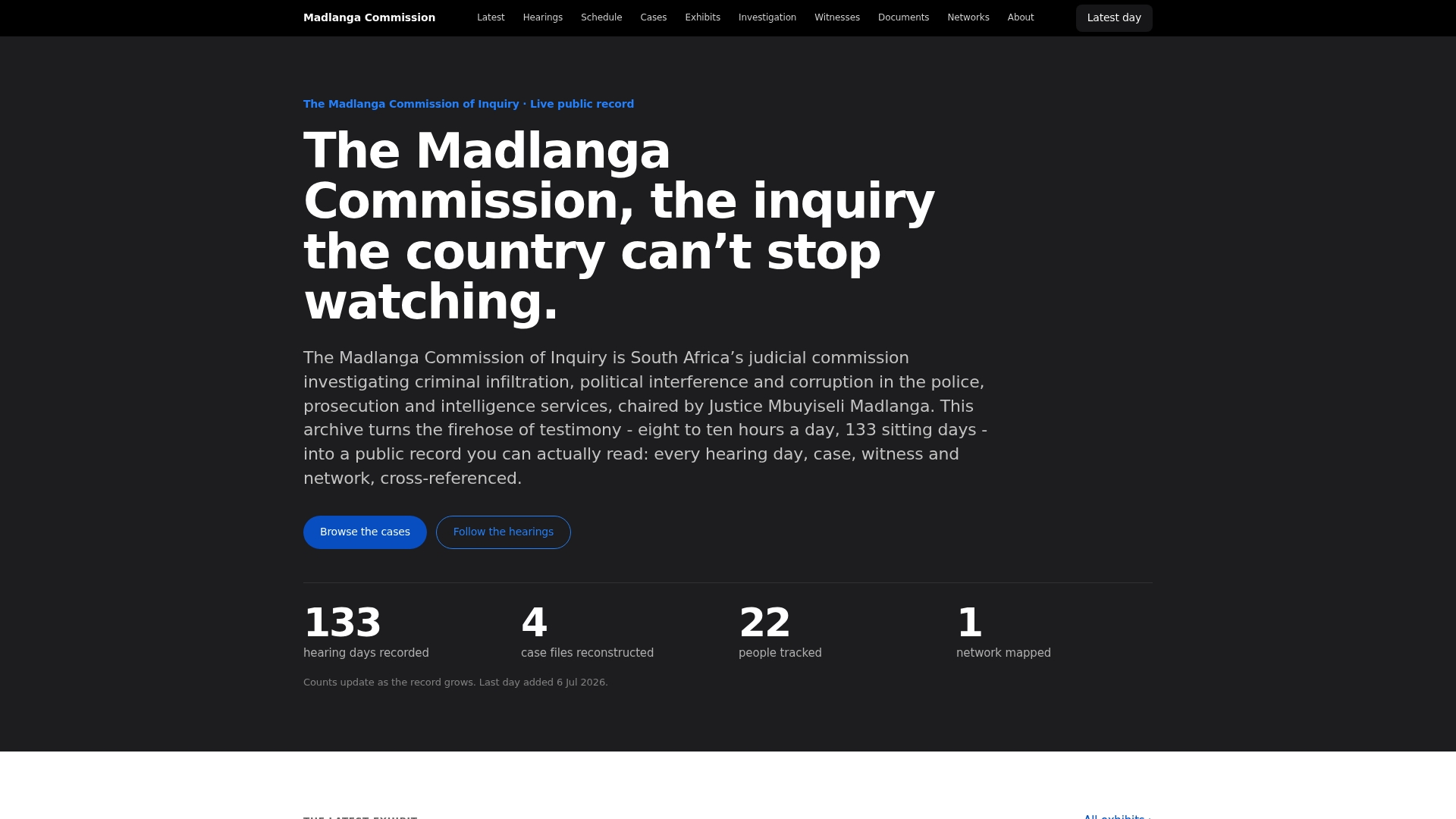
The Madlanga Commission archive gives you direct access to South Africa’s most detailed public record of an active judicial inquiry into criminal infiltration, political interference, and corruption in the police, prosecution, and intelligence sectors. Every hearing day page carries the exhibit index, witness links, downloadable transcript, and persistent permalinks, so you can cite, verify, and preserve materials without attending a single session.
To request access to restricted or redacted exhibits, reference the specific Rule number from the commission’s procedural directions and include a short statement explaining the public-interest basis for your request, addressed to the Chairperson’s office. For current hearing records, Day 123 (22 June 2026) is a good entry point: it shows how recent exhibits are indexed alongside witness testimony and ruling notes.
Start your search at the Madlanga Commission archive and use the witness profiles and hearing day index to locate the exhibit you need.
Useful sources
Primary sources and practitioner references used in this guide:
- Commissions Act 8 of 1947: the foundational statute governing commission powers, including the authority to summon witnesses and seize documents.
- Commission of Inquiry Rules (Government Gazette, 2018): procedural rules covering exhibit submission, notice periods, implicated-person rights, and the Chairperson’s discretion to condone late filings.
- Promotion of Administrative Justice Act 3 of 2000 (PAJA): the administrative-law framework that binds commissions to act fairly and within their mandate.
- Commissions of Inquiry and the Rules of Evidence, Obiter: the most thorough South African academic treatment of how commissions handle evidence, hearsay, and the limits of commissioner discretion.
- Africa Check: A quick guide to commissions of inquiry in South Africa: accessible overview of commissioner powers and the active investigator role.
- Mondaq South Africa: Rules of evidence — admissibility and trial bundles: practitioner commentary on the authenticity/truth distinction.
- Madlanga Commission of Inquiry public archive: primary source for hearing transcripts, exhibit indexes, and witness profiles.
“A commission of inquiry is entitled to adopt its own procedures for the receipt of evidence, but its discretion is not unfettered — as an organ of state engaged in administrative action, it is bound by PAJA and must act fairly.” — Obiter
FAQ
What is an exhibit in a South African commission of inquiry?
An exhibit is any document, recording, object, or sworn statement formally admitted by the Commissioner into the commission record. It can range from a written affidavit to a hard drive or video file.
Does admission of an exhibit prove its contents are true?
No. Admission establishes that the item is part of the record, but the truth of its contents must be proved separately, usually through witness testimony or forensic evidence.
How do I find exhibits from the Madlanga Commission?
Go to the Madlanga Commission archive, open the relevant hearing day page, and check the exhibit index. Witness profile pages also list the sessions and exhibits linked to each person.
Can I challenge an exhibit in a commission hearing?
Yes. Raise your objection at the moment of admission, stating the ground clearly (authenticity, relevance, or prejudice). The Commissioner rules on it and the ruling is recorded in the transcript.
How do I request a restricted or redacted exhibit?
Reference the specific Rule number from the commission’s procedural directions, include a short statement explaining your public-interest basis for access, and address the request to the Chairperson’s office.