In camera hearings in South Africa: what you need to know
TL;DR:
- In camera hearings in South Africa are private court sessions authorized by statute to protect justice or participants. Courts remain committed to open justice but may seal records or exclude the public for specific, justified reasons. The process involves detailed applications, reasoned rulings, and the preservation of fair trial rights and appeal options.
An in camera hearing is a court proceeding held in private, closed to the public and press, when open proceedings would frustrate justice or endanger a participant. South African courts derive the power to order one primarily from section 32 of the Superior Courts Act 10 of 2013 and from sections 153, 158, and 170A of the Criminal Procedure Act 51 of 1977. The onus always rests on the applicant to justify closure by establishing a “special case,” meaning the harm from open proceedings must clearly outweigh the constitutional right to open justice.
Key statutory hooks at a glance:
- Superior Courts Act s32: General power to exclude the public from any hearing when justice requires it.
- Criminal Procedure Act s153: Allows courts to clear the public gallery for certain offences or to protect witnesses.
- Criminal Procedure Act s158: Permits testimony via closed-circuit television or other remote means.
- Criminal Procedure Act s170A: Governs the use of intermediaries for child or vulnerable witnesses.
Table of Contents
- What do in camera proceedings actually cover?
- What statutory and constitutional foundations apply?
- How does an application for a private hearing actually work?
- What changes — and what stays the same — after an in camera order?
- What do the leading South African cases actually decide?
- How can journalists, litigants, and researchers follow in camera hearings?
- Key takeaways
- The trade-off between open justice and necessary privacy
- The Madlanga Commission archive and in camera hearings
- Useful sources
- FAQ
What do in camera proceedings actually cover?
The term “in camera” comes from Latin for “in the chamber,” and in South African practice it covers a wider range of situations than most people expect. The most familiar use is protecting child complainants in sexual offence cases, where the court clears the gallery and may appoint an intermediary under section 170A. But the mechanism extends well beyond that.
Courts also invoke private sessions for evidence touching on legal professional privilege, national security intelligence, intimate images, and commercial or tax secrets. A taxpayer litigating against SARS, for instance, may argue that filing detailed financial records in an open court file would cause irreparable harm to a third party or expose confidential business information.
“The presiding officer can open parts of the hearing in the public interest, yielding hybrid outcomes — some evidence heard publicly, other portions sealed — so transparency and protection coexist rather than compete.” Mengo and Judge President Mbenenge Ruling on in-camera hearing
Partial closures are common and often the most proportionate response. In the Mbenenge tribunal ruling, some WhatsApp messages were admitted in open session while others, along with certain images, were ordered in camera. Media directives restricted how journalists could report on the public portions without banning them entirely. That hybrid model is now a standard tool in South African judicial practice.
What statutory and constitutional foundations apply?
Open justice is a constitutional value, not just a procedural preference. Section 34 of the Constitution guarantees the right to have disputes resolved in a public hearing, and section 35(3)© protects an accused’s right to a public trial. Any in camera order cuts across both provisions, which is why courts treat closure as an exception that must be justified, not a default.
| Statute / Provision | What it authorises |
|---|---|
| Superior Courts Act s32 | Court may exclude the public when open proceedings would be contrary to public policy or prejudice the administration of justice |
| Criminal Procedure Act s153 | Court may direct that the public be excluded during evidence in specified offences or to protect a witness |
| Criminal Procedure Act s158 | Allows testimony by CCTV or other electronic means; court must give reasons for refusal |
| Criminal Procedure Act s170A | Intermediary appointments for child or vulnerable witnesses; court must give reasons for refusal |
| Constitution s34 | Right to a public hearing — the baseline that in camera orders must justify departing from |
The Criminal Procedure Act provisions are explicit that where a court refuses protective measures such as CCTV or an intermediary, it must record its reasons. That requirement cuts both ways: it disciplines courts against casual refusal and gives appellate courts a record to review.
The “special case” test, drawn from section 32 and confirmed in multiple High Court judgments, requires the applicant to show:
- A specific, articulable harm that open proceedings would cause.
- That the harm outweighs the public interest in transparency.
- That the closure sought is no wider than necessary to prevent that harm.
Generalities will not suffice. Courts have dismissed applications where the applicant offered only vague assertions of embarrassment or commercial sensitivity without identifying the precise information at risk.
How does an application for a private hearing actually work?
The procedure varies depending on whether you are seeking closure of the main hearing or protection for a specific document or witness. Here is how it typically unfolds:
- Identify the basis. Determine which statutory provision or common-law principle applies. A child witness triggers section 170A; a privilege dispute over documents triggers section 32 and the common-law rules on legal professional privilege.
- File an interlocutory application. In most civil matters, you bring a separate interlocutory application before or during the main hearing, supported by an affidavit that explains the harm without itself disclosing the sensitive material.
- Manage the catch-22. The interlocutory application is ordinarily heard in open court. If your affidavit describes the sensitive material in enough detail to persuade the court, you may have already exposed what you are trying to protect. In SMI v CSARS ([2023] ZAECGHC 115), the applicant’s own papers placed taxpayer information into the public domain before the court could rule on closure — the application was then dismissed for failing to establish a special case. That catch-22 analysis is now required reading for any practitioner in this space.
- Request a judicial peek. Where documents are at the heart of the dispute, ask the court to conduct a sealed in camera review of the documents before any wider disclosure. The Constitutional Court procedure allows a limited record to be kept, with only designated representatives attending under confidentiality undertakings. If the court finds the document is not privileged, the relevant portion enters the public record.
- Draft confidentiality undertakings. Where partial disclosure to opposing parties is unavoidable, prepare undertakings that restrict onward disclosure and specify consequences for breach.
- Expect a reasoned ruling. The court must give reasons for granting or refusing the order, and those reasons form the basis of any appeal.
Pro Tip: Ask for a judicial peek or sealed in camera review as your first step in any document-privilege dispute. It lets the court assess the material without forcing you to describe it in open papers, sidestepping the interlocutory catch-22 that sank the application in SMI v CSARS.
What changes — and what stays the same — after an in camera order?
An in camera order does not suspend the rules of evidence or the rights of the parties. What it does is change who is in the room and what enters the public record.
What the order changes:
- The public gallery is cleared; journalists and observers must leave.
- The court record for that portion may be sealed, meaning the registrar will not provide copies to non-parties without a further court order.
- Parties who receive sensitive material under the order are bound by confidentiality undertakings.
- Media reporting restrictions may prohibit publication of specific evidence even after the hearing concludes.
What the order does not change:
- The accused’s right to be present and to cross-examine witnesses is fully preserved. In camera settings are protective, not punitive.
- The court must still deliver a reasoned judgment or ruling, and that reasoning is ordinarily public even when the underlying evidence is sealed.
- Sealed records can be unsealed. A later court, or the same court on application, may order access if circumstances change or if the original justification no longer holds.
- Appeal rights remain intact. A party aggrieved by the in camera order itself, or by the conduct of the closed hearing, can appeal on the record that was kept.
The Western Cape High Court’s ruling in S v Lenting and Others (ZAWCHC 241/2023) illustrates this balance well. The court ordered intermediaries and CCTV testimony for witnesses suffering PTSD, emphasising that the intermediary must understand psychological impairment. The evidence remained fully testable; only the physical setting changed to reduce trauma.
What do the leading South African cases actually decide?
| Case | Court | Core lesson |
|---|---|---|
| Thint (Pty) Ltd v NDPP | Constitutional Court | Privilege claims require a proper in camera review; courts cannot simply accept or reject claims without inspecting the documents. |
| S v Geiges | High Court | The accused’s right to a fair trial survives an in camera order; cross-examination cannot be curtailed merely because the gallery is cleared. |
| SMI v CSARS ([2023] ZAECGHC 115) | Eastern Cape High Court | Failing to establish a special case is fatal; the interlocutory catch-22 can expose sensitive material before the court rules. |
| Rappa Resources (Pty) Ltd v CSARS | Tax Court | Commercial and tax secrets can justify closure, but the applicant must identify the specific harm with precision. |
| S v Lenting and Others (ZAWCHC 241/2023) | Western Cape High Court | CCTV and intermediaries are legitimate in camera tools for vulnerable witnesses; courts must give reasons for refusal. |
| Mbenenge tribunal ruling (2024) | Judicial Service Commission | Hybrid hearings are permissible; presiding officers can open portions in the public interest under section 32. |
The KwaZulu-Natal High Court authority on section 32 applications remains the clearest statement of the onus: the default is open court, and the applicant must demonstrate why closure is both necessary and proportionate. Courts will not accept a blanket assertion that evidence is sensitive; they want to know precisely what harm would follow from public disclosure.
Most of these judgments are freely available on SAFLII (Southern African Legal Information Institute) by searching the case name or citation.
How can journalists, litigants, and researchers follow in camera hearings?
Closed hearings are not invisible hearings. Here is where to look and what to do:
- SAFLII (saflii.org): Search by case name, citation, or keyword. Judgments that arise from in camera proceedings are usually published in full; only the sealed exhibits are withheld.
- Court registries: Apply in writing to the registrar of the relevant court for access to the court file. If a file is sealed, the registrar will confirm that and you can apply to the court for an unsealing order.
- Official commission archives: The Madlanga Commission public archive publishes daily hearing records, witness profiles, exhibits, rulings, and media briefings for South Africa’s ongoing judicial inquiry into criminal infiltration and corruption in the police, prosecution, and intelligence sectors. Where portions of a hearing are held in camera, the archive notes that fact and publishes whatever public record exists.
- Confidentiality undertakings: If you are a party or accredited journalist seeking access to sealed material, you can apply to the court to be added to the list of persons who may view it under a confidentiality undertaking.
- Witness profiles and testimony records: The Madlanga Commission’s searchable witness pages, such as the Witness K profile and Witness I profile, show how sensitive evidence is handled and which portions of testimony remain public.
Pro Tip: Use the Madlanga Commission’s daily hearing records to cross-reference which sessions were partially closed and what public rulings followed. That paper trail is often the fastest way to identify whether an in camera order was issued and what its stated scope was.
Witness tampering risks are a related concern when researching closed proceedings; understanding witness protection law helps journalists and researchers stay on the right side of the line when approaching witnesses whose testimony is partly sealed.
Key takeaways
In camera hearings in South Africa are a narrow, constitutionally justified exception to open justice, available under section 32 of the Superior Courts Act and sections 153, 158, and 170A of the Criminal Procedure Act, with the onus always on the applicant to prove a special case.
| Point | Details |
|---|---|
| Definition and default | Courts sit in public by default; in camera orders require a justified special case from the applicant. |
| Statutory basis | Superior Courts Act s32 and Criminal Procedure Act ss153, 158, and 170A are the primary powers. |
| The catch-22 risk | Interlocutory applications heard in open court can expose the very material you are trying to protect, as SMI v CSARS shows. |
| Rights preserved | Cross-examination, reasoned rulings, and appeal rights survive an in camera order; closure changes the audience, not the process. |
| Madlanga Commission archive | The Madlanga Commission’s searchable public archive is a practical starting point for tracking in camera orders and related public records in South Africa. |
The trade-off between open justice and necessary privacy
The constitutional commitment to open justice is not a formality. It is what stops courts from becoming instruments of private power. When a litigant asks to close the doors, they are asking for an exception to one of the most fundamental guarantees in the legal system, and courts are right to be demanding about it.
That said, the alternative to a well-crafted in camera order is sometimes worse: a child witness who cannot testify at all, a whistleblower who recants under public pressure, or a privilege dispute that collapses because the applicant had no safe way to show the court what was at stake. The mechanism exists because open justice, taken to an absolute, can itself produce injustice.
What matters most is that the exception is recorded, reasoned, and reviewable. A sealed hearing that leaves a public judgment explaining why it was sealed is accountable. A closed hearing with no public trace is not. The Madlanga Commission’s approach of publishing daily records and noting where portions are in camera is exactly the kind of institutional practice that keeps accountability alive even when the doors are shut.
The Madlanga Commission archive and in camera hearings
Tracking in camera orders across South Africa’s courts and commissions is difficult without a reliable, searchable record. The Madlanga Commission fills that gap for one of the country’s most significant ongoing inquiries: a fully searchable archive of daily hearing records, witness profiles, exhibits, official rulings, and media briefings covering criminal infiltration, political interference, and corruption in the police, prosecution, and intelligence sectors.
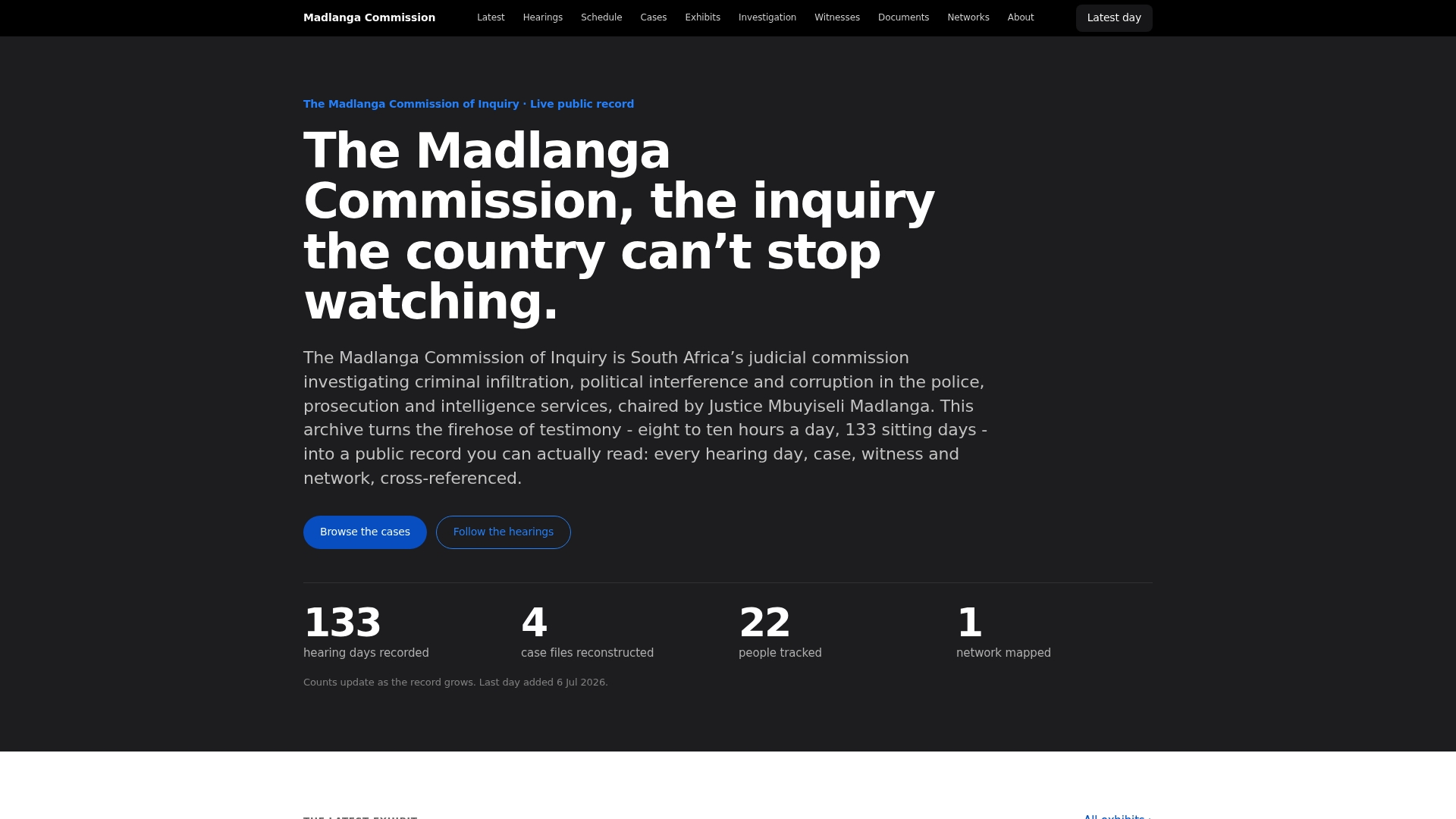
Where a session is partially closed, the archive records that fact alongside whatever public material exists, so you can trace the shape of an in camera order without needing to attend in person. The Day 115 hearing record is a good example of how the archive documents proceedings in real time, including any rulings on confidentiality or witness protection. Start there, then use the witness profiles and articles section to build a fuller picture of how closed proceedings fit into the broader inquiry.
Useful sources
- South Africa: Constitutional Court
- [A catch‑22 analysis: SMI v CSARS ([2023] ZAECGHC 115)](https://doi.org/10.17159/kckq3v31)
- S v Lenting and Others (ZAWCHC 241/2023)
FAQ
What is an in camera hearing in South African courts?
An in camera hearing is a court session held in private, with the public and press excluded, when open proceedings would harm a participant or frustrate justice. South African courts order them under section 32 of the Superior Courts Act or sections 153, 158, and 170A of the Criminal Procedure Act.
What does “in camera proceedings” mean legally?
The phrase means the court sits “in the chamber” rather than in open court. Only the parties, their legal representatives, and persons specifically authorised by the court may attend; the record may be sealed and reporting restrictions often apply.
Does an in camera order remove the right to cross-examine witnesses?
No. Cross-examination and all other fair-trial rights are preserved. The order changes who is present in the courtroom, not the procedural rules that govern how evidence is tested.
Can the public access records from a closed hearing?
Sealed records are not automatically permanent. Any person with a legitimate interest can apply to the court for an unsealing order, and judgments arising from in camera proceedings are ordinarily published in full on SAFLII even when the underlying exhibits remain sealed.
How do I find out if a specific hearing was held in camera?
Check the court’s published judgment on SAFLII, contact the court registry, or search the Madlanga Commission’s public archive for commission hearings. The archive notes where sessions were partially or fully closed and publishes the available public record alongside that notation.