Judicial commissions South Africa: find Madlanga records
The Madlanga Commission’s searchable public archive at madlangacommission.co.za is the authoritative source for every hearing transcript, exhibit, witness profile and official document from South Africa’s Judicial Commission of Inquiry into Criminality, Political Interference and Corruption in the Criminal Justice System. Chaired by Justice Mbuyiseli Madlanga, the commission submitted its interim report on 17 December 2025, which President Ramaphosa accepted. The final report deadline has since been extended to 16 November 2026, and hearings continue.
Start here when you open the archive:
- Live feed and latest hearings: madlangacommission.co.za/latest
- Search by witness name or hearing day: use the archive’s main search bar
- Most recent day page: click the highest-numbered day in the hearings index
Key takeaways
The Madlanga Commission’s public archive at madlangacommission.co.za is the single authoritative source for all hearing transcripts, exhibits, witness profiles and official reports from South Africa’s most significant active judicial inquiry.
| Point | Details |
|---|---|
| Start with the archive | madlangacommission.co.za holds all transcripts, exhibits and reports; the latest page updates same day. |
| Use the interim report as baseline | Submitted 17 December 2025 and accepted by President Ramaphosa; cross-reference all later testimony against it. |
| Verify before publishing | Match transcript timestamps to video, confirm exhibit IDs, and check witness legal names before quoting. |
| Know the deadline | The final report is due by 16 November 2026; hearings examining IDAC and senior officials continue until then. |
| Madlanga Commission archive | Covers 152 sitting days and 40+ official documents; use the search, day pages and corrections contact for restricted material. |
Table of Contents
- What records does the Madlanga Commission publish?
- How to search, download and cite records from the archive
- Which hearings are closed, and how do you request restricted material?
- How to verify transcripts and cross-reference exhibits
- How to watch live and stay notified as hearings continue
- Why the archive is the most underused accountability tool in South Africa right now
- The Madlanga Commission archive gives you direct access to every record
- FAQ
What records does the Madlanga Commission publish?
The official archive organises its holdings into several distinct record types. Knowing what each one contains saves you from downloading the wrong file.
| Record type | What it contains | Typical format |
|---|---|---|
| Daily hearing transcript | Time-stamped testimony, speaker labels, exhibit references | PDF / searchable HTML |
| Official exhibit | Document, image or video tendered as evidence; identified by exhibit ID | PDF, MP4, JPEG |
| Witness profile | Full name, role, hearing day(s), redaction notes | HTML page |
| Case file | Evidence chain across multiple days for a specific allegation | HTML / PDF |
| Interim / final report | Consolidated findings and recommendations | |
| Rulings and directions | Procedural orders by the chairperson | |
| Media releases | Official statements and press briefings | HTML / PDF |
Transcripts are the backbone of any research workflow. Each one carries the hearing day number, the date, the witness’s legal name, and inline exhibit IDs so you can jump directly to the corresponding exhibit file. Video recordings, where available, are linked on the same day page.
Pro Tip: Download the interim report first. The Presidency’s acceptance of the interim report makes it the baseline document against which all subsequent testimony should be measured. It tells you which allegations the commission had already assessed by December 2025.
How to search, download and cite records from the archive
The archive is structured by hearing day, so the fastest route to any record is knowing the day number or the witness name. Here is a reliable workflow:
- Open the hearings index at madlangacommission.co.za and identify the relevant day by date or witness name. The Day 115 page (8 June 2026) is a good example of the standard layout: transcript at the top, exhibit links below.
Pro Tip: Match the transcript timestamp to the video recording before quoting testimony. Spoken words sometimes differ slightly from the typed transcript. The video is the primary record; the transcript is the index.
For inaccessible files, check the methodology and corrections page first. It explains how the archive sources and updates records. If a file is genuinely missing, the contact details listed on the archive are the right escalation point.
Which hearings are closed, and how do you request restricted material?
Not every session is open to the public. The commission holds certain hearings in camera when witness safety is at risk or when disclosing investigative techniques would compromise ongoing prosecutions. Redactions in published transcripts follow the same logic.
Before requesting any restricted material, run through this checklist:
- Review the commission’s rules. The official rules, issued under Proclamation R277 of 2025, set out the grounds for closed sessions and the procedure for challenging them.
Realistic expectation: in-camera testimony about active criminal investigations is unlikely to be released before the final report.
How to verify transcripts and cross-reference exhibits
Always match transcript timestamps against the video or audio recording before publishing a quote. The transcript is a typed rendering; the recording is what was actually said under oath.
A practical verification checklist:
- Witness identity: check the witness profile page to confirm the legal name and role. Nicknames appear in testimony; legal names govern official records.
- Cross-reference with the interim report: if a witness’s testimony contradicts an interim finding, that contradiction is itself newsworthy. The Presidency’s release confirms the interim report’s official standing.
Pro Tip: Use three sources simultaneously: the transcript, the video, and the exhibit. If all three align, the detail is solid. If any two diverge, flag it and contact the archive’s corrections team before publishing.
The scale of the record explains why this discipline matters. Conviction reports the archive spans 152 sitting days and more than 40 official documents, with thousands of transcript pages and hours of video. At that volume, errors compound quickly without a systematic check.
How to watch live and stay notified as hearings continue
The latest hearings page is your first stop every morning the commission sits. Same-day transcripts post there, and the live stream link appears on hearing days before proceedings begin.
Practical ways to stay current:
- Set a Google Alert for “Madlanga Commission” to catch major media coverage. TimesLive publishes live-watch notices on hearing days, and SABC News covers new witness appearances as they are announced.
Pro Tip: Create a browser bookmark folder with the latest page, the witnesses index, and the current week’s day pages. Refresh the folder each Monday. You will catch new transcripts within hours of posting rather than days.
Why the archive is the most underused accountability tool in South Africa right now
South Africa has a long history of commissions of inquiry producing reports that gather dust. What makes this moment different is the archive itself. The Madlanga Commission’s public record is not a summary or a press release. It is the raw material: testimony under oath, exhibits tendered as evidence, rulings made in real time. That is rare.
The temptation for journalists and activists is to wait for the final report and react to the headline findings. That approach hands the narrative to whoever frames the report first. Researchers who have been working through the transcripts since September 2025 already know which witness contradicted which exhibit, and which testimony the interim report quietly set aside. That knowledge is only available to people who used the archive.
Responsible use matters as much as access. Witnesses who testified about criminal networks did so under conditions that sometimes included personal risk. Publishing unverified quotes from in-camera sessions, or naming individuals from exhibits without confirming their legal status, can cause real harm. The archive’s methodology page exists for a reason: it tells you how records were sourced and what corrections have been made. Read it before you publish anything significant.
The deeper opportunity is for civil society. Activists and policy researchers can map the evidence chains in the case files to build structured arguments for institutional reform. The commission’s terms of reference cover police, prosecution and intelligence. That is the architecture of the entire criminal justice system. The evidence is already public. The question is whether anyone will use it carefully enough to matter.
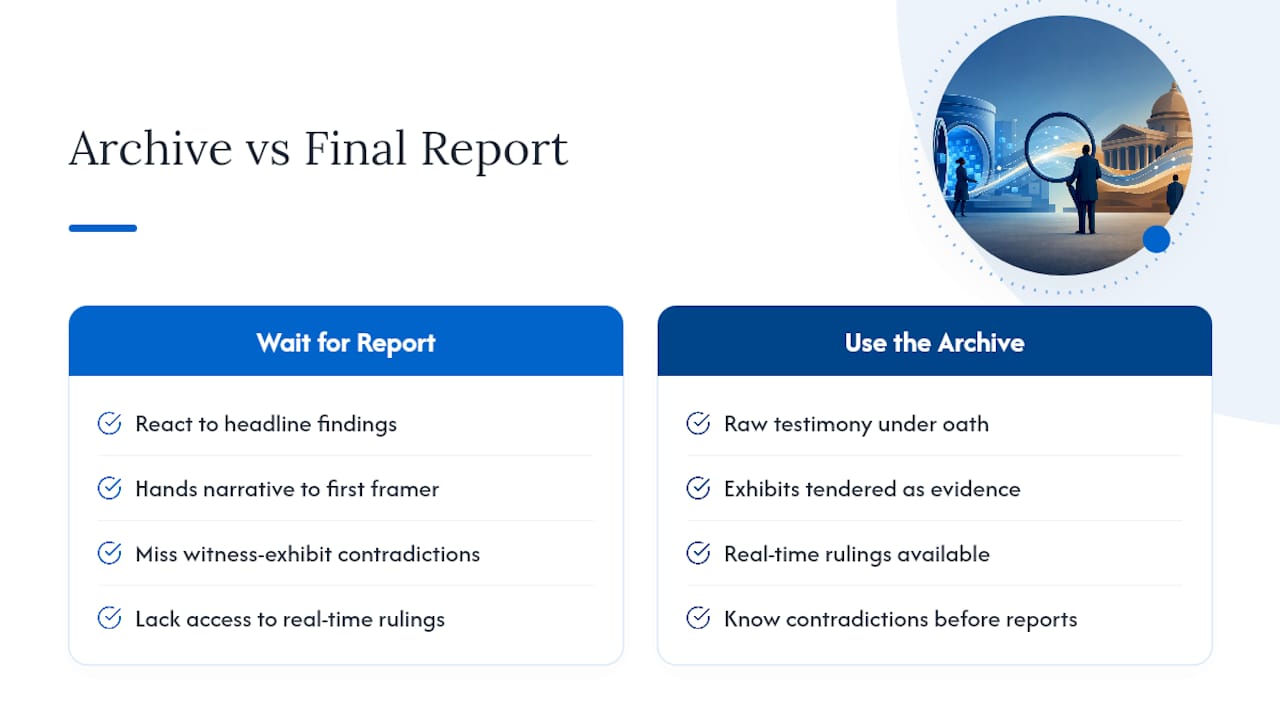
The Madlanga Commission archive gives you direct access to every record
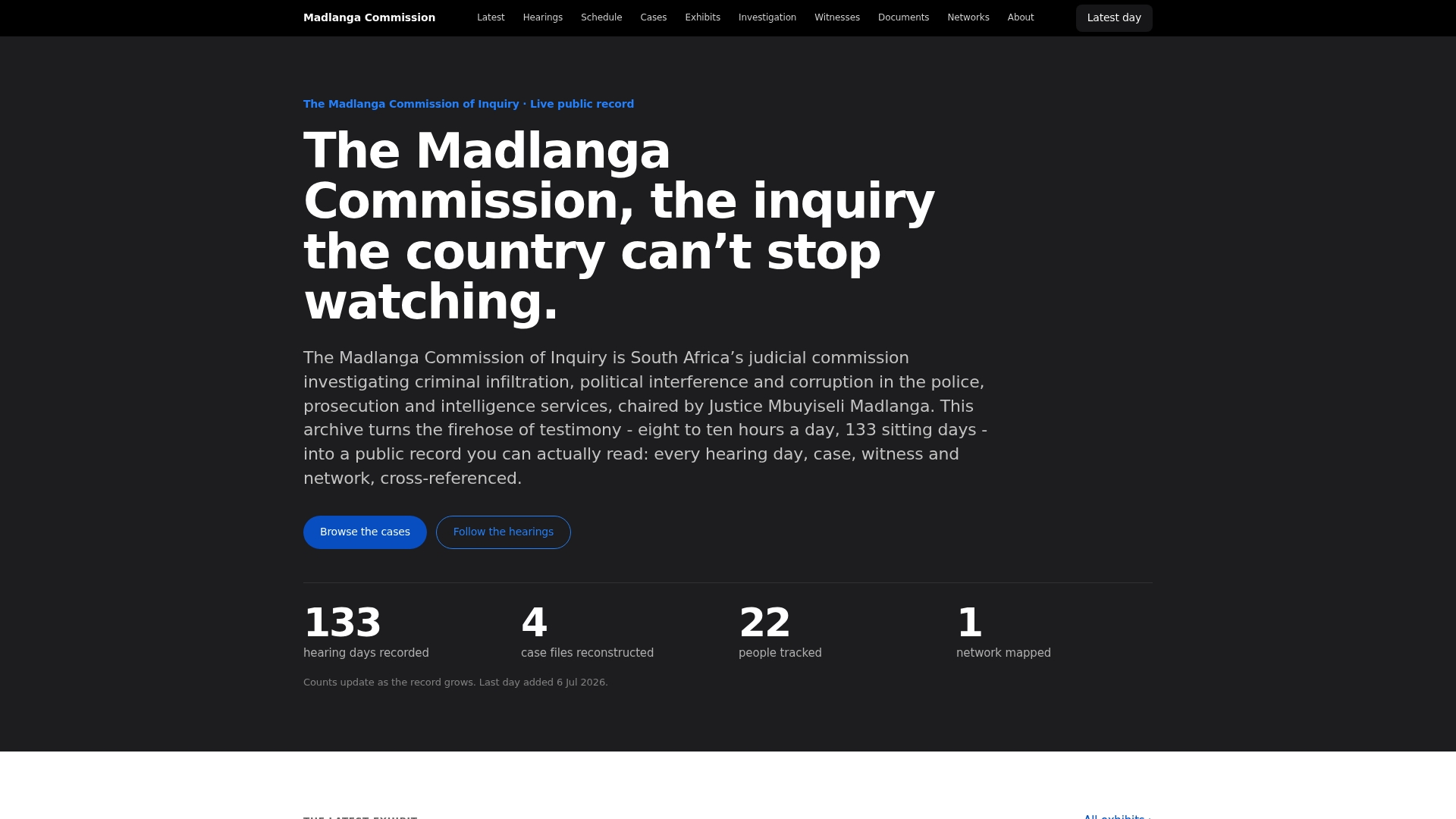
What the archive gives you directly:
- Hearing-day pages structured for fast navigation (open Day 115 to see the layout)
- Methodology and corrections — so you know exactly how records are sourced
Start with the latest hearings page, pick the most recent day, and open the transcript. The evidence leaders section explains how exhibits are structured and presented, which makes reading any transcript significantly faster.
FAQ
What is the Madlanga Commission of inquiry?
The Madlanga Commission is a South African judicial commission of inquiry, chaired by Justice Mbuyiseli Madlanga, investigating criminal infiltration, political interference and corruption in the police, prosecution and intelligence services. It was established in July 2025 under Proclamation R277 of 2025.
Where can I find Madlanga Commission transcripts?
All daily hearing transcripts are publicly available at madlangacommission.co.za, organised by hearing day with linked exhibit downloads and witness profiles.
Has the Madlanga Commission published a report?
Yes. The commission submitted its interim report on 17 December 2025, which President Ramaphosa accepted. The final report is due by 16 November 2026.
How do I request access to closed or in-camera sessions?
Check the public archive first for alternative exhibits, then consult the commission’s rules under Proclamation R277 of 2025. Formal requests go through the commission’s secretariat; a PAIA application is available if the commission’s own process does not apply.
How do I cite a Madlanga Commission transcript?
Use this format: Madlanga Commission of Inquiry, Day [number], [date], Transcript p.[page] / [timestamp], [Speaker name], Exhibit [ID]. Available at: madlangacommission.co.za/hearings/day-[number].