Open data justice: what it means and how to use it

Open data justice is the practice of publishing justice-sector information (court rulings, arrest logs, case files, oversight records) in ways that are technically accessible and genuinely usable by the people affected by the justice system. Publishing a spreadsheet is not enough. If a rural litigant can’t read it, a journalist can’t verify it, or a researcher can’t safely reuse it without exposing someone to harm, it isn’t open data justice yet.
Three things you can do right now, depending on where you sit:
- Publishing a dataset? Check it against a redaction and licensing standard before release, not after.
- Looking for justice data? Start with established portals like Data, the Conseil d’État’s open-data page for administrative decisions, and national Open Government Partnership (OGP) commitments.
- Using data for accountability? Verify provenance and check for re-identification risk before you publish findings, especially involving vulnerable witnesses or complainants.
Key Takeaways
Open data justice succeeds only when transparency (publishing the data) is paired with voice (letting affected communities understand, contest, and act on it).
| Point | Details |
|---|---|
| Definition anchors everything | Open data justice pairs technical transparency with genuine participation, not publication alone. |
| Risk and principle pair up | Every principle (equity, minimisation, contestability) exists to counter a specific, named risk. |
| Process beats a single release | Governance, risk assessment, and anonymisation must precede publication, not follow it. |
| Access gaps need offline fixes | Digital-only portals exclude the roughly one-fifth of the population without internet access in unequal societies. |
| Structure is the real value | The Madlanga Commission archive shows that consistent case-linking and searchable records turn raw hearings into usable public data. |
Table of Contents
- What is open data justice?
- Why does open data justice matter to courts, journalists, and researchers?
- What principles should guide open data justice, and what risks come with it?
- What does open justice data actually look like?
- What legal and policy frameworks govern open justice data?
- How should public bodies operationalise open data justice?
- How can researchers, journalists, and activists work with open justice data?
- What stops equitable access to open justice data, and how can that be fixed?
- What can other institutions learn from the Madlanga Commission archive?
- Where to find open justice data and policy documents
- A practitioner’s perspective on open data justice
- See how an open-justice archive works in practice
- Sources
- FAQ
What is open data justice?
Open data means information released in a format anyone can access, download, and reuse, ideally machine-readable, under an open licence, with no paywall or gatekeeping. Data justice is a separate but related idea: it asks whether the collection, structuring, and use of data actually shifts power toward the people the data describes, rather than just toward the institutions that hold it.
Open data justice fuses the two. The clearest way to think about it comes from research describing a “vision and voice” frame: transparency (vision, can you see the data) is meaningless without participation (voice, can you act on it, contest it, or shape how it’s collected). A study on open data and data justice argues that most open government initiatives nail the vision half and largely ignore the voice half.
Open data justice moves beyond technical transparency toward social outcomes, requiring both visibility into government data and a genuine channel for citizens to act on what they find.
That distinction matters for justice-sector data specifically, because the stakes are higher than a transit schedule or a budget line. A published arrest log or sentencing dataset can affect someone’s employment prospects, immigration status, or physical safety. Academic critiques of open data programs point to a pattern they call “information-centrism”: agencies focus on the act of publishing rather than whether the affected community can actually understand or use what’s published. A dataset dumped online in a format only a data scientist can parse checks a transparency box without doing much for justice.
Three questions separate genuine open data justice from a transparency exercise:
- Can someone without technical training find and interpret the data?
- Does the publishing body have a channel for people to flag errors, contest classifications, or request corrections?
- Was the data structured with input from the communities most likely to be affected by it?
Why does open data justice matter to courts, journalists, and researchers?
Every stakeholder in the justice ecosystem gets something different out of open data, and the differences are worth naming because they shape what “good” data looks like for each group.
Courts and court administrators use published case-flow data to spot backlogs before they become crises. A registrar tracking case-disposition times across magistrates’ courts can flag a division falling behind months before litigants start filing complaints. Journalists use the same kind of data differently: pulling sentencing records across a jurisdiction to check whether outcomes vary by geography, judge, or demographic in ways that warrant a story. Researchers build longitudinal datasets from years of published rulings to test hypotheses about sentencing disparity or prosecutorial discretion that would be impossible to study from paper files alone.
Civil society and legal aid organizations use open data to identify public-interest litigation leads. A pattern of repeated procedural delays in a specific court division, visible only once dozens of case files are aggregated, can become the evidentiary basis for a systemic legal challenge.
The common thread: none of this works from a single case file. It works from volume, structured consistently enough to aggregate. That’s the real value proposition of open justice data over traditional record-keeping.
- Transparency: the public can see how cases move through the system, not just individual outcomes.
- Case-trend analysis: researchers and journalists can identify patterns across thousands of cases that a single file would never reveal.
- Backlog monitoring: oversight bodies can track court performance against targets in near real time.
- Exposing misconduct patterns: repeated procedural anomalies become visible once aggregated, rather than dismissed as one-off errors.
A European Commission analysis of judicial open data makes a similar point: open data can meaningfully improve judicial transparency, but only when publication quality, provenance, and downstream accountability use are actively managed, not treated as an afterthought to the release itself. Publishing without those controls produces noise, not insight.
What principles should guide open data justice, and what risks come with it?
Every open-justice initiative worth its name should be built on a short list of principles, each of which exists to counter a specific, predictable risk.
Equity means designing for the least-resourced user, not the most sophisticated one. It counters the risk of a dataset that only serves institutions already equipped to use it. Participation means the communities described in the data have a channel to shape how it’s collected and correct errors. It counters the risk of data that misrepresents the people it describes with no recourse. Transparency means documenting how data was collected, cleaned, and what was excluded. It counters the risk of selective or misleading releases. Contestability means an appeals or correction process exists for factual errors. It counters permanent reputational harm from a mistaken record. Data minimisation means collecting and publishing only what’s necessary for the stated purpose. It counters unnecessary privacy exposure. Purpose limitation means data collected for one function (say, internal case management) isn’t repurposed for another (say, predictive policing) without fresh scrutiny.
The tension that runs through all six is the one between transparency and privacy. Publish too little and you’ve achieved nothing; publish too much and you’ve re-identified a witness, a victim, or a minor from supposedly anonymized records. A quick anonymisation checklist before release:
- Strip direct identifiers (names, ID numbers, addresses) unless disclosure is legally required.
- Check for indirect identification risk from combinations of fields (age, rare offense type, small jurisdiction).
- Apply k-anonymity or aggregation thresholds for small-population subsets.
- Flag and separately review any record involving minors, sexual offenses, or witness protection.
- Log every redaction decision so it can be audited later.
Algorithmic risk deserves its own line item. As courts start experimenting with data-driven tools for case triage or risk scoring, the explainability question becomes non-negotiable. Deputy Chief Justice Dunstan Mlambo has argued that when courts adopt AI or large-scale data tools, parties must be able to test and challenge the reasoning behind automated outputs. A black-box scoring tool that no litigant can interrogate isn’t compatible with due process, no matter how good its accuracy metrics look on paper. Several African data-protection frameworks already restrict decisions based solely on automated processing for exactly this reason.
Pro Tip: Before publishing any justice dataset, run a “reverse search” test: pick three obscure record combinations and see if a determined searcher could re-identify a specific person using only public information plus your dataset. If they can, your anonymisation isn’t done.
What does open justice data actually look like?
Justice data comes in more forms than most newcomers expect, and each type carries its own typical fields and risk profile.
- Court decisions and rulings: published judgments, usually with case number, date, jurisdiction, presiding judge, and outcome. Often the most mature category, since courts have published rulings for legal-research purposes long before “open data” was a term.
- Docket and case metadata: filing date, case type, current status, and disposition, without the full judgment text. Useful for backlog analysis at scale.
- Sentencing records: offense category, sentence length, aggravating or mitigating factors noted, often the most sensitive category because of re-identification risk.
- Arrest and charge logs: date, location, charge category, and outcome (charged, released, dismissed). High value for pattern analysis, high risk if not properly aggregated.
- Backlog and performance statistics: case counts by stage, average time-to-disposition, resourcing data. Low privacy risk, high institutional-accountability value.
- Administrative and disciplinary decisions: findings against police, prosecutors, or officials, often the category most directly tied to anti-corruption work.
For each, check three things before you rely on it: the licence type (open licences like CC-BY or a government open-data licence versus restricted research-only access), the redaction flags (does the metadata tell you what was already removed), and the update frequency (a “live” portal that hasn’t refreshed in two years isn’t live).
Exemplar portals worth bookmarking: data.europa.eu aggregates EU member-state datasets including judicial ones, France’s Conseil d’État publishes administrative court decisions as open data under a structured licence, and national OGP action plans typically list the specific justice-sector commitments a government has made, which tells you what should eventually appear on a national portal even before it does.
What legal and policy frameworks govern open justice data?
No open-justice initiative operates in a vacuum. A handful of policy instruments shape what can be published, when, and under what conditions.
- Open Government Partnership (OGP) commitments give governments a structured, peer-reviewed process for pledging specific transparency actions, including justice-sector ones, with civil society tracking implementation.
- National access-to-information laws set the default disclosure rules and the exemptions that override them.
- Data-protection statutes limit what personal data can be published and how automated processing can be used in decisions affecting individuals.
South Africa’s fifth OGP National Action Plan (2023–2026) explicitly ties access-to-justice and anti-corruption commitments to its open-government agenda, giving civil society a concrete document to hold government against rather than a vague transparency pledge. That’s the kind of instrument worth checking for any country you’re working in: NAPs name specific deliverables and deadlines, which makes them far more useful than a general transparency law for tracking whether promises turn into datasets.
Access-to-information law sets the outer boundary. South Africa’s Promotion of Access to Information Act (PAIA) has been tested directly against judicial and executive record disclosure, most notably in the Constitutional Court’s ruling in President of the Republic of South Africa and Others v M & G Media Ltd, which addressed how access frameworks apply when government resists disclosure. Cases like this define where the exemptions actually bite, which matters more in practice than the statute’s plain text.
Data-protection law is the third leg. Frameworks like South Africa’s Protection of Personal Information Act (POPIA) and comparable statutes elsewhere restrict decisions based solely on automated processing and require justification for processing personal data even for a transparency purpose. The upshot for anyone publishing: legal permission to disclose doesn’t automatically mean permission to disclose in every format or at every level of granularity.
How should public bodies operationalise open data justice?
Publishing justice data responsibly is a process, not a single upload event. Here’s the sequence that reduces the most risk for the least effort:
- Establish governance first. Name who owns the decision to publish, who can approve exceptions, and who handles complaints after release.
- Inventory what you have. You can’t risk-assess or anonymise data you haven’t catalogued. List every dataset, its source system, and its current access level.
- Run a risk assessment per dataset. Ask: who could be harmed by this release, how likely is re-identification, and does the public-interest value outweigh the residual risk?
- Anonymise and redact according to the assessment. Apply the technique proportional to the risk, not a blanket rule for every dataset.
- Attach complete metadata. A dataset without metadata is barely more useful than no dataset at all.
- Publish in a machine-readable format. CSV for tabular data, JSON‑LD for linked or hierarchical records, with a clear schema document.
- Monitor use and maintain an appeals channel. Track who’s using the data if possible, and give affected individuals a route to request correction.
Metadata is where most public bodies cut corners, and it’s the single cheapest fix available. At minimum, every record needs: publication date, source system, jurisdiction, redaction status (what was removed and why), update frequency, and licence terms. A schema hint (even an informal data dictionary) saves every downstream researcher hours of guesswork.
Risk-assessment prompts worth running on every dataset before release:
- Does this dataset include anyone under 18, a victim of sexual violence, or a protected witness?
- Could combining this dataset with another public dataset re-identify someone?
- Is the geographic or demographic granularity fine enough that a small subgroup becomes identifiable?
- Has legal counsel reviewed whether any statutory exemption applies?
Anonymisation techniques worth knowing beyond basic redaction: generalisation (turning an exact age into a five-year band), suppression (dropping a field entirely for small subgroups), and aggregation (reporting counts by category rather than individual records) all reduce re-identification risk at different costs to data utility. The right choice depends on how the data will actually be used, which is exactly why the risk assessment in step three has to come before the anonymisation choice in step four, not after.
Pro Tip: Build a dual-track access model from day one: a fully open digital dataset for anyone with an internet connection, plus an assisted physical-access channel (a court registry desk, a legal aid clinic terminal) for people without reliable connectivity. A digital-only release quietly excludes exactly the population most likely to need the data for a real legal problem.
How can researchers, journalists, and activists work with open justice data?
Finding a dataset is the easy part. Turning it into something defensible takes a workflow.
Discover. Start with the portals covering your jurisdiction: data.europa.eu for EU-linked material, national OGP action plan pages for country-specific commitments, and the relevant court or ministry’s own open-data page. Search by dataset title and by the government body’s name, since indexing across portals is inconsistent.
Verify provenance. Before you cite a number, confirm which agency generated it, when it was last updated, and whether the methodology changed mid-series (a common and under-disclosed problem in longitudinal justice data).
Clean. OpenRefine handles messy categorical data (inconsistent charge-category naming is the classic justice-data headache) better than most spreadsheet tools. For geographic analysis of case distribution, QGIS is the standard free option. For statistical work, Python’s pandas library or R covers most sentencing-disparity or backlog-trend analysis a newsroom or research team will need.
Analyse. Cross-tabulate before you regress. A simple pivot table showing case outcomes by court division often reveals the same pattern a complex model would, faster and more transparently for a general audience.
Publish responsibly. If your findings could identify an individual even indirectly, especially in a small jurisdiction, re-run the anonymisation checklist from the publisher’s side against your own output before release.
A quick ethics check before you reuse anything: did the people in this dataset consent to this specific kind of secondary analysis, even implicitly, and does your analysis risk widening an existing power imbalance rather than correcting one? A dataset built to hold institutions accountable can be misused to target individuals if the analyst isn’t careful about aggregation level.
What stops equitable access to open justice data, and how can that be fixed?
Open data justice fails quietly whenever it forgets the parts of the population without a laptop and a stable connection. The barriers are predictable, and so, largely, are the fixes.
- Connectivity gaps → publish periodic offline data dumps (USB, printed summaries at legal aid offices) alongside the online portal.
- Low data literacy → run community data-training sessions in plain, local-language materials, not just English technical documentation.
- Cost of access → subsidise data or device access through legal aid clinics and libraries rather than assuming universal home broadband.
- Language barriers → publish core metadata and summaries in the dominant local languages, not just the language of the original court record.
The scale of the problem is easy to underestimate from inside a well-connected newsroom or law office. A review of procedural fairness in South Africa found the country’s Gini coefficient sitting between 0.62 and 0.69, among the highest income-inequality measures globally, with over 20% of the population lacking internet access in the same analysis. Digitisation without an offline counterpart doesn’t close an access gap in a context like that; it hardens it into the system’s design.
Pro Tip: Co-design the release format with the community most affected before you publish, not after complaints arrive. A single afternoon workshop with a legal aid clinic will surface usability problems a government data team will never spot on its own.
What can other institutions learn from the Madlanga Commission archive?
The Madlanga Commission of Inquiry, investigating criminal infiltration and corruption across South Africa’s police, prosecution, and intelligence sectors, built its public record around a simple premise: nobody should have to sit through months of live hearings to understand what the Commission found. Its archive organizes daily hearing records, case files, witness profiles, exhibits, and rulings into a structure a reader can navigate without any legal training.
A few operational choices make that archive worth studying if you’re designing something similar:
- Consistent case-linking. Pages like the Khumalo arrest and Mokwele appointment case file tie testimony, exhibits, and rulings back to a single case narrative instead of scattering them across separate document dumps.
- Named institutional roles. Profiles for figures like Advocate Mahlape Sello SC as evidence leader make clear who is responsible for what gets presented, which is a transparency signal in its own right.
- Searchable witness records, rather than a static PDF archive, so a researcher can find every reference to a specific witness or entity across months of hearings.
- Regular updates through a dedicated latest hearings page, so the record stays current rather than lagging months behind the actual proceedings.
None of this required inventing new technology. It required treating the archive as a dataset from the start, not as a byproduct of a court process to be organized later.
Where to find open justice data and policy documents
Start with the portals and frameworks that already publish structured justice-sector data or the commitments behind it:
- Data for EU-linked judicial and administrative datasets.
- South Africa’s OGP Fifth National Action Plan for justice-linked open-government commitments.
- The Madlanga Commission archive for South African inquiry hearing records, case files, and exhibits.
- The Internet Policy Review analysis of open data and data justice theory for deeper background.
Licence terms and jurisdictional scope vary by portal; always check the specific licence attached to a dataset before reuse, especially for commercial or publication purposes.
A practitioner’s perspective on open data justice
Working with justice data day to day teaches you fast that the hardest part was never the technology. It’s the discipline to keep asking who benefits from a release and who might be harmed by it, dataset by dataset, rather than applying one blanket rule. Every operational checklist in this piece exists because someone, somewhere, skipped a step and either buried useful accountability data under bad formatting or exposed someone who never consented to being findable. The archives that actually change how justice systems are held accountable are the ones built by people willing to slow down at the anonymisation stage rather than treat it as a formality before the real work of publishing.
See how an open-justice archive works in practice
There’s no shortage of ways to study open justice data in theory: academic frameworks, OGP action plans, portal documentation. Seeing a live, structured example is different. The Madlanga Commission archive turns months of inquiry hearings into a searchable public record. Instead of sifting through hours of testimony, you can go straight to a witness profile, a case file, or a specific exhibit.
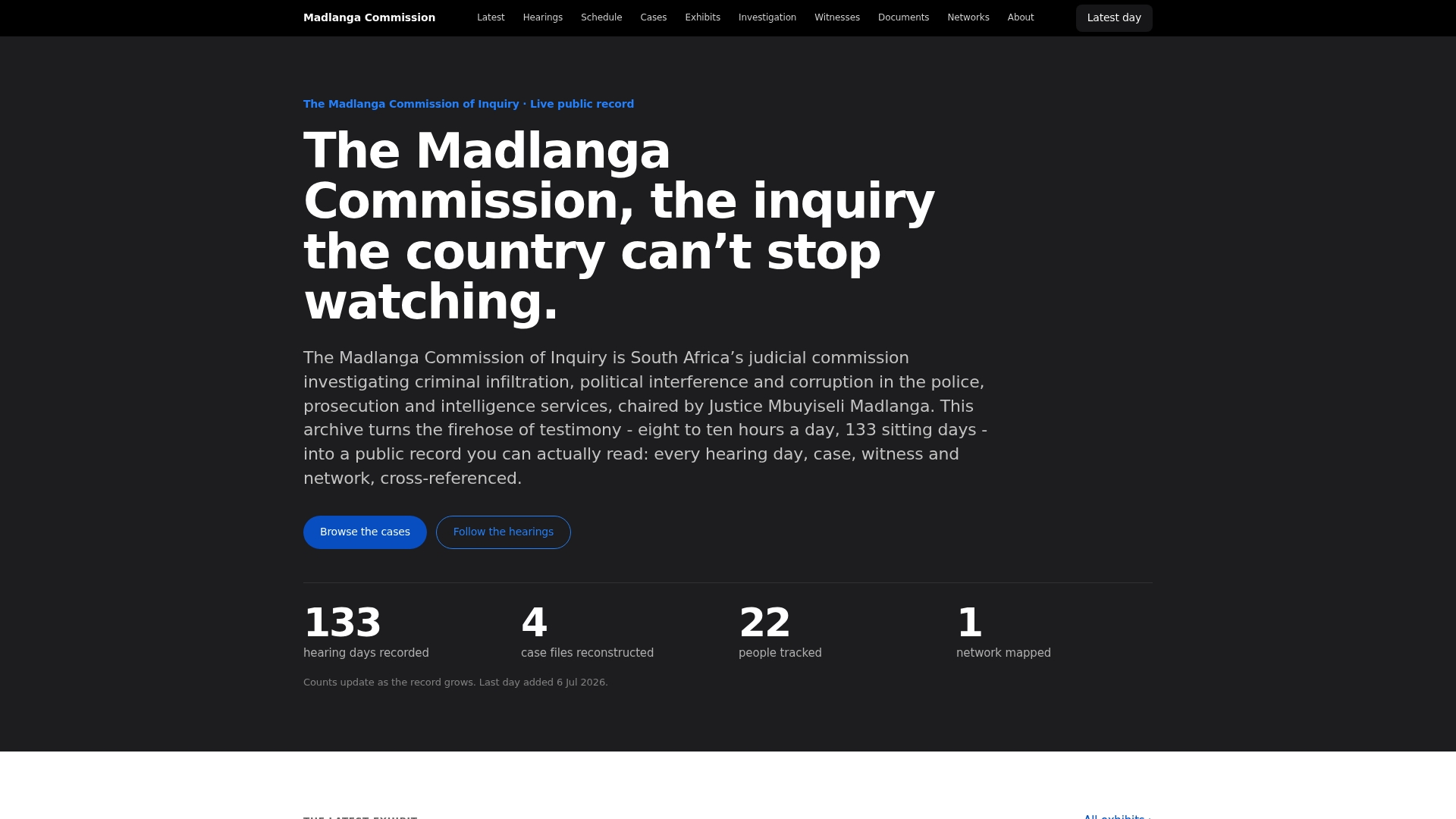
Start at the Evidence Leaders page to understand how the Commission’s legal team curates and presents testimony, then use the case files directory to search by name, date, or topic. If you’re researching a specific line of testimony, individual witness pages give you direct access to transcripts without wading through unrelated hearing days. Keep in mind the archive documents a South African inquiry specifically. Treat it as one working example of open data justice, not a universal template for every jurisdiction. For the fastest way in, search the case files directly by keyword or the name of the institution you’re tracking.
This article is general information, not a substitute for advice from a qualified lawyer. Consult a qualified legal professional about your own circumstances before acting on anything here.
Sources
- Open data meets data justice
- Reviving the Open Government Partnership (OGP) Process in South Africa OGP 5th National Action Plan 2023-2026
- Leveraging open data for transparent judicial activities
FAQ
What does data justice mean?
Data justice asks whether data practices, collection, structuring, and use, shift power toward the people the data describes rather than only serving the institutions that hold it. It goes beyond privacy to include participation and fair representation.
What is open data and why is it important?
Open data is information published in accessible, often machine-readable formats under an open licence so anyone can use it without special permission. It matters in justice systems because it lets courts, journalists, and researchers spot patterns, backlogs, and misconduct that individual case files never reveal on their own.
What are the key principles of data justice?
Core principles include equity, participation, transparency, contestability, data minimisation, and purpose limitation, each designed to counter a specific risk like privacy exposure or unaccountable data reuse. Explainability becomes an additional requirement wherever automated or algorithmic tools touch judicial decisions.
Can you give me an example of open data?
Sentencing records, arrest logs, and published court rulings are common examples of open justice data. The Madlanga Commission archive is a working example of an inquiry turning hearing testimony, case files, and exhibits into a searchable public dataset.

How is open data justice different from ordinary transparency initiatives?
Ordinary transparency often stops at publication, while open data justice requires that the people described by the data can actually understand it, contest errors, and use it, closing the gap between “visible” and “usable.”