Press freedom in South Africa: the 2026 reality check
TL;DR:
- South Africa’s constitutional protections for press freedom are strong, but legal threats against journalists are widespread.
- Protection orders and defamation claims often silence reporters without changing formal legal standing, deepening the gap between law and practice.
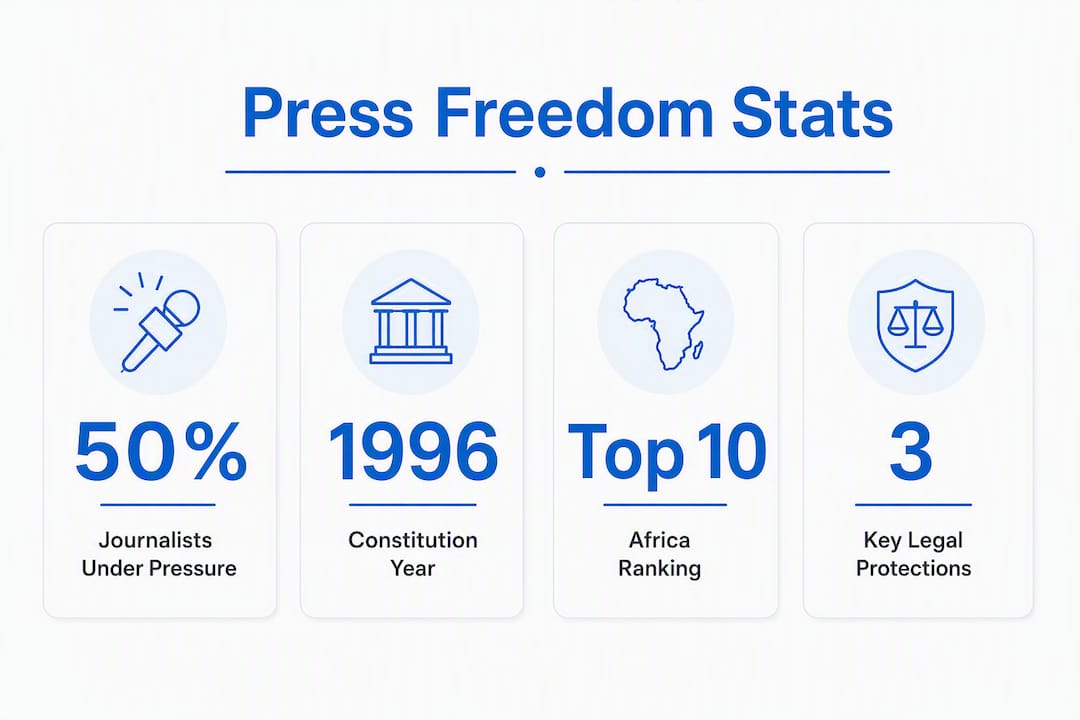
South Africa has press freedom on paper. In practice, it is under sustained, sophisticated attack. The country’s constitution offers some of the strongest formal protections for freedom of expression on the continent, yet Thomson Reuters Foundation research found that 50% of surveyed South African journalists reported facing legal threats. That gap between the law and lived experience is the defining story of media rights in South Africa right now.
The most immediate evidence sits in two places. Reporters Without Borders ranks South Africa among the better-performing African countries on its World Press Freedom Index, acknowledging a dynamic and diverse media sector. But the same profile documents verbal attacks on journalists, political pressure, and a media economy under serious strain. Meanwhile, a June 2026 Daily Maverick investigation revealed that protection orders are being repurposed as gag orders across the country, silencing reporters not through overt censorship but through civil court processes that most newsrooms cannot afford to fight.
Two practical examples make the gap concrete. A journalist investigating municipal corruption in a rural area faces a protection order obtained by a local official. The journalist has no institutional legal backing. The story dies. Separately, a national outlet dependent on a single major advertiser quietly softens its coverage of that advertiser’s industry. Neither incident shows up in a press freedom index score.
For readers who want to verify claims or track developments as they happen, the Madlanga Commission archive provides searchable primary records of hearings, exhibits, and official documents covering criminal infiltration, political interference, and corruption in South Africa’s police, prosecution, and intelligence sectors. It is one of the few places where suppression of a single article cannot erase the underlying record.
Table of Contents
- Who owns South African media and why it matters
- What does the law actually protect for journalists?
- How politics and power shape what gets reported
- Why economic fragility is a press freedom issue
- What threats do journalists actually face on the ground?
- Notable cases and trends shaping the 2026 picture
- Where to find reliable reporting and follow developments
- How the Madlanga Commission archive supports press freedom
- Training and support programs for journalists
- How whistleblower protections and source confidentiality work
- How press freedom evolved in South Africa after apartheid
- How does South Africa compare to its regional neighbours?
- What self-censorship and media regulation reforms look like in practice
- Key takeaways
- Why monitoring press freedom is more urgent than it looks
- The Madlanga Commission archive: a resource for journalists and researchers
- Useful sources
- FAQ
Who owns South African media and why it matters
South Africa’s media ecosystem divides into four broad categories: the South African Broadcasting Corporation (SABC) as the public broadcaster, large commercial groups that dominate print and digital, a growing layer of independent online outlets, and roughly 200 community radio stations that serve local audiences the national press rarely reaches.
The SABC’s editorial independence has been a persistent flashpoint. Its funding depends on government, and its board appointments are politically contested. That structural dependency shapes coverage in ways that are difficult to prove case by case but well-documented in aggregate. Community radio stations face the opposite problem: they are often the only watchdog in a given municipality, but they operate on minimal budgets with no legal department.
Commercial ownership is concentrated. A small number of large media groups control most of the national print and digital advertising revenue. That concentration matters because editorial decisions about which investigations to fund, which stories to pursue, and which sources to protect are ultimately budget decisions. When ownership is narrow, so is the range of editorial risk tolerance.
Independent online outlets have changed the picture meaningfully. Outlets like Daily Maverick operate on a membership model that reduces dependence on advertising and, by extension, on advertisers’ goodwill. That model does not eliminate pressure, but it changes who applies it.
“South Africa has a dynamic, diverse media sector, but journalists face verbal attacks and political pressure that the formal legal framework does not adequately address.” — Reporters Without Borders, South Africa country profile
Pro Tip: To assess an outlet’s likely independence, look for three things: a published ownership disclosure, a named editorial charter or code, and a clear funding model. Outlets that publish all three are significantly more transparent than those that publish none.
What does the law actually protect for journalists?
Section 16 of the Constitution is the foundation. It guarantees freedom of expression, freedom of the press and other media, freedom to receive or impart information or ideas, and freedom of artistic creativity. Section 32 adds the right of access to information held by the state. These are not weak provisions. They are justiciable rights that courts have enforced.
The limits are also written in. Section 16(2) excludes propaganda for war, incitement to imminent violence, and advocacy of hatred based on race, ethnicity, gender, or religion. Courts have had to draw those lines in contested cases, and the jurisprudence is still developing.
The Promotion of Access to Information Act (PAIA) translates Section 32 into a practical mechanism. In theory, any person can request records from a public or private body. In practice, the barriers are significant:
- Response timelines are routinely missed by public bodies.
- Refusals are common, and appeals require legal resources most freelancers do not have.
- Fees and procedural requirements create friction that effectively excludes smaller outlets.
Beyond PAIA, journalists face a cluster of statutory and civil tools that powerful actors use to suppress reporting. The Thomson Reuters Foundation’s country report identifies 17 specific legal threats across four categories: abuse of court processes, regressive legislation, technology harms, and labour and sustainability pressures.
The most common abuse of court processes involves defamation claims and protection orders. A defamation claim against a freelance journalist can cost hundreds of thousands of rands to defend, even when the journalist ultimately wins. Protection orders, designed to protect individuals from harassment, are increasingly being obtained against journalists by officials and private parties who want to prevent publication. The order does not need to succeed permanently. It only needs to delay publication long enough to neutralise a story.
Statistic: 50% of South African journalists surveyed by the Thomson Reuters Foundation reported facing legal threats — the single most common category of threat documented in the 2026 country report.
The Constitution’s full text is publicly available and worth reading directly. The gap between what Section 16 promises and what journalists experience is not a gap in the law. It is a gap in enforcement, resources, and political will.
How politics and power shape what gets reported
The most visible form of political pressure on South African journalists is verbal. Senior politicians have publicly attacked specific journalists and outlets, framing critical coverage as biased, unpatriotic, or racially motivated. These attacks are rarely random. They tend to target reporters working on specific investigations and are timed to coincide with publication.
State advertising is a less visible but more structurally significant lever. Government departments and state-owned enterprises are major advertisers. Outlets that depend on that revenue have a structural incentive to avoid coverage that might cost them a contract. No explicit threat needs to be made. The incentive is built into the business model.
“The most damaging attacks on press freedom in South Africa are legal and economic rather than overt censorship — SLAPPs, protection orders, and funding squeezes raise the cost of accountability reporting.” — Thomson Reuters Foundation, 2026
Social media has added a new dimension. Coordinated disinformation campaigns targeting journalists are documented and growing. A reporter who publishes an investigation into a politically connected figure may find their personal information circulated online, their past work misrepresented, and their credibility attacked across platforms before any formal legal process begins. The goal is not to win an argument. It is to raise the personal cost of the next investigation.
The Khumalo arrest and Mokwele appointment case in the Madlanga Commission archive illustrates how institutional decisions and legal obstacles intersect in ways that affect public-interest reporting. When the actors involved in a story can also influence the legal and institutional environment around it, the chilling effect extends well beyond the individual journalist.
Strategic lawsuits against public participation (SLAPPs) are the formal legal expression of this pressure. They are not designed to succeed in court. They are designed to exhaust the defendant. Journalists without institutional legal support are disproportionately affected, and the concentration of SLAPP activity in local municipalities and rural areas, where scrutiny of public funds is highest and legal defence mechanisms are weakest, is not coincidental.
Why economic fragility is a press freedom issue
The connection between newsroom finances and editorial independence is direct and underappreciated. A journalist whose outlet cannot afford a legal defence will self-censor. An outlet that cannot fund a three-month investigation will not publish one. These are not hypothetical risks. They are the daily operating reality for most South African newsrooms.
Revenue models each carry their own editorial risks:
- Advertising-dependent outlets face pressure from major advertisers, particularly state entities, whose goodwill is commercially significant.
- Donor-funded outlets face the risk of editorial drift toward funders’ priorities, even when funders do not explicitly direct coverage.
- Subscription and membership models reduce advertiser leverage but create pressure to produce content that retains paying readers, which can narrow the range of stories pursued.
- Paywalls protect editorial independence from advertisers but widen the access gap for audiences who cannot pay, concentrating investigative journalism among wealthier readers.
RSF’s South Africa profile notes that media sustainability problems, including dependence on unpredictable donor funding and falling advertising revenues, push outlets toward paywalls and narrower coverage. The result is that investigative reporting becomes costlier and less frequent precisely when accountability journalism is most needed.
Newsroom consolidation is the structural consequence. When an outlet cannot sustain its cost base, it either closes, merges with a larger group, or narrows its coverage to what is cheapest to produce. Each of those outcomes reduces the range of independent voices in the market.
Pro Tip: Before citing an outlet’s investigation, check whether it publishes a funding disclosure. Outlets that list their donors, advertising clients, and ownership structure are significantly more accountable than those that do not. The Press Council of South Africa’s membership list is a useful starting point for identifying outlets that have committed to a formal code of conduct.
What threats do journalists actually face on the ground?
Physical and digital threats to journalists in South Africa span a wider range than most readers expect. The most visible incidents involve arrests or detentions, but those are far from the most common.
| Threat type | Typical actors | Immediate contacts |
|---|---|---|
| Arrest or detention | Police, state security | Press Council SA, South African National Editors’ Forum (SANEF), legal aid |
| Physical assault | Private security, political operatives, community members | SANEF, South African Police Service (SAPS), union (MWASA) |
| Equipment seizure | Police, court officials | Press Council SA, SANEF legal desk |
| Surveillance and interception | State intelligence, private actors | Right2Know Campaign, legal counsel |
| Doxxing and online harassment | Coordinated online actors, political operatives | Committee to Protect Journalists (CPJ), online safety resources |
| Protection orders / SLAPPs | Private parties, officials, corporations | Media Defence, SANEF, legal aid |
The trend line on online abuse is particularly concerning. Gendered harassment, meaning coordinated abuse targeting women journalists specifically, has increased alongside the broader rise in disinformation campaigns. Female reporters covering politics, corruption, and security face a qualitatively different threat environment than their male colleagues, and the psychological cost of sustained online abuse affects coverage decisions even when no physical threat exists.
Statistic: The Thomson Reuters Foundation’s 2026 South Africa report documents 17 specific legal threats across four categories, with abuse of court processes identified as the most prevalent and 50% of journalists surveyed reporting direct legal threats.
For journalists facing an immediate threat, the South African National Editors’ Forum (SANEF) and the Media Workers Association of South Africa (MWASA) are the first points of contact for professional support. The Right2Know Campaign covers surveillance and interception specifically. For international escalation, the Committee to Protect Journalists (CPJ) and Reporters Without Borders maintain incident documentation systems.
Notable cases and trends shaping the 2026 picture
The period from 2023 to 2026 has produced a clear pattern: legal mechanisms, not physical force, are the primary tool for suppressing journalism in South Africa. Several cases illustrate how that pattern works in practice.
-
Protection orders as gag orders (2025–2026): Daily Maverick’s June 2026 investigation documented a systematic pattern of protection orders being obtained against journalists by officials and private parties. The orders do not need to be upheld on appeal to achieve their purpose. Publication is delayed, legal costs mount, and the story loses its news value. This represents the clearest current example of court process abuse targeting the press.
-
State capture and commission testimony (2020–2026): The Zondo Commission produced an enormous volume of primary-source testimony about corruption in state institutions. That record has been used by journalists to corroborate and extend investigations. The Madlanga Commission continues that function, generating a searchable public archive of testimony about criminal infiltration in police, prosecution, and intelligence services.
-
SLAPP litigation against investigative reporters: Multiple journalists covering municipal corruption have faced defamation claims from the officials they investigated. The claims rarely proceed to judgment. Their function is to occupy the journalist’s time and resources.
-
Digital surveillance concerns: The Regulation of Interception of Communications and Provision of Communication-Related Information Act (RICA) governs lawful interception, but its application to journalists and their sources has been contested. The Right2Know Campaign has documented concerns about surveillance of civil society and media figures.
“Archival transparency — publishing inquiry records, transcripts and exhibits in searchable formats — reduces the effectiveness of ad-hoc gagging because it creates multiple, verifiable copies across independent repositories.” — Madlanga Commission archive
The UNESCO Southern Africa Press Freedom Report, launched at the World Press Freedom Day Conference in Lusaka in May 2026, confirmed that legal and economic pressures on journalists are rising across the region despite constitutional protections. South Africa’s experience is not unique, but its formal legal infrastructure means the gap between protection on paper and protection in practice is particularly stark.
Where to find reliable reporting and follow developments
Tracking press freedom in South Africa requires a combination of international indices, national monitoring bodies, and primary-source archives. No single source covers everything.
| Organisation | What they publish | Frequency |
|---|---|---|
| Reporters Without Borders (RSF) | World Press Freedom Index, country profiles, incident alerts | Annual index; ongoing alerts |
| Media Monitoring Africa | Media monitoring reports, election coverage analysis, disinformation tracking | Ongoing; major reports quarterly |
| Press Council of South Africa | Complaint rulings, code of ethics, adjudication outcomes | Ongoing; rulings published as issued |
| South African Human Rights Commission (SAHRC) | Rights investigations, annual reports, media-related findings | Annual reports; ad hoc investigations |
| Madlanga Commission | Searchable hearing transcripts, witness profiles, exhibits, rulings, daily updates | Daily during hearings; archive permanent |
| UNESCO | Regional press freedom reports, safety of journalists data | Annual regional report |
| Freedom House | Freedom of the Press country scores, narrative assessments | Annual |
For verifying a specific claim, a three-step process works reliably. First, identify the primary source: the original document, transcript, or official record. Second, corroborate with at least one independent outlet that has reported on the same fact. Third, search the Madlanga Commission’s case files or latest hearing updates for any relevant testimony or exhibit that touches the same actors or institutions.
Pro Tip: Set up Google Alerts for “Press Council South Africa ruling” and “SANEF statement” to receive notifications when new adjudications or official responses to journalist safety incidents are published. RSF’s country alert feed covers international escalations.
For RSS and social monitoring, RSF, Media Monitoring Africa, and the Right2Know Campaign all publish regular updates. The Madlanga Commission’s latest hearings page provides daily updates during active hearing periods.
How the Madlanga Commission archive supports press freedom
The Madlanga Commission archive is a primary-source asset in a media environment where primary sources are increasingly suppressed. It holds searchable hearing records, witness profiles, exhibits, official rulings, and daily updates covering criminal infiltration, political interference, and corruption in South Africa’s police, prosecution, and intelligence sectors.
For journalists and researchers, the practical value is specific. A hearing transcript is a verbatim official record. An exhibit entered into evidence is a document that has been tested in a formal proceeding. A witness profile links testimony to a named individual with a documented institutional role. These are not secondary sources. They are the kind of primary evidence that makes accountability reporting defensible against legal challenge.
Here is how to use the archive effectively:
- Start at the case index. The Madlanga Commission case files list all active and completed cases. Search by institution, individual, or theme to identify relevant proceedings.
- Pull the hearing transcript. Each hearing day is documented separately. For example, the Day 110 hearing record from June 1, 2026 shows the format: date, witnesses, key testimony, and linked exhibits.
- Check the witness profile. The key figures index provides profiles of witnesses and officials, linking their testimony across multiple hearing days.
- Retrieve exhibits. Documents entered as exhibits are linked from the relevant hearing record. These can be downloaded and cited directly.
- Verify the methodology. The Commission’s sourcing and methodology page explains how records are collected, verified, and published, which is the information a journalist needs to cite the archive in a published story.
A concrete use case: a journalist investigating the appointment of a senior police official finds that the official testified before the Commission. The transcript shows the official’s account of their own appointment. An exhibit entered the same day contradicts that account. The journalist now has a verifiable discrepancy between sworn testimony and a documentary record, both from a public official proceeding. That is a publishable accountability story with primary-source backing that is very difficult to suppress.
Training and support programs for journalists
Safety and ethics training for South African journalists comes from several directions. The South African National Editors’ Forum (SANEF) runs programs covering digital security, legal rights, and editorial standards. The Highway Africa conference, hosted at Rhodes University, has historically been a major gathering point for African journalists to exchange training resources and discuss safety protocols.
Internationally, the Committee to Protect Journalists (CPJ) and Reporters Without Borders both offer digital security guides and emergency support resources that are accessible to South African journalists. The International Federation of Journalists (IFJ) provides resources through its affiliated union, MWASA.
On the ethics side, the Press Council of South Africa’s code of ethics is the primary reference document for print and online journalism. It covers source protection, accuracy, fairness, and the handling of sensitive information. Journalists who are Press Council members can access the adjudication process both as complainants and as respondents, which provides a practical framework for resolving disputes without litigation.
Media Monitoring Africa runs specific programs on election coverage, disinformation, and hate speech, which have direct relevance to journalists covering politically sensitive beats. Their training materials are publicly available and regularly updated.
For digital security specifically, the Freedom of the Press Foundation publishes guides on encrypted communication, source protection, and device security that are widely used by investigative journalists globally and are directly applicable in South Africa.
How whistleblower protections and source confidentiality work
South Africa’s Protected Disclosures Act (PDA) protects employees who report workplace wrongdoing from occupational detriment. In theory, this covers sources who disclose information to journalists. In practice, the protection is narrower than it appears. The PDA’s protections apply to disclosures made through specific channels, and a source who goes directly to a journalist rather than through an internal or official channel may not be covered.
The Constitution does not explicitly protect journalist-source confidentiality, but courts have recognised it as an aspect of the right to freedom of expression. The National Prosecuting Authority (NPA) and police have in documented cases sought to compel journalists to reveal sources, and the legal framework for resisting such compulsion is not as settled as it is in some other jurisdictions.
The practical consequence is that sources in South Africa take a real risk when they approach journalists. That risk is highest for sources inside state institutions, where the Protected Disclosures Act’s limitations are most acute and where retaliation is most likely. Journalists who work with sensitive sources need to understand both the legal framework and its gaps, and to communicate those gaps honestly to sources before they disclose.
The Right2Know Campaign and the South African History Archive (SAHA) both work on access to information and whistleblower protection issues. For journalists handling sensitive disclosures, both organisations are useful contacts for legal guidance.
How press freedom evolved in South Africa after apartheid
The apartheid state operated one of the most comprehensive systems of media censorship in the twentieth century. The Publications Act and its successors gave the government sweeping powers to ban publications, prosecute journalists, and control what South Africans could read or broadcast. The SABC was a state propaganda instrument. Alternative and community media operated under constant threat.
The 1994 transition changed the formal framework entirely. The 1996 Constitution’s Section 16 protections were a deliberate response to that history. The Independent Broadcasting Authority (later ICASA) was established to regulate broadcasting independently of government. The SABC’s mandate was rewritten to require editorial independence.
The first decade after 1994 saw a genuine expansion of press freedom. New publications launched, community radio grew, and investigative journalism produced significant accountability stories. The Mail & Guardian, established in the late apartheid period, became a model for independent investigative reporting.
The second decade brought more complicated pressures. The ANC government’s relationship with the press became increasingly adversarial. The Protection of State Information Bill, widely known as the Secrecy Bill, was introduced in 2010 and generated sustained opposition from media organisations and civil society. It was eventually signed into law in 2023 in a modified form, but concerns about its application to journalists remain.
The post-Zuma period has seen a partial recovery in institutional independence, but the structural pressures on media, economic fragility, legal weaponisation, and political hostility, have not reversed. The South African government’s own 30-year review acknowledges the progress made since 1994 while noting ongoing challenges.
How does South Africa compare to its regional neighbours?
Within Southern Africa, South Africa consistently ranks near the top of press freedom indices. That is a meaningful distinction. Journalists in several neighbouring countries face imprisonment, physical violence, and state-controlled media environments that make South Africa’s challenges look relatively manageable.
The UNESCO State of Press Freedom in Southern Africa 2025 report documented growing pressures across the region, including legal restrictions, economic fragility, and physical threats to journalists. The 2026 follow-up, launched at the World Press Freedom Day Conference in Lusaka in May 2026, confirmed that those pressures are intensifying.
South Africa’s relative advantage comes from its constitutional framework, its independent judiciary, and the depth of its civil society. Those factors create a more contested environment than exists in countries where state control of media is more direct. But the regional comparison should not produce complacency. Being the best performer in a region under pressure is not the same as having a healthy press freedom environment.
The practical implication for journalists working across the region is that South Africa often serves as a base for regional investigative work. Its legal protections, however imperfect, are more reliable than those available in many neighbouring states. That makes the erosion of those protections a regional concern, not just a national one.
What self-censorship and media regulation reforms look like in practice
Overt censorship in South Africa is rare. Self-censorship is common and largely invisible. A journalist who knows that a particular story will trigger a SLAPP does not necessarily kill the story outright. They may soften the framing, remove the most specific allegations, or delay publication until they have more legal cover. Each of those decisions is individually defensible. Collectively, they change what the public knows.
The TRF summary report identifies economic and technological pressures as compounding legal threats in ways that push journalists toward self-censorship without any explicit instruction to do so. A journalist who cannot afford a legal defence, whose outlet depends on state advertising, and who faces coordinated online harassment for their previous work is operating under multiple simultaneous pressures. The cumulative effect on editorial decisions is significant even when no single pressure is decisive.
On regulation, the Film and Publication Board (FPB) and ICASA are the primary regulatory bodies for content and broadcasting respectively. The Press Council operates as a self-regulatory body for print and online journalism. Reforms to the Press Council’s code and complaint processes have generally moved in the direction of greater accountability, but the body’s jurisdiction is limited to its members and its remedies are reputational rather than financial.
The proposed amendments to the SABC’s governance framework have been debated for years without resolution. The SABC’s structural dependence on government funding remains the single largest institutional threat to public broadcasting independence in South Africa.
Key takeaways
South Africa’s constitutional protections for press freedom are among the strongest in Africa, but 50% of surveyed journalists reported legal threats in 2026, revealing a persistent and widening gap between formal rights and practical reality.
| Point | Details |
|---|---|
| Constitutional protection exists but is insufficient | Section 16 guarantees press freedom; practical enforcement gaps leave journalists exposed to SLAPPs and gag orders. |
| Legal weaponisation is the primary threat | 50% of surveyed journalists faced legal threats; protection orders and defamation claims are the most common tools. |
| Economic fragility enables self-censorship | Falling ad revenues and donor dependency push outlets toward paywalls and narrower investigative coverage. |
| Regional context matters | South Africa leads Southern Africa on press freedom indices, but UNESCO’s 2026 report confirms regional pressures are intensifying. |
| Madlanga Commission archive | Provides searchable primary-source hearing records, exhibits, and rulings that journalists can use to verify and publish accountability stories. |
Why monitoring press freedom is more urgent than it looks
The standard argument for press freedom is democratic: an informed public makes better decisions. That argument is correct but abstract. The more immediate case is evidentiary. When journalists cannot publish, the public record shrinks. When the public record shrinks, accountability becomes harder to establish in court, in parliament, and in public debate.
The Madlanga Commission archive exists precisely because individual articles can be suppressed, delayed, or buried. A searchable public record of sworn testimony, official exhibits, and formal rulings is structurally harder to erase. The Commission’s work on criminal infiltration in South Africa’s police, prosecution, and intelligence sectors is the kind of institutional accountability that press freedom is supposed to enable. Following that record is not a passive act. It is a form of civic participation.
If you want to stay current on how these hearings develop, the Madlanga Commission’s latest updates page publishes hearing schedules and rulings as they are issued.
The Madlanga Commission archive: a resource for journalists and researchers
For journalists, researchers, and citizens tracking accountability in South Africa, the Madlanga Commission archive offers something most monitoring tools do not: primary-source records that have been tested in a formal judicial proceeding.
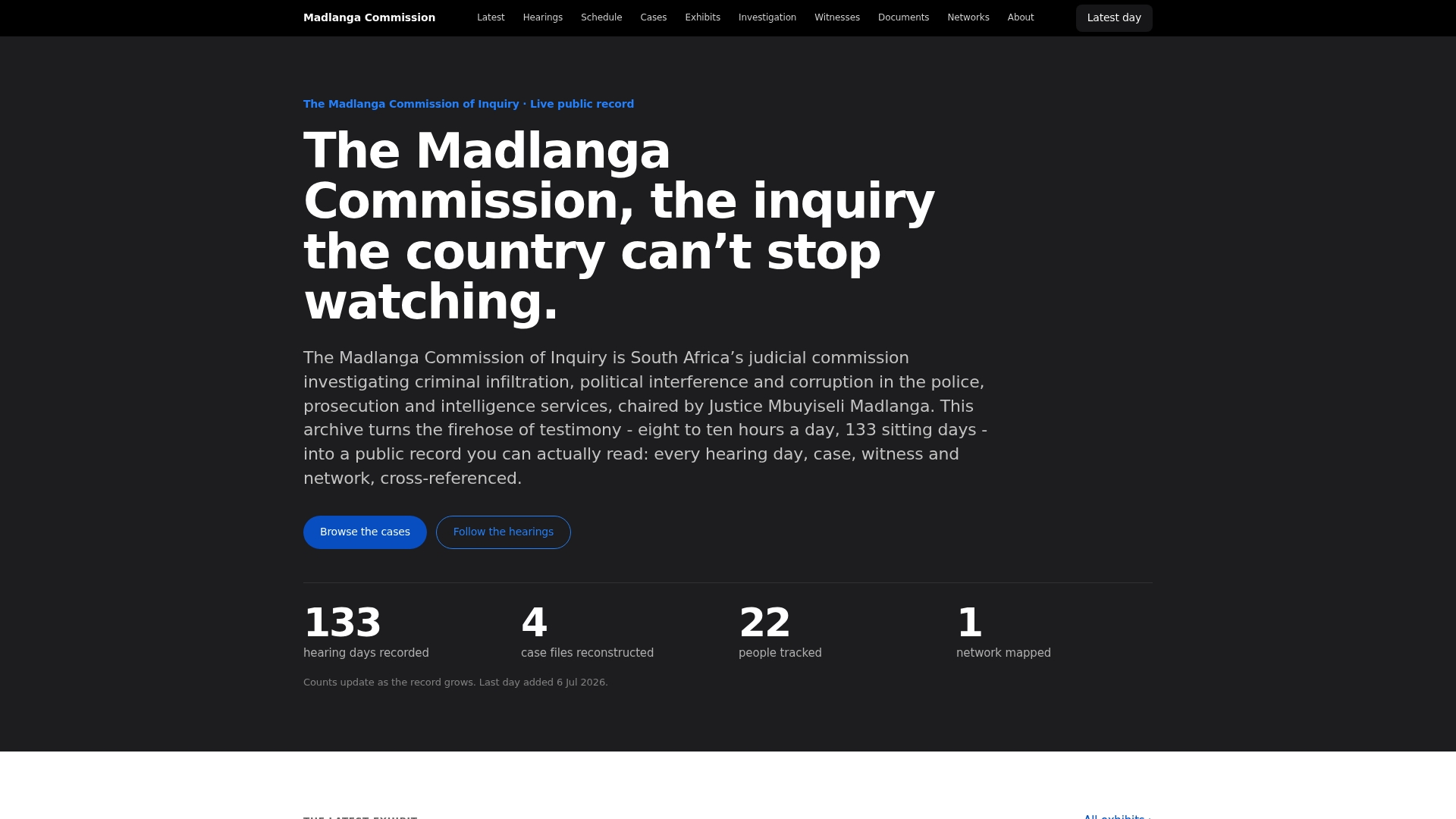
The archive covers daily hearing records, witness profiles, exhibits, official rulings, and media briefings from the Commission’s investigation into criminal infiltration, political interference, and corruption in South Africa’s police, prosecution, and intelligence sectors. Every document is searchable. Every hearing day is indexed. The explainers section walks you through how to navigate the archive and how to cite its records in published work.
For a journalist working on a story that touches any of the institutions under investigation, the archive is a starting point, not a finishing line. Pull the relevant hearing transcript, check the witness profiles, retrieve the exhibits, and verify against the Commission’s published methodology. That process takes less time than a PAIA request and produces primary-source evidence that is significantly harder to challenge in court.
Start with the Madlanga Commission public archive and use the case files index to locate the proceedings most relevant to your investigation.
Useful sources
The sources below underpin the claims in this article. Each is annotated with what it contains and where it was used.
“South Africa has a dynamic, diverse media sector, but journalists face verbal attacks and political pressure.” — Reporters Without Borders, South Africa country profile (used in the opening section and media landscape analysis)
-
South Africa | RSF: — RSF’s country profile with World Press Freedom Index ranking, narrative assessment of legal protections and practical threats, and ongoing incident alerts. Used in the BLUF, media landscape, and economic pressures sections.
-
Weaponising the law: Threats to media freedom in South Africa (TRF, PDF): — Thomson Reuters Foundation’s 2026 country report documenting 17 specific legal threats, the 50% legal threat survey finding, and four threat categories. Core citation for the legal framework, political context, and recent cases sections.
-
Threats to media freedom in South Africa (TRF summary): — Web summary of the PDF report with thematic breakdown and reform recommendations. Used in the economic pressures and self-censorship sections.
-
Constitution (English text, FSL copy): — Accessible PDF of the full constitutional text. Used as a backup primary source for legal citations.
-
Southern Africa Press Freedom Report (UNESCO, 2026): — UNESCO’s 2026 regional report launched at the World Press Freedom Day Conference in Lusaka. Used in the recent cases and regional context sections.
-
Madlanga Commission of Inquiry archive: Primary-source archive of hearings, witness profiles, exhibits, and rulings. Used in the BLUF, EEAT, and promo sections as the primary resource for verifying claims about institutional conduct.
-
30 Years of Press Freedom (South African Government): — Government review of press freedom developments since 1994. Used in the historical overview section.
Statistic: The Thomson Reuters Foundation’s 2026 South Africa report identifies 17 specific legal threats across four categories, with 50% of surveyed journalists reporting direct legal threats — the highest single-category threat documented in the study.
FAQ
Is press freedom constitutionally protected in South Africa?
Yes. Section 16 of the Constitution explicitly guarantees freedom of the press and other media, alongside freedom of expression and the right to receive or impart information. The right is justiciable and has been enforced by courts.
Does press freedom still exist in South Africa in practice?
Formally, yes. Practically, it is under sustained pressure. The Thomson Reuters Foundation’s 2026 report found that 50% of surveyed South African journalists faced legal threats, and protection orders are being used as gag orders against reporters covering public interest stories.
Which country has the highest press freedom in Africa?
Rankings shift year to year, but Reporters Without Borders consistently places South Africa among the top performers on the continent. The RSF World Press Freedom Index is the most widely cited annual benchmark for cross-country comparison.
How can journalists contact support organisations in South Africa?
The South African National Editors’ Forum (SANEF) and the Media Workers Association of South Africa (MWASA) are the primary professional contacts for journalists facing threats. For digital security and surveillance concerns, the Right2Know Campaign provides specific guidance.
How can I access primary records from the Madlanga Commission?
The Madlanga Commission archive provides searchable hearing transcripts, witness profiles, exhibits, and official rulings. The case files index is the starting point for locating records relevant to a specific investigation or institution.