How to read hearing transcripts: a guide for researchers and the public

You read a hearing transcript by finding it in a public repository first, such as the Madlanga Commission archive or the Constitutional Court’s collections, and only requesting one from a registrar when no public copy exists. Not every hearing produces a transcript automatically, and access often comes with a deadline.
Work through this checklist before you spend hours searching:
- Search by case number or witness name in any public archive before contacting a court.
- Check the three main repositories: ConCourt Collections for Constitutional Court matters, Court Online (CaseLines) for finalised High Court cases, and the Madlanga Commission archive for commission testimony.
- Contact the registrar or clerk in writing if the hearing you need is not published anywhere public.
- Budget time and money: portal access can be limited to a single day, and registrar requests can involve a deposit and a wait of weeks.
Key Takeaways
Reading a hearing transcript reliably means checking public repositories first, understanding whether transcription was automatic or requested, and budgeting for both cost and time-limited access.
| Point | Details |
|---|---|
| Check public archives first | Search by case number or witness name before contacting a registrar or court. |
| Transcription is not automatic | Magistrates’ courts transcribe shorthand notes only when directed or specifically requested and paid for. |
| Portal access is time-limited | Court Online (CaseLines) gives read-only public access to finalised cases for 24 hours once approved. |
| Know your correction rights | Errors in a received transcript can typically be raised within a 10-day correction window. |
| Use a purpose-built archive | The Madlanga Commission archive publishes daily hearing records, witness profiles, and exhibits without a portal time limit. |
This article is general information, not a substitute for advice from a qualified lawyer. Consult a qualified legal professional about your own circumstances before acting on anything here.
Table of Contents
- Where to read hearing transcripts and how they get made
- How do I request or access a court hearing transcript?
- How do you read your transcript once you have it?
- What do transcripts cost and how long do they take?
- Why would a court refuse or redact a hearing transcript?
- Where can you find published hearing transcripts online?
- Decoding the legal shorthand inside a transcript
- Verbatim transcripts vs. summaries: why the difference matters
- Accessibility options for reading transcripts with a disability
- Search the Madlanga Commission archive before you request anything
- Sources
- FAQ
Where to read hearing transcripts and how they get made
Not every court produces a transcript the same way, and that shapes where you should look first. Magistrates’ courts still rely on shorthand or mechanical recording, and those notes are not automatically typed up. Under the magistrates’ courts rules, transcription happens only if a judicial officer directs it or someone specifically requests it afterward.
High Courts increasingly manage evidence through Court Online, built on the CaseLines platform, which functions more as an evidence index than a guaranteed verbatim transcript store. Commissions of inquiry and parliamentary committees tend to behave differently again: they usually publish daily hearing records as a matter of course, because their mandate is public accountability rather than case adjudication.
A working rule of thumb: verbatim transcripts are far more likely to exist for appeal records and major public commissions than for routine or informal magistrates’ proceedings, where a written record may never get created unless someone asks and pays for it.
- Magistrates’ courts: shorthand notes, transcribed on direction or request only.
- High Court: electronic case management via CaseLines, used for evidence and enrolment.
- Commissions and parliamentary committees: published transcripts as a normal output of proceedings.
How do I request or access a court hearing transcript?
Getting hold of a transcript is mostly a matter of sequencing. Skip a step and you will waste weeks.
- Gather your case identifiers. Case number, party names, and the hearing date matter more than anything else. Without them, registrars and portals cannot find your record.
- Search public repositories first, including Court Online and any relevant commission archive, before assuming you need to request anything.
- Contact the registrar or clerk of court in writing if nothing is published. State the case number, the date of the hearing, and exactly which portion you need.
- Register on Court Online (CaseLines) if the matter is finalised and might be publicly viewable. Registration is browser-based at sajustice.caselines.com, no software install required, and typically requires clicking Register and confirming a verification email; if that email doesn’t arrive within about 15 minutes, contact the helpdesk.
- Arrange payment or a deposit if transcription has to be done from scratch, since costs are usually fixed by contract with the transcription service and payable upfront.
A short written request might read: “I am requesting access to the hearing transcript for case number [X], heard on [date], for research purposes. Please advise on cost and turnaround.”
Pro Tip: Search by case number before anything else, and submit your access request as early as possible. Court Online’s public “Access a case” function is forwarded to the registrar for approval, and that approval step can take longer than the actual reading window.
How do you read your transcript once you have it?
A hearing transcript looks nothing like a news article, and that trips up first-time readers. Expect a formal heading with the case name and date, followed by speaker labels (often “COURT,” “MR X,” “ADV Y”), timestamps or page and line numbers, and formal notations for objections, rulings, and bench interventions.
The biggest distinction to grasp early: verbatim transcripts capture every word spoken, while shorthand-derived or summarized notes compress testimony into paraphrase. That difference matters enormously if you plan to quote directly. A summary can tell you what was discussed; only a verbatim transcript lets you cite exact wording with confidence.
- Speaker labels tell you who is talking. Cross-reference them against the hearing roll if names are abbreviated.
- Page and line numbers are how lawyers and researchers cite specific testimony.
- Bracketed notes like “[inaudible]” or “[pause]” flag gaps the transcriber could not resolve.
Pro Tip: Use your PDF reader’s search function to jump to a witness name or keyword rather than scrolling. Annotate any phrase you are unsure about so you can flag it for verification instead of guessing at meaning.
As a planning benchmark, a full day of oral testimony can run a substantial number of transcript pages, so budget your reading time accordingly if you’re covering multiple hearing days.
What do transcripts cost and how long do they take?
Cost and turnaround catch most first-time requesters off guard. Transcription fees are usually fixed in advance by the contract between the court and its transcription service, and you may be asked for a deposit before work starts.
There is one exception worth knowing: under the magistrates’ courts rules, if transcription was not directed by the judicial officer and you request it afterward, you typically pay the full cost, but you are entitled to one free copy of that transcript once it is produced.
Turnaround varies enormously depending on contractor backlog. The case of Malgas and Others v Minister of Justice and Correctional Services documents a real-world dispute where obtaining a complete, certified transcript dragged on for years, implicating both the transcription contractor and state departments in the delay.
If you find an error once you receive your copy, most courts allow a 10-day correction window after notification or judgment to raise it.
- Ask for a written cost estimate before committing.
- Request partial or priority pages first if funds are tight.
- Note the 10-day correction period and act within it if something looks wrong.
Pro Tip: If a full transcript quote seems too high, ask the registrar whether you can pay for and receive specific pages or a specific day’s testimony rather than the entire record.
Why would a court refuse or redact a hearing transcript?
Courts withhold or redact transcripts for defensible reasons: closed or in-camera hearings, witness protection concerns, sealed records by court order, national security, or matters still under active litigation. None of these are automatic dead ends.
Start by asking the registrar for the specific reason in writing. You can often request a narrowly redacted extract rather than the full record, which sometimes satisfies both the court’s confidentiality concern and your research need. If access is contested and the matter has genuine public interest, framing your request around that interest, or getting legal advice, gives you a stronger footing than a bare request.
Where can you find published hearing transcripts online?
Three repositories cover most of what a researcher, journalist, or member of the public will need.
ConCourt Collections is the Constitutional Court’s own digital archive, holding judgments, court rolls, and related case records. It is the authoritative source for anything that reached South Africa’s apex court, searchable by case name or number.
Court Online, built on CaseLines, gives the public read-only access to finalised High Court matters for a limited 24 hour window once a request is approved. It’s browser-based, so no software install is needed, but remember it functions primarily as an evidence-management system. If a case file doesn’t contain a standalone verbatim transcript, that’s not a bug. You’ll need to request one separately through the registrar.
Commission and government archives, including the Truth and Reconciliation Commission’s amnesty hearing transcripts hosted by the Department of Justice, and the Madlanga Commission archive covering testimony on police, prosecution, and intelligence sector corruption, publish daily hearing records as standard practice. These tend to be the most navigable option for non-lawyers because they are built for public consumption from the start, indexed by witness name and hearing date rather than buried in case-management software.
Decoding the legal shorthand inside a transcript
Transcripts are full of abbreviations and procedural notation that make no sense until someone explains them once. “Q” and “A” mark question and answer during examination. “Ex A,” “Ex B,” and so on refer to numbered exhibits entered into evidence. “Objection sustained” or “objection overruled” record a ruling on an evidentiary dispute in real time, not a summary judgment on the whole case.
You’ll also see Latin and procedural terms carried over from common law tradition: viva voce for oral evidence, in camera for a closed hearing, sub judice for a matter still before the court and therefore restricted from public comment. None of these require a law degree to understand once you’ve seen them defined, but they trip up first-time readers who assume every unfamiliar term signals something legally significant.
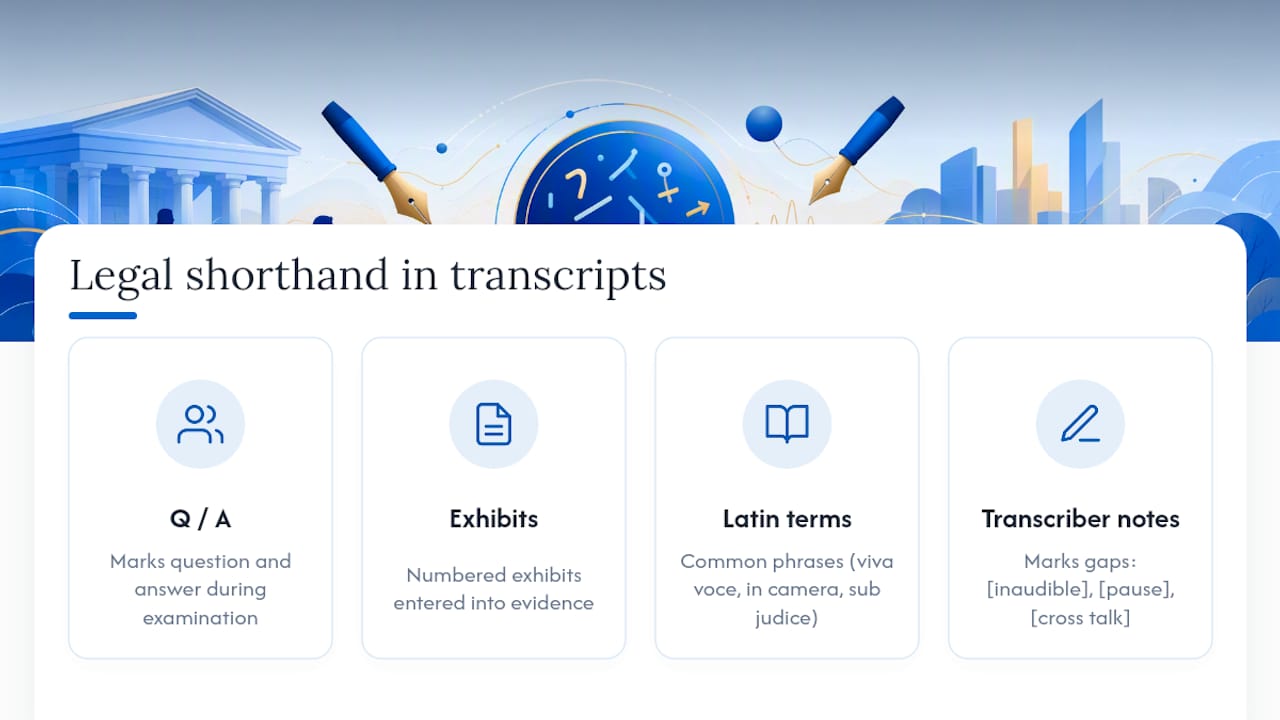
Bracketed annotations do real work too. “[Inaudible],” “[pause],” and “[cross talk]” are the transcriber’s honest admission of what could not be captured cleanly, not editorial commentary. Treat them as gaps in the record rather than something to read meaning into.
The safest approach: keep a running list of unfamiliar terms as you read, look each one up once, and you’ll find the vocabulary repeats constantly across hearings. A handful of terms cover the vast majority of what shows up in any given transcript.
Verbatim transcripts vs. summaries: why the difference matters
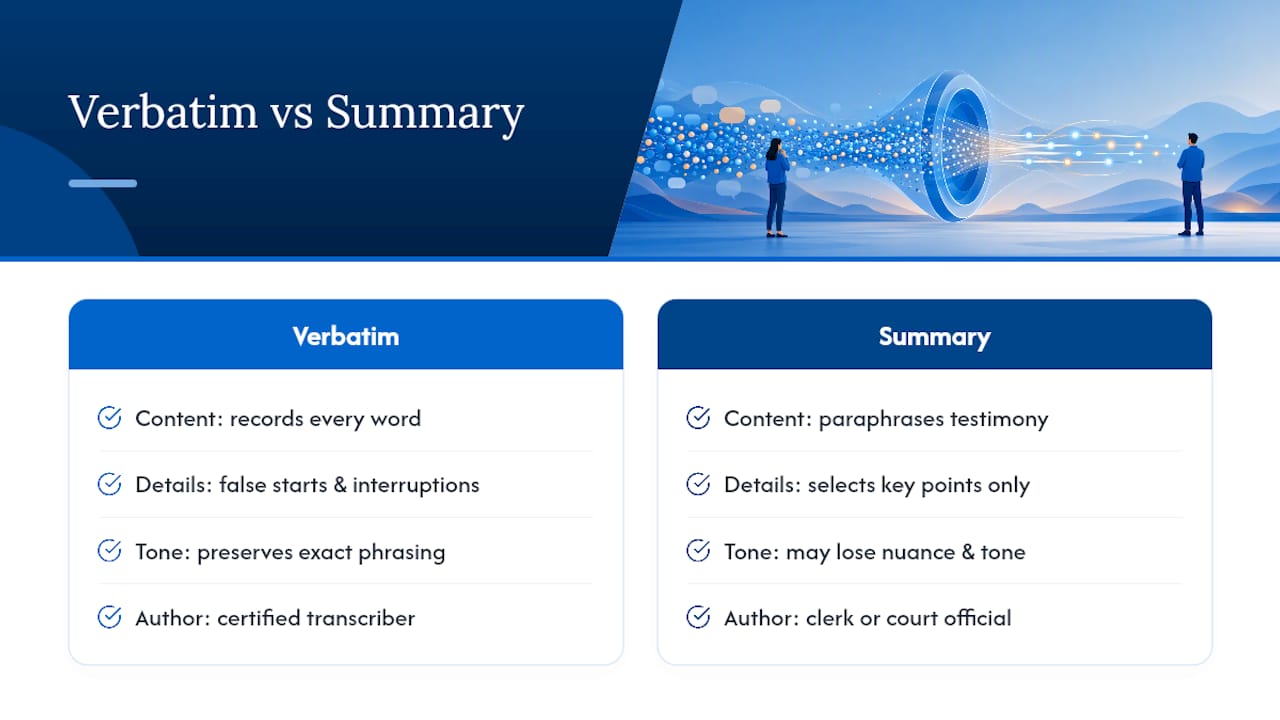
A verbatim transcript records every word spoken, including false starts, repeated words, and interruptions. A summary or hearing note distills that same testimony into paraphrased key points, often written by a clerk or court official rather than a certified transcriber.
For most casual research, a summary is faster and perfectly adequate. It tells you what was discussed and what was decided. But summaries carry a real risk: paraphrasing introduces the summarizer’s judgment about what mattered, which means nuance, tone, and exact phrasing can disappear entirely.
If you plan to quote a witness directly, cite testimony in a report, or rely on exact wording for legal or journalistic purposes, only a verbatim transcript will hold up. Courts themselves draw this distinction sharply. Appeal proceedings almost always require certified verbatim transcripts precisely because a summary cannot capture the precision an appellate court needs to review whether a ruling was properly reasoned.
The practical implication: check which type of record you’re looking at before you rely on it. A document labeled “hearing notes” or “summary of proceedings” is not the same thing as a transcript, even when it covers the same hearing, and treating the two interchangeably is one of the more common mistakes researchers make when working with public records.
Accessibility options for reading transcripts with a disability
Reading a dense legal document is harder still if you’re working with a visual, cognitive, or motor impairment, and most public archives are only starting to catch up.
PDF transcripts published through portals like Court Online can generally be run through screen readers if the file is text-based rather than a scanned image, so check whether a document is searchable text before assuming it’s inaccessible. Searchable PDFs also let you use browser zoom and high-contrast display settings without losing formatting.
For anyone finding dense procedural transcripts difficult to parse cognitively, breaking a document into smaller sections and reading by witness or by hearing day, rather than attempting the full record at once, makes the material far more manageable. If a portal or archive doesn’t offer accessible formatting, contacting the registrar or archive administrator directly to request an alternative format is a reasonable and often successful ask.
A practical workflow for reading many transcripts efficiently
Reviewing dozens of hearing days calls for discipline: gather every case identifier first, search public archives before requesting anything, submit access requests early, and download extracts the moment access opens, timestamping each one. Time-limited portals punish hesitation, so pull your highest-priority documents first. Archives built for public research, like the Madlanga Commission’s, tend to remove much of that friction because the records are already indexed and searchable.
Search the Madlanga Commission archive before you request anything
Before filing a registrar request or waiting on portal approval, check whether the hearing you need is already published. The Madlanga Commission archive holds daily hearing records, witness profiles, exhibits, rulings, and media briefings from its inquiry into criminal infiltration, political interference, and corruption across South Africa’s police, prosecution, and intelligence sectors, all searchable without a registration wait or a 24 hour access clock ticking down.
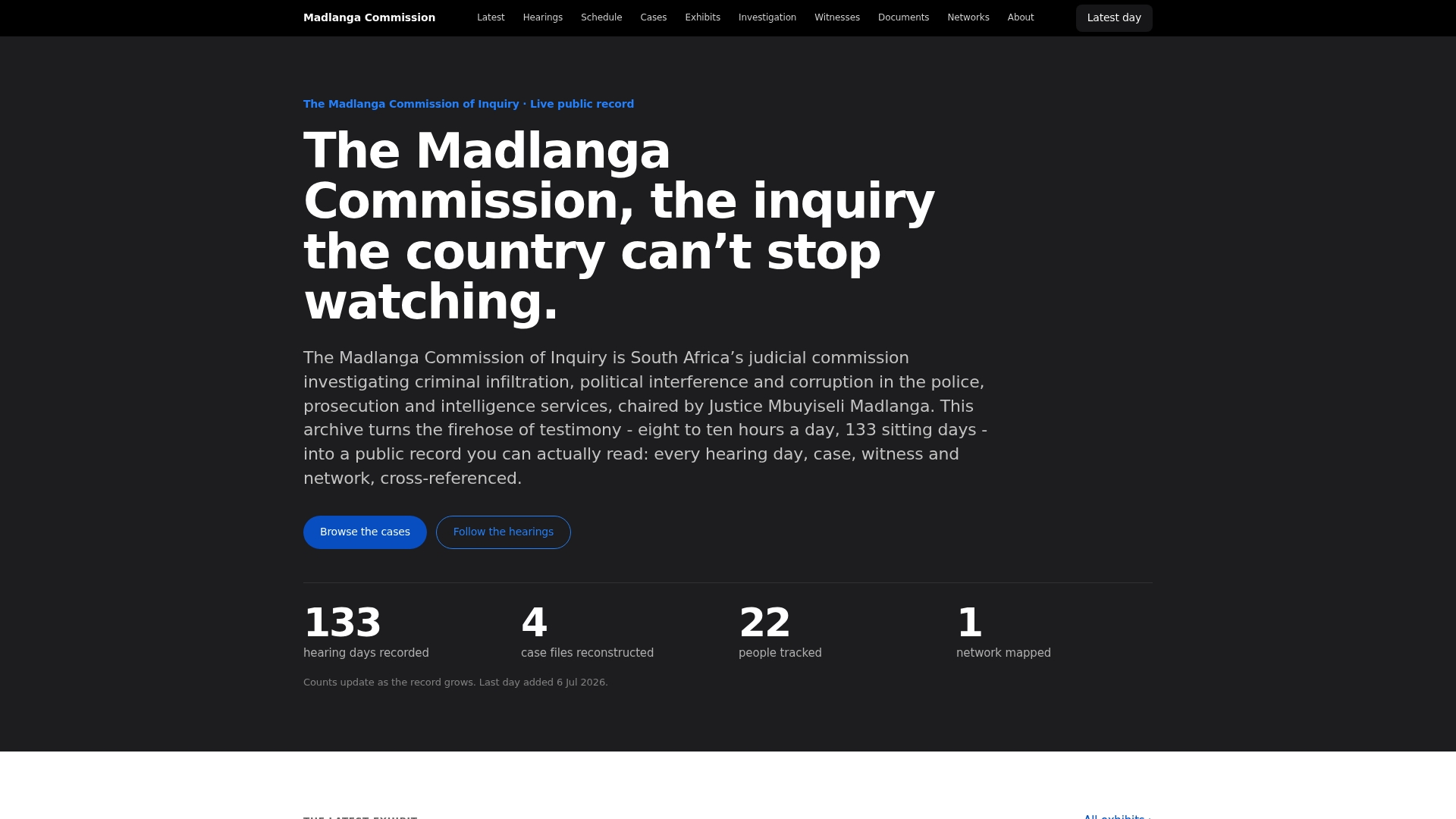
That’s the real advantage over starting with a registrar request or a CaseLines application: the records are already indexed by witness and hearing day, and they don’t disappear after one viewing window. Testimony from witnesses like Lieutenant-General Shadrack Sibiya or case files like the Medicare24 SAPS tender are grouped together, so you’re not hunting across multiple systems for related exhibits and rulings. Search the archive by case name or witness name and see what’s already public before you draft a single request letter.
Sources
- Court Online (CaseLines)
- ConCourt Collections
- Malgas and Others v Minister of Justice and Correctional Services (73418/16) 2021 ZAGPPHC 90 (18 February 2021)
FAQ
How do you read your transcript?
Locate it in a public repository such as a court archive or commission collection, or request it from the registrar if no public copy exists, then work through it using the speaker labels, timestamps, and page and line numbers as your navigation points.
How do I get my court transcripts?
If the matter is finalised, try Court Online’s public access function first; otherwise, submit a written request to the registrar or clerk with your case number and hearing date, and be prepared for a deposit if transcription was not already directed.
How do I view a transcript?
Most transcripts are distributed as searchable PDF documents, viewable through a court portal like Court Online or downloaded directly from an archive such as the Madlanga Commission’s public record.
How many pages is a court transcript?
A full day of oral testimony can run a substantial number of transcript pages, so multi-day hearings can easily reach into the thousands of pages.
Can I read Madlanga Commission hearing transcripts online for free?
Yes. The Madlanga Commission archive publishes daily hearing records, witness testimony, and exhibits publicly and without a registration or access-approval process.