Avoid 10 Year Jail: RICA and POPIA Rules for South African Employers

RICA (Act 70 of 2002) prohibits interception of communications unless an expressly listed exception or a judicial direction applies. If you’re recording a call you’re part of, that’s usually lawful. If you’re bugging someone else’s line without consent or a court order, that’s a criminal offence carrying up to 10 years in prison. Get the exceptions wrong and you also risk falling foul of POPIA, which governs what happens to any data you’ve captured.
TL;DR:
- Recording your own conversations is lawful without permission, but secretly intercepting others’ calls or monitoring private emails is illegal without a judicial order or consent.
- Law enforcement requests require a judge’s approval based on reasonable grounds before telecommunications providers assist with interception or decryption.
- Unlawful interception can lead to up to 10 years of prison and evidence obtained illegally may be excluded from legal proceedings.
- Employers can monitor company-owned communication systems if they notify staff and limit data collection to specific, justified purposes.
- Public access to hearing records and testimonies from commissions like Madlanga enhances accountability and verifies proper use of interception powers.
Table of Contents
- What RICA covers: scope, purpose and where to read the act
- When recording or interception is lawful: the key exceptions
- How interception directions and decryption directions work
- Penalties, enforcement and interaction with POPIA
- Practical compliance checklist for organisations
- Why public oversight and archives matter
- A publisher’s view on interception law and public accountability
- Find primary hearing records and methodology at the Madlanga Commission
- Sources
- FAQ
What RICA covers: scope, purpose and where to read the act
The Regulation of Interception of Communications and Provision of Communication-related Information Act, known simply as RICA, became law in 2002 and took effect on 30 September 2005. It sits at the centre of South Africa RICA compliance because it does two jobs at once: it bans interception of communications by default, and it sets out the narrow circumstances where interception becomes lawful.
The Act’s reach is wide. It covers phone calls, emails, instant messages, and any “communication-related information” such as call records or location data. It also places direct obligations on telecommunications service providers, including a duty to build in interception capability where a judicial direction demands it.
For the authoritative, amended version of the text, the consolidated Act on SAFLII is the better reference point than the original gazetted version, since it folds in later amendments, including changes introduced alongside the Cybercrimes Act. Anyone doing serious legal research on the RICA act overview should start there rather than relying on secondhand summaries.
When recording or interception is lawful: the key exceptions
RICA’s default position is a blanket prohibition, but sections 4 through 8 carve out specific, well-defined exceptions. Understanding these is the core of the RICA process in South Africa for most individuals and businesses.
- Section 4, participant recording: if you’re a party to a conversation, or physically present when it happens, you can record it yourself without asking permission. Recording your own phone call with a client falls here.
- Section 5, consent: a third party who isn’t part of the conversation can intercept it lawfully if they have prior written consent from one of the parties involved.
- Section 6, business exception: a company can monitor communications on its own systems, for business purposes such as fraud detection or quality control, provided reasonable steps are taken to notify users of the monitoring.
- Sections 7 and 8, emergency exceptions: interception is permitted where necessary to prevent serious bodily harm or to determine someone’s location during a genuine emergency.
The lawful/unlawful line gets crossed most often in workplace disputes. A manager secretly recording a colleague’s private call on their personal phone is unlawful interception. That same manager monitoring emails sent through the company server, with a signed policy the employee acknowledged, generally sits inside Section 6. As legal commentary from Michalsons points out, the difference often comes down to documentation, not intention.
How interception directions and decryption directions work
State agencies can’t simply tap a line because they suspect wrongdoing. RICA channels every state interception request through a judicial gatekeeper, and the process has real teeth on both sides: it protects citizens from arbitrary surveillance, but it also gives investigators a working path when there’s a genuine threat.
- Application stage. A law enforcement or intelligence official applies to a designated judge, showing reasonable grounds to believe a serious offence has been or will be committed, or that a serious threat to public safety exists.
- Judicial assessment. The designated judge weighs necessity and proportionality before issuing an interception direction, a real-time or archived communication-related direction, or a decryption direction, each authorising a different scope of access.
- Compliance by telecoms and key holders. Once a direction is issued, telecommunications providers and holders of decryption keys must assist, including retaining the technical capability to intercept where required under Section 30 obligations.
- Time-bound execution. Directions are not open-ended; they specify a defined period and purpose, and providers who fail to cooperate face their own liability.
This judicial layer is what separates RICA regulations South Africa from a system of unchecked state access. The designated judge function exists specifically so that interception power doesn’t sit solely with the State Security Agency or police, even though those bodies are the ones applying for the directions in practice.
Penalties, enforcement and interaction with POPIA
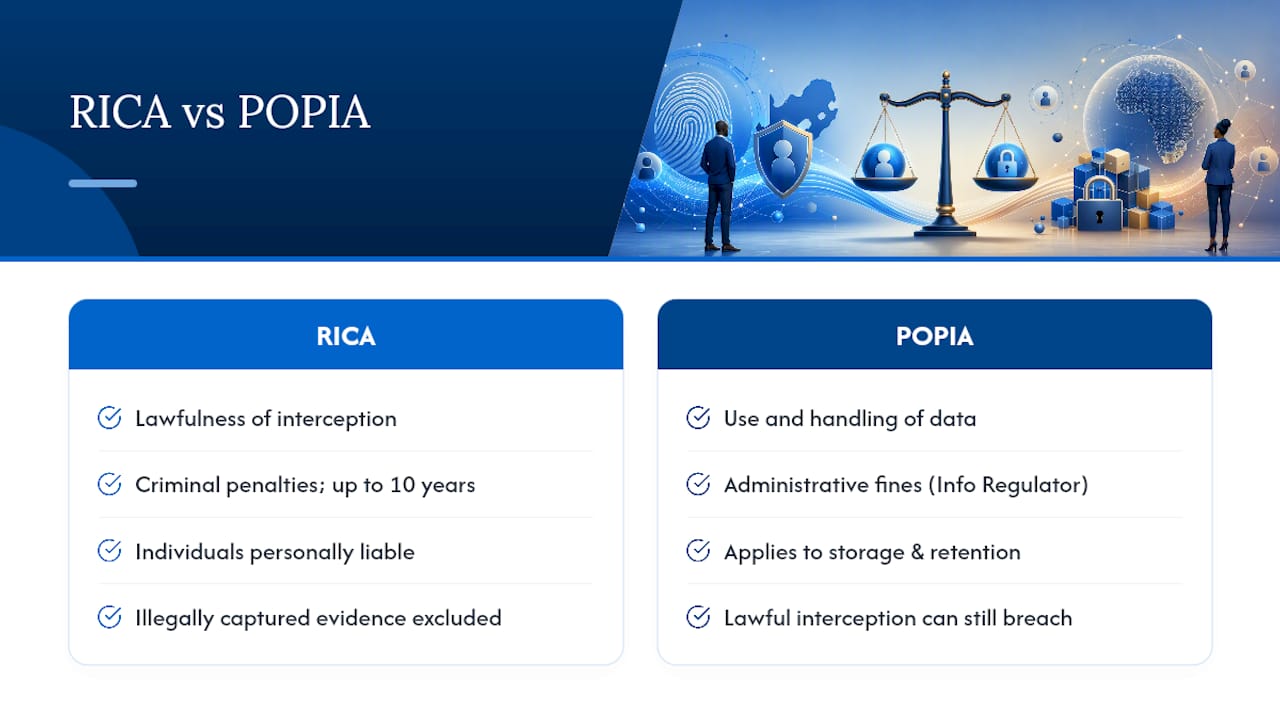
Unlawful interception under RICA is a criminal matter, not a civil one. Convicted offenders face fines and imprisonment of up to 10 years, and that exposure lands on individuals, not just organisations, meaning a manager or IT administrator who oversteps can be personally liable.
There’s a second cost that catches people off guard: evidence obtained through unlawful interception can be excluded from disciplinary hearings or court proceedings, as case law on interception and evidence has shown. A recording that would have proven misconduct becomes worthless if it was captured illegally.
RICA and POPIA operate side by side rather than as substitutes for each other. RICA governs whether you were allowed to intercept a communication in the first place. POPIA governs what you can lawfully do with that data once you have it, covering storage, retention, security, and further disclosure. The Information Regulator enforces POPIA with administrative fines, running in parallel to RICA’s criminal penalties. An employer who lawfully monitors emails under Section 6 but then stores that data indefinitely, with no access controls, can still land in breach of POPIA even with RICA compliance sorted.
Practical compliance checklist for organisations
Meeting RICA registration requirements and staying inside the law isn’t a one-time task. It’s an ongoing discipline that touches policy, technology, and paperwork.
- Draft or update a monitoring policy that states the legal basis, scope, and purpose of any interception, and get it signed off by employees.
- Notify staff clearly, through employment contracts, policy acknowledgements, or visible notices wherever systems are monitored.
- Limit interception strictly to company-owned systems and apply data minimisation, so you’re only capturing what the stated purpose requires.
- Set retention and deletion schedules aligned with POPIA, encrypt captured records, and restrict who can access them.
- Log every access to intercepted data, creating an audit trail that shows exactly who viewed what and when.
- Get independent legal advice before relying on Section 6 for anything beyond routine business monitoring, and pursue a court direction where the situation calls for it.
Pro Tip: Treat consent and notification as living practices, not a one-off form buried in an onboarding pack. Courts specifically look for evidence of “reasonable efforts” to inform employees, and a policy nobody remembers signing rarely holds up.
Why public oversight and archives matter
Interception law only works if people can check how power gets used. That’s the gap the Madlanga Commission archive fills for South Africans following allegations of criminal infiltration or surveillance abuse inside police, prosecution, and intelligence structures.
A searchable public record of hearings, exhibits, and witness testimony lets journalists, lawyers, and ordinary citizens verify claims of institutional overreach without sitting through months of live proceedings. Transparent inquiry records are what turn abstract accountability into something checkable.
Readers researching how state surveillance powers have actually been used, or misused, can consult witness testimony directly rather than relying on secondhand reporting.
A publisher’s view on interception law and public accountability
Laws like RICA only earn public trust when their exceptions are exercised visibly, not just legally. Judicial oversight of interception directions means little if nobody outside a small circle of officials can ever see how those powers get used in practice. That’s precisely why public inquiry records matter as much as the statute itself: they’re the mechanism that lets ordinary people check whether “reasonable grounds” and “serious threat” were ever more than a rubber stamp. Readers who want primary source material, rather than a secondhand paraphrase, should go straight to the Madlanga Commission’s published articles and hearing archive.
— Meriol Lainchyon
Find primary hearing records and methodology at the Madlanga Commission
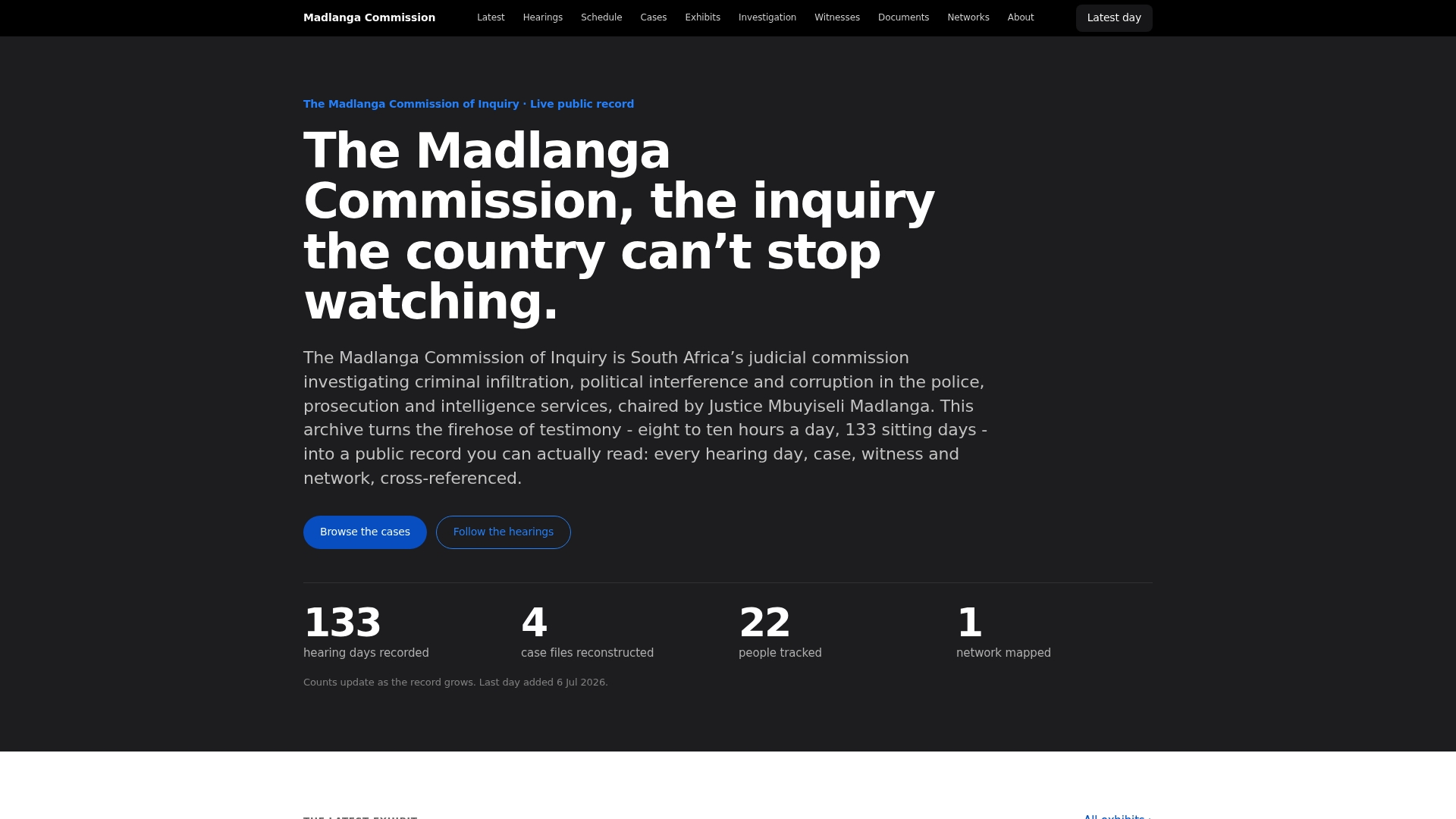
Statutes like RICA only mean something when you can see how the powers they create actually get used, or abused, in the real world. That’s the specific gap the Madlanga Commission’s archive fills: a free, searchable public record of testimony, exhibits, and rulings from South Africa’s inquiry into criminal infiltration and political interference within police, prosecution, and intelligence structures.
If you’re trying to understand how a commission of inquiry actually functions and what powers it holds, start with what a commission of inquiry is and how its mandate differs from a court or a criminal investigation. Journalists and legal researchers verifying specific claims can go straight to the hearing records themselves rather than relying on media summaries. Everything on the archive is free to browse, so the next step is simple: open a hearing day, a witness profile, or an exhibit, and read the primary material for yourself.
Sources
- Regulation of Interception of Communications and Provision of Communication-related Information Act 70 of 2002 | South African Government
- Regulation of Interception of Communications and Provision of Communication-related Information Act 2002 — SAFLII
- Complying with RICA – a guide for organisations | Michalsons
FAQ
What is the purpose of the RICA Act in South Africa?
RICA exists to prohibit unauthorised interception of communications while creating a controlled legal pathway, through designated judges, for lawful interception in serious criminal or national security cases.
How does RICA work in South Africa?
RICA bans interception by default, then allows it only under specific exceptions such as participant recording, consent, business monitoring, emergencies, or a judicial interception direction issued to law enforcement or intelligence agencies.
Is it legal to record a conversation without the other party’s consent in South Africa?
Yes, if you’re a party to the conversation yourself, Section 4 permits you to record it without the other side’s consent. Recording a conversation you’re not part of is generally unlawful without consent or a court order.
What is the RICA Act?
RICA, formally Act 70 of 2002, is South Africa’s principal law regulating the interception of communications, and it took effect on 30 September 2005 with criminal penalties for breaches.
Can employers monitor staff emails and calls under RICA?
Yes, under the Section 6 business exception, provided the monitoring happens on company systems for a legitimate business purpose and employees have been given reasonable notice of the policy.