Protecting Sources in South Africa With PDA, OWP and Madlanga

In South Africa, source protection rests on the Protected Disclosures Act and, where safety is at risk, admission to the Office for Witness Protection. Document every threat, get legal advice before you report anything further, and if danger is immediate, go straight to a protected reporting channel or the OWP. Everything else, the statutes, the case law, the operational habits, builds on that first move.
TL;DR:
- Disclosures must be made through recognized channels and in good faith to qualify for legal protection, including internal reporting or designated public bodies.
- Court orders and subpoenas can compel the disclosure of sources’ identities, and confidentiality rules do not automatically shield sources outside the official witness protection program.
- Proper digital habits like using encrypted messaging, redacting sensitive data, and maintaining chain-of-custody are essential for safeguarding sources.
- Whistleblower protections mainly apply to employees, with limited safeguards for public citizens and independent contractors, requiring legal advice before reporting.
- Citing sworn testimony from the Madlanga Commission archive offers a safe alternative to revealing living sources when corroboration is needed.
Table of Contents
- What counts as a protected disclosure under South African law?
- Who can you safely report wrongdoing to?
- How does witness protection work in South Africa?
- Can your identity as a source still be exposed?
- What digital and physical steps actually protect a source?
- What should you do if a source faces immediate threats?
- Why cite the Madlanga Commission archive instead of naming a living source?
- How do you actually file a protected disclosure step by step?
- What protection exists for whistleblowers who aren’t employees?
- What role does the Human Rights Commission play here?
- How reliable are anonymous reporting hotlines?
- What court rulings have shaped source protection rights?
- How does the Harassment Act protect you from intimidation?
- The gap between the law on paper and how it actually plays out
- Where to find documented testimony instead of a live source
- Sources
- FAQ
What counts as a protected disclosure under South African law?
The Protected Disclosures Act 26 of 2000, amended in 2017, shields employees who report wrongdoing from being fired, demoted, harassed or otherwise punished for it. It has been in force since February 2001, and the 2017 amendment extended and clarified who qualifies and how disclosures must be made to count as protected. A disclosure only earns protection if it goes through a recognised channel and is made honestly, not maliciously.
The PDA doesn’t work alone. Section 159 of the Companies Act gives company employees a parallel route for reporting suspected financial or governance misconduct. The Labour Relations Act backs up PDA remedies through unfair dismissal claims, and the Criminal Procedure Act governs how evidence from a disclosure can end up in court. The Protection Against Harassment Act becomes relevant the moment a whistleblower starts receiving threats rather than just professional retaliation.
One point employers hate hearing: no NDA, confidentiality clause, or employment contract term can override PDA protections. If a clause conflicts with the Act, it’s void to that extent.
- Occupational detriment claims go to the CCMA first for many disputes, or directly to the Labour Court
- Dismissal linked to a protected disclosure can be automatically unfair, carrying stronger remedies than a normal unfair dismissal
- The PDA covers employees and workers, but excludes volunteers and independent contractors in most circumstances, a gap that matters if you’re not on payroll
Who can you safely report wrongdoing to?
Choosing the wrong recipient can strip a disclosure of its legal protection entirely, so this decision matters more than most people realize.
- Start with a legal adviser. Getting counsel before you disclose anything increases the odds your report meets the PDA’s technical requirements for protection.
- Report internally first, where possible. Your employer or a designated compliance officer is usually the safest first channel under the Act.
- Escalate to a prescribed public body when internal reporting isn’t viable. The Public Protector and the Auditor-General are named recipients under the PDA’s 2018 regulations, alongside other prescribed bodies depending on the sector.
- Reserve external or media disclosure for narrow circumstances. General protection for disclosing to outside parties, including journalists, applies only when specific conditions are met, such as reasonable belief of a cover-up or fear of victimisation.
- Keep a paper trail. Note dates, timestamps, and who received each disclosure, and tell your lawyer about any parallel reports you’ve made elsewhere.
How does witness protection work in South Africa?
The Witness Protection Act 112 of 1998 created the Office for Witness Protection, which operates under the National Prosecuting Authority and the Department of Justice and Constitutional Development. Admission isn’t automatic. It follows a formal risk assessment tied to the value of your testimony and the credibility of the threat against you.
The process moves through distinct stages. Temporary protection can be granted almost immediately, within an initial 14-day window, while officials assess whether full admission is warranted. If approved, you move into a formal protection agreement, ongoing management, and eventually discharge once the threat has passed or the case concludes.
- Relocation and new identity documents are common, along with support for schooling and medical needs for dependants
- Family members can be covered too, something many eligible witnesses don’t realise until it’s almost too late
- Communication with people from your previous life is restricted, sometimes severely, for as long as you’re in the programme
Pro Tip: Temporary admission is designed to buy assessment time, not to be a soft landing. Ask your lawyer exactly what restrictions apply during those first 14 days, new documentation, relocation, limits on contacting family, before you agree to anything.
Can your identity as a source still be exposed?
Confidentiality has real limits, and pretending otherwise sets people up for a shock later. Subpoenas and court orders issued under the Criminal Procedure Act can compel disclosure of a source’s identity. Journalists have no absolute legal privilege in South Africa. Courts weigh public interest against the value of the evidence, and a “just excuse” may sometimes shield a reporter from having to name a source, but that’s decided case by case, not guaranteed by statute.
RICA adds another layer of risk. The Constitutional Court found that the Act lacked adequate safeguards, particularly for journalists, and stressed the importance of notifying people after surveillance has ended so they can challenge it. Interim relief followed that judgment, but the underlying interception powers remain significant.
- The Witness Protection Act criminalises unlawful disclosure of a protected person’s identity or location, with severe penalties attached
- Those confidentiality rules protect people inside the formal programme; they don’t extend automatically to sources who haven’t been admitted
- A court order can still require disclosure even where journalistic or professional confidentiality would normally apply
What digital and physical steps actually protect a source?
Good intentions don’t protect anyone. Specific habits do.
- Separate devices for sensitive work. Don’t mix source communications with your everyday phone or laptop.
- Use encrypted messaging and strip identifying metadata from documents and images before sharing or storing them.
- Redact before you retain. Store only what you need, and remove names, ID numbers, and location data from working copies.
- Keep chain-of-custody notes for any physical or digital evidence, who handled it, when, and how it was transferred.
- Route sensitive material through legal counsel rather than holding it yourself when a matter is heading toward litigation or a formal inquiry, following the kind of practical safeguards described in guidance on confidential legal documents.
- Choose meeting locations that don’t create a paper trail, and avoid recording identifying details (car registration numbers, workplace names) unless the source has agreed.
- Check in on your source’s wellbeing, not just the story. Sources under pressure make mistakes that expose themselves.
Pro Tip: Before any interview, agree with your source on exactly what gets recorded, quoted, or attributed, and what stays off the record permanently. Renegotiating that after the fact rarely goes well for anyone.
What should you do if a source faces immediate threats?
Speed matters here more than thoroughness. Move through this in order:
- Call emergency services first if there’s an active physical threat.
- Contact the investigating officer or prosecutor handling the underlying matter, and flag the threat immediately.
- Reach out to the OWP to explore temporary admission if the threat is credible and connected to testimony.
- Get a lawyer involved the same day, not after the situation escalates further.
- Preserve evidence now, screenshots, call logs, messages, timestamps, duplicated in at least two storage locations.
- Apply for a protection order under the Protection Against Harassment Act if the threat falls short of requiring police intervention but still constitutes harassment or intimidation.
Why cite the Madlanga Commission archive instead of naming a living source?
Public inquiry archives give reporters a corroboration option that doesn’t put anyone at further risk. Using documented inquiry material to back up allegations reduces the pressure to name a living source when sworn testimony already exists on record.
The Madlanga Commission publishes daily hearing records, exhibits, rulings, and witness statements, material generated under judicial process rather than off-the-record conversation. Profiles like Zelda Maphosho’s witness page show how the Commission documents testimony while respecting the same confidentiality principles that govern protected witnesses elsewhere in the justice system.
- Look for the specific hearing date and exhibit number when citing Commission material, not just a general reference
- The evidence leaders organising each strand of testimony are a useful starting point for locating related exhibits
- Witness pages such as Clive Naicker’s demonstrate how sworn testimony gets attached to a public record you can cite directly
How do you actually file a protected disclosure step by step?
The PDA doesn’t hand you a fixed countdown clock the way some litigation deadlines do, but it does demand precision in how you disclose. Vague reports made to the wrong recipient, or made in bad faith, lose protection even if the underlying facts are true.
Start by putting the disclosure in writing wherever possible. Verbal reports are harder to prove later and easier for an employer to dispute. State what you observed, when, and who else may have knowledge of it, without embellishing beyond what you can support.
Route it to the correct recipient the first time. Internal channels (your employer, a designated officer, or an internal audit function) generally come first under the Act’s structure. If you reasonably believe internal reporting would be pointless or dangerous, the Act allows escalation to bodies like the Public Protector or Auditor-General, and in narrower circumstances, to the media or the public, but only if specific statutory conditions around good faith and proportionality are met.
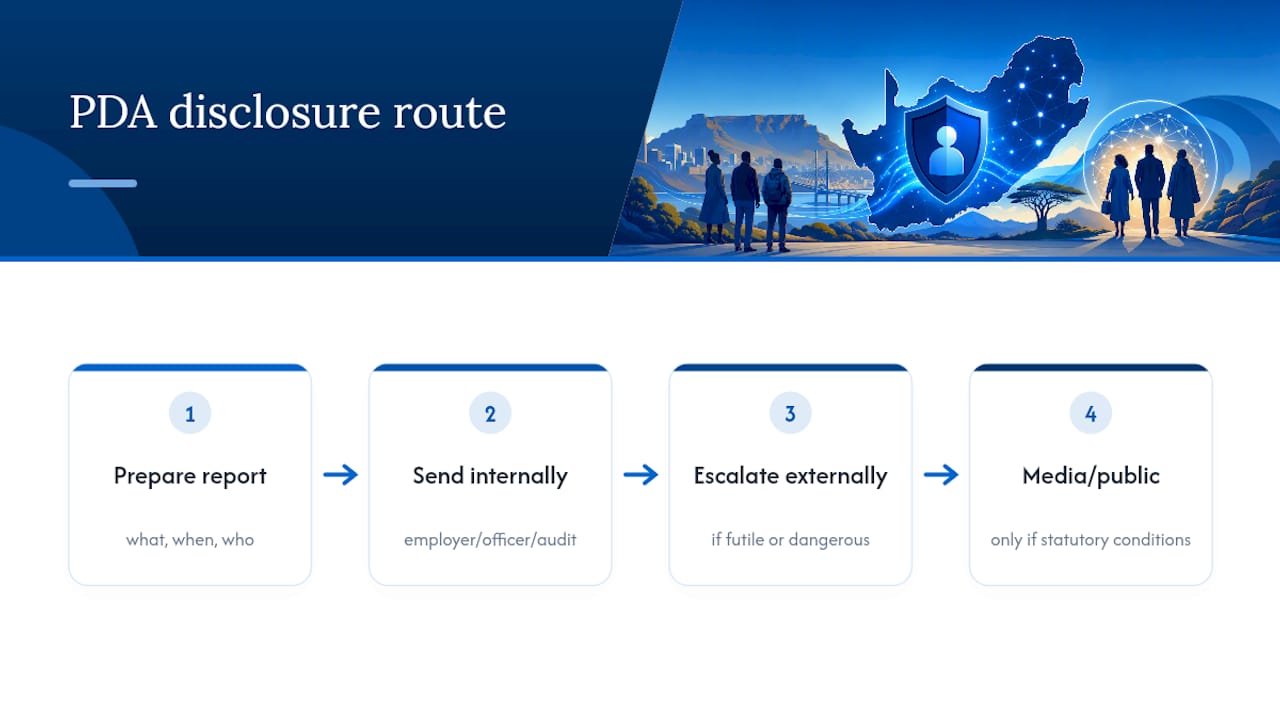
Keep your own copy of everything you send, along with delivery confirmation where you can get it. If retaliation follows, that timeline becomes central evidence in a CCMA referral or Labour Court application. Legal commentary consistently notes that early legal advice meaningfully improves the odds a disclosure holds up as protected once challenged. Don’t wait until after you’ve made the report to find a lawyer, involve one before you send anything.
What protection exists for whistleblowers who aren’t employees?
Citizens reporting corruption they’ve witnessed, not experienced at work, sit in a genuinely harder legal position. The PDA’s core protections were built around the employment relationship, so a member of the public reporting bribery they witnessed at a municipal office doesn’t automatically get the same occupational detriment remedies an employee would.
That doesn’t mean there’s no recourse. Criminal reporting channels remain open regardless of employment status, corruption is a criminal offence, and reports to the South African Police Service or directly to the National Prosecuting Authority don’t require an employment relationship to proceed. The NPA can act on information from any credible source, employee or otherwise.
Non-employee whistleblowers who face intimidation as a result of reporting can still turn to the Protection Against Harassment Act for a protection order, entirely separate from any workplace remedy. And where a citizen’s report leads to a formal inquiry, becoming involved with a public process like a judicial commission gives that testimony a documented, protected status quite different from an anonymous tip that disappears into a filing cabinet.
The honest gap here is real: independent contractors, volunteers, and members of the public reporting corruption they’ve observed rather than experienced as employees fall outside the PDA’s strongest protections. Anyone in that position should get legal advice before reporting, specifically to understand which protections, if any, actually apply to their situation.
What role does the Human Rights Commission play here?
The South African Human Rights Commission isn’t a whistleblower protection agency in the way the OWP is, but it has real relevance for source and whistleblower protection cases. Its mandate covers the constitutional rights implicated when someone faces retaliation, harassment, or intimidation for speaking out, including rights to dignity, security of the person, and freedom of expression.
Where a whistleblower’s treatment raises a human rights dimension beyond a straightforward labour dispute, systemic harassment, discrimination tied to the disclosure, or state actors involved in retaliation, the Commission becomes a legitimate avenue for a complaint. It can investigate, mediate, and in some cases refer matters onward for further legal action.
For journalists specifically, the Commission’s broader work on freedom of expression intersects with source protection questions, particularly where surveillance or state pressure on media organisations raises constitutional concerns rather than purely contractual or employment ones. It won’t replace a CCMA referral or a Labour Court claim for occupational detriment, but it adds a constitutional layer that those bodies don’t cover. Treat it as a complementary channel, not a substitute for a PDA-specific remedy, and raise it with your lawyer as one option among several rather than the first call.
How reliable are anonymous reporting hotlines?
Anonymous tip lines and whistleblower hotlines exist across South African corporates, some public bodies, and several NGOs, but their reliability varies enormously and readers should not assume anonymity is absolute.
Technical anonymity depends entirely on how the hotline is built. A properly configured third-party hotline that strips metadata and doesn’t log identifying details offers genuine protection. A poorly configured internal system, an email address monitored by the very department implicated, or a hotline that captures caller ID by default, offers none. Before using any anonymous channel, ask who operates it and whether it’s independently run.
Anonymity also has a legal cost. A disclosure made anonymously can be harder to pursue for occupational detriment remedies later, because proving you were the source of a specific disclosure becomes difficult if you deliberately concealed your identity at the time. If you may eventually need PDA protection, there’s a real tension between staying anonymous now and being able to prove retaliation later.
Anonymous channels work best for triggering an investigation, flagging a pattern of misconduct without exposing yourself, rather than as a long-term protection strategy for someone likely to need formal remedies down the line. If you expect the matter to escalate into a legal dispute, named disclosure through a protected, documented channel usually serves you better than anonymity, even though it feels riskier in the moment.
What court rulings have shaped source protection rights?
The most consequential ruling for journalists and their sources came from the Constitutional Court, which found RICA’s interception framework constitutionally deficient, largely because it failed to provide adequate safeguards, particularly around notifying surveillance subjects after the fact so they could challenge what had happened to them. The Court specifically flagged the risks secret surveillance poses to journalists and their sources, recognising that source confidentiality is foundational to a functioning press.
That ruling didn’t grant journalists absolute source privilege. South African courts have consistently balanced the public interest in protecting sources against the public interest in law enforcement having access to evidence, deciding matters case by case rather than through a blanket rule. A “just excuse” defence can sometimes protect a journalist from being compelled to disclose a source, but it’s argued and won in court, not assumed in advance.
For whistleblowers, much of the case law that matters plays out quietly at the CCMA and Labour Court level, disputes over whether a dismissal followed a genuinely protected disclosure, and whether the disclosure met the PDA’s technical requirements for good faith and proper recipient. These rulings rarely make headlines, but they’re what actually define how far PDA protection extends in practice. Anyone relying on the Act should understand that its real boundaries get drawn in these individual labour disputes, not just in the statute’s text.
How does the Harassment Act protect you from intimidation?
Threats and intimidation aimed at a source or whistleblower don’t always rise to a criminal charge, but they still cause real harm and often escalate if left unaddressed. The Protection Against Harassment Act fills exactly that gap, offering a civil remedy that doesn’t require proving a criminal offence to the standard a police case would demand.
A protection order under PAHA can be obtained relatively quickly through the Magistrate’s Court, and it doesn’t require the harasser to be identified by name if their identity isn’t yet known, an important detail for situations where threats arrive anonymously or through intermediaries. The order can prohibit contact, require a harasser to stay away from specified locations, and carries criminal consequences if breached.
For whistleblowers and sources, PAHA becomes relevant the moment retaliation shifts from professional (a demotion, exclusion from meetings) into personal intimidation (threatening messages, being followed, unwanted contact at home). The two tracks aren’t mutually exclusive. Someone can pursue a CCMA claim for occupational detriment under the PDA while simultaneously applying for a PAHA protection order if the retaliation has turned into harassment. Document both threads separately, because they go to different forums and require different evidence.

The gap between the law on paper and how it actually plays out
South Africa has a genuinely solid legal architecture for source protection. What it doesn’t have is enough people who know it exists before they need it. Most whistleblowers I’ve seen written about only discover the PDA’s requirements after they’ve already made a disclosure the wrong way, to the wrong recipient, without legal advice, and lost protection they didn’t know they had to secure deliberately.
The statutes work. The habit of using them early doesn’t yet, for most people. That gap, not the law itself, is where most whistleblowers actually get hurt. Talk to a lawyer before you disclose anything, not after.
— Meriol Lainchyon
Where to find documented testimony instead of a live source
Every step above assumes you sometimes have to work with a living, breathing, vulnerable person, and that’s real. But not every claim needs a fresh source. Where sworn testimony already exists on the public record, citing it carries none of the risk that naming a confidential contact does.
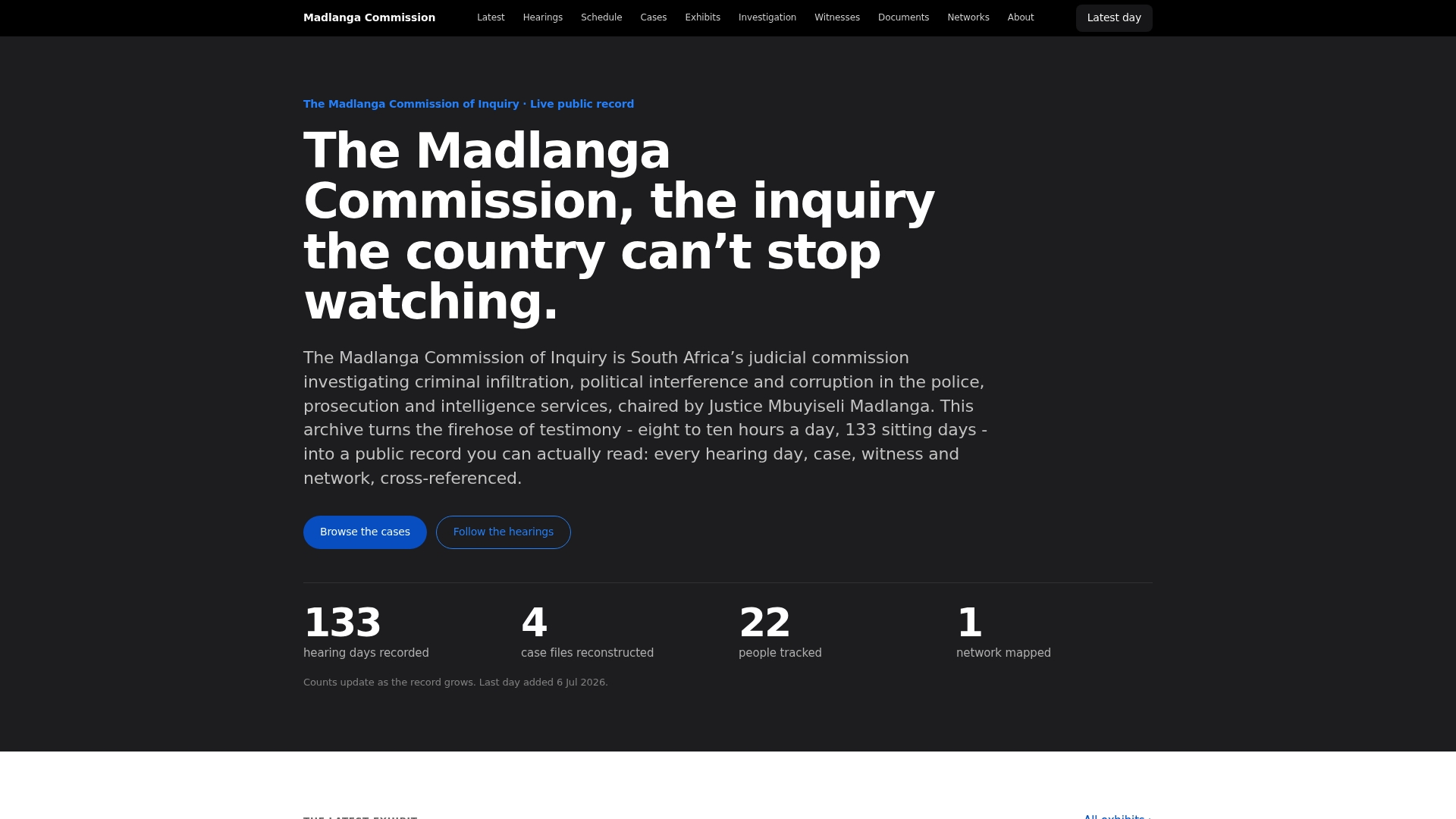
Madlanga Commission maintains a growing archive of hearing transcripts, exhibits, and witness statements from South Africa’s judicial inquiry into police, prosecution, and intelligence corruption, all searchable, all attributable to a documented proceeding rather than an anonymous tip. Pages like Witness I’s testimony from the Hawks narcotics team or Witness K’s account from JMPD’s VIP Protection Unit give reporters and researchers a citable, on-record foundation without ever putting a source at risk. If you’re building a story that needs corroboration rather than a brand-new leak, start by searching the archive before you approach anyone confidentially.
Sources
Consult the Protected Disclosures Act 26 of 2000 and the Witness Protection Act 112 of 1998 directly, alongside the OWP’s own programme materials, the Constitutional Court’s RICA ruling, and the Pinsent Masons whistleblowing guide for deeper legal context.
- Protected Disclosures Act (PDA) 26 of 2000
- Office for Witness Protection Republic of South Africa (OWP presentation)
- Constitutional Court judgment on RICA and journalist privacy (ZACC 2021/3)
- Whistleblowing legislation in South Africa (Pinsent Masons guide)
FAQ
What is source protection in South Africa?
It’s the combination of statutory protections, chiefly the Protected Disclosures Act and the Witness Protection Act, plus operational practices that shield whistleblowers, confidential sources, and vulnerable witnesses from retaliation, exposure, or harm during corruption investigations and inquiries.
Does the PDA protect anonymous whistleblowers?
The PDA protects disclosures made in good faith through proper channels, but proving you’re entitled to protection later becomes harder if you disclosed anonymously and can’t establish that you made the report.
How do I get admitted to the Office for Witness Protection?
Admission follows a risk assessment by the OWP under the National Prosecuting Authority, often starting with temporary protection within an initial 14-day window while your case is evaluated.
Can a court force a journalist to reveal a source in South Africa?
Yes, through a subpoena or court order under the Criminal Procedure Act, though journalists can sometimes argue a “just excuse” defence, and courts decide it case by case rather than granting automatic privilege.
Where can I find documented testimony without exposing a new source?
The Madlanga Commission’s public archive of hearing records, exhibits, and witness statements offers citable, sworn testimony that reporters can use to corroborate reporting without approaching a confidential contact.