Searchable Archives Stop State Capture: Lessons for South Africa

The central lesson from South Africa’s state capture era is that institutional independence and procurement transparency are what stop it happening again, not just new laws on paper. The Zondo Commission reviewed over 1.7 million pages of evidence before reaching that conclusion. Since then, Parliament has passed the Public Procurement Act 2024 and created the Investigating Directorate Against Corruption, but implementation is uneven and the real work of watching it happen falls to citizens and researchers.
TL;DR:
- Reforms like the Public Procurement Act 2024 and the Investigating Directorate aim to improve transparency, but implementation remains inconsistent and requires civic oversight.
- Appointment and procurement capture relied on loyalist placements, skewed tender processes, and information suppression, which reinforced each other and resist single-policy fixes.
- Progress has been made in recoveries and some prosecutions, especially within SARS, but deep institutional fragility and slow criminal investigations persist.
- Access to searchable, primary evidence archives supports ongoing monitoring, early detection of anomalies, and sustained public pressure for reform.
- Civil society and researchers must actively continue oversight, as legal measures alone cannot prevent future capture without persistent civic engagement.
Table of Contents
- State capture lessons from the Zondo Commission’s evidence
- How appointments and procurement were captured
- Reforms since Zondo: what’s done, what’s stalled
- Prosecutions, recovered assets and institutional repair
- What policymakers and citizens can actually do
- Why a searchable public archive matters for prevention
- Sustaining political will after the headlines fade
- Track the record yourself through the Madlanga Commission archive
- Sources
- FAQ
State capture lessons from the Zondo Commission’s evidence
Justice Zondo’s Commission used a precise definition: state capture is the systemic redirection of state power and resources toward private, often criminal, networks through control over appointments, procurement and decision making rather than one-off bribery. It heard from over 300 witnesses and generated a documentary record so vast that the Commission itself later estimated roughly R57 billion of state spending was tainted by the practice.
Two lessons dominate the legal and policy commentary that followed:
- Constitutional checks (Parliament, the courts, the Auditor General) only function if the institutions inside them are staffed independently, not by political loyalists.
- Capture in South Africa was structural, not incidental. It worked over years through parallel tracks of appointments and procurement, which is why Freedom Under Law and SAIIA argue that transparency and independence matter more than any single statute.
Commissions like Zondo’s, and the ongoing Madlanga Commission work covering criminal infiltration of policing and intelligence, generate the evidence base. Turning that evidence into durable protection is a separate, harder task.
How appointments and procurement were captured
State capture followed a repeatable pattern once you strip away the individual scandals. Three mechanisms did most of the damage:
- Strategic appointments. Loyalists were placed atop the National Prosecuting Authority, SARS, state-owned enterprises and intelligence structures, hollowing out professional oversight from the inside rather than abolishing it outright.
- Procurement manipulation. Tender specifications were written to favour specific bidders, oversight committees were bypassed or stacked, and contracts moved through shell companies tied to politically connected families.
- Information control. Whistle-blowers faced intimidation and career destruction, while sympathetic media coverage and selective leaks shaped public narratives away from scrutiny.
Each mechanism reinforced the others. A captured appointment protected a captured tender; a controlled information flow protected both. That interlocking quality is why single reforms, a new law here, a reshuffled board there, rarely hold on their own.
Reforms since Zondo: what’s done, what’s stalled
The President’s Response set out 60 concrete actions. As of March 2025, about half of the actions were complete or substantially complete, some were on track, and others were delayed.
What has actually landed:
- The National Prosecuting Authority Amendment Act, 2024 created a permanent Investigating Directorate Against Corruption with its own police powers, operational since 19 August 2024.
- The Public Procurement Act 2024 consolidates fragmented procurement rules into a single framework with stronger audit and disclosure requirements.
- Anti-money-laundering reforms and intelligence-service restructuring have moved forward, though more slowly than procurement changes.
What’s still exposed: whistle-blower protection remains legally thin, NPA senior appointments still lack full public transparency, and the National Anti-Corruption Advisory Council’s final report flags the absence of a dedicated Public Procurement Anti-Corruption Agency as a live gap, not a solved problem.
Prosecutions, recovered assets and institutional repair
Government reports nearly R11 billion recovered in stolen public funds by mid-2025, up sharply from R2.9 billion reported back in October 2022. That trajectory is real progress, but it is still a small fraction of the estimated R57 billion in tainted spending Zondo identified.
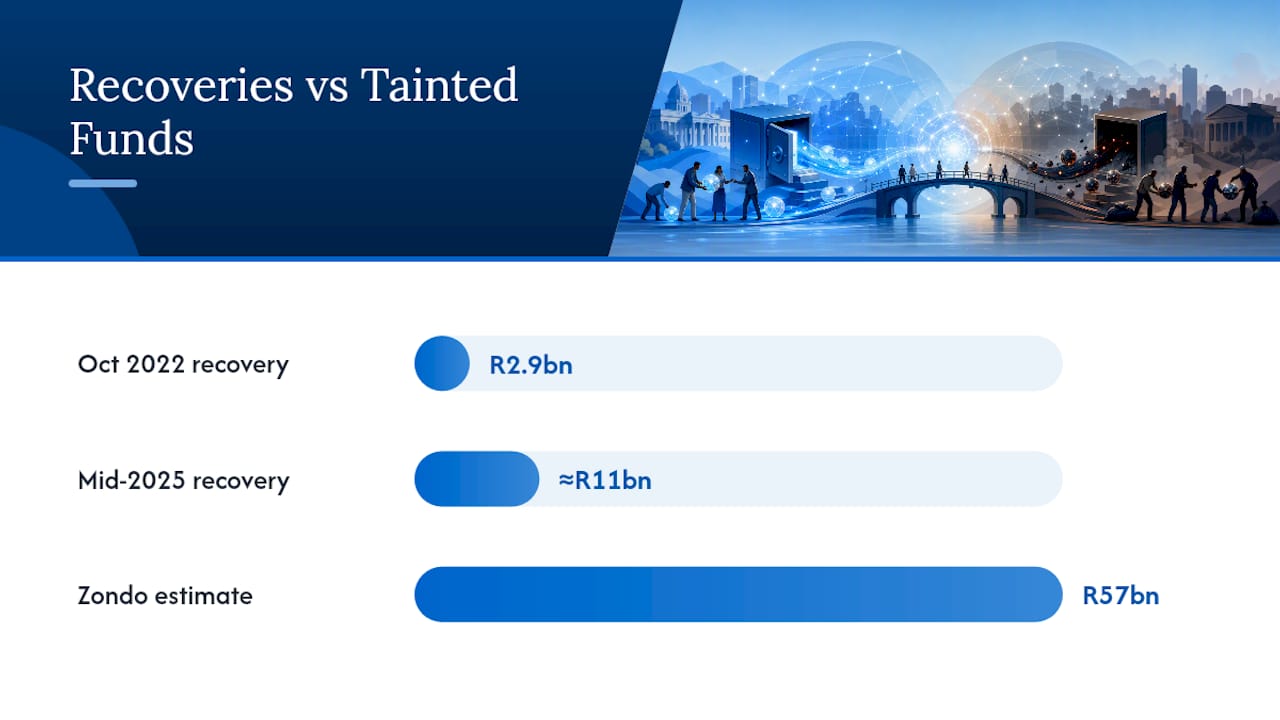
Prosecutions have moved slower than recoveries. High-profile cases tied to state-owned enterprises remain in the investigative pipeline years after the Commission’s findings were published. SARS is the clearer success story: leadership was rebuilt and revenue collection capacity largely restored. Some state-owned enterprises and prosecuting units still show fragility, understaffed, underfunded, and vulnerable to the same appointment pressures that enabled capture in the first place.
What policymakers and citizens can actually do
Prevention works best when it operates on three levels at once, policy, operations and civic monitoring, rather than relying on any single fix.
- Fix the appointment pipeline. Merit-based, publicly scrutinised appointment processes for NPA leadership, SOE boards and intelligence heads close the door capture walked through first.
- Give procurement independent teeth. A dedicated procurement oversight body, along the lines NACAC has proposed as a Public Procurement Anti-Corruption Agency, paired with open, machine-readable tender data, lets outsiders catch anomalies before contracts are signed, not years after.
- Resource law enforcement properly. IDAC’s police powers mean little without sustained budget and staffing; forensic accounting capacity, of the kind firms like Amplify Consults provide in the private sector, is exactly the skill set investigators need more of.
- Protect whistle-blowers with resourcing, not just legislation. Legal protection without a funded, fast case-management channel connecting disclosures to investigators does not function in practice.
- Use public archives actively. Researchers and civil-society groups analysing procurement datasets and cross-referencing hearing records catch patterns that any single agency misses.
Pro Tip: If you’re a researcher or journalist, don’t wait for a scandal to break before searching the record. Cross-reference procurement award dates against appointment announcements in the same department. Capture patterns tend to cluster around personnel changes.
Why a searchable public archive matters for prevention
Transparency only deters future capture when the evidence is genuinely usable, not just published. Searchable, downloadable hearing records let journalists and watchdogs build datasets that flag anomalies before they harden into scandals, a point PARI’s 2025 update makes explicitly.
That’s the practical value behind the Madlanga Commission’s approach to its hearings on serious issues in policing, prosecution and intelligence sectors:
- Daily hearing records let readers trace how a specific procurement decision or appointment connects to testimony given weeks apart.
- Searchable case files support building datasets, corroborating whistle-blower claims, and drafting sharper Freedom of Information requests.
- Individual hearing days function as citable primary sources, useful for parliamentary questions as much as journalism.
Sustaining political will after the headlines fade
Reforms stall the moment public attention moves on. Legal fixes and institutional restructuring matter, but they hold only when civil society keeps applying pressure and keeps checking whether the 60 promised actions actually happened. The deeper lesson from Zondo isn’t legal, it’s cultural: a public that stops watching is a public inviting the next version of capture. Evidence archives only work if people keep using them.
— Meriol Lainchyon
Track the record yourself through the Madlanga Commission archive
Madlanga Commission gives you something most reform trackers don’t: the primary evidence itself, searchable, not summarised by someone else’s press release. If you want to know whether police and intelligence oversight is actually being fixed, rather than take a government progress report at face value, this is where you check the underlying testimony.
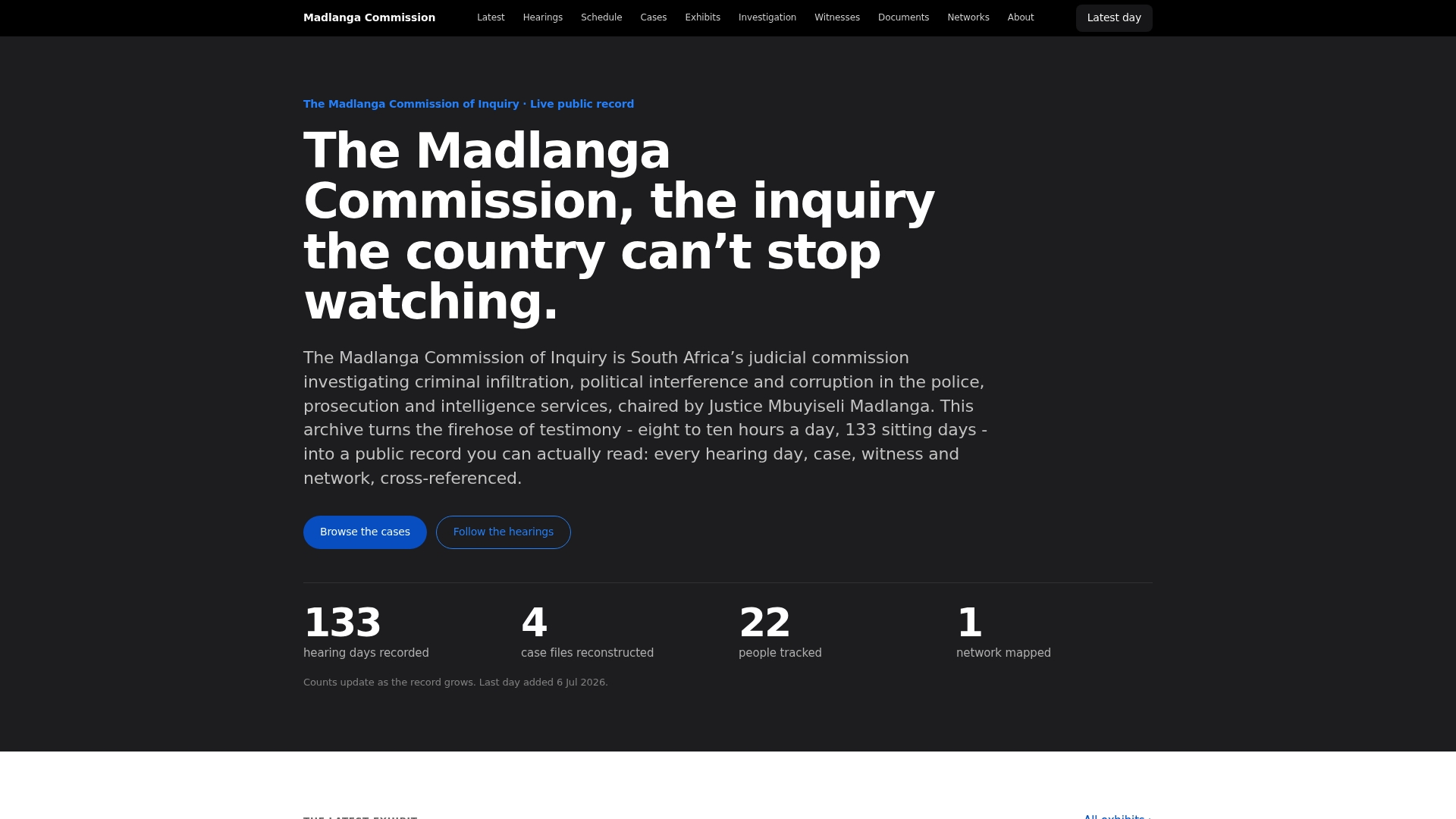
Start with three moves. Search a specific hearing date tied to a name or department you’re following. Follow a case file from opening testimony through to any ruling. Download the exhibits attached to witness statements, since exhibits often carry the procurement or appointment detail that testimony alone glosses over. The case files archive is built for exactly this kind of tracing, and the evidence leaders pages give you the context for who’s asking which questions and why. If you’re building a monitoring project, a submission, or just want to know what’s actually been said under oath, start with the case files today.
This article is general information, not a substitute for advice from a qualified lawyer. Consult a qualified legal professional about your own circumstances before acting on anything here.
Sources
- Judicial Commission of Inquiry into Allegations of State Capture (Zondo Commission)
- Progress report on implementation of actions in the President’s response to the State Capture Commission recommendations
- PARI Zondo update and recommendations (2025)
FAQ
Can you explain state capture in simple terms?
State capture is when private networks gain lasting control over government decisions, appointments and contracts, redirecting public resources for private benefit rather than through isolated bribery.
What was the Gupta family’s role in South Africa’s state capture?
The Gupta family was central to allegations examined by the Zondo Commission, accused of using close ties to senior officials to influence cabinet appointments, state-owned enterprise contracts and procurement decisions for financial gain.
What corruption allegations were made against Jacob Zuma?
Former President Jacob Zuma faced Commission findings and separate criminal charges relating to enabling Gupta family influence over appointments and state contracts during his presidency, along with unrelated corruption charges tied to earlier arms-deal dealings.
What has President Ramaphosa been accused of regarding state capture?
Ramaphosa has faced criticism over the pace of reform implementation and, separately, the unrelated Phala Phala farm cash controversy, though that matter sits outside the Zondo Commission’s state capture findings.
How much money has South Africa recovered from state capture corruption?
Government reported nearly R11 billion recovered in stolen public funds by mid-2025, against an estimated R57 billion in tainted state spending identified by the Zondo Commission.