Terms of reference inquiry: a guide for legal and investigatory teams

An inquiry’s terms of reference (ToR) are the legally binding mandate that defines what a South African commission may investigate and how it must operate. They are issued by presidential proclamation under section 84(2)(f) of the Constitution and published in the Government Gazette, usually alongside or followed by regulations made under the Commissions Act (Act No. 8 of 1947). Together, those three instruments — proclamation, ToR, and regulations — set the commission’s remit, confer its investigatory powers, and cap what it can do. Get the ToR wrong and you risk either an underpowered inquiry or a court challenge that derails it.
Key Takeaways
An inquiry’s terms of reference are the single most important document for understanding what a South African commission can investigate, how it operates, and when its powers can be challenged.
| Point | Details |
|---|---|
| Legal basis is constitutional | ToR are issued under section 84(2)(f) of the Constitution via presidential proclamation and published in the Government Gazette. |
| Three instruments work together | The proclamation, ToR, and Commissions Act regulations must all be read together to understand a commission’s full powers. |
| Timelines are binding | The Madlanga Commission ToR require an interim report within 3 months and a final report within 6 months, subject to presidential extension. |
| Specific questions beat broad mandates | Vague scope language invites judicial review; numbered investigatory questions and named institutions reduce that risk. |
| Primary sources are accessible | The Government Gazette and the Madlanga Commission archive hold authoritative ToR texts, regulations, and hearing transcripts. |
Table of Contents
- What do terms of reference mean in South African law?
- What should every inquiry’s terms of reference contain?
- What investigatory powers can a commission hold?
- How are terms of reference created, gazetted, and amended?
- What timelines and reporting obligations do ToR typically set?
- A practical drafting checklist for inquiry terms of reference
- Annotated South African examples: Madlanga and Zondo ToR
- How do ToR affect witnesses, evidence, and legal protections?
- Reading ToR strategically: how the Madlanga archive helps
- Where to find authoritative ToR and regulations
- Sources
- FAQ
What do terms of reference mean in South African law?
The constitutional hook is section 84(2)(f), which empowers the President to appoint commissions of inquiry. That power is not self-executing: the President issues a proclamation that formally establishes the commission, and the ToR attached to or incorporated in that proclamation spell out the mandate. The Commissions Act then provides the statutory machinery — summons, oaths, penalties for non-compliance — that gives the ToR practical teeth.
Think of the ToR as a leash on a commission: they keep the inquiry focused on the public concern that justified its creation and reduce the risk of overreach that invites a court challenge. The ToR set scope and procedure; the regulations operationalise them.
Three instruments work together:
- Proclamation: the presidential act that establishes the commission and names the chairperson; it incorporates or annexes the ToR and may declare the Commissions Act applicable.
- Terms of reference: the substantive mandate document listing what the commission must inquire into, its temporal and jurisdictional limits, reporting obligations, and any specific questions it must answer.
- Regulations: procedural rules published separately in the Gazette under the Commissions Act, defining terms, setting evidence procedures (affidavits, cross-examination conditions, search and seizure), and restricting dissemination of commission records.
A critical functional distinction: commissions are inquisitorial fact-finding bodies, not accusatorial courts. They can admit evidence that a court might exclude, but they cannot convict anyone. Their output is findings and recommendations, not judgments. Reading ToR through a criminal-trial lens is the single most common mistake legal practitioners make when advising clients who receive summonses.
Legal effects of the ToR in brief:
- They define the outer boundary of what the commission may lawfully investigate; anything outside that boundary is ultra vires.
- They can be challenged by judicial review if they are irrational, overbroad, or conflict with constitutional rights.
- They must be read together with the proclamation, the regulations, and any subsequent High Court orders to understand the commission’s full powers at a given moment.
What should every inquiry’s terms of reference contain?
Terms of reference across disciplines share a common skeleton: scope, objectives, stakeholders, resources, schedule, and success criteria. In the South African judicial-commission context, those elements translate into specific legal clauses. A ToR that omits any of the following is incomplete and potentially challengeable:
- Remit/scope clause: a precise statement of what the commission is directed to inquire into, naming the subject matter, the institutions or sectors covered, and the triggering events or allegations.
- Specific investigatory questions: numbered questions the commission must answer in its report. Vague open mandates invite scope creep and litigation; specific questions keep the inquiry on track.
- Temporal limits: the period of conduct the commission may examine (e.g., “events occurring on or after 1 January 2015”).
- Jurisdictional limits: which organs of state, entities, or individuals fall within scope.
- Powers clause: which investigatory powers are conferred (summons, compel documents, administer oaths, search and seizure subject to law, in camera hearings).
- Evidence and procedure rules: how evidence is received, whether cross-examination is permitted, and under what conditions.
- Witness protections: provisions for in camera sittings, anonymity applications, and protected disclosure.
- Reporting requirements: deadlines for interim and final reports, the format of those reports, and to whom they are delivered.
- Amendment procedure: how the ToR may be varied and by whom (typically a further presidential proclamation).
- Exclusions: matters explicitly outside scope, which are as important as inclusions.
Pro Tip: Draft the exclusions clause with the same care as the remit. Courts have set aside commission findings where the ToR were ambiguous about whether a particular institution or time period was in scope. A single sentence that says “this commission does not inquire into events before [date] or the conduct of [named entity]” can prevent years of litigation.
What investigatory powers can a commission hold?
Powers vary by commission, but the Commissions Act and the regulations made under it establish a standard toolkit. The Madlanga Commission’s regulations illustrate how that toolkit is assembled for a specific inquiry.
| Power | Typical basis | Key limits |
|---|---|---|
| Summons to appear | Commissions Act / regulations | Must relate to matters within ToR scope |
| Compel production of documents | Commissions Act / regulations | Subject to privilege and confidentiality claims |
| Administer oaths and affirmations | Commissions Act | Chairperson or designated commissioner only |
| Search and seizure | Regulations (where declared applicable) | Must comply with constitutional search requirements |
| In camera hearings | ToR / regulations | Chairperson must authorise; reasons recorded |
| Cross-examination | Regulations (subject to rules) | Chairperson authorises; conditions set in regulations |
| Referral to prosecuting authority | ToR (express clause) | Commission cannot itself prosecute or convict |
What commissions cannot do is equally important. Academic legal analysis confirms that commissions must act within constitutional and statutory limits, and that judicial review applies where powers exceed legality or rationality. A commission cannot issue a criminal conviction, impose a sentence, or override a court order. Its findings bind no one in a legal sense — they are recommendations to the executive. The Zondo Commission’s ToR illustrate the outer reach of a broad mandate: the commission was directed to “inquire into, make findings, report on and make recommendations” concerning state capture, with quasi-judicial powers including subpoena authority — yet its recommendations still required executive and legislative action to take effect.
Practitioners also note that the Commissions Act provides statutory teeth (summons, oath, penalties) while separate proclamations and regulations tailor procedural rules such as cross-examination conditions and search and seizure specifics. The ToR alone do not confer those powers; the regulations must explicitly do so.
How are terms of reference created, gazetted, and amended?
The path from political decision to operative ToR follows a defined procedural sequence. Understanding each step tells you where to find the authoritative text and when a ToR becomes legally effective.
The drafting process typically involves the Presidency, the relevant line department (in the Madlanga Commission’s case, the Department of Justice and Constitutional Development), and legal advisers. Parliamentary committees also adopt ToR for their own ad hoc inquiries, publishing them in press releases and committee minutes, though those ToR operate under parliamentary rules rather than the Commissions Act.
The formal sequence for a presidential commission:
- Step 1 — Cabinet decision or presidential directive: the decision to establish a commission is taken, usually following a public trigger event or political commitment.
- Step 2 — Drafting: the Presidency and legal advisers draft the proclamation and ToR; the chairperson may be consulted on scope and resources.
- Step 3 — Proclamation signed and published: the President signs the proclamation, which is published in the Government Gazette. This is the moment the commission legally exists. The Madlanga Commission’s proclamation was gazetted in July 2025 as Proclamation 269 in Government Gazette 53048.
- Step 4 — Commissions Act declared applicable: the proclamation or a separate notice declares the Commissions Act applicable to the commission, activating its statutory powers.
- Step 5 — Regulations published: procedural regulations are published in a subsequent Gazette notice, setting evidence rules, definitions, and operational procedures.
- Step 6 — Amendment (if needed): any change to the ToR requires a further presidential proclamation published in the Gazette. The amendment takes effect on publication unless the proclamation specifies otherwise.
The gazetted ToR for the criminal justice system inquiry were reported in 2025, confirming that publication in the Government Gazette is the authoritative record. Always verify the Gazette number and proclamation number when citing a ToR — secondary news reports sometimes paraphrase scope language inaccurately.
What timelines and reporting obligations do ToR typically set?
Reporting clauses are among the most consequential provisions in any ToR. They set the rhythm of the inquiry and create public accountability milestones.
The Madlanga Commission’s ToR provide a concrete reference point: an interim report within 3 months and a final report within 6 months of establishment, with the President holding the power to extend either deadline. Those timelines are tight by historical standards and reflect the political urgency of the criminal justice system allegations that prompted the inquiry.
| Report type | Typical deadline | Contents | Extension mechanism |
|---|---|---|---|
| Interim report | 3 months from establishment | Preliminary findings, urgent recommendations, progress update | Presidential extension by proclamation |
| Final report | 6 months from establishment | Full findings, all recommendations, evidence annexes, minority views | Presidential extension by proclamation |
Interim reports serve two purposes: they allow the executive to act on urgent recommendations before the full inquiry concludes, and they create a public record that the commission is progressing. Final reports typically include the commission’s findings on each investigatory question in the ToR, recommendations addressed to specific organs of state, a summary of evidence received, and annexes listing exhibits and witness testimony.
Scope expansions complicate timelines. When a proclamation amends the ToR to add new focus areas, the commission may apply for a timeline extension. Practitioners advise building explicit extension-request procedures into the ToR from the outset rather than relying on informal presidential discretion.
A practical drafting checklist for inquiry terms of reference
Use this checklist whether you are drafting a ToR from scratch, reviewing one on behalf of a client, or assessing whether an existing ToR is fit for purpose.
Step-by-step drafting checklist
- Define the problem precisely. State the specific allegations, events, or systemic failures that justify the inquiry. Vague problem statements produce vague ToR.
- Draft numbered investigatory questions. Each question should be answerable with findings and evidence. Prefer “Did [named institution] engage in [specific conduct] between [dates]?” over “Inquire into corruption generally.”
- Set temporal and jurisdictional limits. Name the start date, end date (or “to the date of the final report”), and the institutions or individuals within scope.
- Specify powers explicitly. List each power: summons, compel documents, administer oaths, search and seizure (if applicable), in camera hearings, referral to the National Prosecuting Authority.
- Set timelines and reporting format. Specify interim and final report deadlines, the recipient (President, Minister, Parliament), and whether reports are to be made public immediately or after a defined period.
- Include witness protections. Specify in camera provisions, anonymity application procedures, and any protected disclosure mechanisms.
- Draft an exclusions clause. Explicitly list what is outside scope.
- Include an amendment procedure. State that ToR may only be amended by presidential proclamation published in the Gazette.
- Obtain stakeholder sign-off. Confirm that the Presidency, the relevant department, and legal advisers have reviewed and approved the final text before gazetting.
Sample clauses
Remit clause (adapt as needed): “The Commission is directed to inquire into, make findings on, and report on [subject matter], with particular reference to events occurring between [start date] and the date of the final report, within [named institutions or sectors].”
Powers clause: “The Commission may, subject to applicable law and the regulations made under the Commissions Act, summon any person to appear before it, compel the production of documents, administer oaths and affirmations, and conduct hearings in camera where the Chairperson determines it is in the interests of justice or the safety of a witness.”
Reporting clause: “The Commission shall submit an interim report to the President within [X] months of establishment and a final report within [Y] months of establishment, or within such extended period as the President may determine by proclamation.”
Confidentiality clause: “No person may publish or disclose any information relating to proceedings conducted in camera without the written authorisation of the Chairperson, subject to applicable law.”
Practitioners advise against open-ended mandates such as “inquire into all matters relating to corruption in the public sector.” Courts have found such language difficult to apply and commissions have struggled to manage scope. Specific questions, named institutions, and defined time periods are the markers of a ToR that will survive both operational pressure and judicial scrutiny.
Annotated South African examples: Madlanga and Zondo ToR
The Madlanga Commission
The Madlanga Commission of Inquiry — formally the Judicial Commission of Inquiry into Criminality, Political Interference and Corruption in the Criminal Justice System — was established by Proclamation 269, gazetted in July 2025. Its ToR reflect a tightly scoped mandate triggered by specific public allegations made by Lieutenant General Nhlanhla Mkhwanazi on 6 July 2025.
Key features of the Madlanga ToR:
- Scope language: the commission is directed to inquire into criminality, political interference, and corruption within the police, prosecution, and intelligence sectors, arising specifically from the Mkhwanazi allegations. The temporal anchor to a named public event is a deliberate drafting choice that limits scope creep.
- Timeline clauses: interim report within 3 months; final report within 6 months, both subject to presidential extension.
- Regulations: procedural regulations were published separately in Government Gazette 53183 in August 2025, defining terms such as “Chairperson” and “Commission,” setting powers including affidavits and search and seizure, and restricting dissemination of commission records.
The commission’s hearings began on 17 September 2025, with the ToR directly shaping which witnesses were called and what evidence was admitted in those early sessions. By Day 2, the scope language was already being applied to determine the admissibility of testimony about specific institutions.
The Zondo Commission
The Zondo Commission’s ToR offer a contrasting example of a broader mandate. Published under section 84(2)(f) as the Judicial Commission of Inquiry into State Capture, Corruption and Fraud in the Public Sector, the Zondo ToR directed the commission to:
That language gave the commission a wide investigative remit and quasi-judicial powers. The breadth also generated repeated scope disputes and contributed to multiple timeline extensions over the commission’s multi-year lifespan. The Zondo experience is frequently cited by practitioners as the reason why specific investigatory questions are preferable to broad thematic mandates.
Both commissions illustrate how ToR are read together with proclamations and regulations. The Madlanga Commission archive holds the full gazetted documents, hearing transcripts, exhibit lists, and witness profiles — making it the most accessible primary-source repository for anyone working with the Madlanga ToR in practice.
How do ToR affect witnesses, evidence, and legal protections?
Receiving a commission summons is not the same as being charged with a crime, but the practical stakes are real. Understanding how ToR interact with evidence rules and witness protections is essential for counsel advising anyone who appears before a commission.
- In camera hearings: the ToR or regulations typically allow the Chairperson to direct that specific hearings be held in camera where disclosure would endanger a witness, compromise an ongoing investigation, or prejudice national security. The decision must be recorded with reasons.
- Witness anonymity: commissions can grant anonymity applications where a witness faces a credible threat. The ToR should specify the procedure for applying and the standard the Chairperson applies.
- Evidence admissibility: commissions are not bound by the strict admissibility rules that apply in criminal courts. They can receive hearsay, documentary evidence without formal authentication, and affidavits in lieu of oral testimony. This broader evidentiary latitude is one reason commissions can move faster than courts on complex fact-finding.
- Self-incrimination: witnesses may raise the privilege against self-incrimination, but the Commissions Act and regulations may compel testimony subject to use-immunity provisions. Counsel should check the specific regulations applicable to the commission before advising a client to refuse to answer.
- Privilege: legal professional privilege applies in commission proceedings. A witness cannot be compelled to disclose confidential communications with their legal adviser.
- Judicial review: if a ToR is overbroad, irrational, or the commission acts outside its mandate, affected parties can approach the High Court for review. The constitutional and statutory constraints on commissions mean that proportionality and rationality are live review grounds. Courts have set aside commission subpoenas and findings where the commission exceeded its ToR.
- Non-compliance: failure to comply with a lawful summons or to produce documents is a criminal offence under the Commissions Act. The MNS Attorneys analysis notes that ToR and regulations can authorise subpoena and cross-examination powers, subject to the Chairperson’s authorisation — meaning the procedural rules matter as much as the substantive ToR.
Organisations that receive document requests should immediately assess whether the request falls within the ToR’s scope and temporal limits. If it does not, a formal objection grounded in the ToR is the appropriate response before any documents are produced.
Reading ToR strategically: how the Madlanga archive helps
When you pick up a set of terms of reference, most people read from the top. That is the wrong approach.
Start with the scope clause and the investigatory questions. Those two provisions tell you whether your client, your institution, or the matter you are researching falls within the commission’s mandate at all. If the scope clause does not reach your situation, the rest of the document is background reading.
Then read the powers clause and the regulations. The ToR may grant broad powers in principle, but the regulations determine whether those powers are actually operative and under what conditions. A commission whose regulations have not yet been published is operating with limited procedural authority, regardless of what the ToR say.
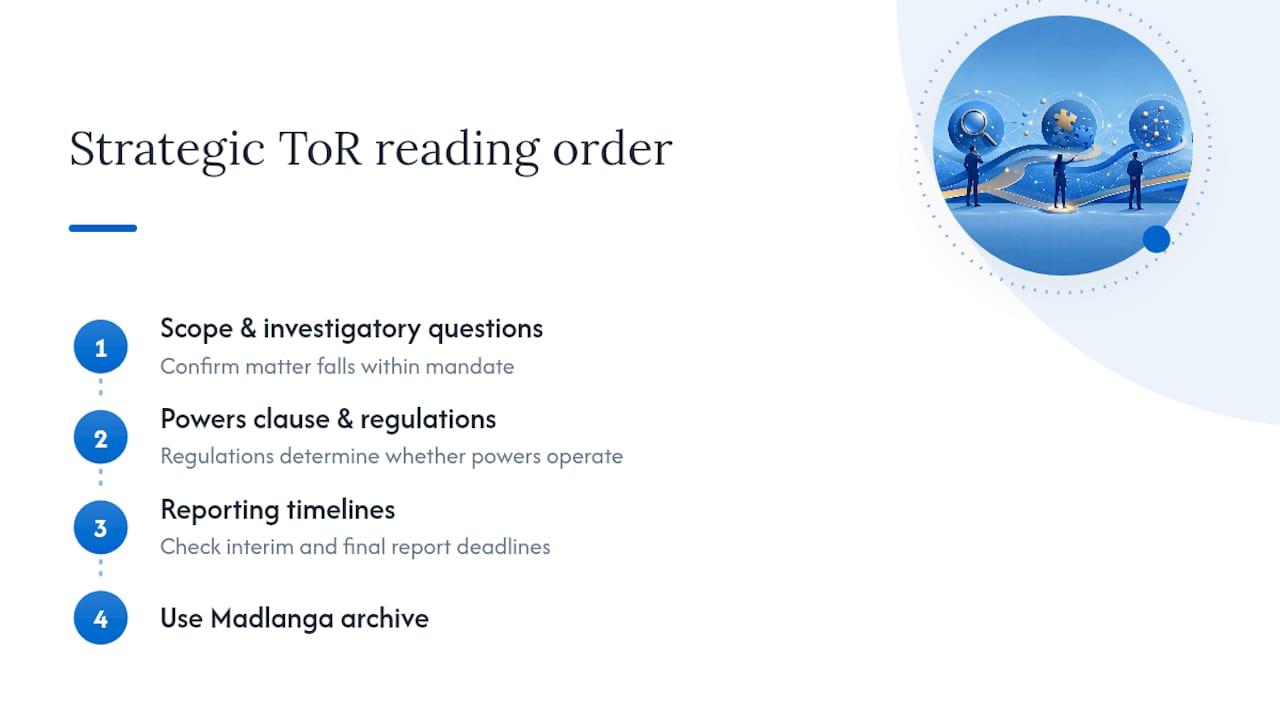
Finally, check the reporting timelines. They tell you when the commission is expected to produce findings and whether an interim report deadline is approaching. Interim reports often contain the most urgent recommendations and can trigger executive action before the final report is published.
The Madlanga Commission archive is built precisely for this kind of structured engagement. You can access the gazetted proclamation and regulations, search hearing transcripts by date or witness, review exhibit lists, and trace how specific ToR clauses have been applied in practice across more than 120 hearing days. For legal practitioners, journalists, and researchers who need to move quickly, that searchable archive removes the need to sit through hours of live proceedings to find a specific piece of evidence or ruling.
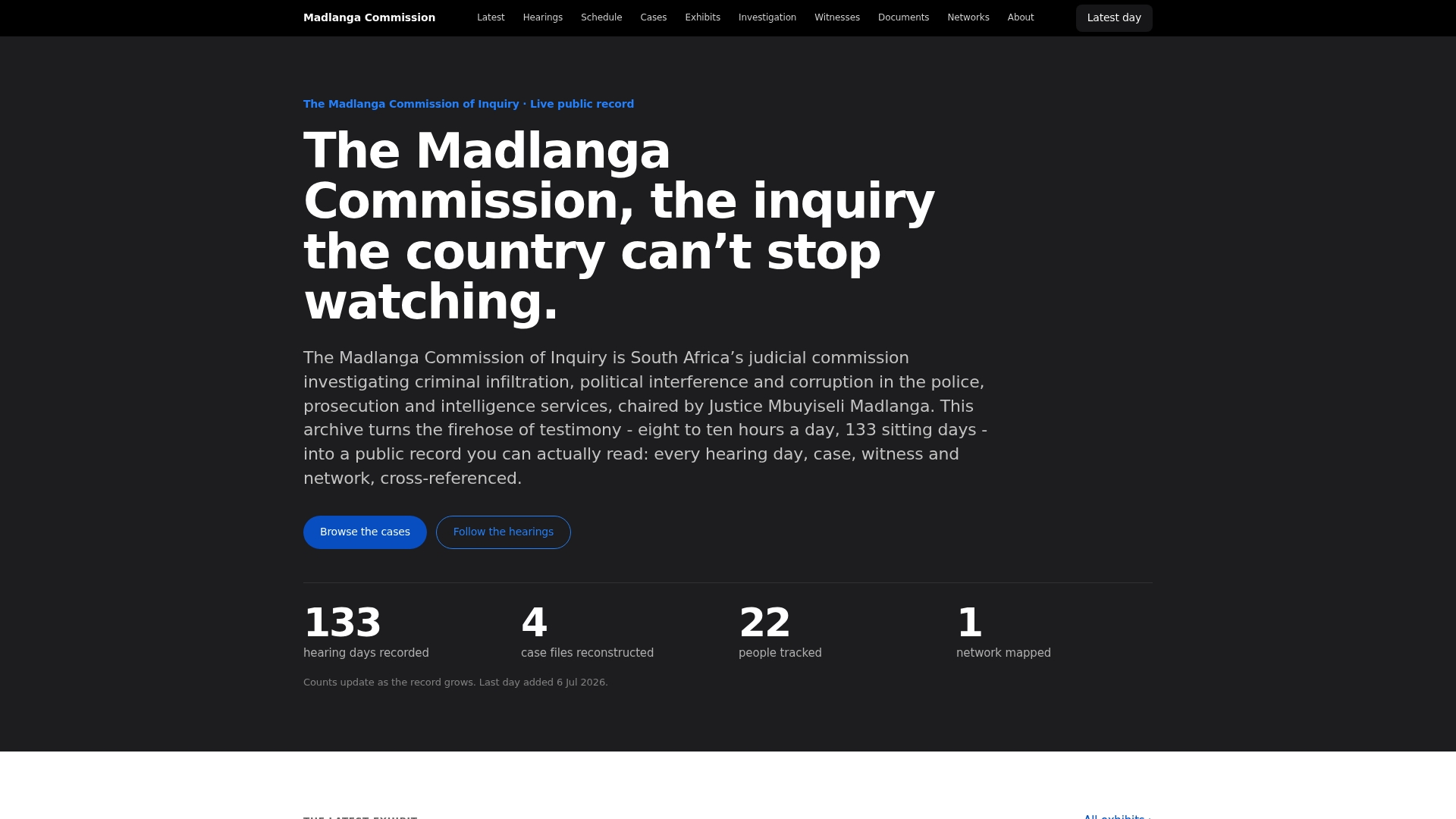
The archive also holds analytical articles that contextualise ToR clauses against hearing developments — useful when you need to understand not just what the ToR says but how the commission has interpreted it in practice.
Where to find authoritative ToR and regulations
Primary sources for South African inquiry terms of reference:
- Government Gazette (gov.za): the authoritative publication for all presidential proclamations and commission regulations. Search by Gazette number or proclamation number. The Madlanga Commission’s proclamation appears in Gazette 53048 (Proclamation 269, July 2025) and its regulations in Gazette 53183 (August 2025).
- Parliament of South Africa (parliament.gov.za): committee ToR and press releases for parliamentary inquiries, including gang-related crime and other ad hoc committee investigations.
This article is general information, not a substitute for advice from a qualified lawyer. Consult a qualified legal professional about your own circumstances before acting on anything here.
Sources
- JUDICIAL COMMISSION OF INQUIRY INTO CRIMINALITY, POLITICAL INTERFERENCE AND CORRUPTION IN THE CRIMINAL JUSTICE SYSTEM ARISING FROM THE SPECIFIC ALLEGATIONS MADE PUBLIC BY LIEUTENANT GENERAL NHLANHLA MKHWANAZI ON 6 JULY 2025
- Reporting the Courts - a guide for South African journalists (Commissions of Inquiry)
- Judicial Commission of Inquiry into state capture, corruption and fraud in the Public Sector: Terms of Reference
- Utrecht Law Review article on commissions and accountability
- The Difference Between a Commission of Enquiry and a Court of Law
FAQ
What is a commission of inquiry in South Africa?
A commission of inquiry is an inquisitorial fact-finding body appointed by the President under section 84(2)(f) of the Constitution to investigate matters of public concern. It produces findings and recommendations rather than legally binding judgments or criminal convictions.
What is the correct citation for the South African Constitution’s commission power?
The power to appoint commissions of inquiry is found in section 84(2)(f) of the Constitution. Presidential proclamations establishing commissions are published in the Government Gazette and cite this provision as their authority.
How many commissions of inquiry are currently active in South Africa?
The number of active commissions changes as new ones are established and existing ones conclude. The Madlanga Commission, established by Proclamation 269 in July 2025, is among the most recently gazetted; checking the current Government Gazette is the most reliable way to confirm which commissions are presently operative.
What is the purposive approach to statutory interpretation in South Africa?
South African courts apply a purposive approach to statutory interpretation by reading legislation in light of its purpose and constitutional context rather than applying a purely literal reading. For commissions, this means ToR and the Commissions Act are interpreted to give effect to the inquiry’s stated objectives while remaining within constitutional limits.
Can a commission’s terms of reference be challenged in court?
Yes. Affected parties can apply to the High Court for judicial review of ToR or commission conduct that is irrational, overbroad, or unconstitutional. Courts apply proportionality and rationality tests, and have set aside commission subpoenas and findings where the commission exceeded its mandate.