Administrative justice in South Africa: the Madlanga Commission guide

Administrative justice means that every decision made by a public body must be lawful, reasonable, and procedurally fair — a guarantee written into Section 33 of the Constitution (1996) and given practical force by the Promotion of Administrative Justice Act (PAJA, Act 3 of 2000). For researchers tracking corruption in South Africa’s police and intelligence sectors, the Madlanga Commission archive is the primary public record of those principles being tested in real proceedings.
Key access points for the archive:
- Daily hearing records — transcripts, exhibits, and rulings published by hearing day
- Witnesses index — every person who has testified, searchable by name or institution
- Case files and exhibits — primary documents submitted to the Commission
- Methodology and sourcing notes — explains redactions, corrections, and citation standards
Pro Tip: Start with the witnesses index when researching a specific SAPS or SSA official. Cross-reference their hearing day against the exhibits list. Note that some records carry suppression orders — those portions will not appear in the public archive.
The Madlanga Commission, chaired by Justice Mbuyiseli Madlanga, operates under the Commissions Act of 1947, which grants powers to summon witnesses and compel documents. It cannot prosecute anyone. Findings are non-binding; enforcement depends on the National Prosecuting Authority (NPA) or executive action.
Table of Contents
- What legal framework governs administrative justice in South Africa?
- How does administrative justice connect to criminal and disciplinary processes?
- Administrative justice outcomes: South African examples
- Which institutions enforce administrative justice beyond commissions?
- How to submit a PAIA request for commission records
- The Madlanga Commission archive: your direct access point
- Key Takeaways
- FAQ
What legal framework governs administrative justice in South Africa?
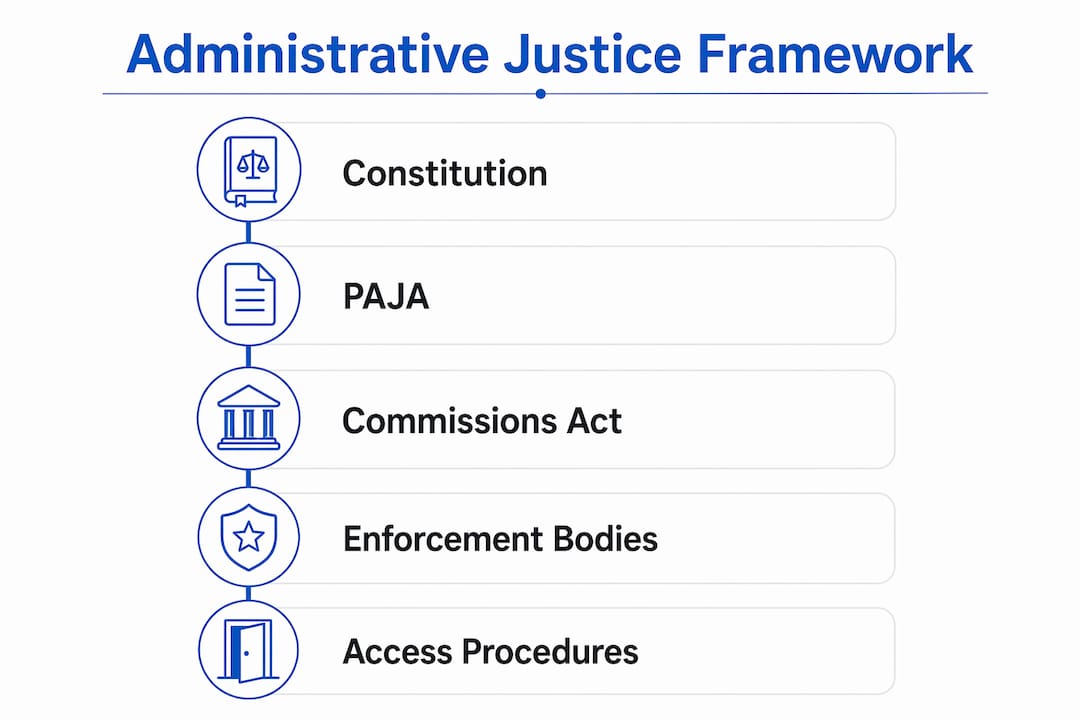
Three statutes do most of the work. The Constitution (1996) is the foundation: Section 33 creates the right to administrative justice, and Section 32 creates the right of access to information. PAJA (2000) operationalises Section 33 by defining what counts as “administrative action” and setting out the grounds on which courts can review public decisions — unlawfulness, unreasonableness, or procedural unfairness. PAIA (2000) operationalises Section 32, giving citizens a statutory mechanism to request records held by public and private bodies.

Commissions of inquiry sit in a specific constitutional space. Their core investigatory functions fall largely outside PAJA’s administrative-action remit and are instead reviewable on rationality and legality grounds. However, when a commission’s decision directly affects a party’s rights — say, a ruling on witness anonymity — PAJA’s fairness duties apply.
How does administrative justice connect to criminal and disciplinary processes?
The connection is sequential, not simultaneous. A commission like the Madlanga Commission establishes facts; it does not adjudicate guilt. Once findings are published, the NPA decides independently whether the evidence supports prosecution. The South African Police Service (SAPS) and the State Security Agency (SSA) each have internal disciplinary frameworks that can run parallel to commission proceedings, but neither process binds the other.
This separation matters for researchers. Commission transcripts are evidentially valuable but carry a different standard than court records: commissions may admit hearsay and media reports that a criminal court would exclude. Treat them as a factual foundation, not as proof of criminal liability.
Administrative justice outcomes: South African examples
The Zondo Commission is a recent illustration. Its reports documented state capture across multiple government departments and formed the factual basis for several NPA referrals. No commission finding itself resulted in a conviction — that required separate prosecutorial action — but the public record it created was indispensable.
The Madlanga Commission follows the same model, focused specifically on criminal infiltration and political interference within SAPS, the NPA, and the SSA. Commissions expose systemic failures that ordinary oversight processes cannot reach, precisely because they combine inquisitorial powers with the ability to hear evidence no court would admit.
Which institutions enforce administrative justice beyond commissions?
Courts are the primary enforcement mechanism. The High Court and Constitutional Court review administrative action under PAJA and can set aside unlawful decisions, remit matters for reconsideration, or award costs. The Public Protector investigates maladministration and has remedial powers, though those powers have themselves been the subject of Constitutional Court litigation. The Auditor-General flags financial irregularities that often trigger PAJA-based reviews. Parliament’s oversight committees can summon ministers and officials, creating political accountability that runs alongside legal accountability.
For police and intelligence matters specifically, the Independent Police Investigative Directorate (IPID) and the Inspector-General of Intelligence provide sector-specific oversight. Their findings can feed into both disciplinary processes and NPA referrals — the same pipeline that Madlanga Commission findings may eventually enter.
How to submit a PAIA request for commission records
When a record is not published on the archive, PAIA is the statutory route. A valid request must include: your full name and contact details, a description of the record precise enough to locate it (hearing day, exhibit number, or witness name), the format you want (electronic or paper copy), and proof of identity. Submit to the Commission’s designated Information Officer.
Processing takes up to 30 days, extendable by a further 30 days in complex cases. Fees apply for reproduction; the request itself carries no charge. If access is refused, you may appeal internally and then to the South African Human Rights Commission or a court.
Pro Tip: Be specific. “All testimony relating to SAPS Crime Intelligence on Day 87” will be processed faster and more accurately than a broad request for “all SAPS records.” Reference the exhibit ID where you know it.
The Madlanga Commission archive: your direct access point
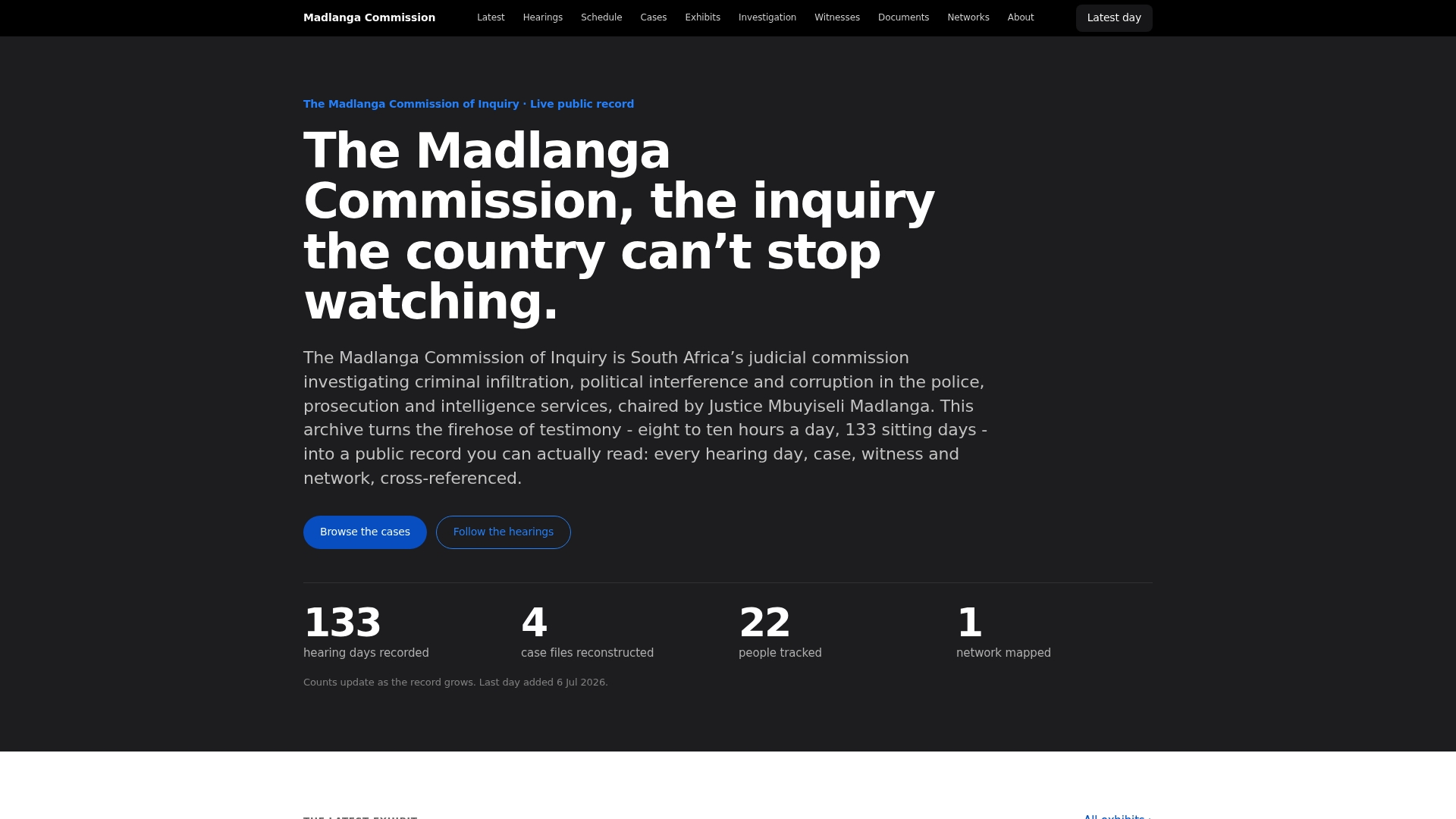
The Madlanga Commission archive is a searchable, structured public record of every hearing day, covering transcripts, exhibits, witness profiles, case files, rulings, and methodology notes. It is free to access and designed specifically for citizens and researchers who cannot follow live proceedings.
Start with a specific hearing day: Day 115 (8 June 2026) and Day 124 (23 June 2026) show how transcripts, exhibits, and witness lists are structured. The methodology page explains redaction decisions and how to cite records in academic or advocacy work. For PAIA requests on unpublished material, the archive’s Information Officer contact details are listed there.
When citing commission records, note the hearing day number, date, witness name, and exhibit ID. That four-part reference satisfies most academic citation standards and makes verification straightforward.
Key Takeaways
Administrative justice in South Africa requires every public decision to be lawful, reasonable, and procedurally fair under PAJA and the Constitution, with the Madlanga Commission archive as the primary public record for researching police and intelligence sector failures.
| Point | Details |
|---|---|
| Constitutional foundation | Section 33 of the 1996 Constitution guarantees the right to administrative justice; PAJA gives it legal teeth. |
| Commissions cannot prosecute | The Madlanga Commission can summon witnesses and compel documents, but enforcement depends on the NPA or executive action. |
| Evidence standards differ | Commissions may admit hearsay and media reports; criminal courts cannot — treat transcripts as factual foundation, not proof of guilt. |
| PAIA is your fallback | For unpublished records, submit a PAIA request with hearing day, exhibit number, and witness name; processing takes up to 30 days. |
| Madlanga Commission archive | The free, searchable archive at madlangacommission.co.za holds daily transcripts, exhibits, witness profiles, and methodology notes. |
FAQ
What is administrative justice under South African law?
Administrative justice is the constitutional right, under Section 33 of the 1996 Constitution and PAJA (2000), to have every public decision be lawful, reasonable, and procedurally fair. Courts can review and set aside decisions that fail any of those three tests.
Can the Madlanga Commission prosecute officials it investigates?
No. The Madlanga Commission is a fact-finding body operating under the Commissions Act of 1947; it can summon witnesses and compel documents, but prosecution is the NPA’s function. Commission findings may inform NPA referrals, but the two processes are legally separate.
How do I access Madlanga Commission hearing records?
Published records are freely available at madlangacommission.co.za, searchable by hearing day, witness name, and exhibit ID. For unpublished records, submit a PAIA request to the Commission’s Information Officer with a precise description of the record you need.
What is the difference between PAJA and PAIA?
PAJA governs the quality of public decisions — it sets the grounds for reviewing administrative action. PAIA governs access to information — it gives citizens the statutory right to request records held by public and private bodies. Both flow from the 1996 Constitution.