What Is the National Prosecuting Authority in South Africa?

TL;DR:
- The National Prosecuting Authority is South Africa’s main body responsible for prosecuting crimes on behalf of the state, but it faces structural challenges due to dependence on the executive branch. Its powers include initiating, managing, and discontinuing criminal cases, with prosecutorial discretion heavily influenced by political oversight. Calls for reform emphasize separating its finances and authority from political control to improve independence and effectiveness.
The National Prosecuting Authority (NPA) is defined as South Africa’s sole constitutionally mandated body responsible for instituting criminal proceedings on behalf of the state. Established under Section 179 of the 1996 Constitution and given operational form by the National Prosecuting Authority Act 32 of 1998, the NPA holds a unique position in South Africa’s justice system. No other body carries the same statutory authority to prosecute crimes at the national level. Understanding what the national prosecuting authority does, how it is organized, and where its limits lie is critical for anyone tracking governance and accountability in South Africa.
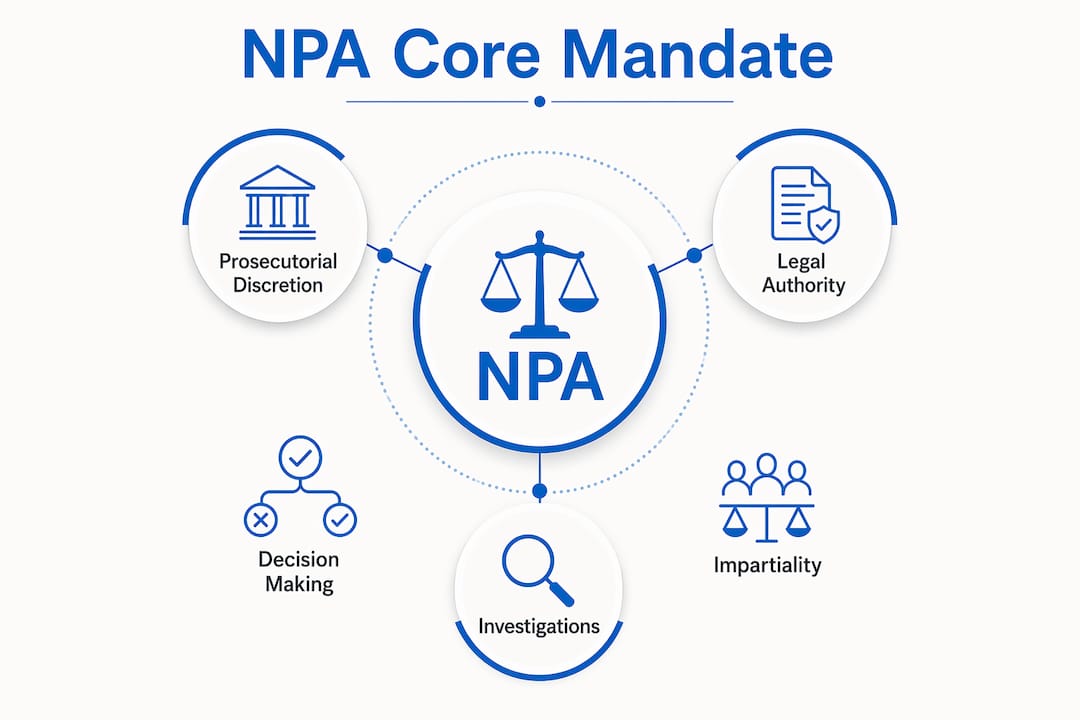
What is the National Prosecuting Authority and its core mandate?
The NPA derives its powers directly from Section 179 of the Constitution and the NPA Act of 1998. These two instruments together define the NPA’s purpose: to prosecute criminal cases on behalf of the South African state. The NPA is not a police body and does not conduct arrests. Its role begins where police investigations end, converting evidence into formal legal proceedings before the courts.

The NPA’s mandate covers every level of criminal prosecution, from ordinary criminal cases in magistrates’ courts to complex corruption trials in the High Court. This breadth makes the NPA functionally equivalent to what many countries call a public prosecutor’s office or, in American terms, a district attorney’s office operating at the national scale. South Africa does not use the term “district attorney,” but the prosecutorial role is comparable: a state-appointed lawyer who decides whether to charge, try, and pursue conviction of an accused person.
The NPA Act also requires the NPA to perform its functions without fear, favor, or prejudice. That phrase appears in Section 179(4) of the Constitution and sets the ethical standard for every prosecutor in the organization. The standard is one of impartiality, not independence. That distinction matters enormously, and it is explored in detail later.
What are the core powers and functions of the National Prosecuting Authority?
The NPA’s legal powers are set out in Section 20(1) of the NPA Act, which grants the authority to institute, conduct, and discontinue criminal proceedings. Each of those three powers carries significant weight.
- Institute proceedings: The NPA decides whether a case goes to court. Police can investigate and arrest, but the NPA alone decides whether to charge a suspect.
- Conduct proceedings: Once a case is in court, NPA prosecutors manage the trial, present evidence, and argue for conviction.
- Discontinue proceedings: The NPA can withdraw charges at any stage if the evidence does not support prosecution. This power is legally significant and politically sensitive.
- Perform incidental functions: The NPA Act also authorizes functions that support prosecution, including witness protection, asset recovery, and legal policy development.
Prosecutorial discretion sits at the center of the NPA’s work. Prosecutors weigh the strength of evidence, the public interest, and the likelihood of conviction before deciding to proceed. This discretion is not unlimited. The National Director of Public Prosecutions (NDPP) sets prosecution policy, and the Minister of Justice has oversight authority under Section 179(5) of the Constitution. That ministerial oversight is a recurring source of tension between legal independence and political accountability.
Pro Tip: If you want to understand how prosecution decisions are made in practice, the Madlanga Commission case files provide real examples of how evidence, policy, and political context intersect in high-profile cases.
How is the National Prosecuting Authority structured?
The NPA operates across national, provincial, and regional levels, with a clear hierarchy that links every prosecutor in the country to a central leadership structure. The NPA is led by the NDPP, who is appointed by the President of South Africa. That appointment process is one of the most debated aspects of the NPA’s design.
The National Director of Public Prosecutions
The NDPP is the head of the NPA and carries final authority over prosecution policy. Deputy National Directors of Public Prosecutions (DNDPPs) support the NDPP and oversee specific portfolios, including specialized prosecutions and court management. Below them, Directors of Public Prosecutions (DPPs) lead prosecution operations in each of South Africa’s provinces.
Specialized units within the NPA
The NPA houses several specialized units that handle categories of crime requiring dedicated expertise:
- Asset Forfeiture Unit (AFU): Recovers assets linked to criminal activity, including proceeds of corruption and organized crime.
- Specialised Commercial Crime Unit (SCCU): Prosecutes fraud, corruption, and financial crimes involving businesses and public officials.
- Investigating Directorate (ID): Created to handle serious corruption cases, particularly those involving state capture and organized crime networks.
- Sexual Offences and Community Affairs (SOCA): Focuses on gender-based violence, child abuse, and community-level crime.
The Investigating Directorate deserves particular attention. Complex corruption cases require specialized prosecutorial focus that ordinary processes cannot provide. The ID was established precisely because standard police investigations proved inadequate for politically sensitive, high-value corruption matters.
What challenges does the NPA face regarding independence and effectiveness?
The NPA’s most significant structural problem is the gap between its impartiality standard and genuine institutional independence. Section 179(4) of the Constitution demands that prosecutors act without fear, favor, or prejudice. That is an ethical obligation, not a structural guarantee. South Africa’s Constitution does not require the NPA to be independent from the executive branch.
This distinction separates South Africa from jurisdictions where prosecutorial independence is explicitly enshrined in law. The practical consequences are significant.
- The President appoints the NDPP, creating a direct line of political influence over the country’s top prosecutor.
- The Minister of Justice holds oversight authority and must concur on prosecution policy under Section 179(5)–(7).
- The NPA is administratively dependent on the Department of Justice, with the Director-General of Justice serving as the accounting officer for NPA finances.
That last point is particularly damaging. An institution that cannot control its own budget cannot fully control its own priorities. The Director-General of Justice approves spending, which means the NPA’s operational choices are subject to executive branch approval at the financial level.
“The NPA’s structural position within the executive branch and its administrative dependence undercut its ability to act with full autonomy, a constitutional design that complicates anti-corruption prosecution efforts.” The result is an institution that is legally required to be impartial but structurally prevented from being fully independent.
The Constitutional Court addressed this tension in the Glenister Two judgment, which mandated a body outside executive control to effectively combat corruption. The NPA, as currently designed, does not meet that standard. This gap has fueled calls for a comprehensive overhaul of the NPA Act rather than incremental adjustments.
Pro Tip: The Madlanga Commission’s latest hearings document how political interference and institutional design failures have played out in real prosecutorial decisions. Reading the testimony gives context that no legal textbook provides.
How does the NPA interact with other institutions in South Africa’s justice system?
The NPA does not operate in isolation. Its effectiveness depends on the quality of investigations it receives from other agencies, and those relationships are often strained.
The South African Police Service (SAPS) conducts most criminal investigations and hands cases to the NPA for prosecution. The problem is that police investigations in high-profile corruption cases frequently fall short of the standard needed for successful prosecution. The best investigators of complex financial crime often sit outside the formal criminal justice system entirely, in bodies like the Special Investigating Unit (SIU) or private forensic firms.
The NPA’s relationship with key institutions breaks down as follows:
- South African Police Service (SAPS): Primary source of criminal investigations. Capacity gaps in SAPS directly reduce the quality of cases reaching the NPA.
- Special Investigating Unit (SIU): Investigates corruption and maladministration in state institutions. The SIU cannot prosecute but refers cases to the NPA.
- Investigating Directorate (ID): An internal NPA unit that conducts its own investigations in serious corruption matters, bypassing SAPS where necessary.
- The courts: The NPA presents cases before magistrates’ courts, High Courts, and the Supreme Court of Appeal. Judicial independence is separate from prosecutorial independence.
Specialized investigative units within the NPA offer a partial remedy to police inefficiency, but they are limited fixes within a system that needs broader reform. The Investigating Directorate, for example, has a narrow mandate and limited resources. It cannot substitute for a fully functional, well-resourced police investigative capacity. Reform proposals consistently call for clearer institutional mandates, better information sharing, and dedicated funding for complex crime prosecution.
Key Takeaways
The NPA is South Africa’s constitutionally mandated prosecuting authority, legally required to act impartially but structurally embedded within the executive branch in ways that limit genuine independence.
| Point | Details |
|---|---|
| Constitutional basis | The NPA is established under Section 179 of the 1996 Constitution and the NPA Act of 1998. |
| Core legal powers | Section 20(1) of the NPA Act grants the power to institute, conduct, and discontinue criminal proceedings. |
| Structural hierarchy | The NDPP leads the NPA, supported by deputies, provincial directors, and specialized units including the AFU and Investigating Directorate. |
| Independence gap | The NPA must act impartially but is not constitutionally independent, with the President appointing the NDPP and the Justice Department controlling finances. |
| Reform pressure | The Glenister Two judgment and commissions like Madlanga have intensified calls for a full overhaul of the NPA Act. |
The design flaw no one wants to fix
The NPA’s core problem is not corruption within its ranks, though that has occurred. The deeper problem is architectural. South Africa’s Constitution created an institution that is expected to prosecute the powerful while remaining financially and administratively dependent on those same power structures. That is not a flaw that better management can fix. It requires legislative redesign.
I have followed the NPA’s trajectory through multiple leadership changes, and the pattern is consistent. When political pressure mounts, the institution bends. Not because prosecutors are cowards, but because the system gives them no structural protection. The NDPP serves at the pleasure of a presidential appointment. The budget sits with the Justice Department. A prosecutor who challenges the wrong person risks institutional consequences that the law does not prevent.
Meaningful reform of the NPA requires a comprehensive overhaul of the NPA Act, not incremental tweaks. That means separating the NPA’s finances from the Justice Department, creating a transparent and merit-based NDPP appointment process, and giving the Investigating Directorate a permanent statutory footing. The Madlanga Commission has surfaced testimony that makes this case with uncomfortable clarity. The key figures in that inquiry include prosecutors, police officials, and intelligence operatives whose accounts reveal how institutional design failures translate into real prosecutorial failures. The reform conversation is no longer theoretical.
— Meriol Lainchyon
The Madlanga Commission as a window into NPA accountability
Citizens who want to understand how the NPA functions in practice, not just in law, have a direct resource in the Madlanga Commission of Inquiry. Chaired by Justice Mbuyiseli Madlanga, the Commission investigates criminal infiltration, political interference, and corruption across South Africa’s police, prosecution, and intelligence sectors.
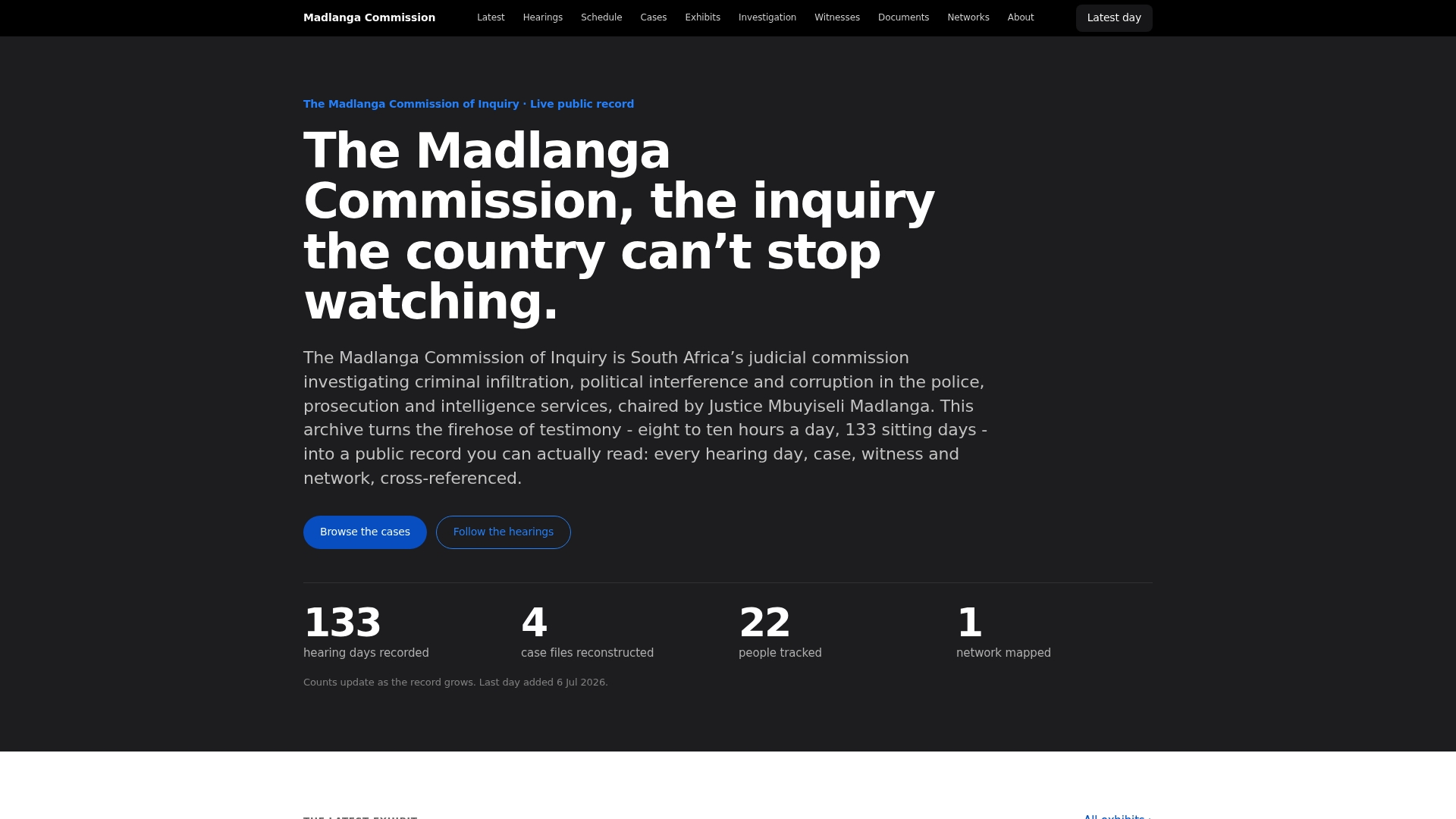
The Commission’s public archive translates dense legal proceedings into accessible records. The full case file archive documents real prosecutorial decisions, institutional failures, and the testimony of witnesses who have direct knowledge of how the NPA operates under pressure. For anyone tracking NPA reform or trying to understand why certain corruption cases stalled, the witness testimony records provide primary source material that no secondary account can replicate. The Madlanga Commission makes accountability visible.
FAQ
What is the NPA’s primary function?
The NPA’s primary function is to institute, conduct, and discontinue criminal proceedings on behalf of the South African state, as defined by Section 20(1) of the NPA Act of 1998.
Is the National Prosecuting Authority independent from government?
The NPA is not constitutionally independent. Section 179(4) requires impartiality, but the President appoints the NDPP and the Department of Justice controls the NPA’s finances.
What is the role of the Investigating Directorate within the NPA?
The Investigating Directorate handles serious corruption and organized crime cases where standard police investigations are insufficient, giving the NPA its own investigative capacity for complex matters.
How does the NPA differ from a district attorney in South Africa?
South Africa does not use the term “district attorney.” The NPA fills a comparable role at the national level, with Directors of Public Prosecutions leading prosecution in each province under the NDPP’s authority.
What reforms are proposed to strengthen the NPA?
Legal experts and commissions including Madlanga call for a full overhaul of the NPA Act, separating NPA finances from the Justice Department and creating a more transparent NDPP appointment process.
Recommended
- Case Files of the Madlanga Commission of Inquiry - The Madlanga Commission Archive
- Key Figures in the Madlanga Commission - Who’s Who
- The R360 million SAPS Medicare24 tender - and Cat Matlala’s guilty plea - Madlanga Commission
- Dr Nolitha Vukuza - Commission Secretary, Madlanga Commission - The Madlanga Commission Archive