Witness credibility factors that actually decide cases
The strongest drivers of witness credibility are consistency, opportunity to observe, clarity, and candour. Demeanour helps, but it rarely proves truth on its own. South African courts split the inquiry into two separate questions: is the witness honest (veracity), and is the witness accurate (reliability)? A witness can fail on one and pass on the other. Multi-factor assessment weighs candour, demeanour, bias, internal and external contradictions, and probability against the observable conditions under which a witness perceived events.
- Consistency between prior statements and testimony
- Clarity and concreteness of sensory detail
- Candour, including admitted uncertainty
- Demeanour, treated as one factor among many
- Opportunity to observe the events described
Reliability turns on conditions, not character. Distance, lighting, stress, and time elapsed since the event shape how much a witness’s account can be trusted, independent of whether that witness is lying.
Key Takeaways
Witness credibility rests on the interaction between honesty (veracity) and accuracy (reliability), and courts weigh both against corroboration rather than trusting demeanour alone.
| Point | Details |
|---|---|
| Separate veracity from reliability | Test honesty and accuracy as distinct questions; a sincere witness can still be wrong. |
| Treat demeanour as one factor | Courts caution against dispositive weight on composure or confidence alone. |
| Prioritise observation conditions | Distance, lighting, stress, and delay all degrade reliability independent of honesty. |
| Use the hearsay gateways | Section 3 admits hearsay only through consent, declarant testimony, or the interests of justice. |
| Corroborate single witnesses | Cautionary rules require testing opportunity to observe before relying on one account. |
Table of Contents
- Why witness credibility factors decide cases and appeals
- Core credibility factors: consistency, clarity, demeanour and authenticity
- Reliability: how perception and memory limit accuracy
- Legal rules and precedent on hearsay and single witnesses
- How to assess and challenge witness credibility step by step
- Preparing witnesses without coaching their testimony
- What the Madlanga Commission’s public hearings show about credibility
- Impact of cultural and language differences on witness credibility
- Role of expert testimony in evaluating witness credibility
- Psychological factors that shape witness credibility
- Differences in credibility assessment between civil and criminal cases
- Effect of witness demeanor under cross-examination
- Theory meets practice in credibility assessment
- Sources
- FAQ
Why witness credibility factors decide cases and appeals
Credibility findings don’t just colour a judgment. They often are the judgment. When physical evidence runs out, courts fall back on whose version is more probable, and that calculation rests entirely on how carefully credibility was tested.
- A single credibility finding can shift the balance of probabilities in a civil dispute or seal a conviction in a criminal trial.
- Appellate courts scrutinise trial courts that lean too heavily on how a witness “came across,” preferring findings anchored in corroboration.
- Where a magistrate’s demeanour-based finding is overturned, it is almost always because the record shows no independent facts backing that impression.
Appellate tribunals frequently modify or reverse verdicts built disproportionately on demeanour or uncorroborated single-witness testimony, particularly where the trial record lacks contemporaneous notes on how the witness handled cross-examination. That is why preserving a clear cross-examination record matters as much as winning the exchange itself.
Core credibility factors: consistency, clarity, demeanour and authenticity
Every experienced cross-examiner tests the same handful of markers. Knowing what each one actually measures, and what it doesn’t, separates useful scrutiny from theatre.
- Consistency. Compare the witness’s police statement, deposition, and oral testimony line by line. Minor discrepancies in timing or sequence rarely sink a witness. Courts routinely accept that some inconsistency is normal and focus instead on whether the account holds together on material facts.
- Clarity. Specific, concrete detail (a street name, a distinctive smell, the exact number of steps climbed) tends to correlate with genuine recall. Vague, generic descriptions (“it was dark, I saw a man”) deserve more scrutiny, not less.
- Demeanour. Confidence, eye contact, and composure are the most overrated cues in the room. Courts have been warned repeatedly that demeanour is an important fixture but never dispositive on its own, because nervous honest witnesses and composed dishonest ones both exist.
- Authenticity and plausibility. A witness who says “I don’t remember that part” is often more credible than one with a suspiciously seamless narrative. Genuine gaps in memory are normal; a story with zero rough edges can be a red flag.
Pro Tip: When a witness answers a hard question with confident, over-elaborate detail on a point they should struggle to recall, treat that as a reliability flag rather than a mark of honesty.
The trap most investigators fall into is rewarding confidence and punishing hesitation. Confident witnesses are frequently mistaken witnesses. Reliability and conviction in delivery are not the same thing.
Reliability: how perception and memory limit accuracy
Honesty is only half the equation. Even a scrupulously honest witness can be wrong, because human perception and memory are not recording devices. Decades of research on eyewitness identification point to a consistent set of conditions that degrade accuracy regardless of how sincere the witness is.
- Opportunity to observe: distance from the event, ambient lighting, duration of exposure, and viewing angle all cap how much detail a witness could plausibly retain.
- Stress and arousal: high-stress incidents, especially those involving a weapon, narrow attention onto the threat itself. This is the well-documented “weapon focus” effect, and it comes at the cost of peripheral detail like a perpetrator’s face.
- Intoxication, age, and cross-race identification each independently reduce the accuracy of recall and recognition.
- Retention interval: the longer the gap between the event and the statement, the more memory degrades and reconstructs itself, sometimes with false confidence attached.
Watch for vague timing that keeps shifting between tellings, sensory detail that would be implausible given the stated conditions (naming a shirt colour from thirty metres in the dark), and accounts that grow more detailed with each retelling rather than less. Memory should fade, not sharpen, with time.
Legal rules and precedent on hearsay and single witnesses
Two doctrines dominate South African credibility law: the treatment of hearsay and the cautionary approach to single witnesses. Both give practitioners a structured way to test admissibility before a case ever reaches oral argument.
- Hearsay is presumptively excluded unless it clears one of three gateways under Section 3 of the Law of Evidence Amendment Act: the parties consent, the person whose credibility underpins the statement testifies, or the court admits it in the interests of justice.
- Where the third gateway is invoked, courts weigh probative value, the reason the original declarant cannot testify, and prejudice to the opposing party. Provisional admission is possible where that declarant is expected to testify later.
- Single-witness testimony triggers a cautionary approach rather than automatic disbelief. S v Cupido confirms courts must test opportunity to observe and seek corroboration before convicting on one account alone.
- Preserve credibility arguments for appeal by insisting on a full record of demeanour observations, cross-examination exchanges, and the specific factors a trial court weighed.
| Hearsay gateway | Practical trigger |
|---|---|
| Consent | All parties agree to admit the statement |
| Declarant testifies | The person behind the statement takes the stand |
| Interests of justice | Court weighs probative value, prejudice, and reason for absence |
How to assess and challenge witness credibility step by step
Assessing witness reliability is a discipline, not an instinct. The strongest cross-examiners and investigators work from a checklist, not a hunch.
- Pull every prior account first. Police statements, affidavits, medical intake notes, and any recorded interviews go into a single timeline before you touch the witness live.
- Cross-reference against objective records. CCTV footage, cell tower data, and access logs test a witness’s account against facts that can’t lie.
- Map contact history and motive. Who spoke to the witness before the statement was taken, and does the witness have a financial, personal, or political stake in the outcome?
- Build cross-examination around gaps, not gotchas. Target inconsistencies between the witness’s own prior statements rather than trying to trap them on unrelated detail.
- Bring in corroboration deliberately. A second independent witness, a document, or forensic evidence does more to move a credibility finding than an hour of aggressive questioning.
Pro Tip: Ask the same factual question two different ways, ten minutes apart. A witness reciting a rehearsed script often answers identically both times; a witness recalling a real event usually varies the phrasing while keeping the substance consistent.
Expert memory testimony, drawn from the same eyewitness research already discussed, can be decisive where the entire case rests on one identification and no corroborating evidence exists.
Preparing witnesses without coaching their testimony
Preparation should sharpen honest recall, not manufacture certainty. The line between the two is where credibility risk lives.
- Teach witnesses that “I don’t recall” is a complete, acceptable answer. Guessing to fill a gap is what creates the inconsistency that later gets exploited.
- Run a mock question-and-answer session against the witness’s own prior statements, specifically to catch places where memory has drifted since the original account was given.
- Coach delivery, not content: slower pacing, deliberate breathing before answering, and pausing to think all read as composure rather than evasion.
Pro Tip: Never rehearse the exact wording of an answer. Rehearsing content, rather than delivery, is what produces the suspiciously identical phrasing that opposing counsel will flag as coached.
What the Madlanga Commission’s public hearings show about credibility
Live inquiry records offer something case law can’t: a real-time view of credibility being tested in front of the public. The testimony from Witness K, an Inspector attached to the VIP Protection Unit, and Witness I, a Hawks narcotics team leader, both show how corroborating documents and communications records were used to test accounts that demeanour alone could never have settled.
- Compare a witness’s hearing testimony against exhibits and prior statements posted in the same case file.
- Use daily hearing transcripts to build your own cross-examination timeline before a similar witness testifies elsewhere.
- Review witness profiles directly through the Commission’s public archive rather than relying on secondhand summaries.
Impact of cultural and language differences on witness credibility
A witness testifying through an interpreter faces a credibility penalty that has nothing to do with honesty. Pauses for translation can read as hesitation. Directness that’s culturally normal in one community can read as evasive or blunt in another courtroom setting, and vice versa.

Eye contact is the clearest example. In many Western legal traditions, sustained eye contact signals confidence and honesty. In several African, Asian, and Indigenous cultural contexts, avoiding direct eye contact with authority figures is a sign of respect, not deception. A cross-examiner or fact-finder unaware of that distinction risks misreading a respectful witness as a shifty one.
Translation itself introduces a second layer of risk. Interpreters render meaning, not just words, and nuance gets lost in the gap between languages, especially around concepts of time, quantity, and certainty that don’t map cleanly from one language to another. A witness who says something equivalent to “around midday” in their first language might have that rendered as a specific time in English, creating an apparent inconsistency that was never in the original testimony.
Practitioners should build interpreter competence checks into their credibility assessment, ask witnesses to clarify culturally specific expressions rather than accepting a literal translation, and treat pauses, indirect answers, or restrained affect as neutral until context rules out an innocent cultural explanation. Demeanour assessment without cultural literacy is not a minor gap. It’s a systematic source of misjudged credibility.
Role of expert testimony in evaluating witness credibility
Expert witnesses don’t testify about whether a particular witness is lying. Courts reserve credibility findings for the fact-finder. What experts contribute is the science that explains why an otherwise honest witness might still be wrong.
A psychologist or memory researcher can testify about the general effects of stress, weapon focus, or retention interval on recall accuracy, without ever opining on the specific witness in front of the court. That distinction matters procedurally: expert evidence frames the conditions under which memory degrades, and the fact-finder then applies that framework to the witness’s actual account.
A science-based approach to eyewitness reliability, drawing on psychological research into stress effects and memory decay, increasingly complements traditional credibility assessment rather than replacing it. This matters most in identification cases where a single eyewitness account carries the whole prosecution or defence, and no amount of confident demeanour can substitute for testing the observation conditions scientifically.
Forensic document examiners, digital forensics specialists, and medical experts serve a related but distinct function: they corroborate or contradict specific factual claims within testimony, giving the fact-finder objective anchors to weigh against the witness’s own account.
Psychological factors that shape witness credibility
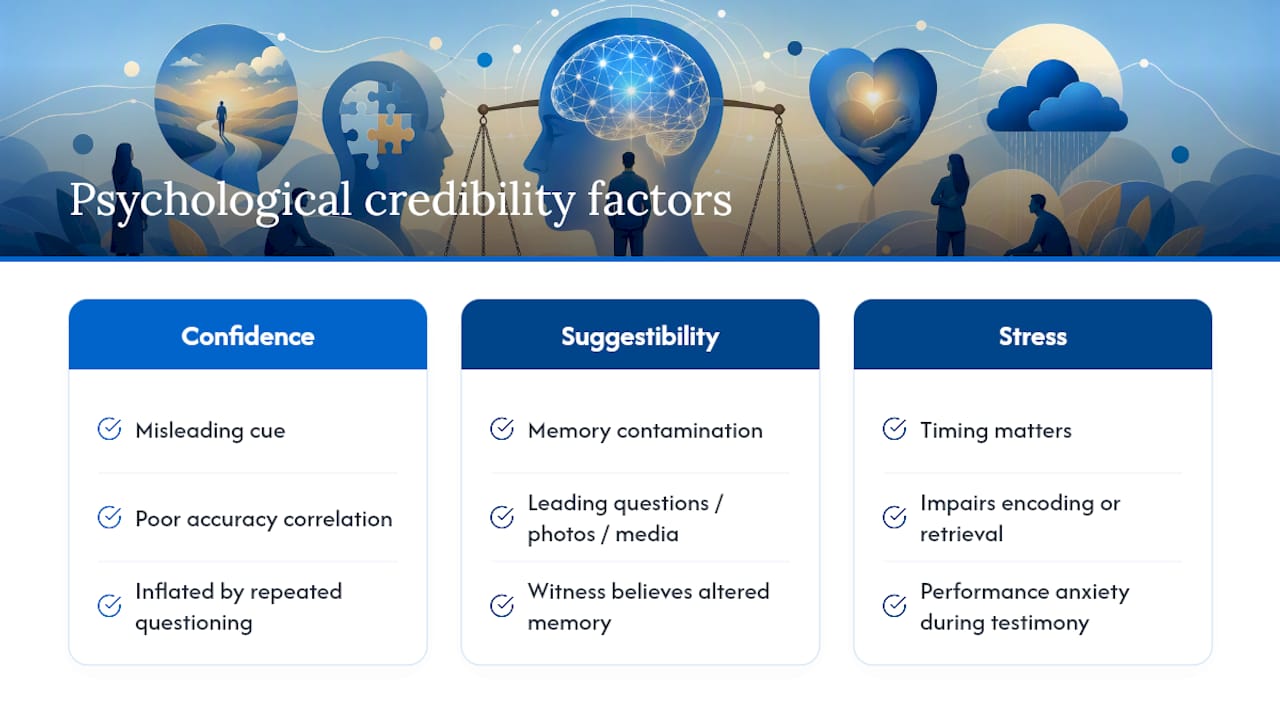
Confidence is the single most misleading psychological cue in witness assessment. Studies on eyewitness identification consistently find that a witness’s certainty about an identification correlates poorly with actual accuracy, particularly when that confidence builds after the event through repeated questioning or exposure to other information.
Suggestibility compounds the problem. Witnesses who are asked leading questions, shown a suspect’s photograph before a lineup, or exposed to media coverage of a case can unconsciously incorporate that outside information into their own memory. The witness genuinely believes the resulting account is their original recollection. This isn’t dishonesty. It’s how human memory reconstructs itself every time it’s accessed.
Stress at the time of the original event affects encoding, but stress during testimony affects retrieval and presentation. A witness who freezes, stumbles, or over-explains under cross-examination isn’t necessarily lying; they may simply be experiencing acute performance anxiety that has nothing to do with the accuracy of their account.
Investigators and litigators should ask, before every interview or deposition, whether the witness has been exposed to leading questions, media coverage, or conversations with other witnesses since the event. Document that exposure. It becomes essential material for testing reliability later.
Differences in credibility assessment between civil and criminal cases
The standard of proof changes everything about how aggressively credibility gets tested. Criminal cases require proof beyond reasonable doubt, so a credibility gap that would tip a civil case can still leave a criminal court unconvinced.
In civil litigation, credibility findings often resolve through the balance of probabilities. When two witnesses give conflicting but equally plausible accounts, courts lean on objective probabilities, independently verifiable facts like documents, timestamps, and third-party records, to tip the scale rather than resolving purely on subjective impressions of who seemed more truthful.
Criminal cases carry heavier institutional caution, particularly around single-witness identification testimony, precisely because the consequences of a wrongful credibility finding are irreversible liberty, not just a monetary judgment. That’s why the cautionary rule for single witnesses is a criminal law doctrine with real teeth, while civil courts have more latitude to decide close calls on the weight of probabilities alone.
Practically, this means a civil litigator should invest heavily in documentary corroboration to move probability findings, while a criminal defence practitioner should focus disproportionate energy on testing the observation conditions and corroboration behind any single-witness identification.
Effect of witness demeanor under cross-examination
Cross-examination is where composed witnesses often become unravelled, and where genuinely honest witnesses sometimes look their worst. Both outcomes are common, and neither should be read at face value.
A witness who grows defensive, repeats stock phrases, or refuses to concede obviously minor points under sustained questioning is giving the fact-finder something to weigh, but it’s evidence, not proof. Genuine witnesses under prolonged, aggressive questioning frequently show frustration or fatigue that has nothing to do with dishonesty.
Conversely, a witness who remains unnaturally composed through hours of pointed questioning, never conceding a single point or showing any emotional variation, can raise its own flag, particularly if the subject matter would reasonably provoke some reaction in a truthful witness.
The safest approach for fact-finders is to log demeanour observations contemporaneously rather than reconstructing an impression afterward, and to treat demeanour shifts under cross-examination as corroborating detail alongside the actual substance of what changed in the testimony, not as a standalone verdict on the witness’s honesty.
Theory meets practice in credibility assessment
The conventional advice on witness credibility spends too much time on demeanour and not nearly enough on documented observation conditions. Every trial advocacy course teaches you to watch how a witness holds themselves under pressure. Almost none of them teach you to reconstruct the lighting, distance, and duration a witness had to actually perceive what they claim to have seen. That’s backward, and the research on eyewitness reliability backs that up consistently.
What actually moves a credibility finding is unglamorous: prior statements lined up side by side, phone records that confirm or kill a timeline, and a second independent account that either matches or doesn’t. If you’re preparing a witness or cross-examining one, spend your limited preparation time there first. Demeanour coaching is the last five percent, not the foundation.
The Madlanga Commission archive is a useful proving ground precisely because it makes this visible in public. Anyone can compare a witness’s live testimony against the exhibits and prior statements sitting in the same case file, and see for themselves how often the paper trail, not the performance, ends up carrying the finding.
Sources
- University of Pretoria repository: credibility and reliability in South African courts
- Western Cape High Court decision (2025) on credibility and probabilities
- Law of Evidence Amendment Act (Act 45 of 1988) — Government of South Africa
- PER journal (2016) — eyewitness identification research and legal implications
- S v Cupido (2024) — Supreme Court of Appeal (summary and holdings)
FAQ
What Are the Three Main Factors of Witness Credibility?
Courts generally look at consistency, opportunity to observe, and candour, with demeanour treated as a supporting factor rather than a standalone test of truth.
What Are the Four C’s of an Expert Witness?
Definitions vary by jurisdiction and commentator, but the qualities most commonly cited for expert witnesses are competence, credibility, clarity, and candour in presenting an independent opinion.
What Are Examples of Witness Credibility in Practice?
A witness who gives concrete sensory detail, admits uncertainty where it exists, and whose account matches independent evidence like CCTV or phone records is showing strong credibility indicators.
How Do You Prove a Witness Is Not Credible?
Show material inconsistencies between their prior statements and current testimony, expose bias or motive, and demonstrate that their opportunity to observe the event was too limited to support the level of detail they claim.
Does Perjury Undermine an Entire Witness’s Testimony?
A finding of dishonesty on one point damages veracity generally, but courts still weigh the rest of the testimony against corroboration rather than automatically discarding it entirely.
Recommended
- Witness K - Inspector, VIP Protection Unit, Johannesburg Metro Police Department (JMPD), Madlanga Commission
- Witness I - Hawks narcotics team leader (SANEB), Madlanga Commission
- The Big Five cartel - Madlanga Commission
- Zelda Maphosho - Assistant Director of Investigations, IPID, Madlanga Commission