Abalone sentence explained: statutes, cases, and records

TL;DR:
- An abalone sentence in South Africa refers to punishments for illegal abalone crimes, often linked to organized crime. Courts impose severe penalties, especially when racketeering charges under POCA are involved, including life imprisonment. Effective sentences are usually reduced through concurrent running, but the presence of POCA indicates harsher potential penalties.
An abalone sentence in South Africa refers to a judicial punishment handed down in prosecutions tied to illegal abalone harvesting, possession, or trade, and, where organised criminality is proven, to related corruption and racketeering. The phrase is shorthand used in media and legal commentary, not a formal charge label. The governing statutes are the Marine Living Resources Act (MLRA) and, in syndicate cases, the Prevention of Organised Crime Act (POCA). On 1 September 2023, two DAFF officials pleaded guilty under section 112 of the Criminal Procedure Act for colluding with poachers, with one receiving direct imprisonment.
Key facts at a glance:
- MLRA alone: fines up to R800,000 or up to two years per count
- POCA racketeering: fines up to R1 billion or life imprisonment
- Officials have received direct imprisonment, not suspended terms
- Primary records are searchable in the Madlanga Commission archive
“The sentences imposed in cases involving racketeering activities provide an illustration of the seriousness with which our courts view organised crime as opposed to standalone abalone poaching.” — Roberts and Others v S, Eastern Cape High Court, 2015
Table of Contents
- What does an abalone sentence actually cover?
- Which statutes do prosecutors actually use?
- How do judges decide how long the sentence is?
- Notable cases and documented sentences
- Why prosecutors add POCA to every serious indictment
- How to find primary records and exhibits
- What citizens, NGOs, and journalists can do
- What qualifies as an abalone offence under South African law?
- What judicial principles guide sentencing consistency?
- Do abalone sentences actually deter poaching?
- Key Takeaways
- Why the Commission record changes what we know about these sentences
- The Madlanga Commission archive: where to verify the record
- Useful sources
- FAQ
What does an abalone sentence actually cover?
The phrase groups several distinct offences that commonly appear together on a single indictment. Courts and journalists use it loosely; the formal charge sheet is more precise.
Typical offences charged:
- Unlawful fishing, collecting, or possession of abalone without a permit (MLRA Regulation 36)
- Possession of abalone not in a whole state
- Selling, delivering, or acquiring abalone without a valid invoice
- Conducting or participating in an enterprise through a pattern of racketeering (POCA s2(1)(e))
- Corruption of government officials (DAFF, DEFF, or SAPS)
- Money laundering
Defendants span the full supply chain. Harvesters and divers sit at the bottom, often with limited knowledge of the enterprise above them. Weight-house operators, processors, and transport intermediaries occupy the middle tier. At the top sit organisers who coordinate tiered criminal enterprises, corrupt officials, and export brokers. POCA targets that top tier specifically.
Which statutes do prosecutors actually use?
| Statute | Key provision | Maximum penalty |
|---|---|---|
| MLRA (unlicensed fishing) | Reg. 36(1)(b) | R800,000 fine or 2 years per count |
| MLRA (unlicensed FPE) | — | R2 million fine or 5 years |
| POCA (racketeering) | s2(1)(e) | R1 billion fine or life imprisonment |
| Criminal Procedure Act | s112 plea; s276 sentencing | Governs plea agreements and sentence form |
The MLRA sets the baseline. POCA changes the ceiling entirely. A conviction under POCA s2(1)(e) alone can attract life imprisonment, which is why prosecutors add it whenever evidence supports an enterprise finding.

Pro Tip: Check the indictment for “s2(1)(e) POCA” before interpreting any reported sentence. Its presence signals that the court had access to far harsher penalties and that the effective term reflects a negotiated or judicially moderated outcome, not the statutory maximum.
Plea agreements under Criminal Procedure Act section 112 are common in high-profile syndicate cases. They produce aggregate headline totals that look alarming on paper but are reduced through concurrent running. Section 276 governs the form of the sentence itself, including whether imprisonment is direct or wholly suspended.
How do judges decide how long the sentence is?
Courts weigh aggravating and mitigating factors against each other. The balance shifts dramatically depending on the defendant’s role.
Aggravating factors courts emphasise:
- Environmental destruction of a protected marine resource
- Organised enterprise structure (weight houses, processors, corrupt officials)
- Scale and weight of abalone seized
- Official status of the defendant (a SAPS or DAFF officer receives no leniency for breach of trust)
- Repeat offending or prior convictions for similar conduct
Mitigating factors:
- Low-level diver role with limited enterprise knowledge
- First-time offender status
- Cooperation with investigators
- Guilty plea and plea agreement
“Judges routinely treat the destruction of marine resources as an aggravating factor — courts can and do raise sentences to reflect ecological harm, not only the rand value of the theft.” — ZAWCHC 170/2019
The distinction between a total sentence and an effective sentence matters enormously. When a defendant faces multiple counts, the court may order sentences to run concurrently rather than consecutively. Solomon Sauls was sentenced to 244 years in aggregate across 42 counts, but the court ordered concurrent running, producing an effective term of 18 years.
Notable cases and documented sentences
-
State v Brown and others (CC 18/2017): Multiple defendants convicted of MLRA offences and POCA racketeering. Effective sentences of 15 years (180 months) and 18 years (216 months) after concurrent running. The case established a direct link to Chinese crime syndicates over a protracted period involving thousands of kilograms of abalone.
-
Solomon Sauls (Western Cape High Court, 2021): 42 charges including 16 counts of corruption, two counts of money laundering, and multiple MLRA contraventions. Aggregate total of 244 years; effective sentence of 18 years after concurrency. Sauls bribed DAFF officials to return confiscated abalone and to prevent seizures.
-
DAFF officials (September 2023): Two officials pleaded guilty under section 112 for colluding with poachers, escorting illegal shipments, and selling back seized stock. One received five years direct imprisonment; the other received suspended terms.
-
Preston Paul Julies (Western Cape High Court, 2021): Five years for POCA racketeering, five years for each of two corruption counts (concurrent), and two years for possession and transport counts (wholly suspended for five years).
| Case | Primary charges | Effective sentence | Primary record |
|---|---|---|---|
| State v Brown (CC 18/2017) | MLRA + POCA | 15–18 years | UNODC case-law summary |
| Solomon Sauls (2021) | MLRA + POCA + corruption | 18 years | Daily Maverick / NPA statement |
| DAFF officials (2023) | Corruption + MLRA | 5 years (direct) | SAPS pressroom |
| Preston Julies (2021) | POCA + corruption + MLRA | 5 years | News24 / Hawks statement |
Why prosecutors add POCA to every serious indictment
POCA is not added reflexively. Prosecutors add it when evidence supports an enterprise finding, and the strategic logic is deliberate. State prosecutors describe POCA as a tool to reach enterprise organisers rather than only the harvesters who get wet. The charge reflects the systemic damage caused by syndicates, not just the value of a single haul.
The process typically runs:
- Seizure of abalone, vehicles, and financial records
- Tracing transaction trails linking harvesters to weight houses and processors
- Identifying corrupt officials who facilitated the enterprise
- Building a POCA indictment that names the enterprise and its participants
- Negotiating plea agreements that produce effective sentences with deterrent weight
Legal analysts Michael Kidd and Shannon Hoctor note a clear trend toward racketeering charges as courts seek sentences proportionate to the environmental and societal harm caused, not merely the street value of the catch.
How to find primary records and exhibits
- Go to the Madlanga Commission case files and search by accused name, hearing day, or exhibit ID.
- Use the Commission exhibits archive to locate physical evidence records such as the Port Shepstone 541kg seizure.
- Search SAFLIi (www.saflii.org) using “State v Brown abalone” or “Roberts v S abalone racketeering” for full judgment text.
- Check the SAPS pressroom for conviction announcements, which list section references and sentence terms.
- Record document metadata: case number, hearing day, exhibit ID, and date accessed. You will need these for FOI requests or formal citations.
Pro Tip: When citing a Commission exhibit, note the exhibit number, the hearing day it was introduced, and the evidence leader who tendered it. That three-point reference is what distinguishes a citable primary record from a press summary.
What citizens, NGOs, and journalists can do
Monitoring and documentation:
- Follow hearing days on the Madlanga Commission archive and flag new abalone-related exhibits
- Cross-reference SAPS press releases with court records to verify sentence accuracy
- Preserve screenshots and PDFs with full metadata before pages are updated
Follow-up actions:
- Submit Promotion of Access to Information Act (PAIA) requests to the NPA or DAFF for docket records on specific cases.
- File evidence of official collusion with watchdog NGOs such as Corruption Watch or the Helen Suzman Foundation.
- Contact the relevant parliamentary oversight committee (Portfolio Committee on Police or Forestry, Fisheries and the Environment) with documented findings.
- For legal remedies related to law enforcement misconduct, consult a specialist practitioner familiar with South African public-law litigation.
Journalists handling witness testimony should avoid publishing identifying details that could compromise ongoing proceedings or endanger sources. Chain-of-evidence metadata must be preserved unaltered.
What qualifies as an abalone offence under South African law?
The MLRA and its regulations define the threshold. Possession of abalone without a permit, possession not in a whole state, and selling or acquiring abalone without a valid invoice are all discrete offences. Ernst Hendrik Theunis Muller’s 2025 Khayelitsha conviction illustrates the lower end: a R30,000 fine or 12 months for possession of fish, and 24 months wholly suspended for the abalone-specific counts.
The threshold for a POCA charge is higher. Prosecutors must show a pattern of racketeering activity, meaning at least two related predicate offences committed as part of an enterprise. A single possession charge does not qualify. Once the pattern is established, every participant in the enterprise, not only the harvester, becomes liable.
What judicial principles guide sentencing consistency?
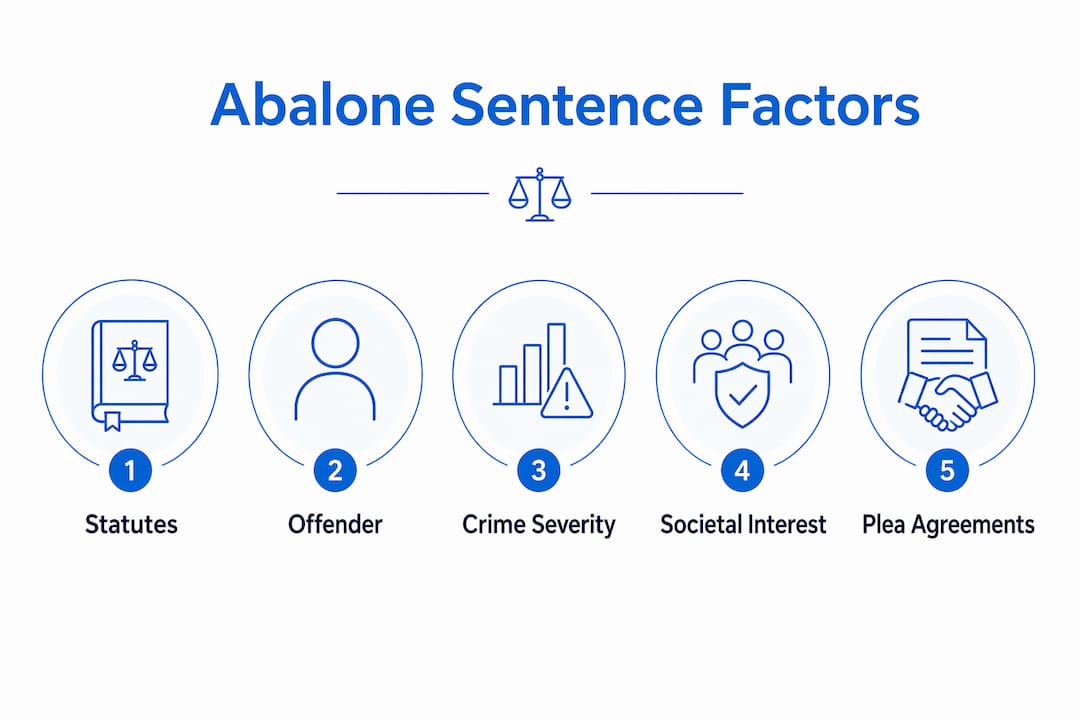
South African courts apply the triad from S v Zinn: the offence, the offender, and the interests of society. For abalone matters, the interests-of-society leg carries unusual weight because the resource is both ecologically threatened and economically significant to coastal communities.
Courts in the Western Cape High Court have consistently treated organised abalone crime as more serious than equivalent-value property offences, precisely because of the environmental dimension. The Roberts appeal confirmed that POCA racketeering convictions warrant sentences in the 15–18 year range even where individual MLRA counts would attract only two years each.
Do abalone sentences actually deter poaching?
The honest answer is mixed. Sentences in the 15–18 year range for kingpins have not eliminated the trade, but they have shifted prosecutorial focus toward enterprise leaders rather than divers. Community awareness in Western Cape coastal towns has grown alongside high-profile convictions, with local NGOs using sentence announcements as public education moments.
The conservation impact is indirect. Sentences reduce the operational capacity of specific syndicates temporarily, but new networks form. The more durable effect may be the asset forfeiture that accompanies POCA convictions, which strips the financial infrastructure syndicates depend on.
Key Takeaways
South African abalone prosecutions turn on one variable above all others: whether POCA appears on the indictment, because that single charge shifts the sentencing ceiling from two years to life imprisonment.
| Point | Details |
|---|---|
| POCA changes the stakes | POCA racketeering convictions carry penalties up to life imprisonment, far beyond MLRA-only charges. |
| Officials face direct imprisonment | DAFF officials received five years direct imprisonment in 2023 for colluding with poachers. |
| Aggregate vs effective sentence | Solomon Sauls’s 244-year aggregate became an 18-year effective sentence through concurrent running. |
| Primary records are accessible | The Madlanga Commission archive holds exhibits, hearing transcripts, and witness profiles for public verification. |
| Madlanga Commission as verification tool | Search the Commission’s case files and exhibits archive to confirm sentence facts beyond press summaries. |
Why the Commission record changes what we know about these sentences
Most public understanding of abalone sentences comes from press releases, which report the headline number and little else. The Madlanga Commission archive does something different: it places exhibits like the Port Shepstone 541kg seizure and the Aeroton cocaine haul into a documented evidentiary chain, with hearing-day context, evidence-leader attribution, and cross-referenced witness testimony.
Testimony from witnesses such as Colonel Brian Padayachee connects enforcement gaps directly to corruption, showing not just that officials were bribed but how the operational mechanics worked. That level of granularity is what turns a press summary into a traceable, citable record. For anyone researching police misconduct in the context of abalone syndicates, the Commission’s primary materials are the starting point, not a supplement to media coverage.
The Madlanga Commission archive: where to verify the record
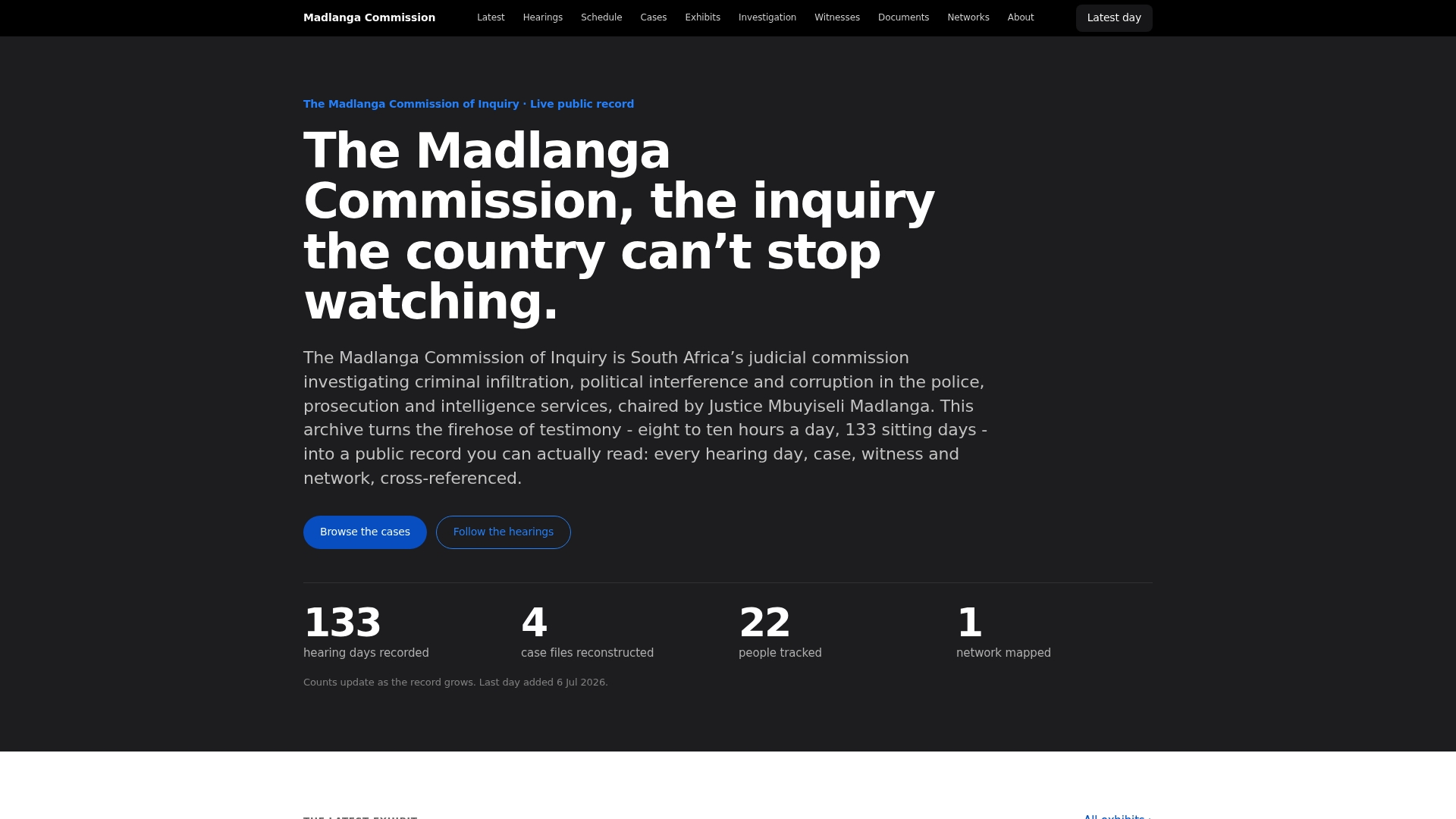
The Madlanga Commission archive is the most direct route to primary evidence on abalone-related corruption in South Africa. Hearing transcripts, witness profiles, and exhibit files, including the Aeroton cocaine bust and Port Shepstone seizure records, are publicly available and searchable by case name, exhibit ID, or hearing day. Start at the evidence leaders page to understand how exhibits were collated and who tendered them. Every record is free to access, and the archive is updated as proceedings continue.
Useful sources
Primary records (court judgments and commission exhibits):
- State v Brown and others (CC 18/2017): UNODC case-law summary with sentence details and enterprise analysis
- Roberts and Others v S (CA10/2015): Full Eastern Cape High Court judgment on POCA racketeering sentences
- SAFLII ZAWCHC 45/2018: Western Cape High Court statutory penalty analysis (MLRA and POCA maximums)
- SAFLII ZAWCHC 170/2019: Judgment citing environmental destruction as a sentencing aggravator
- Madlanga Commission exhibits archive: madlangacommission.co.za/exhibits
- Port Shepstone exhibit page: madlangacommission.co.za/exhibits/port-shepstone-cocaine
Secondary sources (media and analysis):
- SAPS pressroom: conviction announcements with section references and sentence terms
- Daily Maverick (February 2021): Solomon Sauls 18-year effective sentence and NPA commentary
- News24 (February 2021): Preston Julies five-year POCA sentence
- IOL (April 2025): Ernst Muller Khayelitsha conviction and suspended sentence
- Kidd and Hoctor, Obiter vol. 26(2): legal analysis of racketeering sentencing trends
FAQ
What is an abalone sentence in South Africa?
An abalone sentence is a judicial punishment for offences involving illegal abalone harvesting, possession, or trade under the MLRA, and, where an organised enterprise is proven, under POCA. The phrase is media shorthand, not a formal charge label.
How long are typical abalone sentences?
Sentences range from fines and suspended terms for low-level possession to 15–18 years effective imprisonment for POCA racketeering convictions, as seen in State v Brown and the Roberts appeal.
Can government officials receive direct imprisonment for abalone crimes?
Yes. Two DAFF officials received direct imprisonment, one for five years, after pleading guilty in September 2023 to colluding with poachers and selling back seized abalone.
What is the difference between a headline sentence and an effective sentence?
A headline sentence is the aggregate total across all counts. An effective sentence is what the accused actually serves after the court orders concurrent running. Solomon Sauls’s 244-year aggregate became an 18-year effective sentence.
Where can I verify abalone sentence records in South Africa?
Search the Madlanga Commission archive at madlangacommission.co.za for exhibits and hearing transcripts, SAFLIi for full court judgments, and the SAPS pressroom for conviction announcements.
This article is general information for research and public-interest purposes, not legal advice. Confirm current statutory provisions and case outcomes with a qualified South African legal practitioner or the relevant primary source.