Dr Ntandazo Sifolo’s NICOC testimony: what the record shows

Dr Ntandazo Sifolo, the acting head of the National Intelligence Coordinating Committee (NICOC), has not yet given evidence to the Madlanga Commission. He was set down to start on Day 183, 13 October 2026. The commission’s evidence leaders asked for his testimony to be heard behind closed doors, and the chairperson’s ruling sent that question back to NICOC. As of 29 October 2026 his testimony had no date. Below is what happened, what the ruling means, and how to follow it.
TL;DR
- Dr Sifolo has given no evidence to the commission yet. His profile in our archive records that no allegation has been made against him on the commission’s record.
- The evidence leaders applied for his whole testimony to be heard in camera because it relies on intelligence documents declassified for the commission’s use only.
- The chairperson did not grant or refuse the application. He ordered the evidence leaders to ask NICOC which documents could be used in public.
- Dr Sifolo then agreed that pages of six documents may be shown publicly, nine may be used in questioning but not displayed, and fourteen may not be used in open hearings at all.
- His testimony was still unscheduled at the last report. Check his profile and the hearing pages for the current position.
Table of Contents
- Who Dr Sifolo is and why his evidence matters
- Timeline: from the 13 October slot to the ruling
- Why the evidence leaders wanted it in camera
- What the 22 October ruling actually decided
- Which documents can be public and which cannot
- What this means for the public record
- Is there an intelligence inquiry report?
- We think the archive matters most on days like this
- Follow the Sifolo record in the archive
- How to track the next development
- FAQ
- Sources
Who Dr Sifolo is and why his evidence matters
NICOC is the statutory body meant to bring civilian, military and police intelligence together into a single assessment for the executive. Dr Sifolo is its acting coordinator. In April 2026 he said, according to SAnews, that the National Centre for Intelligence Coordination draws its identity from reforms under the General Intelligence Laws Amendment Act 37 of 2024 and from the recommendations of the 2018 high-level review panel.
That makes him the most senior intelligence official the commission has called. The commission is investigating criminal infiltration, political interference and corruption in the police, prosecution and intelligence sectors. A witness who sits where assessments from all those services meet is of obvious interest.
Minister Khumbudzo Ntshavheni’s 23 May 2026 budget speech gives some context. She said that since 2021 the National Intelligence Estimates had raised the need to decontaminate the criminal justice system. She added that compromised elements inside the system had always made it impossible to act on that priority. She welcomed President Ramaphosa’s decision to appoint the commission.
Being called is not an accusation. Nothing on the commission’s public record alleges wrongdoing by Dr Sifolo. He has co-operated with the requests put to him and is presumed innocent.
Timeline: from the 13 October slot to the ruling
| Date | What happened |
|---|---|
| 31 August 2026 | Dr Sifolo’s letter to the commission. Its paragraph 15 provides a route for NICOC to permit use of documents in public hearings. |
| 13 October 2026 (Day 183) | Scheduled start of his evidence. The late update came on the Monday night before, from commission spokesperson Jeremy Michaels, that the appearance was off. See Day 183. |
| 15 October 2026 | Deadline for media houses to oppose the in camera application. |
| 21 October 2026 (Day 185) | The commission sat in open session to argue the application and reserved its ruling. See Day 185. |
| 22 October 2026 | The chairperson’s ruling. It decides neither way and orders the evidence leaders to approach NICOC. |
| 29 October 2026 | Dr Sifolo’s answer on which documents may be used publicly is reported. No testimony date is set. |
The commission’s official hearings page lists Day 185 as Wednesday, 21 October 2026, with Dr Sifolo as witness and Adv Chaskalson SC as evidence leader, and two materials available.
Why the evidence leaders wanted it in camera
The argument rested on classification, not on any claim about a threat to the witness. Chief Evidence Leader Advocate Matthew Chaskalson told the commission that Dr Sifolo’s evidence relies largely on intelligence documents that were only partially declassified for the commission’s use. He argued the declassification order does not allow public dissemination. As things stood, he said, the commission could hear evidence on those documents only in camera.
The application was made under Rule 4.2 of the commission’s rules. It asked that the testimony, recordings, transcripts and supporting documents be kept confidential.
Media houses opposed it. Their argument was the usual one for a public inquiry: the public has a stake in hearing evidence about the state’s own intelligence services. Our guide to in camera hearings in South Africa explains why closed sessions are used and what they mean for the public record.
One point from Day 185 is worth keeping. Advocate Chaskalson confirmed that Dr Sifolo cannot refuse to furnish documents, and has not refused. The commission had not yet asked him to consent to wider disclosure. That gap closed the next day.
What the 22 October ruling actually decided
Many readers assume the chairperson either opened or closed the hearing. He did neither. The ruling turned the contest back into a request to the author of the documents, which was the route Dr Sifolo’s own letter had always provided.
In practice the ruling ordered the evidence leaders to:
- Approach Dr Sifolo, in terms of paragraph 15 of his letter, asking NICOC to permit the commission to use and refer to the qualified-declassified documents in public hearings.
- Ask him whether any of the documents cannot be used publicly, and why.
- Take his answer in writing and report it to the chairperson.
The ruling is published in the commission’s files as the In Camera Ruling, Dr N Sifolo. Our guide to document redaction rules sets out how the chairperson handles confidentiality decisions of this kind.
Which documents can be public and which cannot
Dr Sifolo’s answer was a partial yes. EWN reported on 29 October 2026 that he had agreed to some use of his documents in open hearings but had restricted others. The split has three tiers.
| Tier | Number of documents | What is allowed | Examples reported |
|---|---|---|---|
| Public display | Certain pages of six documents | May be shown to the public | Reports on the activities of suspended Inspector-General of Intelligence Imtiaz Fazel; reports on alleged manipulation of the Crime Intelligence Unit |
| Questioning only | Nine documents | May be used to question him in the open hearing, but not displayed | Intelligence briefs; correspondence between a minister and the IGI; questions over the credibility of IDAC |
| No public use | Fourteen documents | May not be used in a public hearing at all | Threat assessments that Dr Sifolo said carry national security risks and may compromise ongoing investigations |
This matters for how you read the eventual record. When a document is used for questioning but not displayed, you will hear or read the questions and answers, but the page itself will not appear among the public exhibits. When a document falls in the third tier, the open hearing will not touch it. Anything on those documents would need a closed session or may never be heard.
This is a media report of Dr Sifolo’s position. Where the commission’s own files and the reports differ in detail, the commission’s published documents are the reference.

What this means for the public record
There are three practical consequences.
Expect a split record. If his evidence runs partly in open session and partly closed, the open portion will be thinner than the full account. Missing exhibits are not evidence of missing events.
Expect questions to carry weight. Because nine documents can be put to him but not shown, the questions from the evidence leaders will often be the only public trace of what those documents say. Read them carefully and treat them as questions, not findings.
Expect redactions. Documents shown in public may carry redactions. Our note on why the chairperson alone decides explains the decision-maker and what that means for transparency.

For journalists and researchers, the sensible habit is to log every document by tier and note when a page was displayed, discussed only, or withheld. That makes later comparison between hearing days straightforward.
Is there an intelligence inquiry report?
Readers often search for an “intelligence inquiry report” alongside Dr Sifolo’s name. On the record described here, Dr Sifolo has given no evidence and the commission has published no finding about him. What exists publicly is a set of separate things:
- The hearing records, rulings and statements for the days on which he was scheduled or discussed.
- The documents he has agreed may be used publicly, once they are displayed in a hearing.
- Government statements on intelligence reform, such as the budget speech and the SAnews report linked above.
None of these is a report on his testimony, and none should be read as one. When the commission publishes findings, they will come from the commission itself, and we will add them to the archive.
The wider theme is worth understanding. The commission’s mandate covers compromised elements in the criminal justice system, and accountability work of this kind depends on careful recording of gaps and patterns. Advocates who follow that theme may find the method in documenting systemic case disparities a helpful comparison for organising their own notes.
We think the archive matters most on days like this
Closed-door questions are where a public inquiry is most easily lost. A witness is scheduled, a date moves overnight, a ruling is reserved, and a week later most people cannot say what was decided or why.
That is why we built the archive the way we did. Each hearing day, ruling, statement and exhibit sits on its own page and links to the witness it concerns. Dr Sifolo’s profile exists even though he has not testified, because the application, the day he was set down for and the ruling that followed all belong on the record.
Our aim is that you do not have to watch the live feed to understand a development like this one. You can read the sequence, see which documents are open and which are not, and judge for yourself. We restate what was said at hearings and make no findings about anyone.
Meriol Lainchyon
Follow the Sifolo record in the archive
We keep the Madlanga Commission archive free to read. For this witness, start with Dr Sifolo’s profile. It lays out what the record says, how the account unfolded and which commission documents name him. Then read Day 185 for the argument on the application.
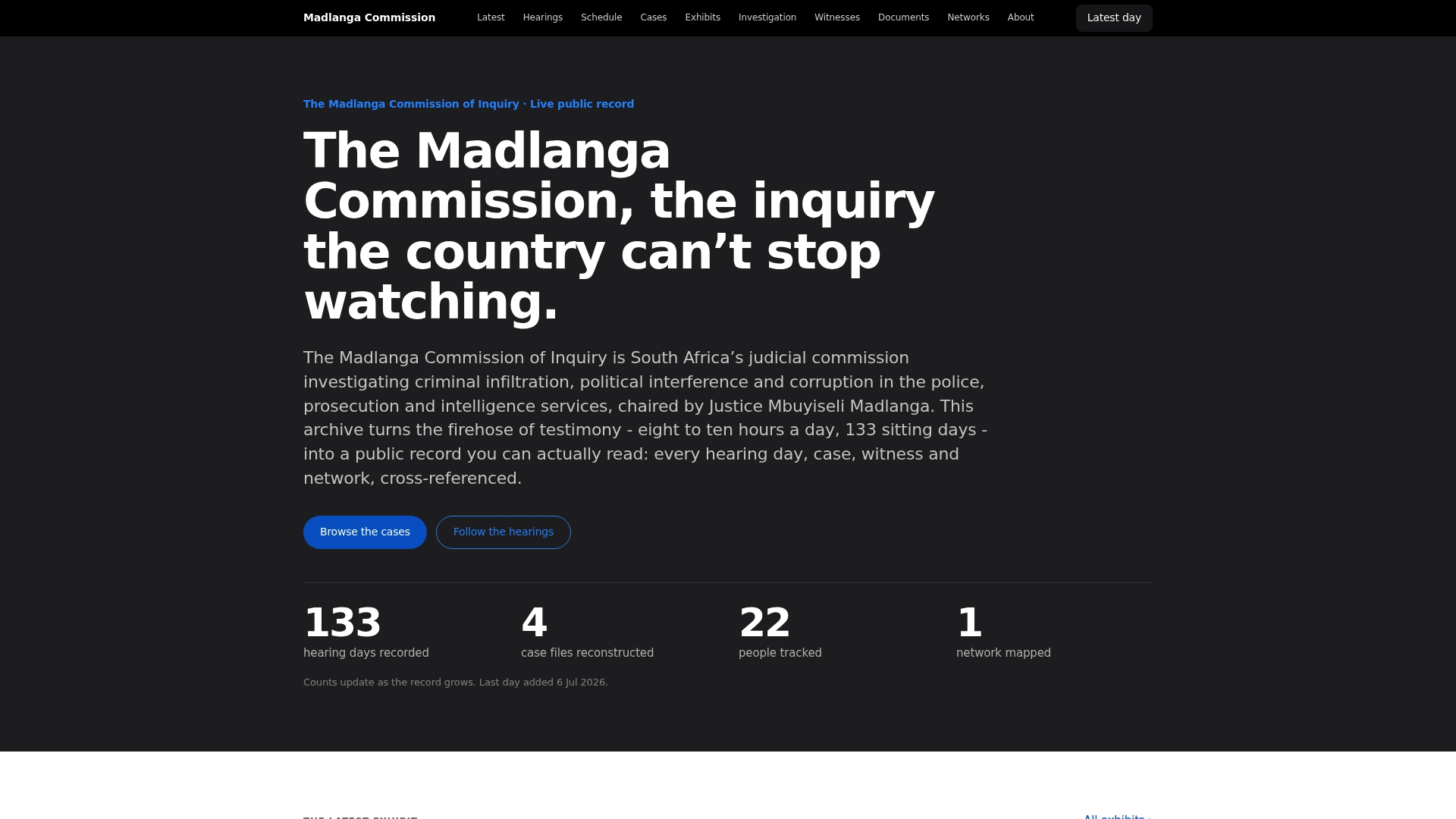
If you want to see how the commission’s other witnesses are profiled, browse the archive home page. Our profiles of Mohammed Sayed and Ignatius Mothakathi show the same structure of record, documents and coverage. For how case papers are organised, see our case file documentation guide.
How to track the next development
A few steps keep you current without watching every session:
- Open the witness profile and read the status paragraph first. It is where we record whether a date has been set.
- Check the newest hearing day pages for any mention of NICOC or the in camera ruling.
- Read the exhibits listed on a day page, noting whether a document was displayed or only referred to.
- Compare the reported document tiers above with what is actually shown.
- Use the redaction guide to find rulings and redacted documents.
As of 29 October 2026, EWN reported that the commission was due to resume in two weeks and that Dr Sifolo’s testimony was yet to be scheduled. Because schedules shift, the witness profile is the page to trust for the current position.
FAQ
Has Dr Sifolo testified at the Madlanga Commission?
No. He was set down for 13 October 2026, but the appearance was called off the night before. At the last report his testimony still had no date. His profile in our archive carries the current status.
Was Dr Sifolo’s testimony ordered closed to the public?
Not by the ruling of 22 October 2026. The chairperson reserved judgment on 21 October, then ordered the evidence leaders to ask NICOC which documents could be used publicly. Dr Sifolo’s answer split the documents into three tiers, so part of his evidence may be heard in open session.
Is Dr Sifolo accused of anything?
No. Nothing on the commission’s public record alleges wrongdoing by him. He appears because the evidence leaders called him and applied to hear him in camera. He is presumed innocent.
Which of his documents can the public see?
Certain pages of six documents may be displayed publicly. Nine may be used in questioning but not displayed, and fourteen cannot be used in open hearings. The figures come from EWN’s 29 October 2026 report.
Where can I read the ruling and hearing records?
The ruling is published among the commission’s files, and the hearing days are on the commission’s official hearings page. In our archive, the Day 185 page gathers the argument and related materials.
Sources
- Hearings, Madlanga Commission official site
- SABC News: Sifolo’s evidence relies on documents declassified for the inquiry
- EWN: National Intelligence Coordinating Committee head agrees to open testimony
- The Presidency: Budget speech by Minister Khumbudzo Ntshavheni, 2026/27
- SAnews: SA strengthens intelligence coordination with National Centre for Intelligence Coordination
- Documenting systemic case disparities