A researcher’s guide to the media briefings archive
A media briefings archive is a searchable, date-ordered collection of past press briefings, transcripts, and supporting documents, held by an institution, government body, or inquiry commission. If you need a specific statement, exhibit, or quote, your fastest route is almost always the host’s own archive search, followed by a targeted look at the Madlanga Commission archive if your subject touches South African policing, prosecution, or intelligence oversight.
TL;DR:
- Archives from research centers and government bodies typically organize briefings by date and policy area, providing metadata like speaker and format to facilitate precise searches.
- Using exact dates, speaker names, or quoted phrases significantly improves search speed, especially when combined with filters or site-specific queries.
- Briefing records include transcripts, exhibits, and media, with the full spoken record often offering essential context that press releases omit.
- Verifying archive credibility depends on provenance details such as host authority, timestamps, and integrity checks, not reputation alone.
- The Madlanga Commission archive offers comprehensive records for South African policing and intelligence, bundling transcripts, exhibits, and rulings for each hearing day.
Table of Contents
- Where to find media briefing archives
- How do you search a briefing archive efficiently?
- What’s actually inside a briefing record
- Preservation and how researchers judge credibility
- How researchers and journalists actually use these archives
- Why we maintain a public briefing archive
- Search the Madlanga Commission archive directly
- Sources
- FAQ
Where to find media briefing archives
Briefing archives live in a handful of predictable places, and knowing which one to check first saves hours.
Universities and research centres often maintain the most consistent metadata. The Johns Hopkins media briefing archive lists expert briefings by date with linked materials, a format that has become something of a template for institutional hosts.
Government and parliamentary bodies run a similar model at scale. South Africa’s Parliament publishes cluster media briefings organized by date and policy cluster, which is useful when you’re tracking a theme across multiple departments rather than a single event.
Special-purpose inquiries and commissions build the deepest archives on a narrow topic. The Madlanga Commission’s hearing-day records bundle transcripts, exhibits, and briefing statements for each sitting, which matters when you need every document tied to one day rather than a scattered press summary.
A few other sources round out the picture:
- Press clubs and professional bodies, which archive event pages and sometimes recordings
- Frozen historical sites, such as the George W. Bush White House briefing archive, preserved exactly as they stood at handover
- Web archives like the Wayback Machine, useful when a host’s own search has been retired or redesigned
- National library collections, which catalog briefing materials long after the original site goes dark
How do you search a briefing archive efficiently?
Most researchers waste time scrolling date lists when a sharper search would get them there in seconds.
- Start with what you already know: an event date, a speaker’s name, or an exact phrase from a quote you’re trying to verify.
- Use transcript or full-text search where the archive offers it. Quoted phrase searches (“exact wording here”) cut through paraphrased summaries fast.
- Filter by media type and metadata, such as speaker role, location, or document format, when the interface supports it.
- Fall back on a
site:search on the host domain through a standard search engine when native search is weak or missing. - If a transcript isn’t posted yet, triangulate using the press release, related exhibits, and adjacent hearing days to reconstruct what was said.
Pro Tip: Save the exact URL and the timestamp of your search, not just the document. Archives get reorganized, and a dead link is far easier to explain when you can show when and where you found it.
Broadcast archivists increasingly lean on AI transcription and consistent metadata tagging to keep old briefings discoverable for breaking coverage, a practice worth borrowing even if you’re working alone.
What’s actually inside a briefing record
A single archived briefing usually bundles several distinct items, and each one tells you something different.
- Verbatim transcript: the full spoken record, including false starts and asides
- Edited transcript: cleaned up for readability, sometimes at the cost of nuance
- Raw audio or video: the only version that captures tone, hesitation, and off-script moments
- Slides and exhibits: supporting documents referenced during the briefing
- The press release: the official summary distributed around the same event
The press release rarely tells the whole story. Briefings routinely surface caveats, qualifications, and Q&A exchanges that never make it into the accompanying release, and that gap is often where the real reporting value sits. Before citing anything, check the metadata: capture timestamps, speaker identification, the method used to record the session, and any update or correction log attached to the file. If a document has been revised, note the revision date in your own citation, not just the original briefing date.
Preservation and how researchers judge credibility
Not every archive deserves equal trust, and the difference usually comes down to a handful of visible signals rather than reputation alone.
A durable archive rests on provenance you can check yourself: who hosted the recording, when it was captured, and whether the file has changed since. Strip those signals out and even a genuine transcript becomes hard to defend in print.
Look for an authoritative host, timestamps on every file, and, where available, checksums or signed manifests that prove a document hasn’t been altered since capture. Preservation guidance from the Scientific Working Group on Digital Evidence recommends the three-copy rule: keep multiple copies on different media, store them in geographically separate locations, run integrity checks regularly, and plan for format migration before old files become unreadable.
Automated tools now help with the heavy lifting. Statement-extraction systems can flag claim sentences inside long transcripts, which speeds up indexing considerably, but the underlying research is explicit that human review remains necessary to catch context the software misses. Treat machine-flagged claims as a shortlist, not a final answer.
A quick reliability checklist: confirm the host, check for a timestamp, look for a correction log, and verify the file hasn’t been silently edited since first publication.
How researchers and journalists actually use these archives
Three workflows come up again and again once you start working with archived briefings regularly.
- Fact-checking: pull the transcript or video and check a disputed quote against the exact wording, not the paraphrase that circulated afterward.
- Tracking messaging drift: compare briefing language across several dates to see how an official position shifted, softened, or hardened over time.
- Legal and audit work: confirm chain-of-custody metadata is intact before citing a document in a filing or report, since a missing timestamp can undercut an otherwise solid source.
A typical sequence looks like this: capture the briefing, extract or request the transcript, search it for the specific claim, then compile a short provenance note recording where the file came from and when you retrieved it. That note is what saves you when someone later questions your source.
Why we maintain a public briefing archive
Preserving hearing records shouldn’t depend on whether you caught the livestream. Our methodology explains how each hearing day is documented and verified, and we welcome corrections or record requests from anyone who spots a gap.
— Meriol Lainchyon
Search the Madlanga Commission archive directly
If your research touches criminal infiltration, political interference, or corruption inside South Africa’s police, prosecution, or intelligence structures, the Madlanga Commission archive is built specifically for that work, not adapted from a general press repository. Every hearing day comes bundled with its transcript, exhibits, rulings, and any related media briefing, so you’re not stitching together three separate sources for one sitting.
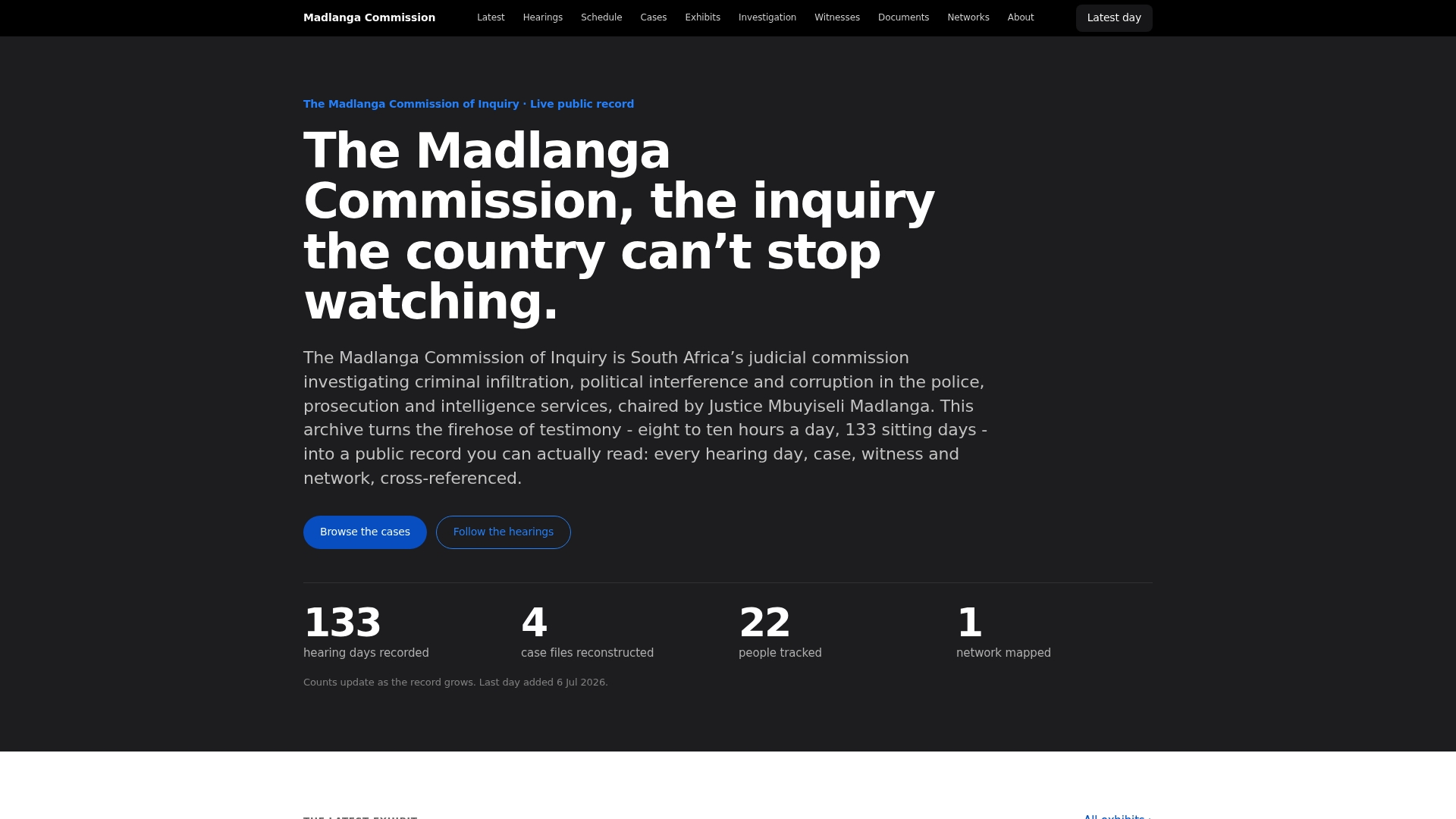
Start with a date you already care about. Day 110 and Day 115 show how a full hearing day is packaged, including exhibits and speaker attribution. If you’re tracing a specific matter, the Khan network profile links related testimony and documents across multiple hearing days rather than leaving you to search them one by one. For provenance details, correction history, or a records request, our methodology page lays out exactly how each document is sourced and verified. Search a hearing day now, and you’ll have the transcript and exhibits in hand within minutes.
Sources
- Media Briefings - Archive | Johns Hopkins
- Cluster Media Briefing
- Automated Statement Extraction from Press Briefings
- Best practices for archiving digital and multimedia evidence | SWGDE
FAQ
What is a media briefing?
A media briefing is a scheduled press event, often with a spoken statement followed by a question-and-answer session, where an official or spokesperson addresses journalists directly rather than through a written release alone.
What is a media archive?
A media archive is an organized, searchable collection of past media materials, transcripts, recordings, and documents, maintained by an institution, government body, or commission so researchers can retrieve records after the original event has passed.
How do I find a specific briefing from a past date?
Search the host archive using the event date, speaker name, or an exact quoted phrase; if native search fails, try a site: search on the host domain or check a web archive like the Wayback Machine.
Why do briefings matter more than press releases for research?
Briefings often include caveats, direct questioning, and off-script remarks that never appear in the accompanying press release, which makes them the more reliable source when accuracy or context is in dispute.
Does the Madlanga Commission archive include media briefings?
Yes. Each hearing day in the Madlanga Commission archive bundles the transcript, exhibits, rulings, and any related media briefing into a single searchable record, such as Day 142.