Build Defensible Case Timelines for Journalists Using Madlanga

A commission case timeline is a strictly chronological list of hearing events and disclosures, each entry anchored to a primary exhibit or hearing-day record. The one rule that overrides every formatting choice: never let an entry stand without a source. Every date, statement and ruling needs a bundle reference, transcript link, or hearing-day URL behind it. The Madlanga Commission publishes exactly this kind of documentary trail, and it’s the model worth following.
TL;DR:
- Every timeline entry must be anchored to primary sources such as exhibits or hearing-day URLs to ensure verifiability and transparency.
- Collect, verify, and link each event to primary documents, and flag disputed or estimated entries clearly to maintain credibility under scrutiny.
- Use structured formats like legal or tabular chronologies for formal reports and online timelines, ensuring consistency and ease of navigation.
- Update the timeline daily during hearings and weekly between sessions, logging every change with details to preserve accuracy and accountability.
- Incorporate multimedia evidence with precise timestamps and links, and maintain a correction log to track edits, fostering trust and clarity in the record.
Table of Contents
- Checklist: the fields every timeline entry needs
- How do you collect, verify and anchor timeline events?
- Which timeline format fits your project?
- How do you keep a timeline defensible under scrutiny?
- How often should you update a running timeline?
- Using Madlanga Commission day pages as your anchor points
- Why iterative updates matter more than a perfect first draft
- How do you collaborate with legal teams without slowing everyone down?
- What mistakes wreck an otherwise solid timeline?
- Bringing video and audio evidence into a written timeline
- Publisher perspective: what neutrality actually requires
- Where to find the exhibits and transcripts to build your own
- Sources
- FAQ
Checklist: the fields every timeline entry needs
Before you write a single row, decide what data every entry must carry. Skip this step and you’ll spend weeks retrofitting citations into a timeline nobody can verify.
Each entry needs these fields at minimum:
- Date (day, month, year — never just a month or a season)
- Event description, written in one neutral sentence with no interpretation
- Exhibit reference: bundle number, tab, page, or a direct hearing-day URL
- Source/provenance: transcript excerpt, sworn statement, or media briefing
- Witness or speaker name, where applicable
- Version stamp: when the entry was added or last edited
Two situations need special handling. First, undated documents: mark them [est] with a one-line justification for the estimated placement, rather than guessing silently. Second, disputed entries: flag them with a status label rather than deleting or softening them.
Before publishing anything, confirm three things:
- Every entry has a working source link or bundle reference.
- Disputed and estimated entries are visibly flagged, not buried.
- A version date sits at the top of the document so readers know how current it is.
How do you collect, verify and anchor timeline events?
Building a defensible timeline is a five-stage process. Rush any one stage and the whole chronology becomes vulnerable to a single “where did you get that?” question.
1. Collect from primary sources first. Pull directly from hearing day pages, transcripts, sworn witness statements, and disclosure bundles. The Commission’s Day 1 hearing page shows the format to expect: dated proceedings, linked exhibits, and named witnesses. Treat secondary summaries and news reports as pointers toward primary material, never as the citation itself.
2. Verify by cross-checking testimony against exhibits. Read the transcript excerpt against the exhibit it references. Preserve the original file and its URL somewhere permanent, because commission websites do reorganize pages over time. Where a witness’s written statement contradicts their oral testimony, that mismatch belongs in your timeline as its own dated entry, not as a footnote. This is exactly the discrepancy-flagging practice public hearing monitoring guidance recommends: track the gap between the two accounts for public scrutiny.
3. Apply consistent dating rules. Use the document’s original date whenever one exists. When it doesn’t, assign an estimated date in brackets, [est 2026-03-14], with a short note explaining your reasoning. Keep your granularity consistent: don’t mix day-level precision in one section with month-level guesses in another.
4. Anchor every event to one primary exhibit. Pick a single bundle/tab/page reference or hearing-day URL as the anchor, and add secondary references only when they genuinely add context. An event with three “maybe relevant” links and no clear primary source is harder to trust than one with a single solid anchor.
5. Package it for readers. Build an exhibit index at the front or back of your document. Cross-reference every timeline entry back to that index. Keep every description factual: “Witness stated X under oath” rather than “Witness admitted X,” which smuggles in a conclusion.
Pro Tip: Screenshot the exhibit page the day you cite it. Commission websites update, exhibits get renumbered, and a dead link six months later is far easier to defend if you kept your own copy of what it said.
Which timeline format fits your project?
Three formats cover almost every use case, and picking the wrong one is the most common structural mistake in this work.
The legal chronology is a four-column table: date, event, bundle reference, source, as explained in detail in The OUI Case Timeline in Massachusetts. It’s the format legal teams place at the front of hearing bundles because a well-constructed chronology anchors every entry to bundle references and primary documents, and decision-makers can scan it in minutes. Use this for formal reports or anything destined for print.
The tabular chronology for print or PDF extends the legal chronology with an index column and explicit exhibit IDs. This is the version you export as a PDF when you need something citable and stable, not something that changes underneath the reader.
The interactive or visual timeline works best online, where readers filter by witness, date range, or hearing module. Build it from a CSV with these fields: id, date, title, description, exhibit_url, hearing_day. A four-column legal chronology commonly sits at the front of a hearing bundle precisely because reviewers need to move fast, and the same logic applies online: filterable fields beat a wall of text.
For portability, export CSV. For formal filing or archiving, export PDF. Keep both versions in sync, and note which one is canonical.
How do you keep a timeline defensible under scrutiny?
Every entry needs provenance: a URL, a bundle/tab/page reference, or an exhibit number, linked to the primary file wherever one exists. Without that, your timeline is an opinion dressed up as a record.
Use a three-status flagging system:
- Confirmed: corroborated by an exhibit or unchallenged testimony
- Disputed: contradicted by another witness, document, or the Commission itself
- Estimated: date or detail inferred, not stated outright in the source
Entries move between these labels as new evidence surfaces, and that movement should itself be logged. A neutral, factual chronology anchored to bundle references is the standard practitioners aim for, and agreed chronologies are preferred wherever the underlying parties can settle on one.
Keep a correction log: timestamp, editor name, and a short reason for the change. This isn’t bureaucratic overhead. It’s what separates a research tool from a rumor mill.
A timeline is only as strong as its weakest citation. Readers don’t trust a chronology because it looks organized. They trust it because every disputed claim in it visibly stayed disputed until the record settled the question, and every settled claim points back to something they can check themselves.
A short methodology statement, naming who checks entries and how, should sit near the top of any published timeline.
How often should you update a running timeline?
Public inquiries move in bursts. Weeks of quiet disclosure followed by three days of live testimony that generate forty new exhibits. Your update cadence needs to match that rhythm, not fight it.
Log every change with a consistent format: date | editor | change summary | link to new exhibit. For example: 2026-06-12 | R. Naidu | Added Day 118 testimony on procurement irregularities | [exhibit link].
Recommended cadence:
- During live hearings: update daily, even if it’s just adding the day’s exhibits with placeholder descriptions you’ll refine later.
- Between hearing blocks: weekly summary updates are usually sufficient, covering any new disclosure bundles or rulings.
- After major rulings: update within 24 hours, since these entries tend to get cited quickly by other outlets.
When an entry gets superseded, don’t delete it. Archive the prior version with its timestamp intact, so anyone auditing your work later can see exactly what changed and when. This matters more for accountability journalism than almost any other editorial choice you’ll make.
Using Madlanga Commission day pages as your anchor points
The Commission’s own hearing-day pages give you a ready-made citation format. When you cite one, copy these fields: day number, date, page URL, and the specific transcript or exhibit ID you’re referencing. The Day 2 hearing page and Day 3 hearing page both follow this structure, which makes cross-referencing across dozens of entries far less error-prone than pulling from scattered news coverage.
For contested entries, the Commission’s Methodology, Sourcing & Corrections page works as your canonical provenance statement. Point disputed claims back to it rather than re-explaining your sourcing logic in every footnote.
When you publish a timeline built from these resources, name yourself as compiler and add a short method note: what you checked, what remains estimated, and when you last updated it. That small disclosure does more for reader trust than any amount of formatting polish.
Why iterative updates matter more than a perfect first draft
The biggest mistake newcomers make is waiting for the “complete” version of an event before publishing it. Public inquiries don’t work that way. Evidence arrives in waves, and effective timelines get updated iteratively as new evidence is released, moving from initial witness statements toward full transcripts as they become available.
That means your first entry for a given event might be thin: a witness name, a date, a one-line summary from a media briefing. That’s fine, as long as it’s flagged as provisional. When the transcript arrives days or weeks later, you update the entry and note the upgrade in your change log.
This approach also solves a subtler problem: mapping disclosure timing against event timing. A document disclosed in June about events from the previous year needs two dates tracked, not one, so readers don’t confuse when something happened with when the public found out about it. Evidence in public inquiries typically arrives in phases or modules tied to the inquiry’s own structure, and your timeline should mirror those modules rather than imposing a different organizational logic on top.
Practically, this means building your timeline with update dates baked into the schema from day one, not retrofitted later. A “first published” and “last verified” field on every entry costs almost nothing to add early and saves enormous cleanup work six months in.
How do you collaborate with legal teams without slowing everyone down?
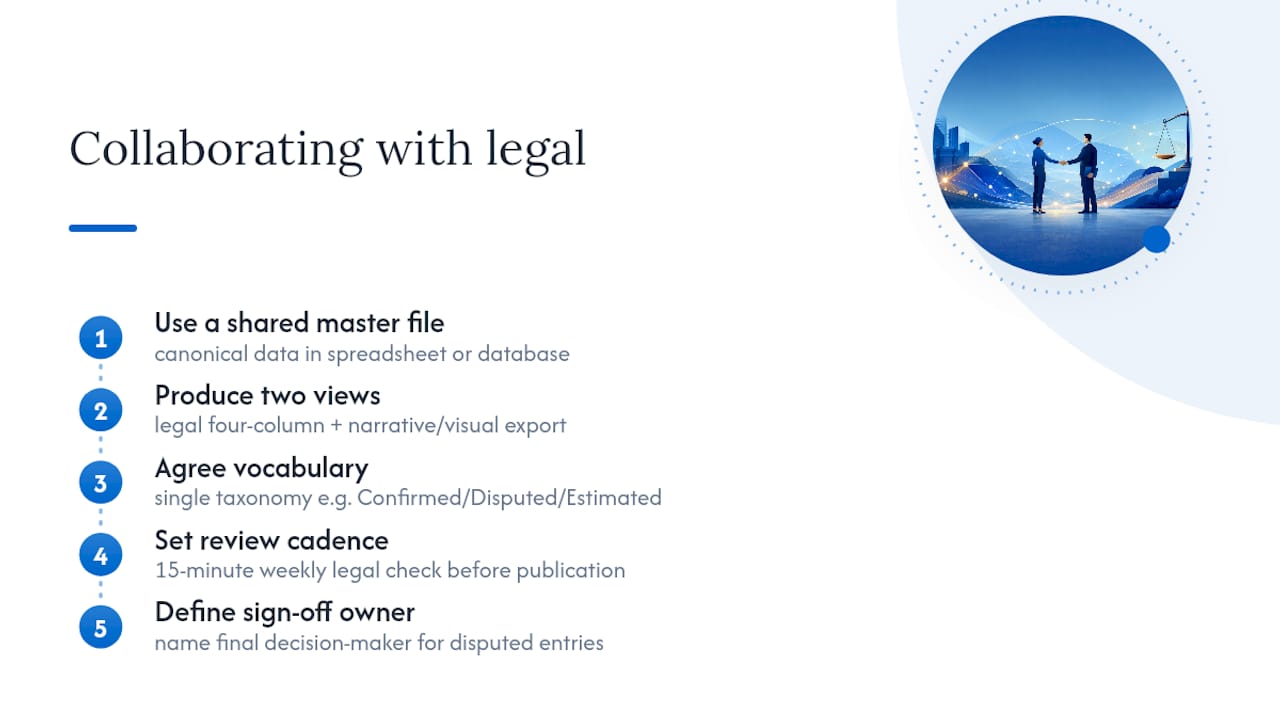
Legal teams and independent researchers want different things from the same timeline, and pretending otherwise creates friction. Lawyers need bundle-referenced entries that map cleanly to submission deadlines. Journalists and researchers want readable, publishable summaries. You can serve both without maintaining two separate documents.
The fix is a shared master file with a legal-chronology view layered on top. Keep your canonical data in a spreadsheet or database, then generate the four-column legal format for legal teams and a narrative or visual export for public use. Witnesses preparing for public inquiries are expected to review statements against primary documents chronologically, and that same discipline should govern how your team hands off entries between legal and editorial functions.
Agree early on a shared vocabulary for status labels. If legal counsel calls something “unconfirmed” while your editorial team calls the same entry “disputed,” you’ll spend hours reconciling terminology instead of substance. Pick one taxonomy (Confirmed, Disputed, Estimated works well) and circulate it before anyone starts entering data.
Set a review cadence, even a light one: a fifteen-minute weekly check where legal flags anything factually risky before it goes public. This catches the entries that read fine to a journalist but carry legal exposure a lawyer would spot instantly, things like naming an uncharged individual in a way that implies wrongdoing.
Finally, agree on who owns final sign-off for disputed entries. Without a named decision-maker, disagreements between legal caution and editorial urgency stall the whole timeline.
What mistakes wreck an otherwise solid timeline?
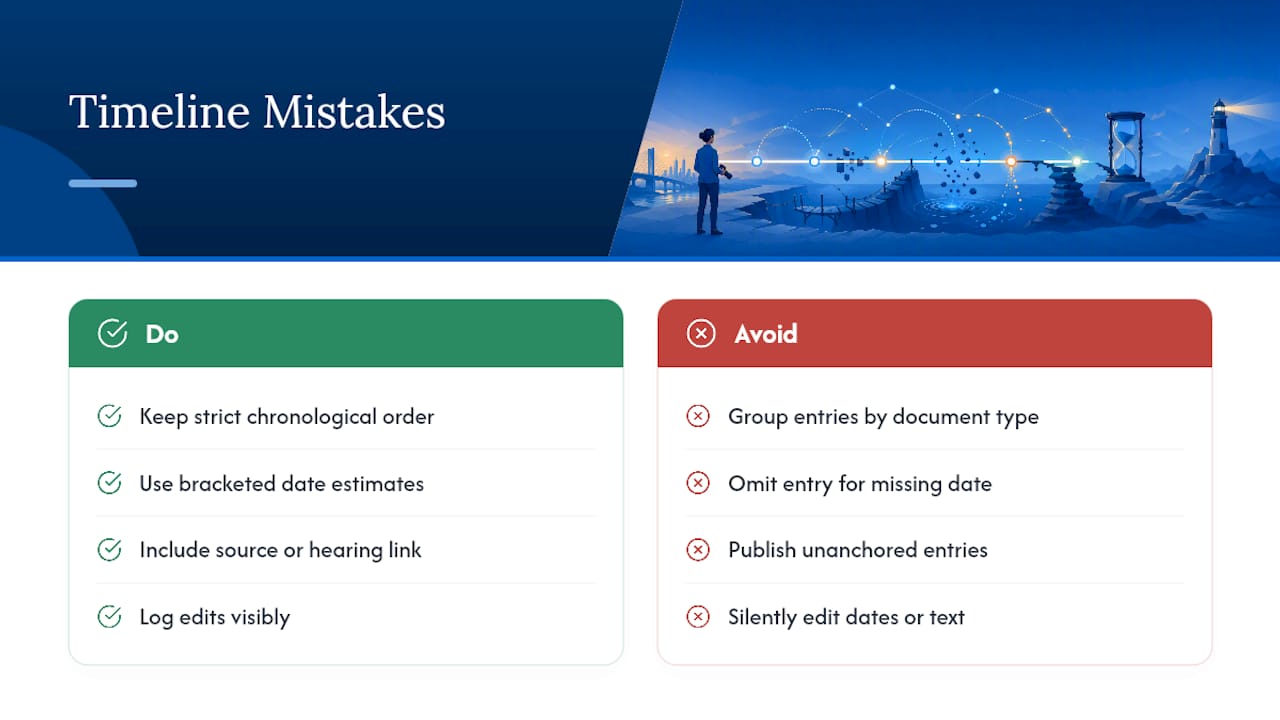
The single most common failure is grouping events by document type instead of keeping them strictly chronological. It feels organized to cluster all witness statements together, then all exhibits, then all rulings. In practice it destroys the thing a timeline exists to show: the sequence of decisions and interventions. Practitioners consistently advise against this grouping instinct, precisely because sequence is the point.
A second frequent error: treating a missing date as a reason to omit an entry entirely. That drops real information from the record. The better fix is a bracketed estimate with a justification note, which preserves the event’s place in the sequence while flagging the uncertainty honestly.
Third, unanchored entries. An event description with no bundle reference or hearing-day link reads as an assertion, not a record. If you can’t source it, don’t publish it yet, mark it for follow up instead.
Fourth, silent edits. Changing a date or a description without logging why erodes the credibility of everything else in the document, because readers have no way to know what else might have quietly changed. A visible version log fixes this in minutes and costs almost nothing to maintain.
Fifth, conflating disclosure date with event date. When a document surfaces in a bundle released in April but describes something that happened the previous November, both dates need separate fields. Collapsing them into one makes the whole timeline misleading about when the public actually learned what.
Last, over-editorializing descriptions. “Witness admitted wrongdoing” is an interpretation. “Witness stated X under cross-examination” is a fact. Keep every entry in the second register.
Bringing video and audio evidence into a written timeline
Commission hearings generate hours of recorded testimony, and a purely textual timeline loses something when it ignores that footage. The fix isn’t embedding video everywhere. It’s linking precisely.
For each multimedia entry, record the source recording’s URL or archive location, then add a timestamp range, not just “see video,” but “14:32 to 16:05,” pointing to the exact segment relevant to that timeline entry. This turns a two-hour recording into something a reader can actually verify in ninety seconds.
Where a broadcaster or the Commission itself provides an official transcript alongside the recording, link both: the timestamp for anyone who wants to watch the moment, and the transcript excerpt for anyone who wants to read it, or who’s working from a low-bandwidth connection. Treat the transcript as the primary citation and the video as supporting confirmation, since transcripts are easier to quote accurately and less likely to be re-edited or removed.
For audio-only evidence, such as recorded phone calls or radio testimony introduced as exhibits, the same rule applies: exact timestamp, plus a written summary of what’s said at that point, never just a file link with no description.
One caution worth flagging explicitly: video and audio files get taken down, re-hosted, or geo-restricted more often than PDF exhibits. Where you can, note a backup source or archived version, and prioritize the Commission’s own published exhibit over a third-party mirror whenever both exist.
Publisher perspective: what neutrality actually requires
Neutrality in a timeline isn’t the absence of judgment. It’s the discipline of keeping judgment out of the entry itself and putting it, if it belongs anywhere, in a separate analysis piece. Every entry we publish gets anchored to an exhibit or hearing-day record, and disputed claims stay labeled disputed until the record itself resolves them, not until public opinion does.
We maintain a visible corrections process: readers who spot an error or have documentary evidence we’ve missed can flag it, and we log the correction with a timestamp and a reason. A public commission timeline works as an accountability tool only when researchers, journalists, and citizens can challenge and improve it. That collaboration is the whole point.
— Meriol Lainchyon
Where to find the exhibits and transcripts to build your own
Everything covered above works best when you’re pulling from source material that already carries the structure a defensible timeline needs. That’s the specific gap Madlanga Commission’s archive fills: it isn’t a summary of the inquiry, it’s the underlying hearing-day pages, exhibits, and rulings already organized so you can anchor entries to them directly, without reconstructing provenance from scratch.
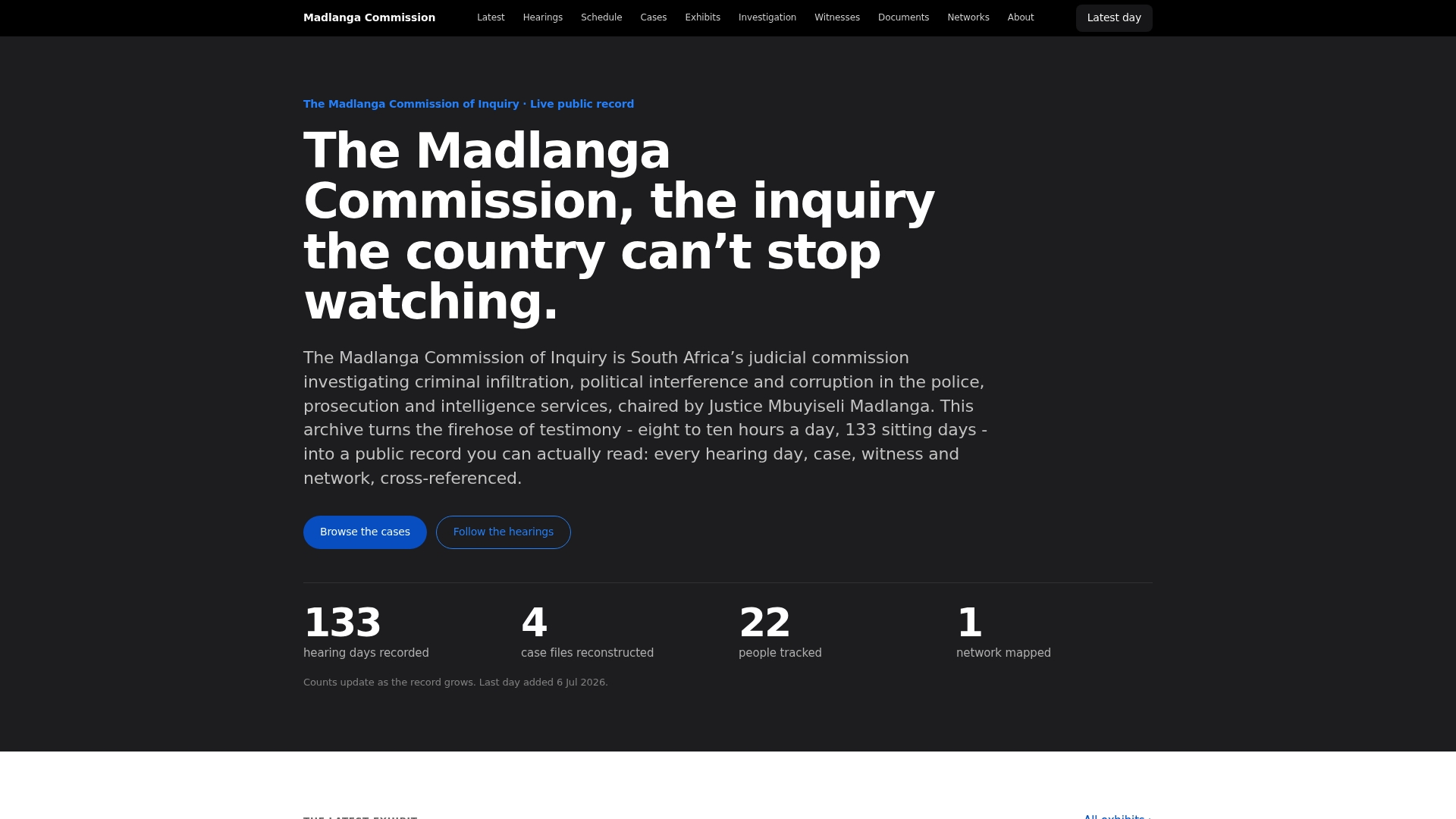
Start with the Methodology, Sourcing & Corrections page, which functions as the canonical statement of how entries in the Commission’s own record are verified and corrected, and is worth citing directly when a reader challenges one of your sourcing decisions. From there, hearing-day pages like Day 114 and Day 118 give you exhibit identifiers and transcript references you can drop straight into a legal chronology or a CSV export. If you’re new to the inquiry’s remit and powers, the commission of inquiry overview is the fastest way to understand what the Commission can and can’t compel, which matters when you’re deciding how much weight a given exhibit deserves. Bookmark the hearing archive as your first stop before reaching for a secondary news summary, and check it whenever a new hearing day is added.
Sources
- Service and accountability: Public hearing manual (NDI)
- Navigating public inquiries (documentary evidence) - Mondaq
- Preparation for public inquiries: how to provide high-quality witness evidence (Brodies LLP)
FAQ
What is a case timeline for a public commission of inquiry?
It’s a strictly chronological record of hearing events, testimony, and disclosures, where every entry links back to a primary exhibit, transcript, or hearing-day page rather than a secondary summary.
How do I handle a document with no clear date?
Assign an estimated date in brackets, such as [est 2026-03-14], with a short note explaining your reasoning, rather than omitting the entry or guessing silently.
What’s the difference between a legal chronology and a tabular chronology?
A legal chronology is a four-column table (date, event, bundle reference, source) built for hearing bundles and reports, while a tabular chronology adds index numbers and exhibit IDs for print or PDF distribution.
How often should I update a running commission timeline?
Update daily during live hearing days and shift to weekly summaries between hearing blocks, adding any major ruling within 24 hours of it being handed down.
Where can I find primary sources for a Madlanga Commission timeline?
The Commission’s hearing-day pages and its methodology page provide the exhibit references, transcripts, and provenance statements needed to anchor entries.
Should I flag disputed testimony in my timeline?
Yes. Use a visible status label, such as Disputed, and update it to Confirmed or leave it flagged if the discrepancy between written statements and oral testimony is never resolved.