Intelligence Oversight in South Africa: Who Watches the Spies

South Africa oversees its intelligence services through four layers: the Constitution, a multi-party parliamentary committee (the Joint Standing Committee on Intelligence, or JSCI), an independent Inspector-General of Intelligence (IGI), and the courts. A fifth, newer layer is the General Intelligence Laws Amendment Act, which rewrites the system but, on the latest official answers we found, had not yet been brought into operation. This guide explains what each layer does, where the weak points are, and how the Madlanga Commission’s evidence tests the whole arrangement.
TL;DR
- The Constitution requires civilian monitoring of intelligence and multi-party parliamentary oversight of all security services. The Intelligence Services Oversight Act of 1994 turns that into the JSCI and the Inspector-General.
- The JSCI scrutinises budgets, audit reports, legislation and coordination. The Inspector-General investigates complaints and monitors compliance with the law and policy.
- The General Intelligence Laws Amendment Act 37 of 2024 splits the State Security Agency, adds judicial review for bulk interception and strengthens the Inspector-General’s independence. It still needed a presidential proclamation to start operating, according to a December 2025 parliamentary reply.
- The Madlanga Commission is looking at political interference, criminal infiltration and the effectiveness of oversight mechanisms, which makes its record a live test of how the system performs.
Table of Contents
- Why intelligence services need oversight at all
- The constitutional foundation
- The Intelligence Services Oversight Act of 1994
- Parliamentary oversight: the JSCI
- The Inspector-General of Intelligence
- The General Intelligence Laws Amendment Act
- Where the Madlanga Commission fits
- Our perspective
- Follow the evidence yourself
- What to watch next
- FAQ
- Sources
Why intelligence services need oversight at all
Secret services collect information, run informers and can intercept communications. Those powers are useful, and they are also dangerous. DCAF, a Geneva-based centre for security sector governance, argues that intelligence oversight is necessary because services can threaten democratic governance, the rule of law and human rights, even when they act in the public interest. The aim of democratic control is to make them both effective and accountable.
South Africa has a sharper reason than most to care. Post-1994 oversight was designed in response to the abuses of the apartheid era, as academic work on the country’s oversight model describes it, and later scandals, including the capture of the civilian services for factional purposes, showed that a design on paper is not the same as oversight in practice.
The short answer to “what is the purpose of intelligence oversight?” is therefore threefold: keep secret power inside the law, keep money spent on what it was approved for, and give citizens some assurance when they cannot see inside.
The constitutional foundation
Two sections of Chapter 11 of the Constitution carry most of the weight.
- Section 198 says multi-party parliamentary committees must oversee all security services, to give effect to transparency and accountability.
- Section 210 requires national legislation to regulate the objects, powers and functions of the intelligence services, to coordinate them, and to provide for civilian monitoring by an inspector approved by at least two-thirds of the National Assembly (see the same chapter of the Constitution).
The two-thirds threshold matters. It means the Inspector-General cannot be installed by the governing party alone, and it is meant to give the office cross-party legitimacy.
The Intelligence Services Oversight Act of 1994
The statute that does most of the work is the Intelligence Services Oversight Act 40 of 1994. The Act on gov.za provides for a parliamentary intelligence committee and Inspectors-General of Intelligence, and defines their functions. It has been amended several times, most recently by the 2024 reform Act discussed below.
In practice the system has two main pillars, one political and one independent.
| Body | Who it is | Main job | Answers to |
|---|---|---|---|
| Joint Standing Committee on Intelligence (JSCI) | Members of Parliament from several parties, drawn from both houses | Parliamentary oversight of intelligence budgets, audit reports, legislation and coordination | Parliament |
| Inspector-General of Intelligence (IGI) | An independent office-holder approved by at least two-thirds of the National Assembly | Monitoring compliance, reviewing activities, investigating complaints | Parliament, through reporting to the JSCI and the responsible minister |
Parliamentary oversight: the JSCI
The JSCI is established under section 2 of the Act. According to its annual report for the year ending 31 March 2024, it conducts parliamentary oversight of the State Security Agency, Defence Intelligence and the Crime Intelligence division of the South African Police Service.
The same report lists what the committee does: it reviews audit reports, considers the secret services’ budgets and expenditure, oversees legislation and reviews coordination among the services. On money, the committee said its critical engagements led the SSA to submit an annual performance plan and budget that complied with national planning prescripts and took government priorities into account.

That is a useful illustration of how this kind of oversight works. It rarely produces headlines. It is a steady process of questioning plans, reading audit findings and pressing for corrections before the money is spent. The weakness is equally clear: much of the detail is classified, so the public has to rely on what the committee chooses to report. Readers who follow committee business closely, for example through legislative committee tracking tools that follow transcripts, bills and alerts, can see how often intelligence matters reach the agenda and how often they are handled in closed session.
Financial oversight in particular has been a recurring concern. An academic article on financial oversight of the civilian intelligence services assesses how the budget and expenditure of the services, now called the State Security Agency, are scrutinised, a reminder that the secrecy surrounding the “secret service account” has long been the hardest part to open up.
The Inspector-General of Intelligence
The Inspector-General is the independent, civilian monitor that section 210 of the Constitution calls for. The Office of the Inspector-General for Intelligence describes the holder as responsible for independent oversight of the South African intelligence services.
What the office can do
Section 7(7) of the Act, as set out on the Act’s section on the Inspector-General, gives the IGI four broad tasks:
- Monitor compliance with the Constitution, applicable laws and relevant intelligence and counter-intelligence policies.
- Review the services’ intelligence and counter-intelligence activities.
- Investigate complaints alleging maladministration, abuse of power, specified transgressions of law or policy, offences, or improper enrichment.
- Perform other functions designated by the responsible minister.
The Act also gives the IGI access to intelligence, information and service premises needed for oversight, and requires the office to act impartially and independently.
How to complain
If you believe an intelligence service has abused its power, the route is a written complaint to the IGI’s office, which can investigate the matters listed above. Complaints from members of the services themselves are also within scope. Be specific: name the service, describe what happened and when, and say which law or policy you think was breached. If your complaint concerns police crime intelligence, you may need to name the Crime Intelligence division, since the IGI’s remit covers the intelligence divisions of the SAPS as well as the civilian agencies.
When the monitor is under pressure
The office’s independence has recently been tested. Daily Maverick reported in July 2026 that the Inspector-General, Imtiaz Fazel, was suspended by the President after his security clearance was withdrawn, and that he is challenging both decisions in an affidavit that describes how he was drawn into the dispute over Crime Intelligence leadership. News24 and amaBhungane reported that the misconduct probe into Fazel has made limited progress, while the secret services’ large budgets go largely unchecked. These are allegations and contested claims in ongoing matters, and readers should follow the outcome of the court and disciplinary processes before drawing conclusions.
The structural point stands whichever way those cases end. An inspector whose security clearance can be withdrawn by the executive is an inspector whose access depends on the people being inspected. That is precisely the problem the 2024 reforms say they address.

The General Intelligence Laws Amendment Act
The President signed the General Intelligence Laws Amendment Act 37 of 2024 on 28 March 2025. The Act amends three laws: the National Strategic Intelligence Act of 1994, the Intelligence Services Oversight Act of 1994 and the Intelligence Services Act of 2002.
According to the Presidency’s statement on assent, the main oversight-related changes are:
- The SSA is disestablished and replaced by two departments: a Foreign Intelligence Service and a Domestic Intelligence Agency.
- Judicial review is introduced for bulk interception, so that this intrusive power is no longer controlled only from within the executive.
- The independence and administrative authority of the IGI are strengthened, as are those of the national intelligence coordination committee.
The reforms were prompted in part by the Constitutional Court’s 2021 ruling on bulk surveillance, though readers should check the judgment itself before relying on that background.
Has it started working?
Not necessarily. A parliamentary reply from December 2025 said the Act had been promulgated but was not yet operational, awaiting a presidential proclamation of its commencement date. An earlier September 2025 reply said preparations included draft regulations on shared services and an Operational Expenditure Framework still at drafting stage. Officials described the preparatory work as developing regulations and designing organisational structures, systems and processes.
Since the commencement date can change, check the Presidency’s website and the Government Gazette for the current position before citing the new provisions as in force. Our guide to the 2026 intelligence agency reform tracks the transition.
Where the Madlanga Commission fits
The Madlanga Commission is not an oversight body in the statutory sense. It is a temporary judicial commission. But its mandate reaches into oversight directly. According to Daily Maverick’s explainer on the terms of reference, the Commission, established in 2025, is tasked with investigating alleged political interference, criminal infiltration and the effectiveness of oversight mechanisms within intelligence and law enforcement agencies. It can also refer matters for immediate criminal investigation and urgent decisions on prosecution.
That combination is unusual. Standing oversight bodies mostly review what services report about themselves. A commission with subpoena-style evidence-gathering can hear from the people who worked inside the system, test documents against testimony, and ask why the existing checks did not catch the problem. If you want the basics of the Commission first, start with what the Madlanga Commission is, or read about how commissions of inquiry get their powers.
Two threads in the record bear directly on oversight:
- Crime Intelligence. The question of who may direct, review and audit a policing intelligence unit runs through the evidence. We summarise it in Madlanga evidence and crime intelligence oversight.
- Vetting and clearances. Security clearances decide who can see what. When they are delayed, withdrawn or bypassed, oversight can fail quietly. See security vetting failures in the Commission record.
Our perspective
We built this archive because oversight only works when people can follow it. Most of the checks described above operate behind closed doors, which is partly unavoidable. A commission is one of the few moments when part of that machinery is examined in public, and the value of that moment is lost if the record is too long, too scattered or too technical to use.
Our reading of the record so far is that the oversight problem is less about missing institutions than about whether they have the access, independence and follow-through to act. South Africa has a constitutional requirement for parliamentary committees, a statutory inspector, an audit process and, soon, judicial review of bulk interception. What the evidence tests is whether each of these can still function when a powerful official, a political principal or a criminal network has an interest in keeping it from doing so.
For that reason we suggest readers look at three things when they read any testimony: who was supposed to be checking, what they were allowed to see, and what happened when they raised a concern. Those are factual questions, and the answers are usually in the documents and exhibits rather than in commentary. A recommendation is only as good as its implementation, which is why we also publish a five-step check on whether recommendations are implemented.
— Meriol Lainchyon
Follow the evidence yourself
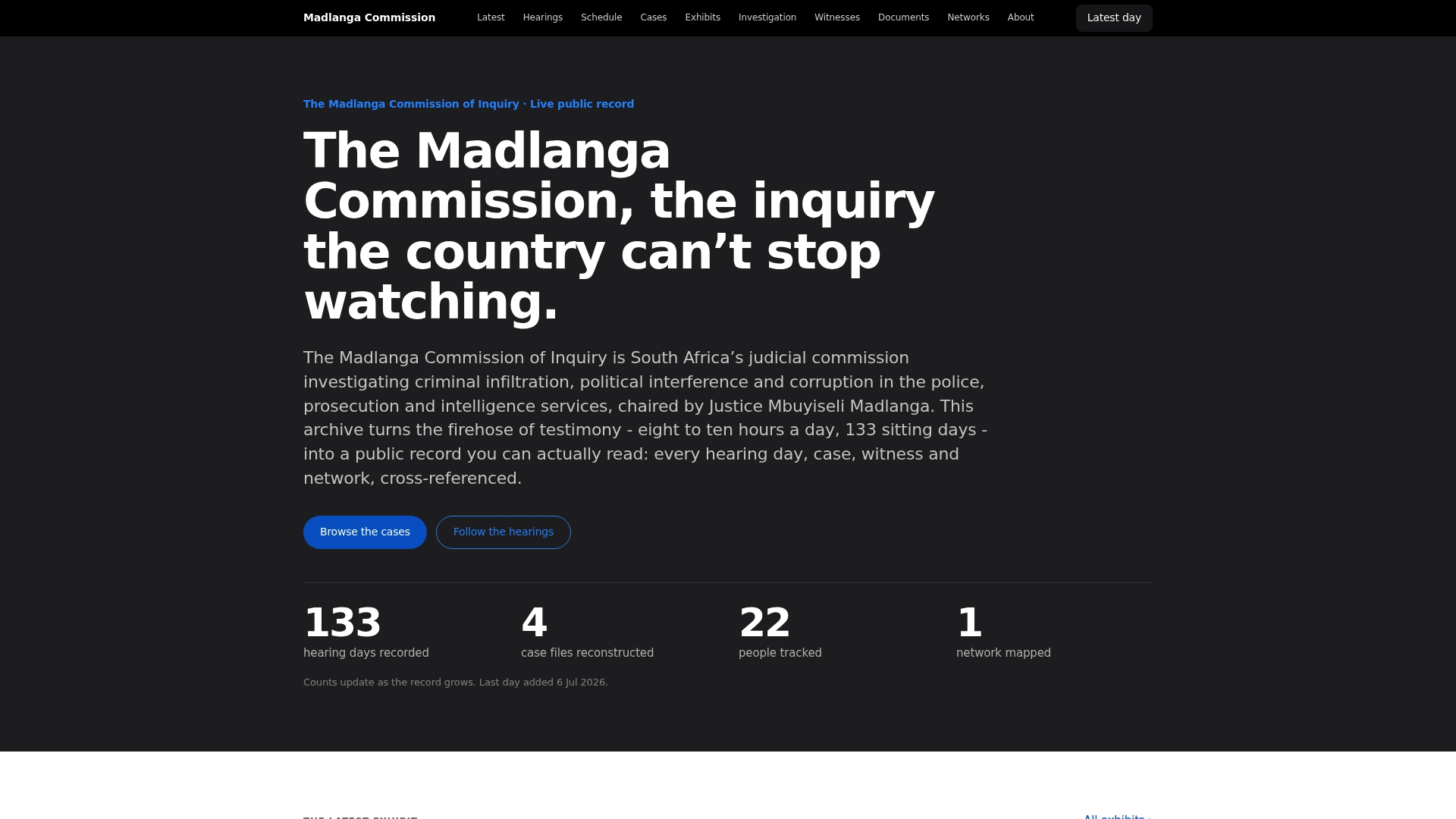
The Commission’s hearings are long, and oversight questions are scattered across many days of testimony. Our archive brings together daily hearing records, witness profiles, exhibits, rulings and statements in one searchable place, with cross-references between people, cases and documents. You can use The Investigation Room to see how witnesses, evidence and institutions connect, or check whether the Commission is sitting today without watching the live feed. Access is free.
If you are researching a specific witness, start from their profile, for example Dr Ntandazo Sifolo, and follow the links to the exhibits and testimony that mention the institutions involved.
What to watch next
For anyone tracking intelligence oversight in South Africa over the coming year, the practical checklist is short.
- Commencement of the 2024 Act. Whether and when the President proclaims it, and whether the regulations and organisational design are published.
- The status of the Inspector-General. The outcome of Fazel’s challenge and of the misconduct process, and whether the post is filled in a way that satisfies the two-thirds requirement.
- JSCI reports. Its annual report is the best public summary of what the committee examined. Compare year on year what it says about budgets and audit findings.
- Commission findings and referrals. Because the Commission can refer matters for criminal investigation, watch for referrals that touch intelligence structures, and for what is done with them.
- Legislative follow-through. Whether the recommendations about oversight turn into amendments, budgets and appointments rather than staying in a report.
FAQ
What is the purpose of intelligence oversight?
Its purpose is to make sure that services with secret powers stay within the law, spend public money as approved, and remain accountable to elected representatives and the public. DCAF describes the aim as making intelligence services both effective and accountable. In South Africa, the Constitution and the 1994 Oversight Act set up the JSCI and the Inspector-General to do this.
Who is the Inspector-General of Intelligence?
The office has been held by Imtiaz Fazel, but media reports in 2026 say he has been suspended by the President and is challenging that decision and the withdrawal of his security clearance. Because the matter is before the courts and disciplinary processes, check the Office of the Inspector-General and recent reports for the current position. The office itself is created under section 210 of the Constitution and the Oversight Act.
What is the equivalent of the CIA in South Africa?
The nearest equivalent has been the State Security Agency, which covered both domestic and foreign intelligence. Under the General Intelligence Laws Amendment Act 2024 it is to be replaced by a Foreign Intelligence Service and a Domestic Intelligence Agency, once the Act is brought into operation. Defence Intelligence and SAPS Crime Intelligence are separate bodies with their own mandates.
How does Parliament oversee the intelligence services?
Through the Joint Standing Committee on Intelligence, a multi-party committee created under section 2 of the Oversight Act. It reviews audit reports, considers budgets and expenditure, oversees legislation and reviews coordination among the services. It covers the SSA, Defence Intelligence and SAPS Crime Intelligence.
Can I complain about intelligence activity?
Yes. The Inspector-General can investigate complaints alleging maladministration, abuse of power, certain breaches of law or policy, offences or improper enrichment. Put the complaint in writing and be specific about the service, the events and the law you think was broken.
Sources
- Intelligence Services Oversight Act (gov.za)
- Intelligence Services Oversight Act, section 7: Inspector-General
- Constitution of South Africa, Chapter 11: Security Services
- DCAF: Intelligence oversight
- Annual report of the Joint Standing Committee on Intelligence, 2023/24
- General Intelligence Laws Amendment Act 37 of 2024
- Presidency statement on assent to the Act
- Parliamentary reply NO1306, December 2025
- Parliamentary reply NO901, September 2025
- Daily Maverick: Madlanga inquiry terms of reference
- Daily Maverick: Inspector-General affidavit
- News24 and amaBhungane: Fazel misconduct probe